Reflections on Hanukkah
by Rachel MacNair
For several years now, during the eight days of Hanukkah, I have a hanukkiah (like a menorah, only eight branches instead of six because it’s eight days). I do the ceremony of lighting one candle the first night, two the second night, and so on. I’m a Christian rather than a Jew, so I’m not properly putting it in the window. But I’m a Quaker, and doing a meditation while spending 30-45 minutes watching candles burn down is right up my alley. So having some reflections on the Hanukkah miracle is something I’ve done more of because of this.
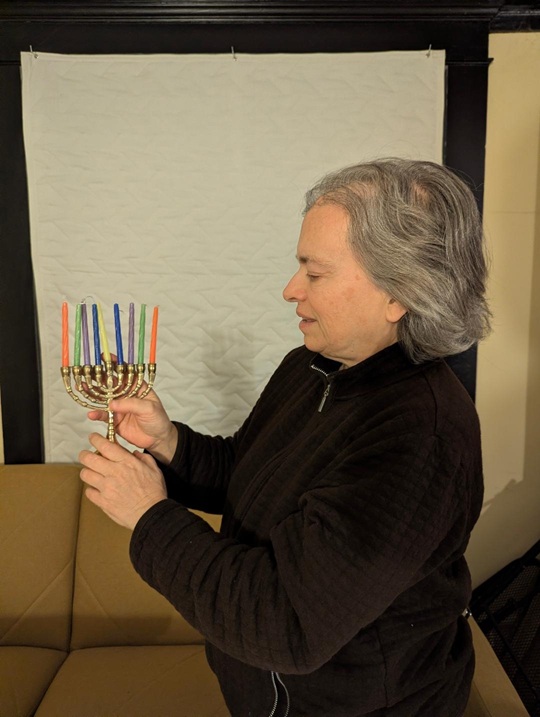
The Miracle
The miracle of Hanukkah is that when the Jews got back the Temple after having driven away their Greek conquerors in 168 BCE, they found they only had enough consecrated oil for one day. It would take many days to properly consecrate some more. But lo and behold, that one day’s worth lasted a full eight days!
Part of the miracle is that the oil lasted so long – a rather mundane miracle, as miracles go – but part of the importance of it is that they did search for the oil and tried to light it at all. They could have been discouraged, thinking the Temple was so badly defiled that there wasn’t really anything they could do to fix it. But they tried to fix it, and in their own terms, they succeeded. Had they remained discouraged, history would have turned out much differently.
So what really happened? Was it a miracle? Was it a natural good shepherding of the oil that later grew into a miracle in the re-telling? Was it actually a group vision? Was it totally made up?
I don’t think it matters. What we do know for sure, and what matters, is that it was a story that got written down around 50 years after the event and got into the Babylonian Talmud a couple of centuries later. It’s been believed by large numbers of people throughout the centuries and still found inspiring to this day.
Under the name of the festival of dedication, what we now call Hanukkah was apparently observed during the time of Jesus inasmuch as it’s mentioned in the Gospel of John 10:22, celebrated in Jerusalem during the winter. The dedication of the Temple was the named focus, not the military victory.
But we do have to face the part of the holiday that’s hardest for consistent-lifers to take: that re-taking of the temple involved a vicious war. It was impressive that such a small number of ill-equipped people were able to pull it off against such a large and well-trained army, to the point that some think of that military victory as another miracle. See the deuterocanonical books of First and Second Maccabees, which glorify the war.
There’s some thought that the rabbis and proto-rabbis (that is, Pharisees) came up with or emphasized the miracle story at a time when Maccabean-inspired aggressiveness could – and did – lead to dire consequences with the Roman conquerors’ abilities to squelch violent dissent. Focusing on this story became a way of emphasizing a nonviolent aspect of the events.
But those of us who decry the normal dynamics of war also take note. What followed the war is what very often follows wars to liberate from brutal oppressors. The monarchy thereby established became brutal oppressors. Intensely.
This was the Hasmonean dynasty of Jewish kings, which involved one astonishing cruel event after another. One king had his own mother imprisoned and starved to death (Judah Aristobulus, r. 104-103 BCE). One king (Alexander Yannai, r. 103 to 76 BCE) had a group of 800 people, primarily Pharisees, crucified. Their wives and children had their throats cut in front of them while they died.
Deadly intrigue followed down that royal line until it fell apart by being conquered by the Romans in 63 BCE. Its corruption was involved in the dynamics of why the Romans were able to do that.
So this is one of the thoughts that occurred to me while candle-watching: the story of the miracle was not only a more nonviolent aspect to focus on. It was needed to help Judaism continue.
The Pharisees later essentially became the rabbis and thereby survived the destruction of the Temple in 70 CE when Sadducees and monarchs didn’t. They and other devout and sincere Jews would have been badly discouraged if they had simply gone from a war that chased off the Greeks to a kingly line that was one scandal after another. With kings that got them tortured to death.
The story of the miracle wasn’t just some nice fairy tale. It was a way of expressing their understanding that God remembered them and was still with them – they hadn’t been abandoned.
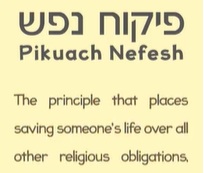
That was a point that really, really needed to be made to them at that particular time. They needed it to sustain them though all the cruelty that the aftermath of war usually generates – to sustain them in a belief system that values all life and obstinately refuses to worship violent gods that approve of violence, as was customary in the influential cultures around them.
Views from Art on Perseverance
I’d like to share an artistic approach by two Jewish singing groups who are playful about the themes of gaining freedom from the Greek oppressors, using take-offs on a medley of songs from musicals. To select one of the many for each: Six13 in West Side Story and the Maccabeats in Hamilton.
Also, a music video I saw years ago and can’t find again is a beautiful version of the positive side of the story – that is, resisting bullies – told all with a Hanukkah song in the background. A high school boy is confronted by other high school boys with Greek letters on their baseball caps. In case that’s too subtle for you, they also have the word “bully” emblazoned on their backs. He’s cowed at first, but then goes to sing with his group that Hanukkah song. He gets some backbone, puts on his yarmulka and goes back to stand up to the bullies – in an admirably nonviolent manner, walking right through them, leaving them confused.
Not Jewish in origin, but a well-known Hanukkah song that focuses on the aspect of “let justice and freedom prevail” and adds “the peacemakers’ time is at hand” was written in 1982 by Peter Yarrow of Peter, Paul, and Mary: Light One Candle.
Australia
The above was all written in preparation for the holiday, but I awoke on Sunday, December 14 to the horrifying news of the mass shooting targeting Jews celebrating Hanukkah at Bondi Beach in Sydney, Australia. While the Seleucid empire is long gone, the targeting of Jewish practices, and lethal targeting of Jewish people that goes with it, is still current.
As Rabbi Jonathan Sacks explains, rather than being about re-dedicating the later-destroyed physical building, the story of Hanukkah became about re-dedicating the living embodiments of Judaism – rather than a military victory, a spiritual and civilizational one. Education marches on, and the cultural victory has lasted millennia.
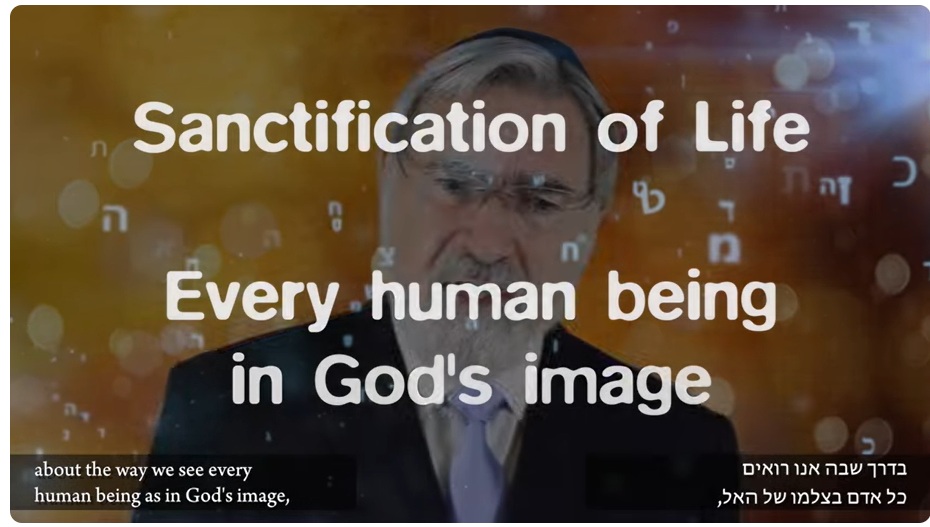
That cultural victory is alive and well. Millions of Jews all over the world will be lighting those candles and commemorating their resilience in the face of bigoted violence. Many non-Jews will light the candles as well, including participation in public events.
A final point: back at the time of the Maccabean story, Jews were pretty well on their own as far as other people in the vicinity were concerned, and the official government was the problem. Nowadays, the official government did its job in protecting people where it could, and is expected to charge the surviving gunman. There’s been an outpouring of condemnation of the crime all over the world, and an outpouring of individuals giving aid. Jews aren’t on their own – as the Australian prime minister Anthony Albanese put it: “An attack on Jewish Australians is an attack on every Australian.”
==================
This is a list of holiday editions of our weekly e-newsletter, Peace & Life Connections.
In 2024, Christmas carols with backgrounds that have a connection to consistent life issues were explained. (Also the same content in a 2024 post)
In 2023, we covered Kwanzaa.
In 2022, the topic was the Christmas Truce of 1914, when World War I soldiers up and down the line treated each other as friends rather than enemies for the holidays. (Also the same content in a 2022 post.)
In 2021, there was a somber topic, but one appropriate to the season: the Massacre of the Innocents, and its role in quotations and art that oppose massive violence of all kinds. (Also the same content in a 2021 post.)
In 2020, given what was most on people’s minds at the time, we covered Pandemics Related to Christmas. (Also the same content in a 2020 post.)
In 2019, we showed Christmas as a Nonviolent Alternative to Imperialism.
In 2018, we detailed Strong Women against Violence – Connected to the Holidays.
In 2017, we covered Interfaith Peace in the Womb.
In 2016, we discussed how “The Magi were Zoroastrians” and detailed how good the Zoroastrians were on consistent-life issues. The ancient roots of the consistent life ethic run deep!
In 2015, we had a list of good holiday movies with consistent-life themes – check it out for what you might want to see this season. We also had information on Muslim nonviolent perspectives.
In 2014, we offered a quotation from a lesser-known Christmas novella of Charles Dickens and cited the treatment of abortion in the Zoroastrian scriptures.
In 2013, we shared several quotations reflecting on Christmas.
In 2012, we had a couple of quotes showing the pro-life aspects of two prominent Christmas tales: A Christmas Carol with Ebenezer Scrooge, and the movie It’s a Wonderful Life. We also quote from John Dear about Jesus as peacemaker and Rand Paul about the 1914 spontaneous Christmas Truce; he then related it to the culture of life.
In 2011, we covered the materialism-reducing “Advent Conspiracy” and offered two pieces of children’s art: a 1939 anti-war cartoon called “Peace on Earth,” and the anti-war origins of “Horton Hears a Who,” whose tagline – “a person’s a person, no matter how small” – is irresistible to pro-lifers.
In 2010, we showed “It’s a Wonderful Movement” by using the theme of what would happen if the peace movement and the pro-life movement hadn’t arisen. We also had quotes from Scrooge (against respect for life) and a Martin Luther King Christmas sermon.


Rachel, I do not know if you have read the Jewish version of the Book of the Maccabees (it is somewhere on the internet) but I believe it talks about how some Jews were sometimes murdered if they refused polytheism. The idea is that if many gods exist and there is not one omnipotent G*d morality can be fluid; the state can impose its morality because there is no absolute moral standard if there are competing gods. The Selucids who were under the Greeks and supported Greek culture wanted polytheism because that supported the supremacy of the state since no one god of a pantheon could supercede it. Hanukah is considered primarily a spiritual victory against the annihilation of Judaism through assimilation into Hellenism. This is in contrast to the Jewish holiday of Purim, which although in the Bible, is probably just fiction, or political satire, but celebrates the victory of Jews against physical annihilation. You are right about the Hasmonean dynasty. At least one of the Hasmonean kings also insisted on forced conversion to Judaism, the only time this happened in Jewish history. The Hasmoneans took on the psychology of the oppressor.