Orphans of Hiroshima
by Sarah Terzo
On August 6, 1945, the United States military dropped an atomic bomb on Hiroshima, Japan. This one of a series on Hiroshima orphans. The rest of the series can be found on my Substack.
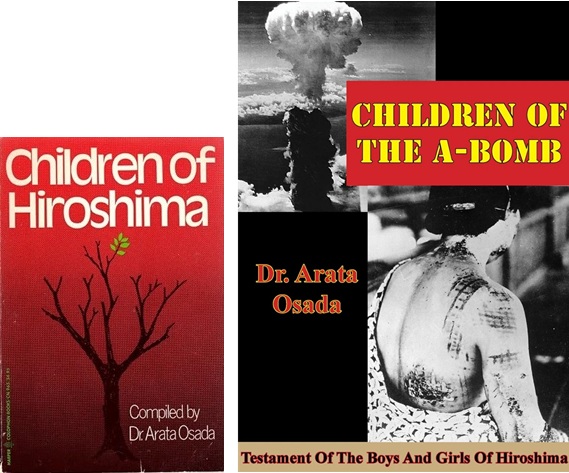
The stories in this article are from Dr. Arata Osada’s Children of Hiroshima, which was published in Japan in 1951 and later translated into English. Osada interviewed children affected by the bombing.
You can find this book in e-book format on Barnes & Noble and Amazon under the title Children of the A-Bomb: Testament of the Boys and Girls of Hiroshima.
Toshihiko’s Story
Toshihiko Tanabe was in second grade (seven or eight years old) when the bomb was dropped. His parents had sent him to stay with his grandmother in the countryside to protect him from Allied bombs.
A few days after the bombing, he and his grandmother went looking for his parents. Their house was empty, and they couldn’t find them. Toshihiko said:
Were my father and mother dead? I felt very sad just thinking that. My father was so good and strong. I thought he wouldn’t be killed by a bomb like that, not Dad. And I kept telling myself that my mother was alive, too.[i]
Six days later:
[A] soldier, dirty and bloody, leaning on a stick, hardly able to walk, lurched in the door. It was no other than my dear, unforgettable father. I was so happy! I rushed to him and hugged him. I was right, my father was strong and wonderful.[ii]
Sadly, his joy was short-lived. His father was sick with radiation poisoning and passed away ten days after the bombing while Toshihiko “just clung to him tightly and cried and cried.”[iii]
He never saw his mother again and doesn’t know where she was when she died. She was one of the many missing; her body never found, presumably obliterated by the explosion.
Takako’s Story
Takako Okimoto was also in second grade. She lost her entire family. She told Osaka, “[P]arents, brothers, and sisters, relatives, and friends. All of them died, one after another.”[iv]
Her big brother, like Toshihiko’s mother, was never found. Her other brother was horribly burned and died a day after the bombing. After he died, she, her parents, and her two sisters went to the countryside, but they were unable to find medical care in the small village. Her mother went back to Hiroshima to be treated for her injuries.
A day later, her uncle sent them a message saying his mother was much worse. Takako and her surviving family members hurried to the city. Takako said, “There was a nasty smell everywhere in the city, and the scene was most horrible.”[v]
Another Hiroshima orphan, Yuriko Sakurai, whose story I shared in a previous article, described the scene when she spoke about going to Hiroshima two days after the bombing: “Bloated bodies were floating in its seven once beautiful rivers. The air … was thick with the stench of burned bodies.”[vi]
Takako arrived too late. Her mother had already died. She said, “I cried and cried. We cremated her body on the dry riverbed. People were cremating corpses here and there.”[vii]
Soon after returning to the countryside, Takako’s older sister died from radiation poisoning, and her father and little sister got very sick.
Even though Takako was only seven or eight, she tried to take care of them as best she could. She said, “Though I was too young to know what to do, I did everything I could to help my father and little sister.”[viii]
But Takako’s little sister died a day after her big sister’s funeral. Her father went to the first sister’s funeral but was too weak and sick to attend the second’s.
Despite losing four of his children and suffering from the horrible effects of radiation poisoning, Takako’s father kept up a positive attitude with her:
Father must have felt very sad and lonely to see his sons and daughters die before him, one after another, but whenever I said, ‘How do you feel this morning?’ he would said, ‘I feel a little better this morning, my dear.’ He didn’t want me to worry, but he was just getting weaker and weaker.[ix]
Her father wanted to live:
[H]e often said, “I hope I don’t die. Now that our house and possessions have been lost in the fire, I want to stay here in the country and do farming, dressed in rags but leading a quiet life with you.”…
On the morning of September 10, he departed this life, with the thought of leaving me alone weighing on his mind.[x]
Despite losing her entire family to the Americans, Takako wasn’t hateful or consumed with thoughts of revenge. Instead, she only wanted peace. She said, “I think that if we are to build a peaceful country, we should be more thoughtful toward each other.”[xi]
Junya’s Story
Junya Kojima was five when the atomic bomb was dropped. He’d lost his mother as an infant. He was staying in the countryside with relatives.
Junya’s father survived the bombing, but, like Takako’s sisters and father, was exposed to a lethal dose of radiation. Takako said, “When he came to the country, he had a lot of colored spots all over, and he soon died.”[xii]
Radiation poisoning affects the blood, reducing platelets and white blood cells and damaging red blood cells. The victim dies from massive internal bleeding.[xiii] Often, the first sign of this bleeding is petechiae. They are the “colored spots” Junya described.
Petechiae look like small red marks on the skin, caused by blood leaking from blood vessels. The spots then spread and grow larger until the bleeding becomes uncontrollable and affects internal organs.
At this point in his interview with Osada, Junya seemed to struggle for words. He didn’t know how to express the grief he felt over losing his father and becoming an orphan. He said he couldn’t find words. At the time of the interview, he was still a child, in sixth grade, eleven or twelve years old.
He finally said:
Why did I have to be so unlucky?…[B]efore [the atom bomb] I was happy. My bad luck started after the bomb. But I know that I’m a lot luckier than some kids in Hiroshima. At least I’ve got a place to live.[xiv]
Indeed, many children in Hiroshima lived in orphanages, and some were on the street.
At the time of the interview, Junya lived with his uncle. His grandmother took care of him for four years after he lost his father, but she died in 1948.
Junya said:
It’s really lonely and sad to live alone without either a father or mother or any brothers or sisters…I wish I could see my father and mother again! But I know it is impossible.[xv]
Because his mother died only two months after he was born, he had no memory of her.
Death from Radiation Poisoning
Takako and Junya watched their family members die. Their deaths weren’t easy ones.
Dr. Michihiko Hachiya, a Hiroshima survivor who treated patients with radiation sickness after the bombing, described some of the symptoms in his memoir.
He and his fellow doctors knew nothing about radiation sickness and didn’t understand why their patients were dying. The symptoms confused them, and they didn’t know how to treat them.
Hachiya wrote:
So many patients died without our understanding the cause of death that we were all in despair… [Common symptoms] were general malaise, anorexia [loss of appetite], eructation, diarrhea, and vomiting…The critically ill patients had all five…
Among those who died many had a bloody diarrhea similar to that seen in dysentery, and others had bloody urine or sputum. Severe uterine hemorrhage… was common among the women.
Some, who lingered as long as a week, died with stomatitis [ulcers in the mouth] or gangrenous tonsillitis… [S]tomatitis appeared and with it petechiae…
[The symptoms] bore no relationship to the type or severity of injury… [T]hose who appeared to be uninjured and even felt well enough to help in the care of other patients were beginning to show these blood spots beneath the skin…
There was no making heads or tails to this puzzle. But what were we to do?[xvi]
Death by radiation poisoning is painful, prolonged, and traumatic both to experience and to witness.
Even today, there’s no effective treatment for exposure to large doses of radiation such as released by an atomic bomb.[xvii] In a nuclear war, millions of people would die this way.
[i] Arata Osada, PhD, translated by Yoichi Fukushima, Children of Hiroshima (London: Taylor & French Ltd., 1980) 111.
[ii] Ibid.
[iii] Ibid., 112.
[iv] Ibid., 106.
[v] Ibid.
[vi] Ibid., 40.
[vii] Ibid., 106.
[viii] Ibid.
[ix] Ibid., 107.
[x] Ibid.
[xi] Ibid.
[xii] Ibid., 37
[xiii] Michihiko Hachiya, MD, trans. by Warner Wells, MD, Hiroshima Diary: The Journal of a Japanese Physician, August 6–September 30, 1945, (Chapel Hill, North Carolina: University of North Carolina Press, 1955) 150, 151,
[xiv] Arata Osada, Children of Hiroshima, 37.
[xv] Ibid., 37-38.
[xvi] Michihiko Hachiya, MD, Hiroshima Diary, 142-143.
[xvii] “Radiation Sickness,” Mayo Clinic, accessed August 7, 2026, https://www.mayoclinic.org/diseases-conditions/radiation-sickness/diagnosis-treatment/drc-20377061.
==========================
This is the second post this year in observance of the anniversaries of the 1945 bombings of Hiroshima and Nagasaki. Last’ week’s was:
Advocating for Peace and Recognition: The Overlooked Korean Victims of the Atomic
Posts from previous years include:
“Oh, the Hateful A-Bomb!”: Survivors’ Stories from Hiroshima and Nagasaki
“Everybody Else in the World Was Dead”: Hiroshima’s Legacy
The Danger That Faces Us All: Hiroshima and Nagasaki after 75 Years
Rejecting Mass Murder: Looking Back on Hiroshima and Nagasaki


[…] Orphans of Hiroshima Advocating for Peace and Recognition: The Overlooked Korean Victims of the Atomic Bombings Post Views: 0 […]