“A Chain Reaction of Spiritual Atoms”: Buddhist Opposition to Nuclear Weapons
Part 1 in a series on opposition to nuclear weapons within different religions.
by John Whitehead
Hatred will not cease by hatred, but by love alone.
This is the ancient law.
All fear violence, all are afraid of death.
Seeing the similarity to oneself,
one should not use violence or have it used.
— Dhammapada 1:5-6
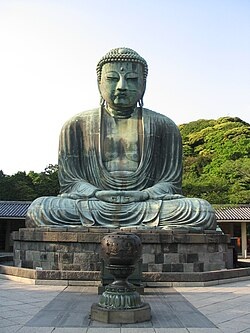
Buddhism and the history of nuclear weapons overlap in different ways. Two countries that possess nuclear weapons—China and North Korea—have historically had large Buddhist populations, although in both countries the governments that built the weapons have been anti-religious. Another country with a significant Buddhist tradition, Japan, is the only country ever to be the target of nuclear weapons in wartime.
Buddhist tradition offers grounds for rejecting nuclear weapons and their use. A central Buddhist precept exhorts people to reject violence and to love all. Inner disposition is especially important. Rejecting hatred and divisive attitudes in favor of loving-kindness and an appreciation of all beings’ interdependence is a basic Buddhist value.
Since nuclear weapons’ invention, Buddhists have been among those seeking to prevent these weapons’ use or calling for their abolition.
Resolving a Nuclear Crisis
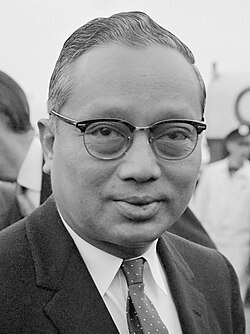
U Thant, 1963
A major Buddhist statesman who worked against the nuclear threat was U Thant, the Burmese diplomat who served as Secretary-General of the United Nations from 1961 to 1971.
Thant began his days with meditation, to cultivate “a certain feeling of detachment…to separate oneself from the conflicts outside.” He described meditation as “an exercise in suppressing evil thoughts and evil attitudes—anger, bitterness, malice, hatred.” (Quoted in “The Meditation of U Thant, New York Times, December 13, 1964) He spoke out against violence, which “erodes the spirit of law, order and international morality.”
Thant’s commitment to avoiding violence was put to a spectacular test during the Cuban Missile Crisis of October 1962, when the United States and Soviet Union approached the brink of nuclear war. The secretary-general played an important role in defusing the potential nuclear confrontation.
When news of Soviet nuclear missiles being stationed in Cuba became public on October 22, the United States announced a naval blockade of Cuba. Fearing a US-Soviet military confrontation, on October 24, Thant appealed to the United States to suspend the blockade and the Soviet Union to suspend any shipments of weapons to Cuba. He also proposed a settlement where the Soviets would withdraw the missiles if the United States pledged not to invade Cuba.
In subsequent negotiations, the two sides reached an agreement consistent with Thant’s proposal. During these negotiations, Thant served as mediator, offering advice to and serving as a go-between among the different parties in pursuit of a final deal. Later, Thant and the United Nations helped facilitate US-Soviet-Cuban negotiations over the details of withdrawing weapons from Cuba.
Following the crisis’ resolution, US President John F. Kennedy commented, “U Thant has put the world deeply in his debt.”
After the crisis, Thant continued to speak out against the nuclear threat. He described testing nuclear weapons as “a manifestation of a very dangerous psychosis.”
Responding to an American politician’s suggestion that nuclear weapons be used in the United States’ war in Vietnam, Thant declared, “I am against the use of atomic weapons for destructive purposes anywhere, under any circumstances—and anybody who proposes the use of atomic weapons for destructive purposes is, in my view, out of his mind.”
Advocating for Nuclear Abolition
Other prominent Buddhist figures have spoken out against nuclear weapons. The Vietnamese monk and peace activist Thich Nhat Hanh wrote:
The nuclear arms race is inextricably linked to other forms of violence and suffering that afflict life on Earth. Recognizing this, I propose reductions in military spending with corresponding allocations to be used for the alleviation of world hunger . . .
I hope the United States will independently declare a stop to the arms race and invite Russia, China, and all other arms-producing countries to do the same…Then, if other countries do reciprocate, the US could take another step toward complete and general disarmament.” (“From Weapons to Human Solidarity,” 1971)
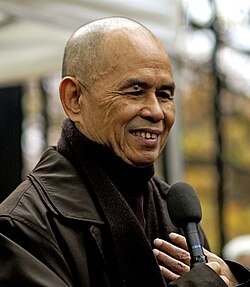
Thich Nhat Hanh
Significant Buddhist anti-nuclear advocacy also has unsurprisingly come from Japan.
Ichiro Moritaki was an academic and Zen Buddhist who survived the Hiroshima bombing, although he was blinded in one eye. During his recovery, meditation led him to a determination that humanity must turn away from the pursuit of power toward the practice of love. Proclaiming that “Nuclear weapons and humanity cannot coexist,” Moritaki dedicated himself to anti-nuclear work, founding the Nobel Peace Prize-winning survivor organization Nihon Hidankyo.
In 1962, Moritaki began a practice of sit-ins at Hiroshima to protest nuclear tests. Commenting on the protests, which grew in size, Moritaki wrote, “There is no other path for a peace movement than that of appealing to public opinion without having recourse to any violent action.” He described the sit-ins as “a universal mode of nonviolent demonstration in which young and old in both West and East can participate.” Moritaki found inspiration in how protesting the nuclear threat prompted people to go beyond concern for their own affairs and to act selflessly.
A major Buddhist organization involved in anti-nuclear activism is Soka Gakkai International (SGI). Founded in Japan in 1930, Soka Gakkai grew out of Nichiren Buddhism, a tradition that has emphasized people’s equality and challenging those in power. Under its third president, Daisaku Ikeda, Soka Gakkai grew into an international association of over 10 million people in 192 countries.
Ikeda spoke out on social justice and peace, particularly nuclear abolition. In 2009, he appealed to the world’s nations, civil society organizations, and the United Nations to join in a common abolition effort. In his appeal, Ikeda commented,
If we are to put the era of nuclear terror behind us, we must struggle against the real “enemy.” That enemy is not nuclear weapons per se, nor is it the states that possess or develop them. The real enemy that we must confront is the ways of thinking that justify nuclear weapons; the readiness to annihilate others when they are seen as a threat or as a hindrance to the realization of our objectives…
Raising one’s voice or taking action is something we all can do. All that is required are the natural feelings shared by people everywhere: the desire to live in peace, the wish to protect those we love, the determination to spare the world’s children needless suffering.
SGI has long worked closely with the International Campaign to Abolish Nuclear Weapons (ICAN), collaborating on peace education efforts. These efforts have included documenting the stories of atomic bomb survivors and releasing a video on the nuclear threat, “Reshape History.” ICAN Executive Director Beatrice Fihn commented, “SGI has been one of our greatest partners in this fight.”
Danny Hall, the Lead Capitol Hill Representative & Faith Community Outreach Coordinator for the Back from the Brink campaign continues the SGI tradition. A Buddhist, Hall was inspired by Daisaku Ikeda’s writings to dedicate himself to nuclear abolition.
“Nuclear abolition is not just a cause,” Hall wrote, “it is a force that gives meaning to our lives, ensuring that all other pursuits for good can thrive without the shadow of nuclear threats.” Hall’s activism includes building support for the Back from the Brink resolutions in the US Congress (H.Res 317/S.Res 323).
Hall organized this year’s “Nuclear Prayer Day” in Washington, DC, on August 6, the anniversary of the Hiroshima bombing. The Prayer Day was an occasion for faith leaders and activists to pray and advocate for an end to the nuclear threat and for reallocating resources from weapons to helping life to flourish. Held in the United Methodist Building on Capitol Hill, the event was illuminated by paper lanterns decorated by children in Hiroshima and Washington, DC. One speaker commented, “Each lantern symbolizes remembrance, hope, peace, and global solidarity.”
Buddhism guides Hall’s work through its recognition of the dignity (or “Buddha nature”) of every human, the “common human thread that exists among all the different kinds of people.” Despite propaganda that may portray someone as a hated “other,” Buddhism teaches “this person’s life has value, this person has something valuable to contribute to the world.”
Hall’s faith provides hope. “We’re capable of more than we think we are,” he says. “Faith becomes very real in people’s lives when you’re really confronted with situations that stretch you as a human being.” Hall says, “I feel grateful to do this work.” (Interview, July 7, 2026)
A Crucial Role for Peace
Buddhists have long played a crucial role in working against nuclear weapons, and their faith can continue to inspire efforts to free humanity from the nuclear threat. Ichiro Moritaki, who emerged from the horror of Hiroshima to advocate for peace, summed up this mission in verse:
A chain reaction of spiritual atoms
Must overcome
The chain reaction of material atoms.
If you’re part of a faith group interested in getting involved with Back from the Brink, you can reach out to Danny Hall at danny@preventnuclearwar.org.
===================================
For more of our posts relating religion to nuclear weapons, see:
Nukes and the Pro-Life Christian: A Conservative Takes a Second Look at the Morality of Nuclear Weapons / Karen Swallow Prior


Leave a Reply