Advocating for Peace and Recognition: The Overlooked Korean Victims of the Atomic Bombings
by John Whitehead
The United States’ atomic bombings of Hiroshima and Nagasaki are among the most infamous acts of violence in history. The bombings of Japan have been a subject of remembrance, analysis, and debate for over 80 years.
Nevertheless, even such well-known events have aspects that many people remain unaware of. One aspect of the atomic bombings that tends to be neglected is the death and injury of Koreans.
Along with the Japanese dead and survivors, many Koreans were harmed by the bombings. Further, in the decades since the bombings, Korean survivors and their descendants have suffered from an array of hardships, not least ignorance of their stories.
The 81st anniversary of the atomic bombings is a good time to remember the Korean victims of the atomic bombings and the ongoing advocacy for peace that has arisen from their experiences.
Second-Class Citizens before and after the Bombings
Japan annexed Korea in 1910. Over the next 35 years of Japanese colonial rule, many Koreans moved to Japan. Some emigrated voluntarily for economic reasons, while others were conscripted as forced labor. In Japan, Koreans were second-class citizens, often given the most difficult or dangerous work.
Lee Jung-soon was an elementary school student in Hiroshima when the bomb was dropped on August 6. She recalled that “My father was about to leave for work, but he suddenly came running back and told us to evacuate immediately…They say the streets were filled with the dead – but I was so shocked all I remember is crying. I just cried and cried.” Lee remembered that in the bombing’s aftermath the bodies of the dead “melted away so only their eyes were visible.”
Another survivor, Choi Il Chul, described his memories of August 6:
I was a twelve-year-old 6th grader of a primary school. At that moment, I was at home, located 1.3 km from the epicenter. Fortunately, as I was inside the house . . . I did not suffer the effects of strong heat rays. Though my house instantly collapsed by the blast, I was saved under the space of a piece of leaning furniture and did not suffer severe injuries.
When the black rain fell, I was inside a building in the suburbs where I took shelter, and I seemed to have escaped the effect of radioactivity contained in the rain. In my family, my older sister’s husband was missing. My immediate older brother was caught by the bomb very close to the blast center and was found in an aid station. Three days after he was taken to the place of refuge, he died.
Jeong Tae-Hong, a teenager in Nagasaki, was playing outside with his brother when the city was bombed on August 9. He remembered seeing the American plane that dropped the bomb and then an intense light, followed by a blast that knocked him to the ground. Jeong’s home was damaged, and his parents suffered severe burns on their faces and hands. Lacking medical treatment, they put mud on their wounds. When Jeong fled Nagasaki with his family, he remembered seeing dead bodies and the city in flames.
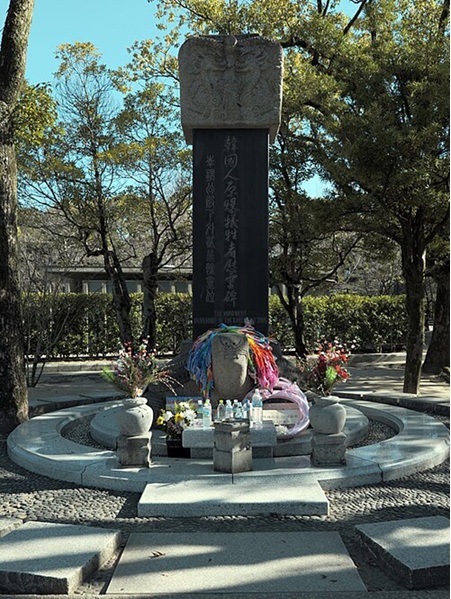
Memorial in Hiroshima to Koreans affected by atomic bomb
Like the overall number of atomic bombing victims, how many Koreans died in the bombings is disputed. The Korea Atomic Bomb Casualty Association, a survivors’ group, estimates 50,000 Koreans were killed in the Hiroshima and Nagasaki bombings combined.
Whatever the precise number of deaths, Koreans may well have been overrepresented among atomic bombing victims because of their position within Japanese society. While Japanese survivors of the bombings could flee the cities to stay with relatives, Koreans lacked such social networks. They often had to stay in the bombed cities and endure prolonged radiation exposure, with limited access to healthcare.
The Gyeonggi Welfare Foundation, a South Korean group, reported that some Korean survivors were forced to clean up the bombings’ aftermath, recovering bodies and clearing rubble. Hiroshima survivor Shim Jin-tae recalls, “Korean workers had to clean up the dead…At first they used stretchers, but there were too many bodies. Eventually, they used dustpans to gather corpses and burned them in schoolyards.”
Because of such poor treatment, the Korea Atomic Bomb Casualty Association estimates a higher death rate among Koreans affected by the bombings: roughly 57% for Koreans, compared to the overall death rate of roughly 34%.
A Legacy of Illness and Stigma
After Japan’s defeat, Korea regained its independence. Many Korean bombing survivors returned to their country. Their ordeal continued, though.
Some who initially survived the bombings died not long after. Choi Il Chul’s parents, who were not present in Hiroshima during the bombing, died shortly after returning to Korea. Choi attributes their deaths to radiation exposure they experienced in Hiroshima when they were searching for relatives in the bombing’s aftermath. Jeong Tae-Hong lost a brother in 1948 and his father and mother a few years after that. He remembered that his mother’s hair fell out and she suffered insomnia and body pain.
Other survivors suffered long-term health problems. Jeong had ailments including high blood pressure and bronchial trouble. Lee Jung-soon has had skin cancer, Parkinson’s disease, and angina.
Health challenges have persisted among survivors’ descendants. Lee’s son, Ho-chang, has experienced kidney failure and is on dialysis. “I believe it’s due to radiation exposure, but who can prove it?” he says. “It’s hard to verify scientifically – you’d need genetic testing, which is exhausting and expensive.” Han Jeong-sun, a second-generation survivor, has difficulty walking because of avascular necrosis in her hips.
A 2005 study showed that second-generation Korean survivors were far more likely than the general population to suffer depression, heart disease, and anemia. A 2013 study found second-generation survivors’ disability registration rate was nearly double the national average.
Beyond health issues, Korean survivors and their descendants have struggled with social stigma and neglect. Lee recalls that “People who were badly burned or extremely poor were treated terribly . . . In our village, some people had their backs and faces so badly scarred that only their eyes were visible. They were rejected from marriage and shunned.”
Han remembers how her in-laws reacted when her first son was born with cerebral palsy. “They said, ‘You gave birth to a crippled child and you’re crippled too—are you here to ruin our family?’”
Advocating for Peace
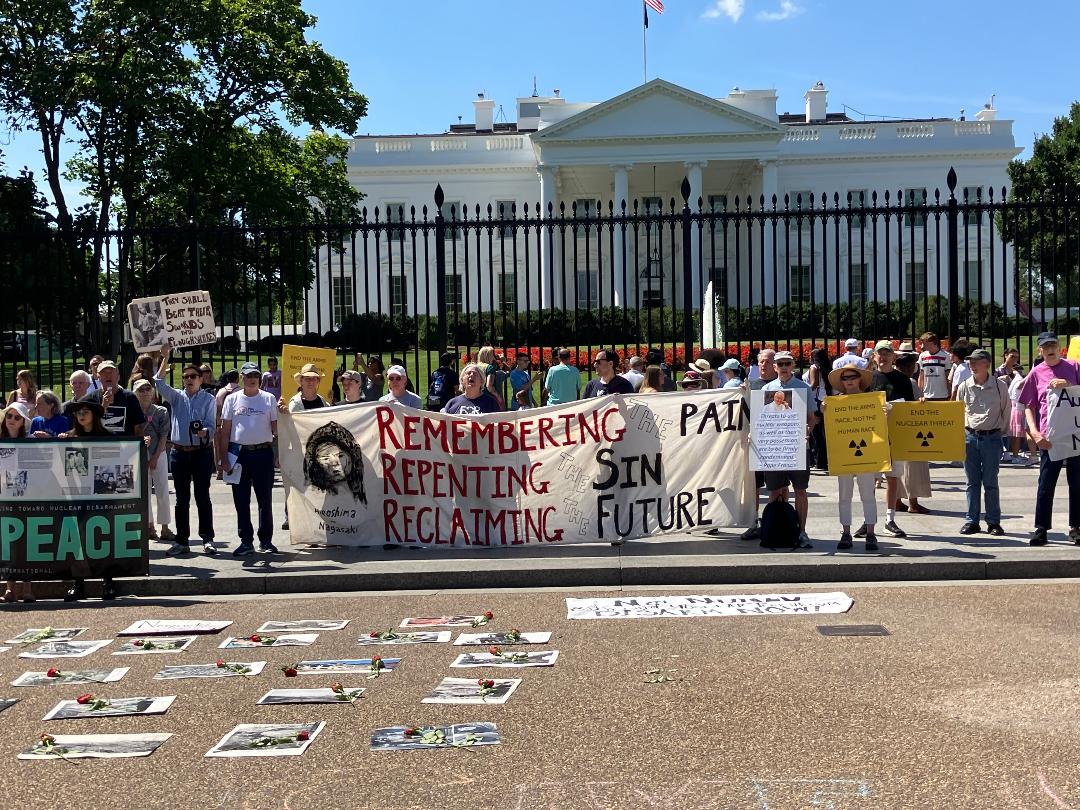
Today, roughly 1,500 Korean atomic bombing survivors remain. They continue to campaign for recognition and compensation and also to speak out against the ongoing nuclear threat. This November, a survivors’ group will hold a tribunal “to establish the illegality of the U.S. atomic bombings in 1945 to secure the basis for condemning all nuclear threats and use as illegal today.”
Earlier in 2026, Shim Jin-tae spoke at the conference of states belonging to the Nuclear Nonproliferation Treaty. Shim declared,
Only when the United States—the nation that actually dropped the bombs—offers an apology and provides compensation will no other nation dare to even contemplate the use of nuclear weapons. All nations possessing nuclear arms must immediately dismantle their barbaric policies that threaten other countries and all of humanity with nuclear destruction.
We—the Korean survivors of the atomic bombings and our descendants—will continue to fight to the very end, until these nuclear weapons—which are, in essence, illegal instruments of war—are reduced to nothing more than scrap metal.
===================
For more of our coverage on Hiroshima and Nagasaki anniversaries, see:
“Oh, the Hateful A-Bomb!”: Survivors’ Stories from Hiroshima and Nagasaki
“Everybody Else in the World Was Dead”: Hiroshima’s Legacy
The Danger That Faces Us All: Hiroshima and Nagasaki after 75 Years
Rejecting Mass Murder: Looking Back on Hiroshima and Nagasaki


[…] Advocating for Peace and Recognition: The Overlooked Korean Victims of the Atomic […]
[…] of Hiroshima Advocating for Peace and Recognition: The Overlooked Korean Victims of the Atomic Bombings Post Views: […]