Capturing Justice and Humanity: The Photography of Steve Schapiro
by John Whitehead
During his career as a freelance photojournalist, Steve Schapiro (1934-2022) produced an extraordinary body of work. He captured notable people and events for magazines such as Life, Look, Newsweek, and Time, with some of his most significant photos chronicling the American Civil Rights Movement. A concern for social justice ran throughout Steve’s photography, which contains much to move and inspire activists today.
This photography and the man behind it are the subjects of a new documentary, Steve Schapiro: Being Everywhere. Directed by Maura Smith, Steve’s wife, the film features countless examples of his work as well as extensive interviews with him about his life and work.
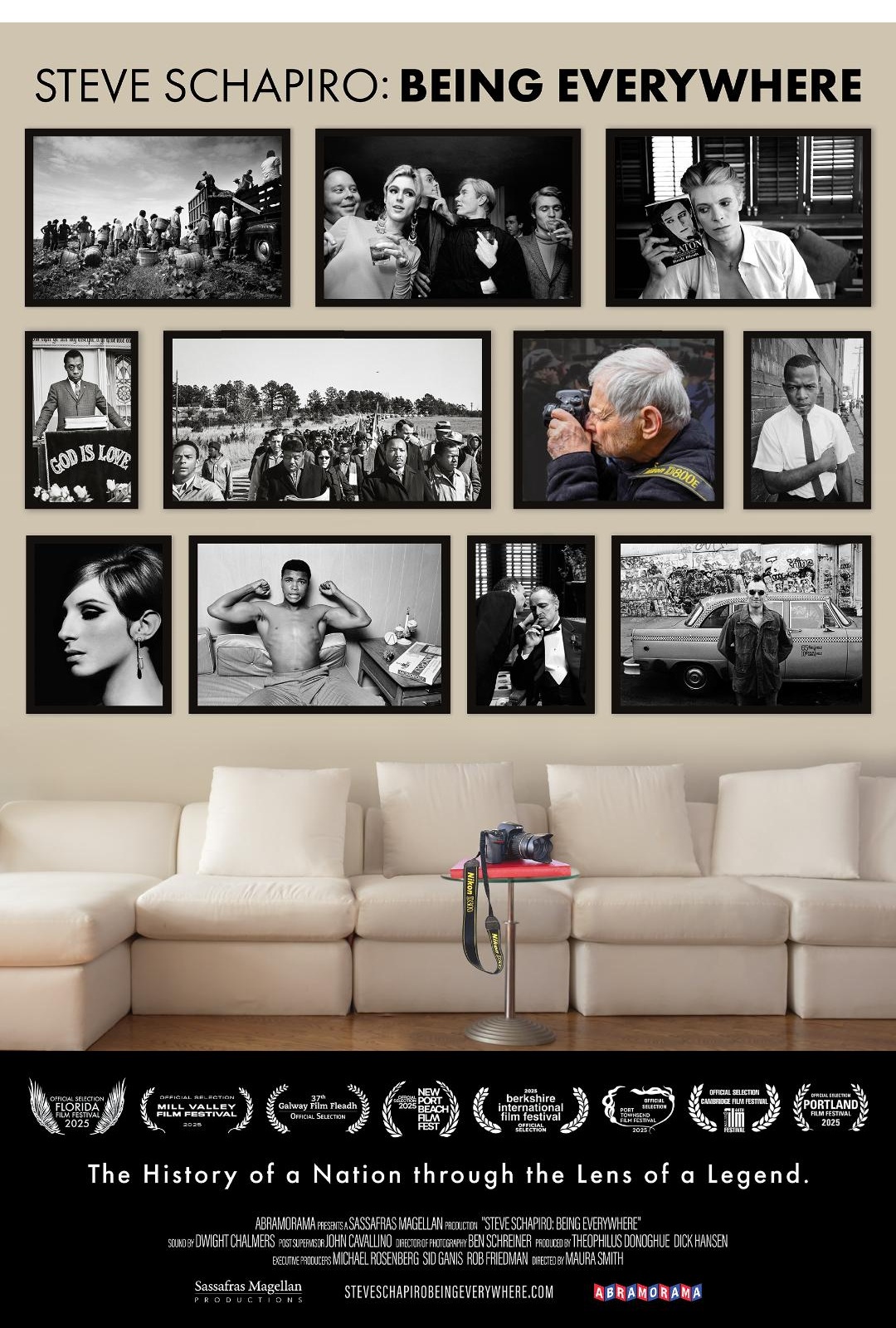
I should provide full disclosure at the outset: in addition to being married to Steve and the documentary’s director, Maura is also my cousin. She, Steve, and their son Theophilus (who is a producer on the documentary) have been family and close friends to me over the years. Thus, I cannot pretend to be objective on this topic. However, I can profess sincere admiration for Steve and his work and tell others why they should take an interest in them.
“People Who Need to Be Talked About”
As Steve recounts in the documentary, his love of photography began at age nine, when he was at summer camp. There he first practiced developing photographs in a dark room and found it a thrill to watch the images slowly emerge. Later in life, he began taking photos on the streets of New York City, in imitation of Henri Cartier-Bresson, who favored capturing spontaneous moments.
Steve comments, “[Cartier-Bresson] was able to catch things at their peak of emotion, with great design and giving you information about the subject. And I thought that was a superb way of doing photographs.”
An important contact Steve made early in his career was the Rev. Norman Eddy, an East Harlem minister. Eddy arranged for Steve to photograph a camp of migrant farm workers in Arkansas. One piercing image from this series shows the outside wall of a cabin for the workers on which someone, probably a child, has written the words, “I love anybody that loves me.” The photo series was eventually picked up by the New York Times magazine and helped bring about electrification to the migrants’ camp.
Another crucial contact was a doctor in East Harlem who worked with people with substance abuse issues. He made it possible for Steve to accompany a group of people with such problems and do a photo series on them.
Steve observes that knowing clergy and social activists offered a way to do stories on “people who need to be talked about.”
Later, Black Americans’ struggle for equal rights became a major focus of Steve’s work. He covered events such as the 1963 March for Jobs and Freedom in Washington, DC, and the Selma to Montgomery march in 1965.
Steve also did a photo essay for Life on James Baldwin and accompanied Baldwin on a trip to North Carolina and Mississippi. During the Mississippi trip, they visited Medgar Evers, who would be assassinated a few months later. Years after the trip, the Baldwin family decided to use Steve’s photos to illustrate a new edition of The Fire Next Time.
Efforts to challenge poverty and racial inequality continued to be a theme in Steve’s work in subsequent years. Toward the end of his life, he did series on the Black Lives Matter movement . Shane Claiborne later wrote a remembrance of Steve.
Capturing Lives in an Image
In keeping with the Cartier-Bresson approach, Steve explains that he liked to “wait for that moment when there’s something in someone’s eyes, in the way they look, which gives you a hint as to who they are and what’s very special about them.”
Steve’s photos certainly met this goal. He had a near-preternatural gift for photographing people or scenes at precisely the angle or moment that would convey something meaningful about the subject. Looking at a Steve Schapiro photo, you feel a story is being told.
This kind of richness in an image is on display in the James Baldwin series. One stand-out photo is of Baldwin talking to another man, whose back is to the camera. Bundled up in an overcoat, Baldwin looks at the other man with a half-guarded, half-inquisitive expression. In his arms, Baldwin holds a copy of The Contours album “Do You Love Me (Now That I Can Dance).” As Steve comments, the photo’s precise combination of elements subtly conveys Baldwin’s loneliness in life.
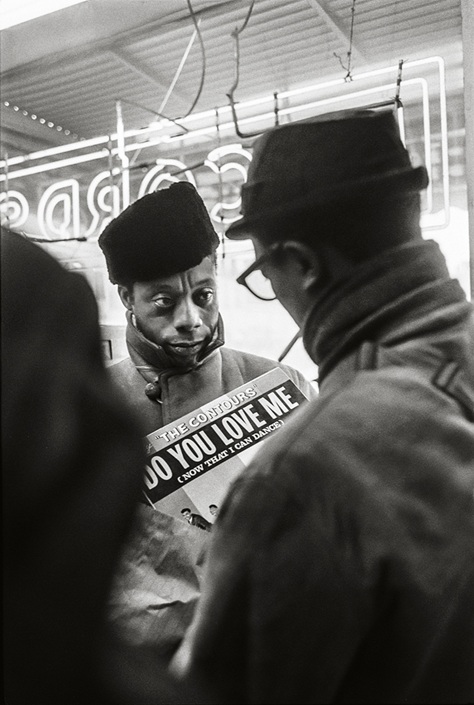
© Steve Schapiro, courtesy of Fahey/Klein Gallery, Los Angeles
Another remarkable combination comes in a photo of Jerome Smith, a Louisiana activist with the Congress on Racial Equality who participated in the 1961 Freedom Rides to protest segregation. Smith endured violence in the course of his work.
Steve photographed Smith while the activist was in a church in New Orleans. Smith sits off to the side of the sanctuary and leans forward with his chin in his hand, in an attitude that suggests prayer, reflection, and weariness. At the other side of the photo is a stained-glass image of Jesus, perhaps in the Garden of Gethsemane.
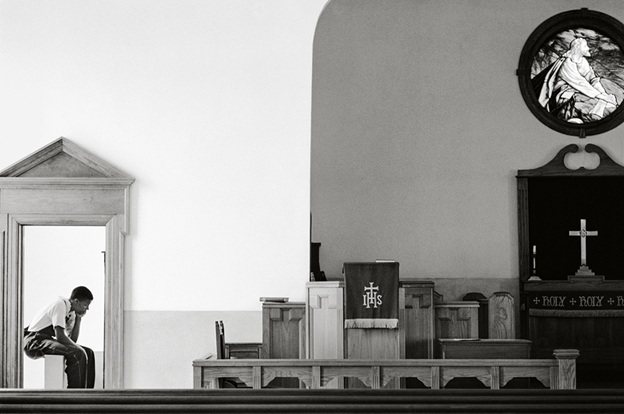
© Steve Schapiro, courtesy of Fahey/Klein Gallery, Los Angeles
Some of Steve’s most eerily powerful images came from a 1968 assignment for Life to cover Memphis in the aftermath of Martin Luther King’s assassination.
Steve had photographed King prior to that point, and the photographs reflected the constant threat of violence that overshadowed the civil rights leader’s life. In the documentary, Steve points out that in photos King was frequently not looking into the camera but looking somewhere off to the side, seemingly scanning crowds of people for possible dangers. Subject to attacks and constant death threats, King was perhaps always “wondering who would be the one.”
When the threats finally became a terrible reality, Steve traveled to Memphis to photograph the site of the assassination. “The streets were empty. It felt very lonely,” he remembers.
At the Lorraine Motel, Steve visited the room where King had been staying. Hosea Williams, one of King’s aides, allowed Steve to photograph the room, which still had the late minister’s clothes and effects in it.
One photograph brought together the different elements in the room in an extraordinary way that spoke volumes. As Steve says, “The physical man was gone, his material things remained, and I knew that his spirit and message would live on forever.”
In addition to activists and other well-known people, Steve’s photos also feature many ordinary people who, while their names might not have been recorded by history, are in their own way no less memorable.
Striking images of this kind appear in the series on migrant workers and people struggling with addiction. Other examples from the documentary include an older woman working as a store cashier; some kids hanging out on a city street; a mother reading a newspaper on the subway while her daughter sleeps on her lap; and another mother and child, presumably poor and even homeless, standing in a grocery store parking lot while the mother holds a sign bearing the message “It’s got to be somebody’s fault!”
My favorite photograph shown in the documentary balances the famous and ordinary beautifully. Taken in 1963, it shows Martin Luther King and his colleague, the Rev. Ralph Abernathy. The two civil rights leaders are not the main subject of the photo, though. Abernathy is off to one side and King is out of focus in the background.
The heart of the photo is a teenage boy standing next to Abernathy and holding a young girl (his sister?). He is looking directly into the camera and smiling with clear delight. Is he delighted about having his picture taken by a professional journalist? At being in the company of eminent clergy? At some private joke? I don’t know, but his warmth and personality suffuse the image.
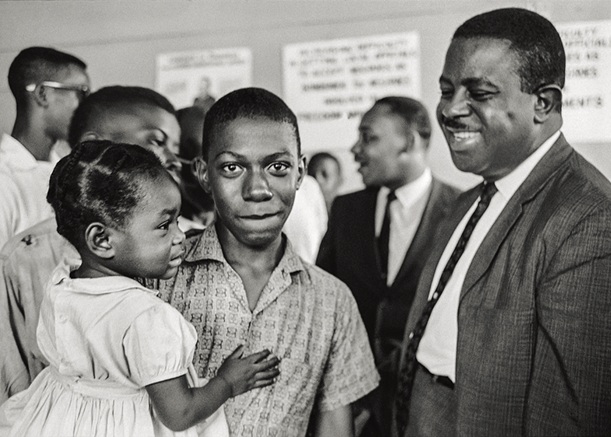
© Steve Schapiro, courtesy of Fahey/Klein Gallery, Los Angeles
Images like these reflect the peculiar magic of Steve’s work and good photojournalism in general. Across divides created by race, class, or (what is perhaps most insidious) everyday indifference toward strangers, a talented photographer can realize an image that clearly conveys the message “I am a unique human being, with dignity.”
Steve Schapiro: Being Everywhere is available for streaming through Amazon Prime, Apple TV, Google Play, and YouTube.
=================================
Some of our other posts on artistic expression:
Exposing Injustice Through Graphic Images
Comprehending Horror through Animation: The Art of the Anti-War Animated Movie
Seeing the Humanity of “the Enemy”: Movies to Provoke Thought and Discussion
Gendercide: Millions of “Missing” (Dead) Women
Behind and Beyond the Shout for Abortion</a


Leave a Reply