Excerpt – Peace Psychology Perspectives on Abortion

Excerpt from the Introduction to Peace Psychology Perspectives on Abortion
by Rachel M. MacNair
Understanding Perspectives
Back when I was in college, pursuing a major in Peace and Conflict Studies at Earlham (a Quaker college, I being a Quaker), several of us activists put together a program to educate about what was wrong with nuclear energy. Once done, we had done so well that a student asked how it could possibly be that anyone would support it. I immediately offered a three-minute pro-nuclear diatribe. My fellow activists started getting uncomfortable, wanting me to explain what was wrong with what I was saying.
I regard this as a crucial skill for all those interested in peace and therefore in conflict resolution. For effective debating, for proper listening, for the opportunity to fashion creative solutions not otherwise thought of, for the ability to get along with people with whom one disagrees, it is important to be able to understand and articulate a view different from one’s own.
In another incident from college days, we were preparing for a program arguing against nuclear weapons. A friend said these were so horrid and dangerous that we only needed to explain this, with no further information needed. When the program came, I watched as an audience member asked this simple question: “What about the Soviets? How can we give up nuclear weapons as long as they still have them?” This was not an unusual question and should have been anticipated. Yet my friend had no answer. It is indeed important to be familiar with all points of view when the goal is to be effective in presenting one’s own. . . .
Abortion: Option, Violence, or Tragedy
The philosophical perspectives on abortion in contemporary controversies can be understood on a continuum from support to opposition, and as with most continuums more people are likely somewhere along the middle rather than at either extreme. Here we will call the two extremes abortion-as-option and abortion-as-violence, with the continuum between called abortion-as-tragic-necessity.
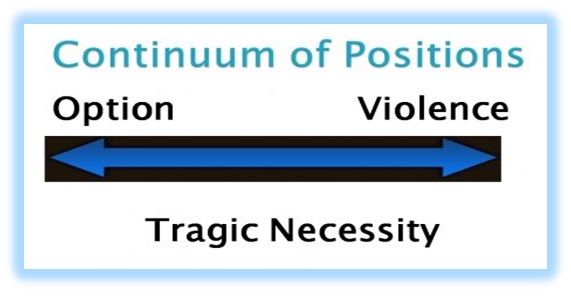
The term “pro-choice” is commonly used for abortion-as-option, and is insisted upon by any peace advocates who favor abortion availability. Their reasoning is for the liberation of women and perhaps also for the alleviation of poverty. Groups that favor this view include the Women’s International League for Peace and Freedom (WILPF), the War Resister’s League, and magazines of wide circulation and long history such as The Progressive and Mother Jones.
However, this extreme is also occupied by men who wish the women they impregnate to take this option whether or not the women themselves actually desire it. Similarly, there are those interested in eugenics or who take a racist attitude. For purposes of this book, we are only interested in aspects of interest to peace psychology, and therefore will not be considering the views of those whose reasoning is not for women’s benefit.
Similarly, the term “pro-life” is commonly used for the abortion-as-violence perspective, but this view is held by many for whom sensitivity to a right-to-life concern is narrow and does not extend to opposing war or capital punishment or favoring effective anti-poverty programs. This has been particularly true in recent partisan politics in several countries.
In the same way, this book is only considering the views of those who oppose all these forms of violence across the board, in what is commonly called the “consistent life ethic”. . . This view is officially held by many Catholic documents and the Mennonite church (Mennonites are a traditionally pacifist church) as well as a large number of people of varying religions and of secular orientation in the peace movement. . . .
Why the Difference?
The fact that peace advocates can be found on both sides and in the middle of the continuum has much to do with understanding the status of the human embryo and fetus.
- If the status is one of “products of conception” or tissue, then removing the growth is nothing more than ending an unwanted pregnancy, and the understanding that this is entirely a decision for the pregnant woman would be determinative; this goes with the “abortion-as-option” view.
- If the embryo or fetus has the status of a baby, a human being entitled to the rights all human beings have to be protected from being killed, then abortion is an act of violence subject to all the problems that using violence as a problem-solver commonly has, as would be understood in the “abortion-as-violence” view.
- If the embryo or fetus is understood to be a living organism but one with a status similar to an animal, then killing an animal is to be avoided when possible but allowed when really needed. Persuasive abortion reduction programs are a good idea, but not legal bans; hence, abortion-as-tragic-necessity. . . .

Left: 6-week embryo. Right: Rachel MacNair in 1985
To illustrate how these different perspectives lead to different discussions, take the impact on women’s equality. To the abortion-as-option view, it is exceedingly obvious that women having control of their own reproductive lives is foundational for women’s equality. From the abortion-as-violence perspective, telling women we must have surgery to be treated equally is disparaging female biology, and therefore a form of privileging male characteristics. From the abortion-as-option view, forcing women to continue pregnancies is itself a form of gender discrimination. From the abortion-as-violence perspective, when pregnancies are regarded as optional rather than a condition to be accommodated, then those employers and schools who understand themselves to be inconvenienced are more likely to discriminate against pregnant women.
================================
For more excerpts of this book as blog posts, see:
Excerpt – Peace Psychology Perspectives on Abortion: Wars Cause Abortion
Excerpt – Peace Psychology Perspectives on Abortion: Child Abuse
Ancient Roots of the Consistent Life Ethic: Greece
by Mary Krane Derr

Mary Krane Derr
The ancient Greek mathematician, musician, vegetarian, and spiritual teacher Pythagoras (580? BCE-??) taught a nonviolence ethic rooted in the kinship of all living beings. Pythagoras’ ethic did not exclude or denigrate women. Most unconventionally, Pythagoras defined only sexual misconduct, not intercourse itself, as polluting. He accepted women equally as his students.
Women originally created the Eleusinian Mysteries, and today these rituals deeply fascinate feminist goddess spirituality devotees. According to local custom, celebrants did not sacrifice a victim to the goddess, but offered her grapes, other cultivated fruits, honeycombs, and wool. The women had a special feast of grains, with perhaps a little fish. Although today’s vegetarians or vegans may find fault here, these rituals were certainly more peaceful and life-affirming than those added on following the Athenian occupation. The Mysteries were changed to begin in Athens with pig and other animal sacrifices.
These changes suited Athens’ ruling elite, who regularly devoured multi-course flesh meals, considering sow’s womb after (induced?) miscarriage to be a delicacy. They ranked women as little better than animals.
Although his legacy has literally come down to us in fragments, one direct contribution of the Pythagorean ethic does remain a cultural presence: the Hippocratic Oath. Some life-respecting provisions of the Oath are still widely held up as integral values of medical practice. For example, the commitments to “do no harm;” to observe confidentiality; and to refrain from sexual abuse of patients, even one’s social “inferiors.”
A single provision, however, has in recent decades occasioned fierce controversy: “I will not give a lethal drug to anyone if I am asked, nor will I advise such a plan; and similarly I will not give a woman a pessary to cause an abortion.”
The controversy refers little or not at all to the expansively life-revering ethic in which this provision originated. Some right-to-lifers treat it as an ahistorical mandate requiring instant, uncritical obedience. Thus they do not apply it to physician-assisted state-sponsored execution.
Some pro-choicers seem similarly unaware of the Pythagorean source ethic’s character, let alone its resonance with present-day values and norms they may aspire to themselves. Thus they find this provision at best irrelevant today, and at worst hostile to sick or disabled persons, and women.
In his Roe v. Wade ruling, Harry Blackmun states that Pythagoreans, in a “spirit of uncompromising austerity,” “frowned upon” suicide and opposed abortion as “a matter of dogma,” the “dogma” that “the embryo was animate from the moment of conception, and abortion meant destruction of a living being.” He notes the commonplace practice and advocacy of abortion and suicide in the ancient Greco-Roman world. Thus the Oath’s Pythagorean values represent not “an absolute standard for medical conduct,” but a minority, sectarian, largely unpersuasive view that survived only because Christians adopted it. Blackmun staunchly defended Roe for the rest of his life, despite his famous announcement in a capital punishment case that he was done “tinkering with the machinery of death.”
“Frowned upon,” “dogma,” “uncompromising austerity”: might not Blackmun be projecting a late 20th century stereotype of grim, rigid moralizers with peculiar opinions onto people it probably does not fit? And even if a position is in the minority – why and how should that in and of itself invalidate it?
Large numbers of Americans have looked with disfavor on death penalty abolitionists like the later Blackmun – yet that by no means invalidates his decision to take up their cause.
But what makes Blackmun’s concern for life on death row qualitatively different from Pythagorean or present-day concern for fetal life? What if he had known that Pythagoreans – and other abortion opponents from antiquity to the present – aspired to respect for all lives, including women’s?
Curiously, Blackmun then concludes “ancient religion did not bar abortion.” Did he mean the state religions of Greece and Rome? These also did not bar – and even outright approved – many practices that today’s pro-life and pro-choice persons alike would likely agree were oppressive and undesirable of repetition.
For example, the Roman paterfamilias, or oldest male in the household, legally claimed not only all its property, but vitae necisque potestas, the power of life and death over its members, “free” and slave. He could force a woman to undergo an abortion, or her baby to undergo infanticide.
Disability, female gender, or non-marital birth usually doomed newborns. He could sell displeasing older children into slavery or have them executed. The state made regular public entertainment spectacles of violent mass human and animal killings.
Small wonder that Martin Luther King, Jr. offered early Christian resistance to officially sanctioned violence in ancient Rome as a model for the African-American civil rights movement.

Editor’s Note: Mary Krane Derr was a leading scholar on pro-life feminism and related nonviolence advocacy of yesteryear. She co-edited the book ProLife Feminism: Yesterday and Today. The above is an excerpt of a section from “Activism Throughout the Centuries,” Chapter 13 of Consistently Opposing Killing: From Abortion to Assisted Suicide, the Death Penalty, and War.
====================================================================
For more blog posts on the history of the consistent life ethic, see:
First Stirrings in Connecting the Life Issues
The Consistent Life Consensus in Ancient Christianity
The Adventures of Prolifers for Survival: Scorned by Mobilization for Survival
Reminiscing on the Founding Meeting of the Consistent Life Network
My Day at the Democratic National Convention

Deb Kosak & Rob Arner outside DN
by Rob Arner
I got to the Democrats for Life of America (DFLA) luncheon just in time to hear John Bel Edwards, governor of Louisiana, speak. I liked him a lot. He had a humble demeanor and was ardent about both being a Democrat and being pro-life. He made the point, familiar to us all, about how there is a difference between being pro-life and anti-abortion. I’d estimate about 50-60 people there, but there was press. The Life Matters Journal (LMJ) contingent was there, as was CL board member Lisa Stiller, along with Rev. Pat Mahoney and Rev. Rob Schenk, and two or three other people I’d met at the Life/Peace/Justice conference at Villanova this last spring.
I met Fr. Ed Bell, a priest in the archdiocese of Philadelphia and pastor of a church in Media, PA. He is ardently for the consistent life ethic (CLE) and maintains a literature table at his parish in which he includes our material. He had our yard signs (pictured with him below).

Father Ed Bell
After connecting with Christina Healy with the LMJ group, Ed and I went down to FDR park, across from the convention site. This was where the Bernie Sanders folks were gathering and the protest site was. It was surrounded by an 8-9 foot high metal fence. Though there were all kinds of security barriers ringing the convention site, I would not say it felt militarized. The police did not wear riot gear, and were mingling with the convention-goers, many on bikes.
But the striking thing was how deflated everything felt. There were 40 or so tents set up for Bernie supporters camping there, and plenty of those supporters, but not the thousands I had been expecting. For the most part they were just sitting in their camp playing guitars under trees and talking about the unfairness of the convention. It actually felt anticlimactic and deflating that there weren’t more people.
We found a few folks to converse with and distribute cards to. When I summarized our stance by saying we were against killing people, one young woman around the fringe of the Sanders group told me “We just disagree on who counts as people!” Another young lady, who was acting quite morose and seemed depressed to me, said “Some people just need to die. I feel like the world would be a better place if Trump were gone.”
Eventually we quit approaching people and just set up with our signs displayed. At this point the Life Matters Journal contingent joined us, adding to our witness. They were energetic and magnetic. More and more people began coming up to us for conversation, attracted by my sign, with many expressing sympathy and taking our cards. I was interviewed by three members of the media, one from the local paper and the other from the Christian Science Monitor and another freelance writer.
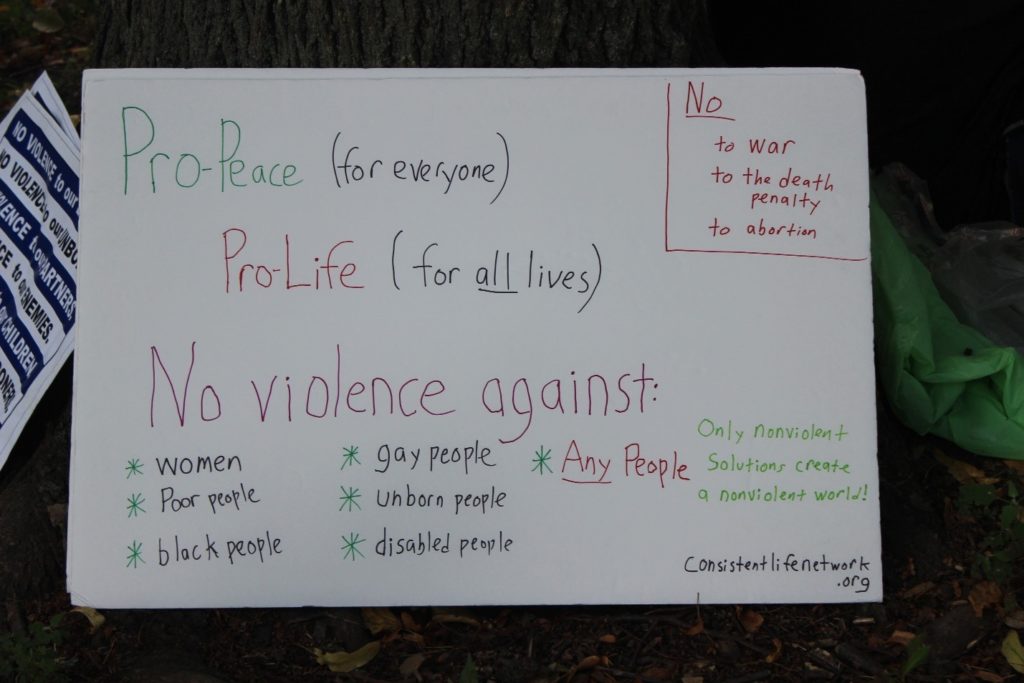
Rob’s sign
In all, I probably only gave out 100 cards or so, less than I would have liked, but I gained some very valuable skills. This was my first time leafleting (for anything!) I’m not usually an especially outgoing person in crowds, but I learned the groove and felt very confident by the time I needed to go home. I can do it.
Inconsistency Sabotages the Peace Movement
Reminder: The Consistent Life Network’s blog is for the airing of a wide variety of views connected to the consistent life ethic. Therefore, the views are those of the author and not necessarily of the organization. Political elections are especially likely to elicit sharply differing perspectives from consistent-lifers.
On the Occasion of the 2016 U.S. Democrat Party Convention
by Rachel MacNair
There are many reasons to think Donald Trump’s electability is low. The alienation he causes is deep, including among conservatives who normally are comfortable voting Republican (see for example columns of Ross Douthat, David Brooks, George Will, and the National Review). Still, as long as he’s on the ballot, Trump winning possible, as polling is showing (though it’s not normally reliable until after Labor Day).
Several endorsers of the Consistent Life Mission Statement have signed on to an open letter entitled “Called to Resist Bigotry,” documenting that we have a candidate who’s far more problematic than usual.
What about Single-Issue Abortion Opponents?
I know from two recent pro-life conferences that many pro-life activists that Trump’s nomination is a harmful turn of events. So why might single-issue pro-lifers still vote for him?
Reason 1: The Supreme Court
The U.S. Supreme Court has become a political football ever since it made a political decision in Roe v. Wade, taking the decision regarding abortion laws away from the state legislatures and taking away the right of the citizenry – including women who’ve had abortions – to petition their legislatures for a redress of their grievances.
Roe was a profound betrayal of democracy. The struggle to restore democratic debate, rather than imposition of top-down policy preferences, by elite judges who are out of touch with the harsh realities of abortion, is not a minor thing. Of course, even having the very right to life of human beings subject to democratic debate is a problem, since it should be a given. But at least that would be an improvement over the current intolerable elitist situation.
Trump knows the Supreme Court justice issue is crucial to a large portion of voters, which is why he’s already released his short list of names he might appoint to the U.S. Supreme Court, ones who may be anti-Roe. And even if he’s unreliable on doing what he said he would – he actually prides himself on being unreliable – at least he might still appoint one of those. And he might fight for their ratification, and not decide to negotiate them away in a deal.
But Clinton can be pretty well counted on to appoint judges that will strengthen Roe for decades.
(Neither candidate, of course, is likely to appoint consistent-life judges, which is what we naturally advocate for, but I’m discussing the reasoning of single-issue voters).
Reason 2: Fear of Clinton
Aside from court appointments, what could happen under Clinton?
- There are many things a president can do to block or water down good legislation.
- She could work hard to promote what from our point of view is bad legislation; she would be in an ideal situation to do so, and her strong advocacy indicates that she’s so inclined.
- Executive orders could be issued or maintained, such as pushing abortion legalization on other countries that accept U.S. aid.
- There have been fears that pro-life voices will be squelched under the idea that they’re “hate speech.”
We’ll be hearing much more of these and similar fears through the course of the election. The fears of what could happen under Clinton are very real.
Reason 3: The Closed Mind of Democrats
Democrats have gotten so they won’t give pro-lifers, including pro-life Democrats, a hearing at all. Many are the times when we can’t even avoid being insulted in the most shocking and unfair terms. Much as what Trump gives may be only lip service, he at least gives that much. Occasionally. Some pro-lifers have a sense that they can meet with him and educate him in a way that’s utterly blocked out for Clinton.
This goes beyond the abortion issue itself. Being closed-minded on any topic is not likely to be healthy.
If Trump Wins?
As usual, abortion defenders would blame pro-lifers for any pro-war and otherwise violent policies that Trump implements. This fits their stereotypes, and it’s a long-standing habit. The exit polls may well back them up on this, for the reasons stated above.
But if progressive people had advocated pro-life principles all these years, then this wouldn’t have happened. Tender-hearted people have been told their concerns for the lives of little babies aren’t welcome in many progressive circles. Therefore, they are told, those concerns must be taken elsewhere. Pro-lifers have been chased off. Not merely people whose only concern is abortion, but pro-life peace advocates have been chased off – see, for instance, how the Mobilization for Survival, supposedly a coalition of groups focused on the arms race, rejected the membership of our predecessor group, Pro-lifers for Survival.
As Mary Meehan put it in a classic 1980 article entitled The Left Has Betrayed the Sanctity of Life:
“If much of the leadership of the pro-life movement is right-wing, that is due largely to the default of the Left. We ‘little people’ who marched against the war and now march against abortion would like to see leaders of the Left speaking out on behalf of the unborn. But we see only a few . . . We are dismayed by their inconsistency. And we are not impressed by arguments that we should work and vote for them because they are good on such issues as food stamps and medical care.”
What if peace and justice advocates had included advocacy for nonviolent solutions for unintended pregnancies? If they had included the well-being of unborn babies, their mothers, families, and communities in their peace-and-justice concerns all along, then the politicians who oppose a peace agenda wouldn’t have been able to gain the foothold they have.
This is what we’ve been saying for years, and is now as urgent as ever: the inconsistency of many peace folks on abortion is causing great damage to other issues of peace and justice.
The solution is to be consistent instead. This is sound strategy on behalf of all peace issues: the more peace activists do this, the quicker we’ll make progress on everything.
Varieties of Hawk: Clinton v. Trump on Foreign Policy
Reminder: The Consistent Life Network’s blog is for the airing of a wide variety of views connected to the consistent life ethic. Therefore, the views are those of the author and not necessarily of the organization. Political elections are especially likely to elicit sharply differing perspectives from consistent-lifers.
by John Whitehead

John Whitehead
For an American peace advocate, the two major political parties rarely offer appealing candidates in a presidential election. The 2016 election is no exception to this rule. Both Hillary Clinton and Donald Trump, the presumptive nominees for the Democratic and Republican Parties, respectively, seem dedicated to the continued use of American military force around the world. However they might differ in other respects, on foreign policy both take a hawkish stance.
Hillary Clinton’s many years in public office have given her a substantial record of hawkish decisions. During her eight years in the Senate, Clinton voted in favor of the broadly worded authorization to use military force in response to the September 11th, 2001, terrorist attacks. This vote led to the 2001 invasion of Afghanistan. She also voted to authorize military force in Iraq, leading to the invasion of that country in 2003. As Barack Obama’s secretary of state, Clinton was the leading foreign policy official during the administration’s escalation of American involvement in Afghanistan, the targeted killing campaign against alleged terrorists, and the Libyan war.
In the case of the Libyan intervention, media reports indicate that Clinton played a prominent role in shaping the administration’s policy: a dubious distinction in light of how the overthrow of Libyan dictator Muammar Qaddafi led to civil war and chaos in the country. Clinton’s foreign policy aide Jake Sullivan described her as being “a critical voice on Libya in administration deliberations, at NATO, and in contact group meetings—as well as the public face of the U.S. effort in Libya. She was instrumental in securing the authorization, building the coalition, and tightening the noose around Qadhafi [sic] and his regime.”
Other statements from former colleagues about Clinton are similarly worrying. Dennis Ross, who served on the National Security Council during Clinton’s tenure as secretary of state, commented, “It’s not that she’s quick to use force, but her basic instincts are governed more by the uses of hard power.” Anne-Marie Slaughter, who served under Clinton as director of State Department Policy Planning, commented “when the choice is between action and inaction, and you’ve got risks in either direction, which you often do, [Clinton would] rather be caught trying.” While some might consider Slaughter’s statement a testimonial to decisiveness, those who wish to see an end to American wars should be concerned by the prospect of a commander-in-chief whose default preference is for “action,” even in the face of risk.
In contrast to Clinton’s substantial public record, Donald Trump’s lack of prior service in public office leaves no guide to his foreign policy stance apart from his public statements—a poor basis for judgment, even when a presidential candidate less mercurial than Trump is concerned. For whatever they are worth, however, Trump’s statements indicate a hawkishness comparable to Clinton’s.
Despite recent claims to have opposed the Iraq War, Trump’s statements on that conflict in 2002-2003 show his position to have been simply a muddle: he once expressed vague support for the war that gave way to equally vague criticisms. Trump’s position on the Libyan war has been similarly confused, moving from support to opposition to support again. His attitude toward the Afghan war is not much clearer. Whatever else these shifting positions demonstrate, they do not show a firm commitment to peace.
Moreover, during his presidential campaign, Trump has infamously made that should alarm peace advocates. He has torturing members of ISIS through techniques such as waterboarding. Trump has also repeatedly called for killing terrorists’ families. The overall impression left by Trump’s public utterances is of a candidate willing to use military force ruthlessly and recklessly.
The choice between Trump and Clinton is a demoralizing one for someone committed to peace and an end to hawkish foreign policies. This choice becomes even more dismaying, however, when viewed in the context of recent electoral history.
Barack Obama has hardly been a dovish president, but peace advocates could at least take some satisfaction in his opposition, while still an Illinois state senator, to the Iraq War. In 2008, this opposition made him more appealing, for many Democratic voters, than Hillary Clinton and contributed to Obama winning the Democratic nomination that year. Obama appeared to be, if not a genuine “peace candidate,” at least less hawkish than Clinton—and of course he appeared considerably less hawkish than George W. Bush. A kind of incrementalism in foreign policy seemed plausible in this context: the Democratic president elected in 2008 was less hawkish than the alternatives and perhaps his successor would be less hawkish still and so American foreign policy could be nudged along in the direction favored by peace advocates.
Yet after eight years of Barack Obama, peace advocates find themselves presented with major party candidates who are both more hawkish than Obama. The apparent incremental progress toward peace under Obama seems to be slipping away in light of the current choices. This should make peace advocates, including those who support a consistent ethic of life, wary of an incrementalism that accepts hawkish candidates because they are somewhat less hawkish than the alternative. Such a strategy might not lead to net improvements in American foreign policy in the long term.

Tom Taylor (left) and John Whitehead (right) holding our banner at the March for Life 2016
Consistent life ethic advocates, and others who care about peace, should consider more radical approaches than choosing the less hawkish major party option. One alternative is to put far less emphasis on precisely who occupies the office of president and instead advocate for reducing the overall power and importance of the presidency as an institution. The tremendous concentration of power, particularly the power of the national security establishment, in a single person’s hands may be far more decisive in shaping foreign policy than the political party to which that excessively powerful person belongs.
Another, non-exclusive, alternative is to renew the peace movement at the grassroots, building an energetic, vocal lobby against war and the national security establishment. If such a lobby constantly challenged hawkish policies when pursued by politicians of either major party, this might serve to change the larger political context in which those politicians operate. A more dovish foreign policy consensus shaped by such a lobby could create better electoral options than “hawkish” and “slightly less hawkish.” Such a cross-partisan goal would also fit in well with the larger cross-partisan philosophy and mission of he consistent life ethic.
Mourning After & Hoping for the Future, We Call for a Consistent Life Texas!
Mourning After & Hoping for the Future, We Call for a Consistent Life Texas!
Thad Crouch (speaking of himself in the third person) offers this report:
Mourning after the Supreme Court of the U.S. (SCOTUS) overturned two of four provisions of Texas law on medical regulations for abortion clinics —while also looking hopefully at two Texas death penalty cases that SCOTUS has accepted for review— the Consistent Life Network (CLN) was joined by spokes persons from a regional Pro-Life group, a state-wide peace group, and a “pro-lifetime” state senator in calling for Texas to become a consistent life state.
On June 28th, the morning after the SCOTUS abortion ruling on the Texas HB2 abortion law, Thad Crouch, CLN board member, facilitated a press conference on the south lawn of the Texas State Capitol. Heather Gardner, executive director of the Central Texas Coalition for Life was the main speaker on abortion while Crouch represented Pax Christi Texas to speak on the death penalty.

Heather Gardner and Thad Crouch at Texas state capitol
Texas State Senator Eddie Lucio, Jr, of District 27 was scheduled to speak, but had to cancel for an urgent matter and issued a written statement. Lucio is known as the Texas “pro-lifetime” senator because he consistently votes in support of both the pro-life cause and issues concerning care for the living, such as funding health services for women and expanding adoption. He also wrote the 2005 “Life Without Parole” law to limit use of the Texas death penalty.
Crouch pointed out that the culture of death categorizes abortion as an issue of reproductive rights, women’s rights, and human rights, and speaks of the death penalty as solely a criminal justice issue, while CLN places both into the context of violence along with war, euthanasia, racism, and extreme poverty.
Senator Lucio’s statement included these words:
“As a pro-lifetime Senator, I remain steadfast in my belief in the sanctity of life. Because God, our Creator, created us in His image, my Catholic faith guides me to support policies that nurture, care for and protect all life — from conception to birth to natural death. This includes the life of the born and the unborn. . . . As a Christian, I pray that we never have the occasion of having the life of a woman be put at risk due to substandard facility conditions while undertaking an invasive medical procedure, such as a surgical abortion. I pray that the life of women is never — ever — put at risk if serious complications ever arise.”
Gardner has trained over 1,500 side walk counselors to help women in crisis pregnancies find loving alternatives to abortion. She explained that while the two provisions of HB2 that require FDA standards for administering abortion drugs and limit Texas abortions to 20 weeks remain in force, SCOTUS struck down provisions that required abortion clinic facilities to meet the standards of ambulatory surgical centers and required their physicians to have admitting privileges at nearby hospitals. She is very concerned for the safety of women after SCOTUS granted the abortion industry a pass from those standards to which other Texas surgical centers must adhere.
She asked “Why are low-income women being treated as second class citizens?”
Gardner noted that Whole Woman’s Health, the very abortion clinic which brought HB2 to court, has itself failed health inspections for numerous reasons, including unsanitary rusty instruments that go inside women’s bodies.
To show that the pro-life movement is much broader than the right-wing-Christian-only stereotype, CLN quoted statements from several of our member groups who responded to the SCOTUS ruling, such as Secular Pro-Life, Feminists For Life, All Our Lives and Democrats for Life as well as our friends at New Wave Feminists. Crouch then asked why the pro-choice movement opposed this law when their leaders keep saying they want abortion to be “safe, rare, and legal.” He invited pro-choice people to send him comments with their ideas to make abortion safer and more rare—including ideas to make society more just towards women.
Gardner responded to Crouch’s question about making abortion safe by pointing out that while pro-choice Texans opposed HB2, she actually did met some pro-choicers in favor of HB2 in 2013 when she was present at the Capitol while the bill was being debated by the Texas legislature. She explained that many former abortion clinic workers had conflicted consciences when they pointed out unsanitary conditions at clinics and their supervisors prioritized completing abortions above the health and safety of women.
Gardner has many friends who are former abortion clinic workers, due her role as a volunteer advocate for And Then There Were None (ATTN), an organization that helps clinic workers leave the abortion industry and heal their Perpetration-Induced Traumatic Stress or their moral injury.
As a matter of fact, when Abby Johnson, the founder of ATTN, left the abortion industry, it was Gardner whom she came to first. The Coalition for Life trains sidewalk counselors to be prayerful, friendly, gentle, and approachable, while offering help to both clinic patients and workers. This way of being of service outside abortion clinics has proven far more effective than carrying signs with scary pictures and being loud and angry. ATTN has so far helped over 150 clinic workers leave the abortion industry.
Responding to “making abortion rare,” Gardner relayed that while many abortion clinic workers truly do want to make abortion rare, the industry does not. Abby Johnson wrote in her book, Unplanned, that her supervisor ordered her to increase the abortion numbers at her clinic because “nonprofit is a tax status, not a business status.”
Gardner then articulated a connection between consistent life stands on abortion and the death penalty by reflecting on friendships she has with former abortion clinic workers. She pointed out that while some people make very bad decisions and harmful actions, even to kill people, “we condemn those actions, but there are people behind those actions.” Further she said, “We have an issue with our justice system that needs to be addressed and the solution is not to kill people.”
Speaking for Pax Christi Texas (PCT), a Catholic group which promotes justice and nonviolent peacemaking, Crouch called the death penalty an important life issue for Texas, which has executed more people than any other state. Further PCT called the death penalty flawed, unnecessary and expensive. Crouch said PCT prays for the victims of crime and their loved ones. He pointed out that Pope St. John Paul II changed the Catholic teaching on the death penalty so that the gravity of the crime is actually not a consideration, but rather the considerations are the sanctity & dignity of life for both the public and the criminal and the common good.
Crouch then told the story of Bishop Daniel Garcia, the auxiliary bishop of the Austin Diocese, meeting Pope Francis at Papal mass on the border of the United States and Mexico. When Bishop Garcia said he was from Austin, Pope Francis said, “Austin, Texas!?! Don’t give up the fight to end the death penalty in Texas!” In May, Bishop Garcia passed that same imperative to PCT and the Respect Life Ministry at St. Ignatius Martyr Catholic parish in Austin when the two groups met with him to discuss this life issue.
Crouch said it broke his heart that when the Pope thinks of Texas he doesn’t think of cowboys, rodeos, or brisket, but the death penalty.
He requested that those who stand for life by working to end the death penalty open their hearts to the possibility of extending their empathy to the lives of the unborn by considering that abortion is a torturous death.
Speaking once again as CLN, Crouch invited Texans to create a consistent life Texas that was consistently pro-life on both abortion and the death penalty:.
“If we merely see only most people as having lives of value worth protecting, and just one category of people whose lives we think are of less value, or don’t deserve protection—whether that’s because of nationality, politics, race, or religion, or whether or not it’s because someone was convicted of a terrible crime, or whether or not they’ve been born yet, or whether they are terminally ill, or whether they are in extreme poverty— if we have just one category the we think is not worth protecting, then we have something in common with the Orlando shooter.”
“Seamless Garment” — Poem by Daniel Berrigan
The beauty of the “seamless garment” image!
No one, not one
exposed to the rude winds of the world,
No one, however lorn or lost, out in the cold.
No one rejected, no one unwanted!
the unborn, the aged, ill, condemned,
the expendable, “lives of no worth”-
no matter the tag,
everyone matters!
If these are expendable, who is precious?
No one is expendable!
Everyone wrapped in a vast enfolding embrace,
a garment designed by God
bequeathed to us we
wear it proudly, tend it, repair it,
cherish it, design it anew,
yes, lend it , offer it everywhere!
a baptismal robe for the twice-born,
the woof and warp of our humanity!
See more on the consistent life of Daniel Berrigan
Reminiscing on the Founding Meeting of the Consistent Life Network
by Carol Crossed
Twenty-nine years ago, March 1987, Consistent Life was born. Patti Narciso and Scott Rains, directors of ProLifers for Survival, affectionately called PS, were the spiritual parents of what was to become and is today, the consistent life ethic movement.
It began as The Seamless Garment Network. Former PS coordinator Mary Rider returned from graduate school to help Scott and Patti, and about 25 people were invited to Chapel Hill, North Carolina, compliments of a LifeWorks grant. The purpose of the gathering was to determine the fate of ProLifers for Survival, an organization that connected the issues of war and abortion. The inspiration for PS had grown out of the discord of single issue politics at a conference of Mobilization for Survival in Washington DC in 1980. MfS was an anti-nuclear war network of more than 65 organizations which was unable to agree on PS becoming a member group.
I still do not know who gave the LifeWorks grant. So being on the Chapel Hill invitation list was like being in an Agatha Christi novel. I heard that Rachel MacNair was invited and that’s all it took for me to mark the 3 days on my calendar. She was an heretofore affinity mate, albeit an anonymous one, from my first experience with her writings about how feminism and abortion rights was a disconnect.
I discovered other luminaries in the peace and justice movement that weekend: Fr. Joseph Nangle, the missionary from Peru who had introduced me to liberation theology in the late 70’s; Ken Maher, a Quaker and conscientious objector; Mary Meehan, anti-Vietnam War activist and author; Catherine Holderread Passmore, Mennonite and film producer; Andy Lipscomb, leader with the Committee of Southern Churchmen. Andy, in his thick Georgia drawl, kept saying profound things, like ‘PS is a keeper’. Juli Loesch, founder of PS, kept us laughing with stories about how she hosted anti-war discussion groups which she called nuclear Tupperware parties.

What began as an intimidating experience for me, ended as a bonding of brothers and sisters who reached down inside my soul and brought up a vision so powerful that my life would never be the same. I was not changed. It’s just that they exposed for me who I was all along and said that was okay.
It wasn’t until we were about ready to go home that The Seamless Garment Network was birthed. The 2 days of discussion were the labor pains necessary for us to realize that it wasn’t enough to be only against the violence of war and abortion, but we needed to expand into the issues of economic injustice, capital punishment, the arms race, and euthanasia. Just like you can look at a child and know its name, we knew our name with not a vote, but with a burst of applause: The Seamless Garment Network. We wrapped ourselves into the cloak of seamlessness, embracing a holistic ethic without political fragmentation or ideological division.
We added racism to our mission in 1993, in response to Rodney King and racial violence. And in 2002, we changed our name to Consistent Life: a Network of Peace, Justice and Life. It was more than our not wanting to answer those numerous solicitations to the Garment Workers Union of America. The name change unraveled the complexities of maneuvering an explanation about symbolism to explain our identity.
We were not and are not a symbol. Today we are over 200 organizations that live and breathe connectedness. We give groups and individuals permission to come out of the stereotypical shadow of partisanship. We allow them to come into the light of social wholeness.
Photo above: Front Row: Cathryn Passmore, Ann McCarthy, Carol Crossed, Rachel MacNair, Scott Raines. Middle row: Martha Yonke (?), Julie Loesch (now Julianne Wiley), Kathy Hayes (?), Faye Kunce, Mary Rider, Mary Meehan and (?). Top row: Kathy H. or Martha (?), Ken Maher, Andy Lipscomb, Joe Nangle, Jack Smalligan, 2 unknowns.
====================================================================
For more blog posts on the history of the consistent life ethic, see:
First Stirrings in Connecting the Life Issues
The Consistent Life Consensus in Ancient Christianity
Ancient Roots of the Consistent Life Ethic: Greece
The Adventures of Prolifers for Survival: Scorned by Mobilization for Survival
Celebrating the Life of Daniel Berrigan

Daniel Berrigan died April 30, 2016, just days before his 95th birthday, from natural causes. We celebrate the long life of this effective consistent-life advocate. Most famous for his long-lasting anti-war activism and many books and poetry on peace and social justice, we always knew him as a dear friend.
Dan and Consistent-Life Activism
Dan was involved in two direct actions in upstate New York that involved both abortion clinics and military weapons facilities. The group was Faith and Resistance, an organization that had an annual pilgrimage to killing centers near Rochester. Berrigan was the keynote for two of these pilgrimages, May 1989 and October 1991.
Carol Crossed reports: “I knew Dan through our mutual nuclear disarmament civil disobedience on the 40th and 50th anniversaries of Hiroshima/Nagasaki. In the fall of 1988, I visited him unannounced at his apartment in New York. He wasn’t home, and so I sat outside his door for several hours, waiting for him to show up. Upon his return, he said he had been visiting AIDS patients at the hospital and asked me to come in for a cup of tea. With trepidation, I asked him if he would lead a Faith and Resistance pilgrimage, protesting a military center and an abortion center on the same day. He said he wondered why he hadn’t been asked before, and quietly said as he sipped his last drop, ‘It’s just my cup of tea.’”
Carol continues: “Within the next two years, Dan sat in at Highland Hospital, Rochester NY, the Seneca Army Depot in Romulus NY, at Planned Parenthood and at the Federal Building in Rochester NY. At the sites, Dan spoke about the spirituality of geography: being present where killing was occurring was necessary to absorb the evil.”

October 27, 1991, Daniel Berrigan sits in to protest Planned Parenthood abortions, soon to be arrested for doing so. Photo from Rochester’s “City” newspaper.
Berrigan Remembrances Include his Consistent Stand
A lengthy obituary in the National Catholic Reporter says: “Berrigan received criticism from the political left for his pro-life views. He was a longtime endorser of the ‘consistent life ethic,’ and he served on the advisory board of Consistent Life, an organization that describes itself as ‘committed to the protection of life, which is threatened in today’s world by war, abortion, poverty, racism, capital punishment and euthanasia.’ “I have always made it clear,” Berrigan said in the America interview, “that I am against everything from war to abortion to euthanasia.”
In their obituary on May 1, 2016, Crux magazine noted: “Despite his image as a radical leftist, Berrigan was also an outspoken opponent of abortion. During a 1984 talk at a Catholic parish in the Archdiocese of Milwaukee, Berrigan denounced what he called a ‘theory of allowable murder’ in contemporary society. Christians should have no part in ‘abortion, war, paying taxes for war, or disposing of people on death row or warehousing the aged,’ Berrigan said on that occasion.”
Crux followed up the next day in a May 2 Crux article on how he embodied the “cultural revolution” of Pope Francis: “nowhere does Berrigan write his theology more clearly than in the area of the consistent ethic of life. Through his activism and writing, Berrigan was abundantly clear that this consistency meant opposing the ‘culture of death’ universally on a range of issues as diverse as war, the death penalty, euthanasia, poverty, and abortion. Why? Precisely because he didn’t consider those to be diverse issues at all. They all dealt with killing God’s creatures. That, Berrigan said in the bluntest way possible, is a sin.”
Quotations from Daniel Berrigan
Reflections (Amherst, Mass.), vol. 2, no. 4 (Fall 1979), 1-2.
I come to the abortion question by way of a long, long experience with the military and the mainline violence of the culture, expressed in war . . . So I go from the Pentagon and being arrested there, to the cancer hospital, and then I think of abortion clinics, and I see an “interlocking directorate” of death that binds the whole culture. That is, an unspoken agreement that we will solve our problems by killing people in various ways; a declaration that certain people are expendable, outside the pale. . . A decent society should no more have an abortion clinic than the Pentagon.”
Signing a 2007 online petition in opposition to Amnesty International’s move to endorse abortion as a “right”:
My moral conviction on abortion and the rights of the unborn are more serious than “a point of view” . . . It’s as close to my conscience as war and the death penalty.
=====================================================================
See the poem Daniel wrote entitled “The Seamless Garment“