Sharon Long: My Personal Pro-Life Journey
by Sharon Long

Sharon Long in the early years
I am a liberal. I believe in a comprehensive government funded social welfare network, national health insurance, more spending on foreign aid, a reduced military budget. I am also a liberal Jew. I believe in a symbolic interpretation of the Bible and support women’s equality within Judaism.
I am also a right-to-lifer and have been very active in fighting to make abortion illegal and to prevent women from having abortions for close to thirty years.
My opinion of abortion first developed in my 10th grade health class, about a year after the Roe v Wade Supreme Court decision legalizing abortion nationwide. After learning inaccurate information, I decided that a fetus became a human being at about 12 weeks of pregnancy. Therefore, abortion on demand should be permitted before then. I could not understand why I saw “Abortion is murder” bumper stickers or why another student wanted to start a pro-life group in my high school.
However, I began doing some volunteer work in a local veteran’s hospital and I began to think about what gave life meaning and purpose. Did I believe that the people for whom I was caring, so debilitated mentally and physically, as well as so dependent, truly had lives worth living? Later, I worked summers as a nurse’s aide in a nursing home and continued debating these questions within myself.
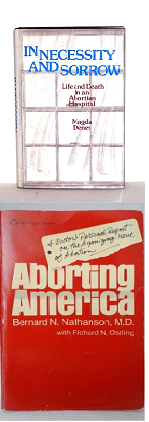 In the summer after my sophomore year in college, while working at a nursing home, I was fortunate to find at my small town library two of the books that have made the most impact on my life. One was In Necessity and Sorrow by Magda Denes, a psychologist observing what went on in an abortion clinic. The book provided graphic descriptions of aborted fetuses as well as interviews with the women having abortions, most of whom felt forced into the abortion because of circumstances. The other was Aborting America by Dr. Bernard Nathanson, an atheist gynecologist of Jewish ethnicity. He was the medical director of one of the first free-standing abortion centers in the country and had also been a leader in the abortion rights movement. He described how he had become pro-life through his study of fetal development and ultrasound in a very dispassionate and rational way that made sense to me. I continued to wonder where the line could be drawn in fetal development as to when a human life became a person. I also wondered when in the continuum of human life did a human being stop being a person?
I viscerally knew that the lives of my nursing home patients had meaning and purpose. My patients, regardless of how “useless” they might be in the eyes of society or even their own eyes, were of infinite value and worth, that is, they were sacred by virtue of being human.
I asked myself, if I believed in personhood at the end of life, then logically what should my belief be as to the value of the fetus?
The answer was clear. If life that was debilitated and dependent at the end of life was sacred then human life at its beginning must also be sacred. A fetus, regardless of the value conferred upon it by others, had to be a person.
I became a reluctant pro-lifer.
I could hardly believe it myself. I was liberal and hip. I went to a feminist women’s college. How could I not believe that a woman had a right to control her own body under all circumstances, and that the right to control one’s own body was the right on which all other rights were based, as I was told over and over? How could I be so politically incorrect?
In my junior year of college 1979 I went to Costa Rica where I first heard about liberation theology, which combined Catholic theology with a Marxist economic analysis. I will never forget the college debate between the feminist group on campus and the Catholic group. The Catholic debater said immediately that this was not about theology. The issue to be debated with feminists was not about whether fetuses had souls.
Instead, the issue was about whether abortion helped women advance in society. The debater explained that abortion does nothing to solve any social problem or advance the rights of women in any way. What it does do is enable society to maintain the status quo by forcing women to kill children rather than require social, economic, and political change to enable society to support them.
I thought, “That makes so much sense!”
While in Costa Rica I worked in a refugee center during the Nicaraguan civil war where I saw pregnant women who would not consider abortion. They considered having a baby as an act of defiance against oppression– that although they were refugees, they were still entitled to have children and extend their legacy.
Although it may have been more politically correct to be a pro-life progressive in Costa Rica it remained a problem when I returned to the U.S. I stayed in the closet about my pro-life beliefs until I was 25 and saw what abortion was doing to my friends. I saw how trapped they felt into having abortions and the lingering grief afterwards.
After this happened several times I decided that I was through with being politically correct. I called the National Right to Life Committee and said that I was a liberal but I was pro-life–was there anything out there for me? The person on the other end of the line chuckled as she referred me to Feminists for Life.
FFL sent me pamphlets that blew me away, especially those by Rosemary Bottcher and Elise Rose explaining how abortion maintains women’s oppression in society and does nothing but maintain the status quo. Rather than meeting the real needs of women and children we offer abortion. I asked myself, “Where have you, that is, Feminists for Life, been all my life?”
I also went to volunteer at the city’s crisis pregnancy center. I said to the middle-aged rosary-toting ladies that I lived with my boyfriend and used birth control but that their cause was my cause and I was with them. After some discussion among themselves (I later found out) they said, “Welcome aboard,” for which I will always be grateful.
Soon the right-to-life movement and pro-life feminism became the center of my life. I involved myself with many pro-life organizations, some progressive, some not. I wrote and spoke on pro-life feminism at every opportunity. I traveled all over the country attending conferences. I joined the executive board of Feminists for Life. I volunteered at crisis pregnancy centers. I contributed thousands of dollars and hours to the pro-life movement. Most of my close friends were pro-lifers. I bored my family by talking about it so much.
I also became a caseworker in child support enforcement. Although I could have earned double the salary as a nurse, I believed that I was preventing abortion. In addition, I was empowering women by enabling women to fight for the resources they needed to care for themselves and their children.
I frequently felt culturally alienated in many pro-life circles, sometimes very painfully so, but I have found in general that pro-lifers are more tolerant of progressives than progressives are tolerant of pro-lifers.
My romantic life was another story. I felt compelled to tell men immediately that I was pro-life. I knew that this was not just theory. My refusal to have an abortion should I be faced with an unplanned pregnancy would have very serious implications in a relationship.
Needless to say, I had many boyfriendless times in my life. Men with whom I might otherwise have a lot in common were frightened by someone who would not consider abortion as a backup. Even the few who were privately sympathetic did not want to be associated with a public right-to-lifer.
Why was I willing to make such sacrifices? Why did I stay so involved in the movement? I was angry. I became furious at ads for abortion that I believed preyed on the panicked and the vulnerable. I saw the genocide of the unborn that was happening in my own country and how it was directly caused to the exploitation of women and the impoverished.
However, through the years my anger slowly began to cool. Maybe it was my weariness with the constant stories I heard about women’s economic and relational oppression in my child support enforcement job. Maybe it was the lack of success pro-lifers were having in the political arena of my state (New York). Maybe it was that on the national level we seemed to be only putting out fires and treading water. Maybe it was the shift to the right of some of my beloved pro-life organizations. But eventually my anger turned to resignation.
Although I had known all along that pro-lifers’ only real enemies were the economy and the culture, I had believed that the law would act as teaching tool. A change in the law would help change the culture and force economic and social welfare policy changes which would empower women to have and raise their children.
Initially I, along with many others, had fought like crazy because I believed that time was running out. I knew that the longer that abortion remained legal, the longer it would become entrenched in our culture. It would therefore become difficult to decrease abortion even if it did become illegal.
I believe that time has now run out, at least in the northeast United States. Making abortion illegal will not make it unacceptable in the short or even in the long run anymore. Just changing the law at this point in time will not substantially decrease abortion.
I now believe that the abortion fight should be handled like the fight against smoking, also another important pro-life issue. It took a massive thirty-year advertising campaign, still ongoing, along with every possible support, such as free smoking patches and support groups, as well as gradual legal restrictions, to reach the point where smoking has become abhorred in our culture. The only way to end abortion is to follow the same strategy.
If we enabled women to have real choices, choices that do not pit their survival against the survival of their children, very few would choose abortions. This will require a massive investment in government services and a very focused and aggressive advertising campaign. Neither political party right now has the will to do this. However, if we work with others who are interested in human and economic rights issues, and especially those who wish to empower women and poor people, we may have a chance.
Ultimately the root cause of abortion is alienation, which sociologists define as powerlessness. After close to thirty years in the pro-life movement I have spiritually come full circle, reuniting with my progressive community. By uniting with everyone, including those who disagree with us, to empower women and achieve a more just society, we will liberate not only pregnant women but ourselves as well.
Editor’s note: Part of this article is slightly revised and republished from The American Feminist with permission from Feminists for Life of America. All rights reserved.
============================================
For more blog posts on personal journeys, see:
Supporting the Dignity of Every Life (Bill Samuel)
Nukes and the Pro-Life Christian: A Conservative Takes a Second Look at the Morality of Nuclear Weapons (Karen Swallow Prior)
Coming to Peace and Living a Consistent Life After Military Service
Off the Fence and Taking My Stand on Abortion (Mary Liepold)
On Being a Consistent Chimera (Rob Arner)
Movie Review: Mothers and Daughters
by Mary Bennett
 Mothers and Daughters boasts an impressive ensemble of stars, including Susan Sarandon, Sharon Stone, Christina Ricci, Courtney Cox, Mira Sovino, and Selma Blair. It features interconnected stories based on the theme of motherhood – complete with the trials, heartache, and rich reward that accompany it.
Rigby Gray (Selma Blair) is a photographer whose voice narration attempts to serve as a connective element throughout the movie. Gray is a single photographer who’s at a career high when she finds herself pregnant and alone, recently dumped by her boyfriend who decides to give his marriage another try.
As a single immersed in her career, Gray initially turns her thoughts to abortion, feeling it is her best option. She has a consultation with her doctor and decides to schedule an abortion, only to discover that she is not able to go through with it. Her decision leads to much introspection, giving her a refreshed spirit and enabling her to reexamine her estranged relationship with her own mother, whose health is deteriorating.
The unconditional love a mother feels for her child is never questioned in the movie. This, coupled with the fact that Gray, though pregnant at an inconvenient time and under less than ideal circumstances, decides to keep her child, make this a movie worth watching. However, the movie could have been much more effective and imprinted a longer-lasting impression on the minds of viewers, had there been fewer relationships to follow, and less melodrama to offer distraction.
Ultimately, the fact that Hollywood decides to have Blair’s character embrace her pregnancy (at a time when far too many women choose to terminate) is enough to elicit a recommend for Mothers and Daughters. Yes, much could be improved, but by watching the movie, the audience is reminded of the fragility of life and the rewards that come from respecting life, even when, or perhaps especially when, it seems the most somber and difficult.
===========================================================
See the list of all our blog posts, put in categories.
For a short list of movies intentionally about nonviolence, see a past holiday issue of our weekly updates, Peace & Life Connections. Our Advisory Board member John Whitehead has written an article on movies with anti-war themes in Peacemaking for Life.
Other movies covered in our blog posts:
Hollywood Movie Insights (The Giver, The Whistleblower, and The Ides of March)
The Darkest Hour: “Glorifying” War?
Movies with Racism Themes: Gosnell and The Hate U Give
How Black Panther Promotes a Consistent Life Ethic
Anyone who wants to offer a movie or book review from a consistent-life viewpoint for us to consider for publishing, see the guidelines at the bottom of the list of all our blog posts.
Why the Hyde Amendment Helps Low-Income Women
by Rachel MacNair
In the US, the 40th anniversary of the Hyde amendment’s first passage was September 30, 2016. The amendment is a legislative provision that taxpayers, especially through the Medicaid program, don’t pay for most abortions. Medicaid provides health care for low-income people and goes state-by-state, so when the amendment passed, some states immediately stopped funding, but others continued funding abortions on their own.
Here are several reasons why the impact of the Hyde amendment has been positive:
Abortion funding helps promote racism.
Social worker Erma Clardy Craven points out:
 “It takes little imagination to see that the unborn Black baby is the real object of many abortionists. Except for the privilege of aborting herself, the Black woman and her family must fight for every other social and economic privilege.”
(Hilgers, Thomas W. & Dennis J. Horan, eds. 1972. Abortion and Social Justice. New York: Sheed & Ward)
One of the abortion doctors she has in mind, Edward Allred, was quoted in the San Diego Union, October 12, 1980:
 “When a sullen black woman of 17 or 18 can decide to have a baby and get welfare and food stamps and become a burden to us all, it’s time to stop. In parts of South Los Angeles, having babies for welfare is the only industry the people have.”
Dr. Allred’s aversion to government subsidies did not prevent him from accepting millions in California tax dollars for his abortion practice.
Abortions may cause poverty.
(For a longer explanation including references, see Studies Suggesting Induced Abortion May Increase the Feminization of Poverty)
An increased feminization of poverty – that is, poverty in which women are a larger portion of those afflicted – coincides remarkably closely to the period of increasingly legalized abortion.
Some argued that the availability of abortion should help avoid this phenomenon, with women not losing jobs due to childbirth and having no burdens of child care. But with the pattern worsening during the period when there was an upsurge in abortions, abortion has at the very least been inadequate at solving the problem.
Instead, abortion may be contributing to the problem. Through an increase in broken relationships, psychological difficulties, and substance abuse, a practice which is performed exclusively on women may put them at greater economic disadvantage.
The many studies that show a correlation between abortion and a reduction in women’s economic well-being don’t prove a clear causation. Some argue the causation is in the other direction. It’s not that the abortions cause the difficulties, but that problems with unhealthy sexual relations with men, domestic violence, and similar challenges may cause both the abortions and the subsequent problems that are correlated with them.
However, another causal factor must be taken into account: how much does the ready access to abortion cause the problems of exploitational sexual attitudes and self-righteous denials of responsibility by men?
Medicaid funding of abortion causes abortions.
One study from the research arm of Planned Parenthood showed that women on Medicaid in states which don’t fund abortion in their Medicaid programs have an abortion rate 1.6 times higher than women of higher income. So it’s likely that poverty leads to more abortions, a point that few would be surprised by.
But the same study reports the abortion rate in states with Medicaid funding is 3.9 times higher for women on Medicaid.
As mentioned above, after the Hyde amendment passed, several states stopped funding abortions right away, but others continued to fund abortions for low-income women. This set up a natural experiment: states that had abortion funding one year and didn’t the very next year could be compared to states that kept abortion funding the same.
A review of 38 studies on the impact of Medicaid funding over the years essentially showed that in those states which stopped such funding, both abortions and childbirths went down. In other words, the abortions that didn’t happen because of the lack of funding were not on the whole replaced by women continuing the pregnancies; many of them were replaced by couples taking more care about becoming pregnant.
The assumption behind Medicaid funding has been that pregnancies occur whether or not funding is available, so funding only determines whether those pregnancies continue or not. However, the impact of funding doesn’t appear to be as neutral as people are assuming. This leads to the next point:
Medicaid funding of abortion means government subsidizing of male domination in sexual relationships.
Most of the time, when a person engages in behavior that could lead to a need for a medical procedure, that same person is the one that goes through the procedure. If I don’t brush my teeth, I’m the one who gets cavities. Even if cavity-filling is free of cost in money to me, I’m motivated to avoid it because of the cost in time and unpleasantness.
The same applies for a woman who engages in behavior that can lead to pregnancy. Yet it doesn’t apply to the man who engages in the same behavior. He’s not the one that has to go through surgery.
If he knows the government will take care of the monetary cost, then sex is free to him. It’s government-subsidized. This won’t matter in situations where women have strict control over their own sex lives, but can be devastating in those situations where men have more control or ability to pressure for sex.
Medicaid funding of abortion means government participation in pressure and coercion of women.
From high school counselors and social workers to family members and the unborn child’s father, it’s often true that other people have decided what’s good for a pregnant woman, and aren’t interested in her participation in that conversation. As long as the abortion is government-subsidized, their ability to pressure her – or give her insufficient time to think it over – becomes all the greater.

For more on connections of poverty and racism to both abortion and the death penalty, see chapter 7 of Consistently Opposing Killing: From Abortion to Assisted Suicide, the Death Penalty, and War, published by Praeger in 2008.
For more on the impact of various kinds of abortion restrictions – not only in the US, but world-wide – see Chapter 15 of Peace Psychology Perspectives on Abortion.
================================================
For more of our blog posts on abortion and the law, see:
The Poor Cry Out for Justice, and We Respond with Legalized Abortion

Graciela Olivarez
by Graciela Olivarez, 1972
Commissioner appointed by US President Richard Nixon
from the “Separate Statement of Graciela Olivarez”
in Report of the President’s Commission on Population and the American Future
U.S. Government Printing Office, 1972
To brush aside a separate statement on the issue of abortion on the grounds that it is based on religious or denominational “hang-ups” is to equate abortion—a matter of life and death—with simpler matters of religion such as observance of the Sabbath, dietary restrictions, abstention from coffee and alcoholic beverages, or other similar religious observances. I believe that even nonreligious persons should be concerned with the issue of life and death as it pertains to the unborn. . . .
Advocacy by women for legalized abortion on a national scale is so anti-women’s liberation that it flies in the face of what some of us are trying to accomplish through the women’s movement, namely, equality—equality means an equal sharing of responsibilities by and as men and women. With women already bearing the major burden for the reproductive process, men have never had it so good. Women alone must suffer the consequences of an imperfect contraceptive pill—the blood clots, severe headaches, nausea, edema, etc. Women alone endure the cramping and hemorrhaging from an intrauterine device. No man ever died from an abortion.
[What] kind of future [do] we all have to look forward to if men are excused either morally or legally from their responsibility for participation in the creation of life?
Women should be working to bring men into the camp of responsible parenthood, a responsibility that women have had to shoulder almost alone. Perhaps in our eagerness for equality, we have, in part, contributed to the existing irresponsible attitude some men have toward their relationship to women and to their offspring. Legalized abortion will free those men from worrying about whether they should bear some responsibility for the consequences of sexual experience. In the matter of divorce where children are involved, for instance, very few men fight or even ask for custody of their children. It is customary to measure male responsibility in terms of dollars and cents, rather than in terms of affection, attention, companionship, supervision and warmth.
And laymen are not the only ones who reflect this attitude. Blame must also be placed on churchmen, who throughout the tumult and controversy surrounding legalized abortion, have expressed their concern only as abortion affects the moral and psychological problems of women, adroitly avoiding the issue of man’s responsibility to decisions connected with his role in the reproductive process. . . .
To talk about the “wanted” and the “unwanted” child smacks too much of bigotry and prejudice. Many of us have experienced the sting of being “unwanted” by certain segments of our society. Blacks were “wanted” when they could be kept in slavery. When that ceased, blacks became “unwanted”—in white suburbia, in white schools, in employment. Mexican- American (Chicano) farm laborers were “wanted” when they could be exploited by agribusiness. One usually wants objects and if they turn out to be unsatisfactory, they are returnable. How often have ethnic minorities heard the statement: “If you don’t like it here, why don’t you go back to where you came from?” Human beings are not returnable items. Every individual has his/her rights, not the least of which is the right to life, whether born or unborn. Those with power in our society cannot be allowed to “want” and “unwant” people at will.
I am not impressed or persuaded by those who express concern for the low-income woman who may find herself carrying an unplanned pregnancy and for the future of the unplanned child who may be deprived of the benefits of a full life as a result of the parents’ poverty, because the fact remains that in this affluent nation of ours, pregnant cattle and horses receive better health care than pregnant poor women.
The poor cry out for justice and we respond with legalized abortion. The Commission heard enough expert testimony to the effect that increased education and increased earnings result in lower fertility rates. In the developed countries of the world, declining fertility rates are correlated with growing prosperity, improved educational facilities, and, in general, overall improvement in the standard of living.
But it is not necessary to go beyond our own borders to verify this contention. Current data indicate that the same holds true for minority groups in this country. The higher the education attained by minorities and the broader the opportunities, the lower the fertility rate. . . .
Infant mortality rates are not reduced by killing an unborn child. How sad and incriminating that quality health facilities and services, denied to the poor for lack of money, are being used for performing abortions instead of being utilized for healing of the sick poor. But then, one represents a profit and the other an expense. It is all a matter of values. . . .
If Men Could Get Pregnant
by Rachel MacNair
The “Sacrament”
We’ve recently had the idea of what would happen with abortion if men could get pregnant come up twice. In last week’s blog, Mary Liepold said:
“I still agree with blessed, angry Florynce Kennedy, may she rest in peace, that if men could get pregnant abortion would be a sacrament. That’s consistent with the history of patriarchy in the church and the world.”

In a movie fantasy of male pregnancy, the man yells “My body, my choice” to escape an attempt to abort his pregnancy
But Mary Krane Derr was quoted in the Quotation of the Week for Peace and Life Connections just a few weeks ago:
“It’s been said that if men got pregnant, abortion would be a sacrament. On the contrary: if men got pregnant, pregnancy would be treated as the sacrament; abortion would be considered blasphemy against their sacred bodies and lives and those of their children; and pregnant humans would finally, finally receive the alternatives they deserve instead of what one social activist calls, from bitter experience, the ‘choice’ between ‘abortion or else.’”
(“Pro-Every Life, Pro-Nonviolent Choice”; ProLife Feminism: Yesterday and Today, second edition, p. 375)
I’ll say what my first thought was about the if-men-could-get-pregnant question: of course abortion would then be a sacrament. Men treat war as a sacrament. In days of yore, human sacrifice was literally treated as a sacrament. The perversion of applying sacredness to killing has long been one of the ways such violence has been sustained.
Then, of course, there’s the obvious point that if men could get pregnant, they would be women and not men anymore. The ability to get pregnant is a major part of the definition of what makes each gender each. This has been part of the dynamic of male domination throughout history.
Indeed, men have been regarding women’s abortions as part of men’s own privilege for a long time. Rodney Stark in his book Discovering God discusses the Roman Empire in the first three centuries of the Christian era:
Once married, pagan girls had a substantially lower life expectancy, much of the difference being due to the great prevalence of abortion, which involved barbaric methods in an age without soap, let alone antibiotics. Given the very significant threat to life and the agony of the procedure, one might wonder why pagan women took such risks. They didn’t do so voluntarily. It was men – husbands, lovers, and fathers – who made the decision to abort. It isn’t surprising that a world that gave husbands the right to demand that infant girls be done away with would also give men the right to order their wives, mistresses, or daughters to abort. (p. 321)
An Entirely Different Tack
Yet all of these views take male domination as a starting point. They don’t consider the vision of a world where such domineering is no longer prevalent.
One of the strong links among the many life/peace issues is that domination of any group by any other should cease. We should treat each other as equals. We need to be sensitive to one another. In this case, we must move beyond male domination, and recognize where it’s already fading.
My own son is the soul of gentleness. And check out the tenderness in the photo of my father with me as a baby:

Then multiply that by the millions.
So here I want to make an entirely different answer to the point:
Men do “get” pregnant.
Biologically, the part they do is to help get the pregnancy started. Their contribution there is indispensable, and you can’t get more important than indispensable. And while they’re physically capable of running off and abandoning the pregnancy, and many do, they’re still a psychological hook there. The best men know the value of this.
I had a friend once who, in referring to himself and his wife, talked about the time when “we” were pregnant. My first thought was to be bemused. She was clearly doing all the biological part, everything connected with having the child inside her body. But as I thought more about it, I decided it made perfect sense. He was fully participating.
Some men have had sympathetic physical symptoms. Men have certainly been intimately involved in all kinds of aspects of nurturing and nourishing. While women are capable of doing a pregnancy alone and men aren’t, when the two of them do their pregnancy together, beauty results.
I think this positive vision is the best of all the answers to the “if-men-were-pregnant” idea.
===============================================
For more on men and abortion, see:
What do Men Have to Say on Abortion?
No Combat Experience, No Opinion: Parallels in Pro-bombing and Pro-choice Rhetoric
“The Daily Show” Doesn’t Do Its Homework
Off the Fence and Taking My Stand on Abortion
by Mary Liston Liepold, OSF, Ph.D.

Mary Liepold
I’d been saying for decades that I straddled the fence on the abortion issue. I’m a middle-ground Catholic―definitely not “recovering,” but also not Rome’s most docile daughter. You’d never catch me at a rally for or against. Though I’m a true-blue liberal and I make plenty of donations, I’ve steered clear of Emily’s List and other organizations that take “pro-choice” stands because that single issue just didn’t sit right. It was all fairly abstract for me, though, until one March a few years ago.
All at once abortion became personal, as an option affecting two people I’m very close to. I told them both I’d support them no matter what decision they made, and blessedly, both issues were soon peacefully resolved. But the itch at the back of my brain was still there. I signed up for emails from Consistent Life, a forum for some rare individuals who are passionately pro-life across the life course, opposing both war and abortion. Once in a while I even read one. I know a handful of smart people who occupy that ground. I was still lurking, though―still on the fence.
Then I happened to see the lovely 2011 Canadian film Monsieur Lazhar. M. Lazhar is an Algerian refugee hired by an elementary school principal to replace a teacher who committed suicide―in her classroom during recess. We focus on two of the children, a boy whose childish fib may have fuelled the teacher’s despair and a girl, formerly his friend, who blames the boy. Both children saw the teacher hanging. The principal provides counseling sessions for the whole class, but these children, at least, are still haunted. Lazhar knows that what they need to hear is what none of the adults are willing to tell them: that their former teacher did something wrong.
The children had loved their gentle, troubled teacher. Out of love for her, the counselor and the others refuse to label her despairing act. It doesn’t seem to occur to anyone that they can call it wrong without dishonoring her. So the boy is left to bear the burden until the little girl, and then Lazhar, insists on clarity. He loses his job but she regains her friend.
And watching the movie, my mind was suddenly clear. A dictum flashed back from my catechism days: “Hate the sin and love the sinner.”
Thank you, Lord! I can hate the war and love the warriors, with Paul Chappell and my friend Debbie and many other peace-loving friends and parents and partners and children of soldiers. I can embrace the individual who chooses (or considers) suicide or abortion and leave judgment to a merciful God, while still being clear that a precious and unique life is involved.
Now, having reached this conclusion, I would no more harass women who seek abortions than I would bomb Boeing or spit at a returned soldier. With war and abortion both, my interest is all in education and prevention. Spare me the angels-on-pins arguments about weeks of gestation. I still agree with blessed, angry Florynce Kennedy, may she rest in peace, that if men could get pregnant abortion would be a sacrament. That’s consistent with the history of patriarchy in the church and the world.
I’m going to be a strange, crabby pro-lifer. I will not promise not to scream the next time someone calls fetuses “innocent life,” as though passing through the birth canal destroys innocence and children murdered by our drone attacks are guilty. Come to think of it, I may do a lot of screaming when I meet my new fold, but I’ll make them at least as crazy as they make me. It’s high time we start talking to each other.
Will I be joining the March for Life next year, alongside all those Catholic school kids giddy with the excitement of a day out of class? It seems unlikely, but I won’t rule it out. If I march, I’ll be with Consistent Life, behind a banner that says Life Belongs to God or Life & Dignity for All―No Exceptions. I’ll expect to see the same people on another day vigiling for peace or the environment and against fracking, mourning the victims of the last drone attack, reaching out to the parents of children with severe disabilities and the parents of the next well-armed, mentally ill person who carries out a domestic terror attack. No blame, and no exceptions. I’ll bring my very best listening skills, and we’ll all learn something new.

I’m a pro-lifer for peace and a peacenik for life, and I’m in good company. Get used to it! I don’t have all the answers. And I don’t know where this road will lead. But the ground finally feels firm under my feet.
Bio sketch: Mary Liepold is a Secular Franciscan, a wife, mother, & grandmother, a writer and editor, an avid reader, and an activist. She lives in Silver Spring, MD.
Mary says about this blog entry: “It has an interesting history. A few years ago I paid several hundred dollars for a one-day workshop with an organization dedicated to increasing the roughly 15% share of the public conversation that women’s voices occupy. Their promise was to assign each participant a mentor who would help place a piece on Huffington Post or something of the sort. So I got one, worked up a version of this, and sent it to her. Dead silence, no matter how many times I followed up. I had violated feminist orthodoxy, and she wouldn’t touch it.”
==================================================
For more blog posts on personal journeys, see:
Supporting the Dignity of Every Life (Bill Samuel)
Nukes and the Pro-Life Christian: A Conservative Takes a Second Look at the Morality of Nuclear Weapons (Karen Swallow Prior)
Coming to Peace and Living a Consistent Life After Military Service
Sharon Long: My Personal Pro-life Journey
On Being a Consistent Chimera (Rob Arner)
When “Choice” Itself Hurts the Quality of Life
by Richard Stith
Consistent Life Network board member and Research (non-teaching) Professor of Law
Editor’s note: these ideas are more fully developed in a 2011 paper available for sale, entitled Her Choice, Her Problem: How Having a Choice Can Diminish Family Solidarity.
 Here’s a question about “choice” and abortion, assisted suicide, and voluntary euthanasia: Could the very existence of these options have a negative impact on the legally-authorized choosers, no matter what they choose?
Consider that women who refuse legal abortion may be blamed for their choice by boyfriends, families, employers, and others. Infirm or dying people may find family and other caregivers upset by their refusal to agree to assisted suicide, if it’s available as a legal option.
These are the sorts of overlooked consequences of choice that this blog is about.
How Choice Harms the Chooser
Society sometimes limits choice to stop a choice that’s harmful to the chooser. For example, we might not permit people to sell their organs because they might seriously harm themselves by preferring money to health.
But there’s a second kind of harm that could befall voluntary organ sellers, not from what they choose but from their having been able to choose in the first place. Simply because they had a choice, they may lose support among friends, family, and employers.
Compare the plight of someone who needs expensive and time-consuming special care because of an operation forced on her by an illness – say, cancer surgery – with a person having the same health needs resulting from her free and deliberate choice (not extreme economic necessity) to excise and sell part of her body. Cheerfully-given help for the post-surgery care of the voluntary seller will be less forthcoming, for her sad situation will be said to be her own fault.
This is separate from any evaluation of which choices are good and which are bad. If the sale of one’s organs were legal, someone who refused to sell them could also be blamed for her own voluntary impoverishment. (“Don’t ask me for a loan. You could have a lot more money if you wouldn’t insist on keeping both your kidneys!”) She incurs this blame simply because of having a choice. If organ sale had remained illegal, others would have been more sympathetic to her economic needs.
Even if she made a wise choice in not selling a kidney, her having a choice to sell or not to sell may make some people less sympathetic to her financial plight. This has nothing to do with the paternalistic notion that society should intervene to save people from making unwise choices. Here we (society, the law) cause her harm simply by leaving this choice open. She may be blamed by some no matter what she does.
Care for the most vulnerable among us, those at the beginning of life and those who may be nearing the end of life, requires solidarity. Truly single parenting is nearly impossible; the help of others is needed to bear and raise a child, and solidarity with the child is needed as well. Likewise, the afflictions of age and illness are often too much to bear without family or friends standing in solidarity.
Yet autonomous choices are now being proposed for human life in its initial and final stages. Those choices concern the existence of life itself: “Should I choose abortion or birth?” and “Should I choose assisted suicide?”
But the ability to choose – to undergo or to refuse abortion or suicide – may isolate the chooser. It may leave her without the solidarity she needs to implement her choices. That undercuts real autonomy.
Throughout human history, children have been known to be the consequence of sexual relations between men and women. Both sexes knew they were equally responsible for their children. Contraception didn’t change this; it makes fertilization and birth less likely, but mother and father are still equally responsible if fertilization and birth nevertheless occur.
Elective abortion changes everything. Abortion absolutely prevents the birth of a child. A woman’s free choice for or against abortion breaks the causal link between conception and birth. It matters little what or who caused conception. It matters little that the man involved may have insisted on having unprotected intercourse when the woman didn’t want it. It is she and she alone who finally decides whether the child is to be born.
A grandmother’s “right” to assisted suicide or voluntary euthanasia means that she has been given a way out. So her suffering seems no longer to call for as much family compassion or social support. In choosing to continue living in great dependency, a grandmother may be felt to be deeply selfish, preferring to benefit herself at a heavy cost to her family.
Similarly, social policy planners may reason that the option of voluntary death diminishes any public duty to regulate toxic industries, or to secure health insurance benefits, to decrease the risk of suffering. Even if governmental acts or omissions cause suffering, it may be thought, no duty of solidarity arises where the victim has refused an accessible option of suicide.
How Choice Harms the Life Chosen
Here’s another question: can a life chosen as an option ever have the dignity of a life simply accepted? Does a child a mother once chose not to abort suffer from her having been able to choose otherwise? Does the severely disabled but suicide-rejecting person suffer from having an existence that needs to be justified? Does making choice possible bring a profound change to our perception of the life that is made optional?
Choosing to let a being live confirms a radical domination over that being, like the upraised thumb of a Roman emperor in the Coliseum – when thumbs-down was always possible.

“Pollice Verso” by Jean- Léon Gérôme, 1872; goriest part cropped out.
Public domain in a source country on January 1, 1996 and in the US.
That makes the chooser – and others – less likely to respect the object of choice.
Even if someone ends up being evaluated so highly that one would never choose her death, when an evaluation was required rather than the person simply being accepted for who she is, something very valuable has been lost.
=============================================
For more blog posts from Richard Stith, see:
Open Letter to Fellow Human Rights Activists
Equal Concern for Each Human Being, Not for Each Human Issue
Oppressors of Women Scapegoat Fetuses to Preserve Patriarchy
Courageous Woman: Elizabeth Anscombe (1919-2001)
by Julianne Wiley (a.k.a. Juli Loesch)

Anscombe as a young woman
In the fall of 1939, shortly after Great Britain declared war on Germany, the Royal Air Force was openly promoting a counter-city bombing strategy against Germany. They were preparing to carpet bomb entire cities. Their first target in each city would be the city water-pumping stations, and then they would wipe out, not just the military assets, but all its civilian inhabitants. The cities of Dresden, Cologne, and Hamburg were to be bombed in this way. Elizabeth Anscombe and a fellow student, barely out of their teens, wrote, printed, and started distributing a brief, powerful essay entitled “The Justice of the Present War Examined.” Not on the basis of pacifism, but by the application of traditional Just War principles, she argued that the British government’s plan to incinerate large numbers of civilians by means of indiscriminate obliteration bombing was not an act of Just War but an act of murder.
But before Anscombe’s essay could be widely disseminated, her own bishop, the Bishop of Birmingham, told her to withdraw it from publication. He said it was not the job of undergraduates to judge their nation’s military policy, and that she had a lot of learning to do before she could make complex judgments. She agreed that she had much learning to do, and she withdrew the pamphlet. But it is her words, rather than those of her bishop, which remain in our memory and were later echoed by the Second Vatican Council.
Anscombe’s responsibilities as a philosophy professor at Oxford in the 1950s did not include teaching ethics, which was covered by her friend Philippa Foot. But at one point Foot took a sabbatical and asked Anscombe to fill in for her. When Anscombe started to organize her thoughts by reading the usual texts of modern moral philosophy she was flabbergasted.
Despite the differences between them, all the 20th century authors she encountered shared one thing in common: they had no moral absolutes. None. There were no actions that could be ruled out if you were aiming at a good enough result. Not rape, not torture, not abortion, not murder. They said it could all be justified by circumstances. And this was an absolute break with 20 centuries of Western Civilization, with its basis in Judeo-Christian moral teaching, and even a break from the teachings of Aristotle and the greats of pagan Greek and Roman civilization.
Anscombe knew this was wrong. Two years previously, in 1956, Oxford University had decided to grant an honorary degree to Harry Truman, who, as President of the United States, had been responsible for the deliberate massacre of hundreds of thousands of Japanese civilians at Hiroshima and Nagasaki. She contested this honorary degree, but she was told that she was the only one who found it objectionable. She forced a vote, but only four faculty members were willing to say that a man who authorized the deliberate killing of innocent human beings ought not to be given public honors.
Anscombe’s reflections on moral absolutes developed into her 1958 paper “On Modern Moral Philosophy.” She boldly challenged the sheer relativism of almost all 20th century moral philosophers. Standing practically alone against the entire academic philosophical establishment, she defined, described, and pulled apart “consequentialism,” the view that there are no acts, no matter how evil, which cannot be justified if one is aiming for good consequences.
Although Oxford was still, in the 1960s, a place of considerable outward conventionality, it was inwardly shaken by the moral confusion of the Sexual Revolution. Undergraduate women often got pregnant, but never had babies, if you catch my meaning.
Once Professor Anscombe was sought out by a young woman who was pregnant by a professor 30 years older than she. This young student was quite upset and unsure what to do about it. She confided that this professor, the father of the baby, thought abortion would be the obvious solution. “And why does he think that?” asked Anscombe. The girl replied, ‘Well, the first problem is, he doesn’t entirely accept the full humanity of the un-born.” “No,” Anscombe shot back, “His first problem is that he doesn’t even accept the full humanity of the undergraduate.”

Professor Elizabeth Anscombe
Although Anscombe’s stand against the atomic bomb had been widely reported at the time, when she decided to personally and nonviolently intervene to stop the dismemberment of living babies, the coverage was practically zero. A newspaper photograph that her family cherishes shows her being hauled away from the abortion clinic doorway by two policemen, but she is not even identified in the caption or in the article. This, despite the fact that at the time she was arguably the world’s most prominent living philosopher.
In 1970, Elizabeth Anscombe was appointed to the Chair of Philosophy at Cambridge. She spent the next 10 years doing more original work in philosophy, writing, speaking, and striving to empower women – particularly young women – with the intellectual strength to resist conformism, to seek and love the truth, and to accept no substitutes.
=================================================
See the list of all our blog posts, put in categories.
Where Violence Begins
by Rachel MacNair
The planetarium presentation, as usual, was beautiful. Yet there was a disquieting aspect to the language used.
Stars were “dying.” Why not “being transformed”?
These stars did something in a “desperate” attempt to prevent this. How can an inanimate object be desperate?
One star taking material from another star was “cannibalizing.”

Artist’s impression. Credit: ESO/L. Calçada/M.Kornmesser
The animation of the solar ray was as wonderfully dramatic as fireworks. Yet it was described as violent. It was doing what it was supposed to, and not hurting anyone. In fact, it was most definitely doing the opposite – it was life-giving. We couldn’t be alive if the sun didn’t do this.
Why all the battle language? It’s a violent perspective on what are not violent phenomena.
Why not an analogy to cooking instead? They could be “giving the recipe for making a black hole.”
We could suggest this is a male vs. female way of looking at it, but that’s unfair to men. Most men spend more time cooking than battling.
It reminded me of the Babylonian creation myth in which the god Marduk kills the dragon Tianmut, she being his own mother or grandmother, and divided her body to make the earth and sky.

This violence is a common feature of the mythologies of imperial cultures. When violence is entangled in the very core of governing, with war and execution, torture and genocide, infanticide and feticide, plus cruelty to animals, then violence is also entangled in the very creation of the universe. It’s natural. It need not be avoided. Instead, it’s celebrated as glorious and heroic.
We don’t generally see stars as gods in our culture, but the planetarium show was treating them as beings with feelings and intentions just the same. Creation of new things was narrated with the language of destruction. This would be expected from a philosophy that sees the world through a violent lens.
This is not science. Giving such a lens a scientific topic doesn’t turn it into science.
The Babylonian myth was the one I thought of out of the many that could also illustrate the point because it was countered by a group of the empire’s conquered people. They came up with a story of creation where gods didn’t battle each other because there was only one God. The stars were not gods, but useful items. The process was orderly, logical, and peaceful.
The story told by the rebels is the one most familiar to people nowadays; millions of people have it in their homes and it’s recited frequently all over the world as the first chapter of Genesis in the Bible. The Babylonian empire, on the other hand, is long gone, its myths only known to some. Ancient nonviolent activism made an enduring change.
Yet the impetus of seeing things through a lens of the idea that violence is at the core of the universe is still with us, and academics who themselves spend more time cooking than battling nevertheless find erudite ways of using violent metaphors.
If all the lethal violence we oppose starts in the thinking process before it makes its way to gory reality, we need to pay attention to opposing it even at the stage of simple language.
Adventures as a Delegate to the Democratic Party Convention
by Lisa Stiller
Reminder: The Consistent Life Network’s blog is for the airing of a wide variety of views connected to the consistent life ethic. Therefore, the views are those of the author and not necessarily of the organization. Political elections are especially likely to elicit sharply differing perspectives from consistent-lifers.

Lisa Stiller
It was quite a challenge, as a Consistent Life Ethic supporter, to become a delegate to the national Democratic convention. And in so many ways, it was also a challenge to be there. But looking back, I think the whole experience was probably worth the effort it took to get there.
So, why did I even bother to do it?
One of the biggest challenges for us Consistent Life people is election time. There are so few candidates out there that are really CL. Former Pennsylvania Governor Bob Casey and Former US Senator (OR) Mark Hatfield are two of the most well-known leading elected officials who came close to a consistent ethic of life. Today, it is almost impossible to get elected to any office if you are CL: it’s that opposition to abortion snag.
And along with this, it’s almost impossible to become an active member of a local Democratic party if you even breathe the idea that you oppose the sacred cow of the “right to choose.” Especially if you are from the west coast or the northeast.
But believing strongly that I cannot just sit around and not vote at all, I try to go for the candidates who come closest to a Consistent Life Ethic stand. So when Bernie Sanders announced his candidacy for president, I was pretty excited. Yes, he is pro-choice. I wish there had been a chance at some point for some CL people to have a talk with him. But his economic policies would do the most to drive down the abortion rate — look at countries that have universal health care and better social supports than we have, and their abortion rates are considerably lower. And Bernie opposes the death penalty, does not believe we need to rush to war, and supports measures which would bring down poverty rates.
So, for the first time in about 27 years, I got involved in a presidential campaign. I had my sights set on going to Philadelphia from the beginning. I wanted to support Bernie’s message of peace; caring for the poor; opposing the death penalty; and taking a big step out of the box to try to make single payer health care, a $15 minimum wage, and free public higher education a reality. And I wanted to use that opportunity to begin discussions about CL with other Bernie supporters and the media.
Working with the Bernie people was the easy part. I even met a few other people who opposed abortion, and supported Bernie because his economic policies would drive down abortion rates. Fortunately, abortion never became a big issue in this campaign. And when I spoke about it terms of a consistent life ethic to people, I didn’t get ostracized. Of course most people did not agree, but some did say they got being opposed to abortion from the opposition to violence perspective and appreciated the consistency of the CL viewpoint, even if they were pro-choice.
I campaigned hard, had my name out there, and was incredibly shocked when I received the highest number of votes in my congressional district to become a Bernie Sanders delegate!
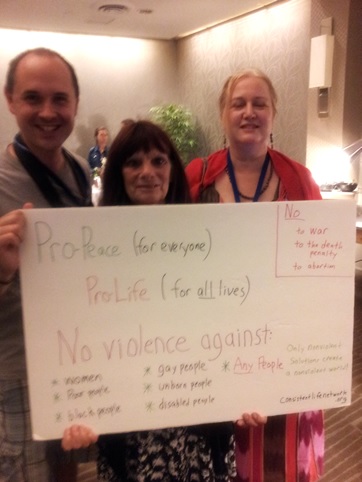
At Democrats for Life Luncheon, Democratic Convention: Rob Arner, Lisa Stiller, Rosemary Vorel
So I got to Philadelphia, and realized I had some work to do. And some real challenges. There were endless speeches, with many speakers throwing in their support for the “right to choose.” There were three that were chosen specifically for their support for abortion, including speakers from Planned Parenthood and NARAL Pro-Choice America. I took that opportunity to try to walk around the lobby area where the media was hanging out to try to interest reporters in a different view, and to talk to them about the fact that yes, there were Democrats who opposed abortion. Most that I managed to have a conversation with were surprised. Very surprised. A few gave me cards, or took mine, and one finally agreed to interview me for a talk show to be aired at some future date. We have our work cut out for us in educating the media about “pro-life liberals.”
The other challenge was trying to talk to other delegates I met. Conversations got started anywhere and everywhere; the phone charging station, food lines, and at the after convention parties that went until after 2am (and were the major cause of all that sleep deprivation). And when the subject of abortion came up, or even when asked why I supported Bernie, if I felt comfortable with the person, I started talking about the consistent life ethic. And no one turned away from me. Of course, most did not agree, and I returned to subjects we had common ground on. I can only hope I planted some seeds.
Perhaps the most challenging task I took on was was talking to all of the Planned Parenthood volunteers who swarmed throughout the convention center every morning, and approached just about everyone. Some actually engaged in a conversation. Many did not realize that opposing abortion was a cause for being closed out of involvement in local and state Democratic Party involvement. And with most we were able to end the conversation agreeing to disagree about abortion but agreeing that we needed to do more to support those resources that women and families need to thrive. Yes, some walked away when I told them how I felt. But it was those other conversations that seemed to make the effort worth the time.
I guess that is why I decided going to Philadelphia was so important. The challenge of talking about CL to other delegates, and the chance I knew I would have to talk to people such as those Planned Parenthood volunteers. It’s about planting seeds, starting a dialogue, and putting a human face on “the opposition.”
Now that it’s over, I am trying to decide if I want to stay so actively involved with the local Democrats. I have built some good relationships. Met some pretty good people, who I might even want to have as friends. If I continue, I will be taking on the challenge of promoting the Consistent Life Ethic in a tough environment. But I have come to believe that so much of our work is about relationships. Build on those first, and keep planting those seeds. You never know where they will fall.
=============================================
See the list of all our blog posts, put in categories.
For more of our blog posts on Actions and Adventures, see:
The Adventures of Organizing as a Consistent Lifer
Violence Bolstered by Professional Contradictions
Mourning After & Hoping for the Future, We Call for a Consistent Life Texas!
My Day at the Democratic National Convention