“Trust Landlords”: Pro-Choice Candidate Supports Eviction Rights
Satire by Richard Stith
Reporter: “I am so grateful for your willingness to answer a few questions about the eviction controversy. As I’m sure you know, in response to the “My Building, My Choice!” campaign, the US Department of Housing and Urban Development has proposed rules to make it easier for landlords to evict tenants. What’s your position on eviction rights?”
Candidate: “I think you’ll like the consistently deferential approach I take on this sort of issue. As I said at a recent Town Hall, I’m for trusting decisionmakers to draw their own lines. So here I say, ‘Trust landlords.’ I’m not personally pro-eviction or anti-eviction. But landlords’ eviction decisions are not going to improve just because the government dictates how they should be made.”
 Reporter: “What do you tell people who believe that God wants them to protect tenants from unjust eviction?”
Candidate: “I respect and support those with pro-tenant religious beliefs, even though I don’t think that’s what the Bible says. But they may not use their private beliefs as a political weapon against a landlord’s freedom to choose what to do with his own building.”
Reporter: “Here’s a tough one for you: Suppose a particular landlord has already made a choice. He has invited a tenant in, clearly agreeing to shelter her for nine months, but later he changes his mind. Can he just kick the tenant out in the sixth month, even though she has no other place to go? Suppose it’s winter, even.”
Candidate: “I would trust that landlord to make the right decision.”
Reporter: “OK, but what if that landlord has a discriminatory motive? What if he has discovered in the sixth month of occupancy that the tenant has Down Syndrome, for example? Can she just be put out on the street, where she’s really not capable of surviving until the weather gets warmer in a few months?”
Candidate: “I’m against all discrimination, but we have to trust the landlord on this. The building is their private property. We can’t interfere with total control of one’s own building, even if the owner chooses to draw a line with which we may disagree.”
Reporter: “In late 2019, there was an article entitled “Reconsidering tenant pain” in the Journal of Medical Ethics. The article concluded that a tenant may have settled in and feel quite pained by an eviction after just 12 weeks of occupancy. The authors’ research showed, in their own words, “Overall, the evidence, and a balanced reading of that evidence, points towards an immediate and unreflective pain experience . . . from as early as 12 weeks.” Do you think that, after she’s been living there 12 weeks, landlords should hire a doctor to give the tenant some sort of pain killer before evicting her? One of the two co-authors of the article is strongly pro-eviction, by the way, but he still supports their joint conclusion about tenant pain.”
Candidate: “The provision of a pre-eviction pain killer is something that a landlord might want to consider, if they wish. But it’s up to them, not me, to draw that line. It’s all a matter of trust, you see. I trust landlords to do what’s right.”
Reporter: “It looks like you, like your party, are against tenants’ rights at any stage of occupancy, but what if it’s the second to last day of the ninth month of the occupancy, so the tenant is going to move out tomorrow. Can the landlord refuse to wait and just hire a tough guy to grab her and toss her out today? What if she holds on, and the tough guy has to pull her out piece by piece?”
Candidate: “Your questions are getting pretty outrageous. Let me ask you one. Do you own a building with a room available for occupancy? If not, I don’t see how you even have a right to speak on this issue. It’s a basic American legal principle that we only trust the testimony, and then the decision, of somebody with a personal interest in a case. That’s why I say we should trust the landlord.”
Reporter: “Sorry. I’m not very up on our law. I thought I had heard that neither party should be the sole judge of a case — and that when rights are in conflict, that’s exactly when we need to find an outside perspective to mediate between them. Thanks for straightening me out on that.”
A version of this satire was first published on March 2, 2020 by MercatorNet

Richard comments: Here’s an old photo of me from the 1970s. Around my neck I have our National Youth Pro-Life Coalition emblem, the Wheel of Life, a Buddhist symbol we saw as pregnant with the usual peace symbol within.
============================
See more of our posts from Richard Stith:
When “Choice” Itself Hurts the Quality of Life
Open Letter to Fellow Human Rights Activists
The Mirror-Image Counterpart of the Selfish Society
Equal Concern for Each Human Being, Not for Each Human Issue
Oppressors of Women Scapegoat Fetuses to Preserve Patriarchy
Most of his writings can be found here.
Sickness is the Health of the State? Civil Liberties and Conflict during a Pandemic
by John Whitehead
The COVID-19 pandemic has consumed the world’s attention during these early months of 2020. The virus’ health threat, especially to older people and other vulnerable groups, is correctly the primary concern right now, with the pandemic’s economic consequences perhaps being the second greatest concern. Both these aspects of the pandemic fully deserve the attention of policymakers and the media. Other, less prominent, threats from the COVID-19 crisis are worth noting, however. Peace activists and others concerned about the power of state security agencies should pay particular attention to these other threats.
Pandemics, wars, and other crises can become occasions for governments to restrict civil liberties and increase their repressive powers over their own people. Evidence suggests some governments around the world are doing this or are using the COVID-19 pandemic to justify pre-existing repression. Further, because COVID-19 originated in China before spreading to other countries including the United States, the pandemic has aggravated already tense China-US relations. The current crisis may contribute to the growing danger of conflict between the two countries.
Repression during the Pandemic
 Dramatic government responses to a global public health crisis are certainly justified. Measures to keep people at home and prevent large gatherings, produce more medical supplies, or provide relief for those in economic need are all reasonable and appropriate. However, some measures have been more ominous.
The Committee to Protect Journalists reports that several governments have curtailed freedom of the press since the pandemic began. Turkey and Venezuela have detained or intimidated journalists because of COVID-19-related reporting or with COVID-19 used as a pretext. Egypt and Iran have reportedly restricted press coverage of COVID-19. Honduras responded to the crisis by declaring a temporary state of emergency that allowed for limiting press freedom.
South Africa has adopted regulations that make deceptive statements about COVID-19 or the government’s response to it punishable by fines or prison. While preventing the spread of misinformation is a worthy goal, giving the government the power to punish statements is easily open to abuse. Restrictions on freedom of the press might even interfere with an adequate response to the pandemic, if, for example, journalists cannot accurately report on the number or rate of infections or other crucial information.
In the United States, the Justice Department proposed to Congress measures that would allow certain judges to suspend regular judicial procedures during emergencies. Such suspension could allow for keeping people detained without trial. While Congress is currently unlikely to adopt these measures, their proposal is a sign of how a crisis can become an occasion for limiting civil liberties.
Moreover, even without new regulations, the federal government already has broadly defined powers to check the spread of illness by stopping and detaining people traveling to or within the United States. Meanwhile, the British Parliament recently rushed through legislation in response to the pandemic that may allow police and other government officials to detain people to prevent them from spreading COVID-19.
Even less intrusive measures, such as government surveillance, that are used for the good purpose of ensuring social distancing, have their alarming side. For example, the Chinese government has installed cameras outside the homes of people under quarantine, to make sure they don’t leave. In South Korea, the government uses CCTV video, smart phone location data, and other methods to track the movements of people confirmed to have COVID-19. Indian authorities monitor airline and train reservations to check if quarantined people are traveling. European countries have used cell phone data to track people’s movements, and the European Commission has requested similar data, covering hundreds of millions of people, from telecommunications companies.
Even if such surveillance measures are defensible during the current crisis, they demonstrate the alarming scope of government powers. These powers, whether they pre-date the COVID-19 pandemic or have been adopted in response to it, presumably will not go away when the pandemic recedes. This should be cause for concern for everyone concerned with checking the national security state’s power.
As the writer Bill Wirtz comments, “No matter what legitimacy we want to ascribe to these emergency measures, we ought to recognize that they usually outlast emergencies… Emergency rules are easily implemented, yet awfully hard to get rid of. This is particularly true if the threat has no expiration date.”
US-China Tension during Pandemic
The relationship between the world’s two most powerful nations, which was hardly cordial before 2020, has not been improved by the pandemic. Officials and policymakers in each nation have blamed the other for COVID-19 or made similar provocative comments. In March, US National Security Adviser Robert O’Brien criticized China for its handling of the pandemic. Soon afterwards, a Chinese Foreign Ministry spokesman insinuated that the US military was behind the virus. This claim was met by a diplomatic rebuke from the US State Department to Cui Tiankai, the Chinese ambassador to the United States, although Cui rejected the notion of US responsibility both before and after the Foreign Ministry spokesman’s claim. Meanwhile, President Trump sometimes has referred to COVID-19 as the “Chinese virus,” although he has backed away from the term more recently.

In addition to this war of words, each country is putting pressure on the other’s media. In February, the US State Department imposed new requirements on Chinese state media outlets operating in the United States. The Chinese government responded by expelling three Wall Street Journal reporters from China. The United States then limited the number of visas available for Chinese state media employees. China then revoked the visas of 13 reporters for American media outlets and imposed other restrictions on such outlets.
At the grassroots, both people of Asian heritage in the United States, and Americans and other westerners in China, have faced discrimination and harassment. Asian Americans have been verbally and physically assaulted in recent months.
While hard data are not available, the number of racist incidents against Asian Americans appears to have risen. One man in Syracuse, New York, recalls someone yelling at him in a supermarket check-out line: “It’s you people who brought the disease.” One dramatic indicator was reported by a gun shop in Rockville, Maryland, a city with a large Asian American population: the number of Chinese Americans buying guns increased noticeably in early March. Meanwhile, westerners in China report increased police questioning of them and their employers, as well as restrictions on visits by non-Chinese.
Mutual hostility, at both the official and popular level, between two powerful nations is very dangerous. It has already led to episodes of people being harmed by xenophobia and if unchecked could lead to some larger conflict in the future.
Being Vigilant
Much of the world is concerned today with staying alive and healthy and preventing this terrible illness’ further spread. That is as it should be. Peace activists and others concerned about preventing war and abuses by state security forces should not lose sight of other trends, however. The COVID-19 pandemic has reminded us of governments’ extraordinary capacity for repression, as well as how crises can escalate tensions among nations. We should promote peace and protect civil liberties so that the present situation doesn’t lead to violence and injustices that last beyond the current pandemic.
The Message of “Never Rarely Sometimes Always”: Abortion Gets Sexual Predators Off the Hook
by Rachel MacNair
With the initial theater release interrupted by the Covid-19 closing of theaters, this movie was offered online April 3, 2020.
The title of the movie, “Never Rarely Sometimes Always” is based on an intense scene in which the protagonist, Autumn, is being counseled at an abortion facility before her abortion. Those are the answers she’s to offer to the questions. The counselor asked if she had ever been hit, slapped, or physically hurt. Autumn hesitated, and never answered. When asked if she had sex when she didn’t want to, Autumn cried, but never answered. Then asked more bluntly: had she had forced sex ever, yes or no? She answered, “Yeah.”
Nobody but nobody could watch that scene and not understand that this 17-year-old had been abused. Yet the counselor simply scheduled her abortion and never did any follow-up at all. The facility cleaned her up (so to speak) and sent her back into the abusive situation.
That she’s emotionally numb and troubled about the abuse is clear throughout the entire movie – and especially in the final scene, after the abortion, on the bus on her way home. Looking at her face (pictured) we see a crushed spirit.

Empowerment?
Yet that’s not what the entire audience sees. Apparently, it’s not what the writer and director of the film, Eliza Hittman, sees. Reviewers refer to Autumn as on a brave journey, and being empowered.
This is my view of empowerment for a young woman in Autumn’s situation: she gathers evidence, turns the sexual assaulter in, and if the police and courts aren’t doing their job, rallies the press and public opinion behind her. If she already has reason to suspect the police will make things worse, she can come up with other nonviolent actions. Perhaps getting a group of her friends to picket the abuser’s house. Or she could find (if needed, create) organizations that can work through restorative justice so the abuser can understand the harm he’s doing and how intolerable it is.
An inspiring, empowering story is one in which a way is found to keep the abuser from going on to abuse others. If she’s empowered, she does it. But if that’s a lot to ask of a traumatized 17-year-old, at least have others around who can help her toward that goal.
That’s not what we have here. This is a story of a young woman acquiescing to her abuse, being resigned to it, and being emotionally numbed by it.
There was even a point where she was offered help in finding a place to stay overnight and turned it down. This led directly to the cousin who accompanied her having to put up with an intense-kissing predator in order for them to get money they needed. She sympathetically held the cousin’s hand, but offering sympathy for someone else who must succumb is so very inadequate. It was a weary resignation to their fates.
And once when Autumn was moping in the bus station, the cousin asked her, “What do you want me to do?” Her answer was, “Bug off!” They reconciled soon after, but the tension is palpable. Another time, when she has the laminaria in as the first step in her two-day abortion process, at one point she starts vaginal bleeding. Autumn calls the facility, but when the woman answers, Autumn doesn’t speak, and finally hangs up and leaves. These are not the marks of an empowered young woman driving her own fate.
So how is it that the reviewers don’t see what seems so glaringly obvious to me? Because the idea that the abortion “choice” is empowerment is a premise, not a conclusion. They start looking at the situation that way, and all evidence to the contrary is dismissed. The foundation is unshakable.

A “Pro-Choice” Movie?
The view is that this promotes the pro-choice cause because it’s demonstrating what’s wrong with legal restrictions, by showing a young woman navigating obstacles:
- The initial pregnancy test was at a Pregnancy Resource Center. Autumn was shown a sonogram of her baby, with a positive message about hearing her baby’s heartbeat. The National Review reviewer reports that at his showing, a woman blurted out “Bitch!” at the mention of a beautiful baby. And then Autumn is shown an “anti-choice propaganda video” – again, showing the baby. And she gets cheerful offers of help, which are apparently seen as sinister since they’re trying to veer her away from abortion.
- Pennsylvania has a parental consent requirement. Hence, she goes by bus to New York City, where other dangers lurk
- She can’t use her insurance because then her parents will know. So she struggles with cash.
- They can’t take her until the next day, so she and her cousin stay up all night; the abortion facility had never offered her help with a place to stay at that point.
- It’s a two-day procedure. This time she’s offered overnight help and turns it down – hardly someone taking charge of her circumstances.
So here are my questions:
- If Pennsylvania had no parental consent law, how much better off would she have been? Sneaking to a nearby abortion facility would have saved her the trip to New York – but it would have left her every bit as much in the abusive situation and the distress it was causing.
- If New York did have a parental consent law, and there were no other place she could go that didn’t, how much better off would she have been? She would have had no trip to New York. If the reason she didn’t want parents to know is that her father was the source of the abuse, then perhaps she needed to get to some agency that could help her with that. But in this movie, she didn’t work that through; the trip and abortion allowed her to accommodate the situation. And maybe get back into the same trip to New York again.
- If nowhere offered abortions, and we had a society where feticide was held in the revulsion it deserves, how much better off would she have been? Would the sexual abuse still have occurred in a situation where pregnancy means the abuser is bound to get caught?
That last point does mean we’re hoping for a situation better than it was before Roe v. Wade, or the methods of abortion legalization in other countries, when women got clandestine abortions as part of letting their abusers off the hook. But back then there were several additional astonishingly sexist parts of letting abusers off the hook, and for the future, we need to cut all of them out.
Or a “Pro-Life” Movie?
I’d love to see this experiment, easily done in college classes once the Covid-19 crisis is lessened and we have those again: Show the movie in some classes and present it as a pro-choice movie. Show it in other classes and present it as a pro-life movie. In other classes, present it as an interesting story to make people think. Then give them a questionnaire, which includes asking the students their own position on abortion.
My prediction is that the pro-choice students would love it as a pro-choice movie and be utterly outraged by it as a pro-life film. And it could be presented as pro-life. It’s entirely believable that way.
In fact, I recommend that it (or pertinent clips from it) be used in training people working at Pregnancy Help Centers. The realism is notable, and it would make an excellent case study for discussing how to deal with a young woman whose own numbing at her victimization makes her impervious to the cheerful information about the baby and offers of options.
I think the movie helps the case against abortion even for those who don’t understand it that way. All assurances that abortion is an easy no-big-deal thing are out the window. I suspect no one watching this film is more likely to get one, and plenty of people who buy the writer’s premise that restrictions are a terrible thing are nevertheless less likely to think of getting one when it’s that much trouble. It’s a lengthy anti-advertisement.
This is a movie that would have much more of an anti-abortion impact if we pro-lifers were able to see how very much this realistic film documents one crucial aspect of how abortion is so very bad for women.
A Healing Metaphor: Pandemic as War
by Julia Smucker
The language is everywhere: we’re at war against an invisible enemy, adjusting to new realities of wartime living and expressing gratitude to the brave men and women fighting on the front lines to keep us safe. Except that the front in this war is in hospitals and labs, and the front-line fighters are healthcare providers, armed with medical equipment and armored with protective gowns and face shields. Most notably, they are fighting not to cause premature death but to prevent it. The war is not one of killing, but of healing.

Cartoon by Safaa Odah, Gaza artist (pictured). From her Instagram
If the problem were on a smaller scale, this might seem an aggressive metaphor, especially for an endeavor whose means and aims are so opposite to that of war. Yet, when describing the response to a global pandemic, the situation seems to beg for such language in order to convey an appropriate level of gravitas, a scale of organization and readiness akin to the preparation and implementation of military strategies. But with one major difference: whatever human casualties are suffered, they will not occur at human hands.
It’s not only the life-affirming mission of this “fight” that redeems the metaphorical language of being at war: some tools and mechanisms made for war are also being literally redirected toward strictly lifesaving ends as the concerns of public health and “national security” intersect. For example, the Defense Production Act, as its name suggests, was originally designed to shore up weapons production during the Korean War but has occasionally been used for disaster relief and has now been invoked to enable production of necessary medical supplies.
U.N. Secretary General Antonio Guterres has called for a reorientation from killing to healing on a global scale, pleading for a turn from hostilities among warring parties toward a united front against humanity’s “common enemy,” COVID-19. In a potent rhetorical turn, he applied the metaphor in both directions, first calling the virus the common enemy we must fight against, then calling war itself a sickness.
To be sure, the extent to which pleas like Guterres’ are heeded remains to be seen, and responses so far are predictably mixed, ranging from bilateral acquiescence to open defiance to more ambiguous scenarios in between. There also hasn’t been a complete turn from militarism to medicine in the U.S., as some manufacturers of military equipment disregard calls to close in order to prevent coronavirus spread, judging themselves essential.
The metaphor itself has its shortfalls, as all metaphors do. As a few have pointed out, there may be dangers in overly anthropomorphizing a virus by assigning it human attributes like intent or nationality, especially in ways that feed prejudice by associating certain categories of human beings with disease. And “wartime” policies can of course be both good and bad, lending themselves to mutual aid, solidarity and protection of the vulnerable, or to opportunistic power grabs by autocratic governments in the name of public safety.
Still, despite its limits, the seemingly violent language of a war against the pandemic contains some ironic potential for hope – if the metaphor is realized in a shift toward nonviolent practices. Public crises, whether they involve humans fighting each other or fighting a nonhuman entity such as a virus, have a way of bringing out the best and worst in humanity. If we as individuals and as societies allow the best in us to win out during and after the crisis we’re currently experiencing, that would be a war worth winning.

Julia Smucker
======================================
See some of the other posts from Julia Smucker:
The Price of Violence: When Dehumanizing the Vulnerable Hurts One’s Own Causes
What Does it Mean to be Inconsistent?
Defining Reproductive Justice: An Encounter
Why the Interfaith Approach is Important
by Rachel MacNair
This February in 2020 I went on a trip to Israel and Palestine with a group called In the Steps of Our Ancestors: an Interfaith Peace Pilgrimage. In addition to seeing the holy sites of Judaism, Christianity, Islam, and Baha’i, we spoke with several groups promoting peace in different ways.
(I went just in time – Israel stopped everyone from coming into the country just two weeks after I got home because of the Covid-19 crisis. While we heard of cases, nothing was closed until days after we had visited).
One major point that needs to be understood about the interfaith movement is that it’s most emphatically not asking people to water down their own religions by adding other religions. To the contrary, it helps you reflect more deeply on your own faith tradition and find more insights into it.

Rachel adds a stone to the growing peace mosaic on the Gaza Strip wall, which can be seen at one spot by the people stuck inside. Since they know each stone was placed by a different person, this communicates widespread concern for their plight.
Peace and Social Justice Goals
When people of different religions have violent conflicts, being in greater harmony over religious matters is crucial.
Of course, religion is often actually a stand-in for ethnic conflicts, or used as an excuse for what’s really a leadership struggle or territory grab. This is because people engaged in violence like to think of themselves as virtuous rather than thinking of themselves as people engaged in violence.
Nevertheless, there’s often religious content to brutal conflicts, which turns off onlookers who don’t share the religious views. That’s one reason an interfaith approach helps with conflict resolution or transformation.
Another reason is that social justice movements wanting to convince as large a number of people as possible to support their specific goals do well to have respect for religious traditions. They can use persuasion that takes those different traditions into account.
Expressions and Essentials
One of the basic concepts of the interfaith approach is to make a distinction between what’s essential, and what would be just different expressions. In philosophy they call the different expressions “accidentals,” but since people don’t regard their beliefs system as accidental, it’s probably better to just use the word expression.
Some people pray by bowing their head and folding their hands and closing their eyes. Other people lift their arms up and look to the heavens. Some people bow on a prayer rug with specified motions, some use prayer beads, or prayer wheels, or elaborate set-ups that take 15 minutes to arrange. Others say quick prayers quietly inside their heads. All of these things are different expressions. The essential: prayer.
The things that religions most have in common are the essentials. Many of the differing expressions can be celebrated as a matter of diversity, when people are able to look at their own religion with what’s most important in mind. And we can be entirely pleased with how different people express it differently. Disagreements on specifics remain, but a focus on the essential enriches even those disagreements.


Top: Rachel takes a selfie at Dome of the Rock in Jerusalem, Islam
Bottom: Rachel at House of Justice in Haifa, Baha’i
Applied to Abortion
As is common in peace groups, on this pilgrimage I felt free to bring up my position on all issues except for the one on feticide. The one time it came up was when one of the tour guides explained that Sister Kelly, our guide at the Magdala museum, had commented to him about what a problem abortion is. He complained that she didn’t know how he felt about it. A member of our group vigorously agreed with him that Sister Kelly hadn’t ought to have brought it up.
In one way, that was rather odd, inasmuch as a devout nun expressing that opinion was clearly practicing her own religion. And we had a custom that people were to be free to express their own religions, with other people being accepting of it rather than being critical. On the other hand, they were treating the issue as a political one, rather than a religious one, which of course is exactly what we want. But I stayed silent for the sake of harmony. As did everyone else.
But the interfaith movement is beneficial to the pro-life movement in the same way that it benefits other social justice movements: we need to make the case to people in terms that they understand.
So, for example, many years ago I was talking to a pro-life woman who was speaking of the importance of the Judeo-Christian ethic. I said to her “you know, every Buddhist that’s a friend of mine is pro-life on abortion.” I could see the wheels going on in her head, and she finally said “Oh, OK. It’s bad karma to kill a baby.” And I said “yes, that’s right.” So she said that she didn’t mean to put down other religions, she just thought that it was a struggle against secular humanism.
Yet the secular case against abortion is also quite important. The National Right to Life Committee recently had a full workshop at its national conference with Kelsey Hazzard of our member group Secular Prolife. We need to be able to make the case everywhere.
But another reason why I think this is important is that too many people think opposition to abortion is nothing more than a religious expression – some kind of rigid rule, which some religions have and others don’t have. If their religion doesn’t have this rule, why are people from other religions trying to impose their rule on them? We need to get across instead that our opposition is an essential value having to do with compassion to all human beings, a value shared across religions and ethical atheism.
I remember years ago when I was speaking to a college group and they asked me about contraception. I gave them this answer: “If you’re fertile, and have genital contact intercourse with a fertile member of the opposite gender, you might make a baby. If you use contraception, you cut your chances. But you don’t cut them out, you only cut them down. If you make a baby, you’re a parent. Conduct your sex life accordingly.” The students later said they were pleased I hadn’t lectured them on morality. I found that interesting, since I kind of thought that I actually had. But of course it wasn’t expressing a religious rule. It was laying out the obvious principles – that is to say, the essential.
Concluding from Religious Sources
Taken from a story in the Talmud (Shabbat 31a)
A gentile said he would accept Judaism only if a rabbi would teach him the entire Torah while he, the prospective convert, stood on one foot. First he went to Rabbi Shammai, who was insulted by this ridiculous request and chased him off with a stick. The man then went to Rabbi Hillel, who accepted the challenge, and said:
“What is hateful to you, do not do to your neighbor. That is the whole Torah; the rest is commentary – go and study!”
Qur’an 49:13 – English translation
[God speaking] People, We have created you all male and female and have made you nations and tribes so that you may know one another. The most honorable among you in the sight of God is the best in conduct. God is All-knowing and All-aware.

At the Church of the Beatitudes on the Sea of Galilee where the Sermon on the Mount was supposed to have happened
===================================
For our posts with differing religious perspectives, see:
Atheism
The Vital Need for Diversity / Sarah Terzo
Christianity
The Consistent Life Consensus in Ancient Christianity / Rob Arner
The Early Christian Tradition / Rob Arner
Hinduism
Abortion and War are the Karma for Killing Animals / Vasu Murti
Islam
Breaking Stereotypes in Fearful Times / John Whitehead
Paganism
Ancient Roots of the Consistent Life Ethic: Greece / Mary Krane Derr
Is Abortion Different from Other Violence?
by Julia Smucker
Four Ways of Isolating One Issue
Any advocate of the consistent life ethic (CLE) can expect to encounter people who share their pro-nonviolence position on certain issues but depart from it on others. And among those working on various peace and life issues, including those of us who adhere to the CLE, there are many who feel compelled for various reasons to focus their energies on some issues more than others.
Yet I’ve often been puzzled to notice that abortion, more than any other such issue, is frequently singled out from the rest, and from starkly different perspectives. Whether friendly or hostile to the CLE, whether seeking to prioritize or deprioritize opposition to abortion, it seems the one thing many ideologically divergent people can agree on is that abortion is somehow different.
Julia Smucker
I’ve observed at least four ways this differentiation is made:
On one end of the spectrum is abortion as exception to nonviolence. Those who hold this view may connect certain nonviolence issues but reject the inclusion of abortion as a form of violence, sometimes even purging would-be allies who do include it.
At the other extreme are the purely single-issue, to whom any focus on life issues other than abortion represents an unconscionable moral compromise – at best a misguided distraction from what really matters, at worst a deliberate scheme to preserve abortion.
While the above groups are often sources of open and visceral hostility toward the CLE, there are also more mitigated forms of these positions, which may share their ideological leanings while displaying at least a grudging openness to connecting issues across the conventional ideological boundaries.
Closest to the abortion-as-exception position, without condoning abortion, is a view I call anti-anti-abortion, whose adherents may oppose abortion in principle but take pains to distance themselves from traditional abortion opponents. Those holding this view may identify as pro-life, but in a way that overcorrects from what they see as disproportionate emphasis on abortion, to the point of avoiding the issue, downplaying its gravity, or even disproportionately investing their own energies in overgeneralized complaints about those working against abortion.
Others are quasi-single-issue, conceding that other worthy life issues exist, but rarely doing so without insisting on the inherent, objective preeminence of opposing abortion. Even while allowing for some degree of multi-issue connections or granting that some may legitimately focus on other things, the idea of considering abortion as one life issue among many seems almost as anathema to many of these people as to the purely single-issue.
The former two positions are irreconcilable with the CLE, and their adherents are often overtly antagonistic toward it. The latter two may be marginally compatible with the CLE, but in a lopsided way, prone to zero-sum thinking that assumes the importance of one thing can only be stressed at the expense of another, even when dealing with life-and-death issues.
Common Explanations
But why does the divide in this zero-sum dichotomy so frequently fall between abortion and everything else?
The most immediate, though superficial, answer that occurs to me is political: for reasons that have never made sense to me, opposition to abortion has become associated with the political right, and most other opposition to violence with the political left. Arbitrary as these categories may be, political loyalties do seem to have strong pulls in both directions on the weight given to different life issues. But this still doesn’t explain why opposition to euthanasia, also typically associated with the right and often mentioned alongside abortion, isn’t set apart from other issues as frequently or emphatically.
Adherents of the four positions I’ve outlined will offer their own reasons for the differentiation. All of these are real claims I’ve heard from real people, and while I hope to represent them fairly, I haven’t found any of them convincing.
Holders of the “abortion-as-exception” view and maybe even the “anti-anti-abortion” view would claim that in contrast to their altruistic advocacy on behalf of oppressed groups, abortion opposition is all about controlling and oppressing women. This oversimplified narrative fails to account for pro-life women’s perspectives, dismissing them as internalized misogyny or ignoring them altogether. Furthermore, it ignores the ways abortion contributes to gender-based injustice by masking pregnancy discrimination and sexual abuse, facilitating gendercide, and enabling men who feel entitled to unlimited access to women’s bodies.
Those who are “purely single-issue” or “quasi-single-issue” may agree that abortion opposition is differently motivated from other issues, but in the opposite way. In their narrative, it’s pro-life activists who have more purely altruistic motives: they simply love babies and are concerned for the weakest and most vulnerable human beings, even at personal cost, whereas concern for more popular issues might be at least partly to do with scoring political points or signaling membership in an in-group. This assumption relies on a larger narrative of one-sided persecution, ignoring how point-scoring and virtue-signaling cut in multiple directions, sometimes including a perceived need to prove one’s pro-life bona fides.
Aside from questions of motive, the same people often stress the absolute vulnerability of the preborn as a reason abortion deserves pride of place among life issues, to which those who are “anti-anti-abortion” may respond that women considering abortion are often in vulnerable positions themselves and can’t simply be cast as villains in the attack against life. On its face, this is a worthy point (and generally better understood by the “quasi-single-issue” than the “purely single-issue”). This is why the best pro-life groups consider the empowerment of women integral and indispensable to the protection of their unborn children. It’s important to consider when offering pregnancy support or dialoguing with pro-choice people. The vulnerability of children in the womb and women in crisis pregnancies is always worth considering – but using either to rank abortion as of greater or lesser importance than other threats to life is counterproductive.

Another reason offered for prioritizing abortion is that life is a foundational right, without which other rights are meaningless. But why would this not equally apply to other forms of killing? In particular, a similar point could be made about the nuclear danger: if a full-scale nuclear war obliterated all human life on the planet, all the work against other threats to life, including abortion, would come to naught. This point rightly underscores the urgency of averting such a catastrophe, but it wouldn’t be a good reason to deemphasize other threats to life that are occurring now.
Similarly, the fact that abortion happens earlier in the human lifespan than other violence doesn’t make the killing of humans post-birth any less grave, nor the threats to those vulnerable to other violence any less real, nor their lives any less valuable – just as prenatal lives are no less valuable or vulnerable for being less visible.
Dealing with Limits
At this point, it becomes necessary to differentiate between two types of critiques often made of pro-life activists which, though similar, have differing degrees of merit. One critique would seem to require every pro-lifer to spread themselves evenly across all possible issues as proof of authenticity, expressed in statements such as, “Don’t call yourself pro-life unless you’re also doing x, y and z,” or, “If you’re pro-life and not willing to adopt all the unwanted babies, you’re a hypocrite.” People whose most visible work is against abortion are justified in complaining of such impossible demands, which often simply serve as an excuse to dismiss pro-life activism as a whole.
Sometimes, however, the politicization of life issues does lead to genuine inconsistencies in the application of stated values such as reverence for life and concern for the vulnerable, in the form of tacit acceptance or even outright endorsement of violence against certain human lives besides those in danger of abortion. Though far from being true of all pro-life activists, such inconsistencies belie those stated values and give pro-life activism a bad name. Confusing matters further, these two critiques are often conflated, making it easy for those who want to discredit the pro-life cause to dismiss all pro-lifers as inconsistent on the basis of the worst examples, and for those focusing primarily on opposing abortion to in turn dismiss even valid critiques of inconsistency as holding them to an unfair all-or-nothing standard.

If this standard is disproportionately applied to pro-life activism, it’s due not to any unique virtues or vices of pro-lifers but to broad acceptance – from either side – of the dichotomy between abortion and other life issues. The CLE, of course, rejects this dichotomy. But even those who fully embrace the CLE must inevitably deal with practical limits to what they can do.
Some attempt to reconcile this dilemma by advocating equal concern for human beings but unequal concern for human issues. But when the issues under discussion all deal with threats to human life or other particularly grave offenses against human dignity, this distinction contains an implicit contradiction: if certain threats to life are inherently less important because of the life stage or other circumstances in which they occur, then so by extension are the lives that are under threat. Human lives and human life issues are not so easily separated.
This doesn’t mean that all who care about life issues must give equal attention to every one, nor even that all possible issues one could give attention to necessarily have the same moral weight. But these are separate questions. A more helpful distinction, then, is between the question of inherent worthiness of issues and that of practical necessity. Nobody can work full-time on every issue, but whatever one chooses to prioritize should never become an excuse to give other forms of violence a pass, or to insist that the issues one feels most compelled to focus on are objectively worthier than all others.
Even if working on one or two issues more intensely, it’s not difficult to let our passion for protecting human beings from violence show on other things from time to time. Indeed, it should come naturally, if protecting human beings from violence is our driving concern.
Often it’s a simple matter of showing up. I’ve personally attended public events opposing various forms of violence including abortion, war, the death penalty, gun violence, anti-immigrant violence and police brutality, knowing that these events by themselves – let alone my presence there – are not enough to stop these things, but also knowing that showing up sends a message, all the more powerfully if the same people show up for different issues across the expected ideological lines.

One can write about these and other life issues, speak about them in public forums and private conversations, support nonprofits, sign petitions, and share information as the occasion arises, whatever one’s other commitments may be. With inevitable limits on time and resources and the subjectivity of personal experiences, influences and callings, it’s understandable for individuals and organizations not to expend equal effort on every issue. But ultimately, if all human lives at all stages are objectively worthy of respect, then all threats to human lives at all stages must be objectively worthy of opposition. It can only detract from this message to argue what – or who – is worthier.
===================================
See other posts from Julia Smucker:
The Price of Violence: When Dehumanizing the Vulnerable Hurts One’s Own Causes
What Does it Mean to be Inconsistent?
Defining Reproductive Justice: An Encounter
Amnesty International’s Blind Spot
The Redemptive Personalism of Saint Oscar Romero
Ireland’s Votes for Violence: Sinn Féin and Abortion
by Maria Horan

Maria Horan
Not Surprising
It may surprise those outside the Republic of Ireland that Sinn Féin (SF) came in second in the recent Irish elections. However, people voting for a political party with a strong connection to the IRA and many of the murders in the North during the Troubles and which still refuses to condemn violence isn’t so remarkable.
There’s a strong correlation between SF’s popularity and the landslide vote to legalize abortion (“Repeal the 8th”) in Ireland in 2018. Of 18-24-year-olds, 31% voted SF in this election, and 87% of them voted for abortion.
Journalist Róisín Agnew claims these votes demonstrate how “savvy” the young Irish generation is, but they actually demonstrate ignorance of SF’s bloody and violent roots. Instead of being the supposed “woke” generation, Ireland’s young voters chose to sleepwalk through both the 2018 abortion referendum and the 2020 General Election, ignoring the experiences of those who lived through the Troubles and the experiences of other nations with years of legalized abortion. Only 12.2% of those over 65 (who will remember the Troubles) voted for SF, and 58.7% of them voted against legalizing abortion in 2018.
The dancing and singing at Dublin Castle on May 26th, 2018, was a disgrace. Pro-lifers endured gloating abortion advocates celebrating the “right” to poison and dismember children who hadn’t even been conceived yet (abortions began January 1, 2019).
Likewise, the singing of old rebel songs during election time and the shouting of “Up the ‘RA [IRA]),” including by various SF representatives, were insensitive to families who had suffered during the Troubles. Just as abortion was deeply unacceptable in Ireland until recently, IRA songs would once have horrified many Irish people. As Northern Irish journalist Jenny McCartney put it so well: “its voters have [shown their support] not by compulsion, but by choice.”
Sinn Féin’s Role in Legalizing Abortion
SF played a prominent part in the “Repeal of the 8th” campaign two years ago. After the outcome, it rapidly changed its stance from being officially opposed to abortion to not even permitting its members a conscience vote. Former SF members Peadar Tóibín and Carol Nolan were both sanctioned by SF for their pro-life votes and soon left.
SF helped foist abortion on Northern Ireland by refusing to take their seats in the Northern Irish Assembly at Stormont on October 21 but reconvened once abortion was securely in. As Irish Times journalist Breda O’Brien aptly observed: “‘England get out of Ireland’ does not apply to abortion.”
The Northern Irish abortion framework outlined by the UK government is so extreme that it allows for the possibility of babies being left to die from “failed” abortions.
Bullying
Violence can take many forms and can appear hidden to onlookers. There are many concerning stories emerging from within the ranks of SF, including the endemic bullying reported by various members.

Noeleen Reilly
Former SF Councillor Noeleen Reilly resigned in 2018, claiming she was the victim of an orchestrated bullying campaign by colleague Dessie Ellis (who has just been voted back into SF and has been linked by forensic evidence to 50 murders in the Troubles) and was assaulted. Reilly said she made several attempts to have the bullying addressed, but each time she was ignored or blamed.
SF Deputy Louise O’Reilly claimed the party doesn’t have a problem with bullying, despite being told by its own legal advisor it needs to change disciplinary procedures, along with the frequent departures of councilors, many of them women, who cite harassment and intimidation. O’Reilly herself has been seen in the Dáil [Irish parliament] “putting manners” (as described on the SF Twitter feed) on other Dáil members and behaving aggressively. One O’Reilly target includes former colleague Carol Nolan, whom she reduced to tears with her bizarre claims that Nolan was receiving funds from a well-known businessman, and that pro-lifers have a visceral hatred of women. O’Reilly wasn’t disciplined by the Dáil or SF.
When 21-year-old Paul Quinn, from just over the Northern Irish border, was brought to Drogheda hospital in 2007, every major bone in his body was broken and his ear was half hanging off. He had been beaten for hours with iron bars and nail-studded cudgels and was left looking like a lump of jelly. The doctors told his parents there was nothing left of him to fix. He died later that evening. His crime? Not showing enough reverence towards the local IRA. Sinn Féin completely denied any IRA involvement, although a subsequent report strongly pointed to IRA involvement in Quinn’s death. SF local politician Conor Murphy claimed Quinn brought it upon himself, a grievous hurt to Quinn’s family. Murphy has only recently apologized,.
Others similarly and brutally killed were Andrew Kearney in 1998 and Robert McCartney and Joe Rafferty, both in 2005. Such murders are a great inconvenience to SF, with the potential to spoil its new public image of pacifism.
Sex Crimes
Live Action has produced detailed investigations of Planned Parenthood’s cover-up of sexual abuse in at least eight states. SF has also protected sex abusers for years, failing to report such crimes to the police.
Irish Independent journalist Martina Devlin commented, “one of the dirty little secrets of the Troubles now emerging is the way sex crimes were handled within the IRA — and a pattern is taking shape.” Former SF leader Gerry Adams knew about his niece’s rape by her father but refused to do anything about it. As Áine Adams said of her uncle, “I realized it was all about PR and protecting his own image.”
Those who’ve been sexually abused by IRA men have been ignored or had their names slandered. For example, Máiría Cahill waived her anonymity to name her rapist but was forced to attend an IRA “kangaroo court” in an attempt to make her back down. SF has been trying to destroy her reputation ever since.
With its seemingly endless money and power, Planned Parenthood has attempted to destroy the lives of various individuals who have taken them on, including Sandra Merritt, David Daleiden and Mayra Rodriguez. Having been raped as a teenager by IRA leader Seamus Marley, Paudie Gannon could have been describing the abortion industry when he said: “I was taking on a powerful monster with limitless resources and a record of burying anyone who ever tried to expose the truth at the center of its rotten heart.”
As Martina Devlin points out, how can SF talk of protecting the vulnerable in society when the victims of abuse weren’t protected?
A SF chat group referred to IRA victims as “waster[s]” with “sob stories.” Names mentioned included rape survivor Máiría Cahill and the brutally murdered Paul Quinn.
We’re Not Going Away
Irish abortion campaigners want prolifers to go away and be quiet. That hasn’t happened. Vigils continue outside GPs’ clinics that are providing abortions. The Rally for Life is gearing up for its “United For Life” March in Dublin on the 4th of July.
Likewise, Sinn Féin and its many supporters want its critics to disappear: the grieving families, the mothers who mourn their children’s deaths, the women and children abused and raped by those who thought they were too powerful to be held to account for their crimes.
Ireland has made serious errors in judgment in the last two years. It’s time for its people to demonstrate courage and stand against the attempts to quell those who still refuse to be silenced.

=======================================
See more of Maria Horan’s coverage of Ireland on our blog:
Sinn Féin and the New Legacy of Violence
The Referendum on Abortion in Ireland: The Violation of Rights
“Remember Pearl Harbor—Keep ‘Em Dying”: War and Racism in the Pacific
by John Whitehead
American planes dropped firebombs on Tokyo 75 years ago, on the night of March 9-10, 1945, killing an estimated 80,000-100,000 people. The firebombing began a six-month-long American bombing campaign against 66 Japanese cities that culminated in the two atomic bombings and killed roughly 400,000 people in total. This killing campaign was the climax of a war between the United States and Japan characterized by the most extreme racism imaginable.
 The Pacific War brought together two of the major threats to life identified in the Consistent Life Network’s mission statement: racism and war. While the Pacific War was hardly unique in this regard, it does offer a vivid example of how war, especially wartime propaganda, encourages racist perceptions of others to make it easier to kill them. Propaganda often draws on existing prejudice and stereotypes about a racial, ethnic, or national group and pushes them to an extreme. Consistent life ethic advocates working against both racism and war would do well to remember this historical instance of how the two merged.
Demonizing the Enemy
Before 1941, Japan and the United States had never fought a full-scale war, but each had negative attitudes toward the other that wartime leaders could exploit. Japanese hostility toward Americans was fostered partly by resentment over western colonialism (a 1943 Japanese propaganda paper declared the war “the counteroffensive of the Oriental races against Occidental aggression”) combined with nationalist ideology that elevated Japanese over others as the “Yamato race,” a spiritually privileged people. Long-running negative American attitudes toward the Japanese existed in a larger context of racism toward Asians and other non-whites and had prompted, almost 20 years before the war, restrictions on Japanese immigration and state laws against Japanese Americans owning land.
Once war began, racial hatred went into overdrive. Historian John Dower, in his book War without Mercy: Race and Power in the Pacific War and elsewhere, has analyzed the language and imagery used. Japanese propaganda literally demonized the Americans and British: “Devilish Anglo-Americans” became a stock phrase. In 1944, a Japanese magazine published demonic caricatures of Roosevelt and Churchill threatening Japan, along with the exhortation, “Beat and kill these animals that have lost their human nature! That is the great mission that Heaven has given to the Yamato race, for the eternal peace of the world.” Another magazine commented that the more Americans “are sent to hell, the cleaner the world will be.” Official newsreels referred to Iwo Jima as “a suitable place to slaughter the American devils.”
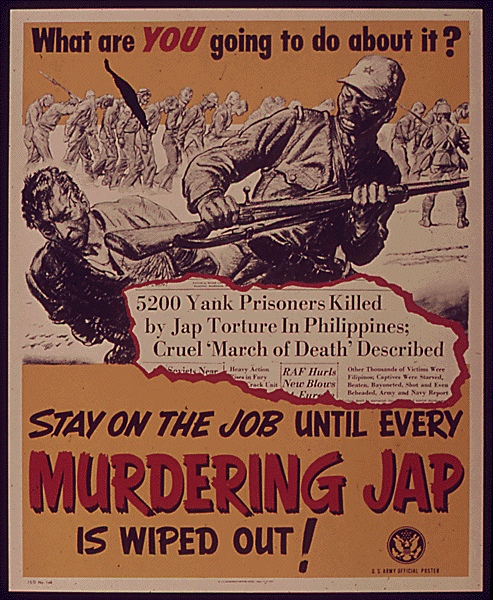 American propaganda and popular sentiment were equally extreme. The official 1945 propaganda film Know Your Enemy—Japan characterized the Japanese as masses without individuality: “photographic prints off the same negative.” The Marine Corps magazine Leatherneck ran a cartoon in 1942 featuring a caricature of a Japanese soldier in a gun’s cross-hairs with the slogan “Remember Pearl Harbor—Keep ‘Em Dying.” A 1944 edition of Leatherneck referred to an insect called “Louseous Japanicas” and foreshadowed future events by saying that “before a complete cure may be effected the origin of the plague, the breeding grounds around the Tokyo area, must be completely annihilated.” A 1942 parade in New York similarly predicted future American actions by featuring a float that showed bombs falling on yellow rats and bore the slogan “Tokyo: We Are Coming.”
Anti-Japan propaganda differed significantly from US propaganda about Nazi Germany or Fascist Italy. Posters, cartoons, and the like generally focused on the European countries’ leaders, with caricatures of Hitler and Mussolini. By contrast, the Japanese people as such were targets of American propaganda. A popular song’s title reflected the contrast: “There’ll Be No Adolph Hitler Nor Yellow Japs to Fear.” Wartime attitudes did not leave room for “good Japanese” as it did for “good Germans.” Leatherneck ran a photo of Japanese killed in the battle of Guadalcanal with the caption: “GOOD JAPS.”
Anti-Japanese sentiment also drew on familiar racist tropes. Propaganda posters featured monstrous Japanese soldiers menacing white women, echoing racist fears about black American men. Simian imagery, frequently applied to black Americans (and sometimes others, such as Irish Americans) in the United States, was also applied to the Japanese. Admiral William Halsey, the commander of US South Pacific naval forces, referred to “yellow monkeys.” Halsey also offered this mission statement: “Kill Japs, kill Japs, kill more Japs.”
Halsey was unusually crude, but other leading American and Allied officials provided their own share of extreme rhetoric. Addressing a joint session of the US Congress in 1943, Churchill spoke of “laying the cities and other munitions centers of Japan in ashes…before peace comes back to the world.” A US naval official involved in postwar planning argued at one point for “the almost total elimination of the Japanese as a race,” emphasizing that “white civilization was at stake.” Government official Paul McNutt gave a speech in April 1945, during the US bombing of Japan, calling for “the extermination of the Japanese in toto.” A significant minority of Americans seemed to agree: a December 1944 public opinion poll found 13 percent of respondents’ favored post-war policy was “kill all Japanese.”
Effects of Racism
The Pacific war pushed existing racism to new extremes. How did such extreme racism in turn shape the conduct of the war?
The US-Japanese War was marked by horrifying violence, not only the bombing of Japanese cities and battlefield violence but also the torture and killing of prisoners, the wounded, and other helpless troops by both sides. Extreme racism presumably contributed to this brutality, although the contribution should not be overstated. The war in Europe was also horrifically violent: German cities were firebombed. Also, while Japanese propaganda did not demonize other Asian nationalities, that did not protect those nationalities from massive Japanese violence.
Nevertheless, one can recognize both other wartime violence as comparable to that between the United States and Japan and other causes of violence apart from racism while still identifying pervasive racism as a factor in the Pacific War’s brutality. US policymakers’ own statements point to such a connection. Secretary of War Henry Stimson thought ignorance contributed to the uncompromising American attitude toward Japan and lamented the “complacency, the indifference, and the silence with which we greeted the mass bombings in Europe, and, above all, Japan.”
Justifying the atomic bombings, Truman made the revealing statement “When you have to deal with a beast you have to treat him as a beast.”
Moreover, the US wartime approach to domestic civil liberties provides a clear example of racism shaping policy. The imprisonment of more than 100,000 Americans of Japanese heritage in concentration camps, on suspicion of disloyalty to the United States, was unambiguously the result of racism. General John DeWitt, the official in charge of the imprisonment, summed up the underlying attitude by saying “A Jap’s a Jap. You can’t change him by giving him a piece of paper.” While some imprisonment and persecution of German-Americans and Italian-Americans took place during the war, it was never on the same scale as with Japanese-Americans.

Postwar Change?
Following Japan’s surrender and the American occupation, violently racist propaganda faded on both sides. While the occupation was deeply violent and unjust in crucial respects, the United States did not pursue “the extermination of the Japanese in toto” and no longer used such extreme dehumanizing rhetoric and imagery toward their former opponents. Paternalism toward Japan replaced hatred, and the United States and Japan have remained allies in the decades since the occupation. The change in attitudes has both hopeful and ominous lessons.
The hopeful lesson is that racist attitudes are not fixed or unchangeable and that even the most toxic racism can dissipate if the political context encouraging it changes. The ominous lesson is that those in power can promote extreme racism that might not otherwise exist if they deem political needs—such as fighting a war—require it.
Consistent life ethic advocates should remember these lessons. We must be on guard against the racist demonization of people our governments designate as “enemies” and insist on recognizing our common humanity. The Pacific War provides a horrifying example of what can happen when such recognition is lost.
====================================
For more of John Whitehead’s posts on World War II and its aftermath, see:
The Wages of War, Part 1: How Abortion Came to Japan
Wages of War, Part 2: How Forced Sterilization Came to Japan
Rejecting Mass Murder: Looking Back on Hiroshima and Nagasaki
Finding Common Ground on and Learning from World War II
Nuclear Disarmament as a Social Justice Issue
A Consistent Day in the Neighborhood
by Andrew Hocking
 While Tom Hanks plays Mister Rogers in the 2019 movie A Beautiful Day in the Neighborhood, the plot centers on a journalist named Lloyd Vogel. When assigned to write a short piece depicting Fred Rogers as a hero, he would much rather uncover moral failure and write an exposé. His cynical approach and Rogers’ authenticity provide insight for the consistent life movement as we engage a pessimistic society.
A Cynical Assumption
As Lloyd protests his assignment to his editor, the audience learns that no other interviewee would talk with him. People knew his reputation and feared that they would be presented in a negative light. Despite knowing this possibility, Rogers agrees to be interviewed.
Lloyd believes the compassionate man on Mister Rogers’ Neighborhood is a character dissimilar from the man playing him. He says “Well, there’s you, Fred, and the character you play, Mister Rogers.” Lloyd hopes to expose that Rogers struggles with the burden of other people’s problems, that he’s motivated by money, or that he didn’t parent like the TV personality would suggest.
Lloyd represents our society. Others perceive low levels of trust in public institutions and other people today. Compounding pessimism with rampant political polarization, people regularly assume the worst of anyone who holds contrary political beliefs.
I imagine that anyone who identifies with the consistent life movement gets frustrated, as I do, every time they see a Facebook friend criticize the pro-life position on the basis that pro-life people only care about life before birth. I just want to jump up and down and say, “I care. There’s a lot of us.”
To make matters worse, many imagine other people to have the most nefarious motives. Many progressives say that conservatives don’t care about the unborn, but only want to control women’s bodies. Many conservatives argue that progressives don’t care about immigrants and refugees, but only want them to become citizens in order to vote Democrat.
What can we do when political opponents want to assume the worst?
A Consistent Authenticity
First, we need a consistently loving political philosophy that protects all life at all stages. To help educate ourselves and others regarding the consistent life ethic, I read and refer people to the Consistent Life Network website as the organization supports the unborn, the prisoner, the refugee, the minority, the foreign civilian caught in a war zone, and even the foreign combatant.
A political philosophy, however, only goes so far. We need to live authentically. I’ve commented in a previous post on Mister Rogers that our belief in the dignity of all people must transcend political beliefs as part of an underlying worldview that affects our every interaction. A Beautiful Day in the Neighborhood highlights Rogers’ consistent authenticity, as he would spend a long time caring for his guests in the studio or fans on the street. As a movement and as individuals, we need to ask ourselves if we’re truly defending everyone or if we are neglecting certain people.
In the example of Vogel’s cynicism, the film reminds us that others will mistrust us. As Vogel had interviewed a lot of people who required an exposé, society has seen a lot of hypocrisy.
Consequently, trust must be earned. It doesn’t help to feel bitter about this burden. Whether we like it or not, we must patiently work overtime to make up for the hypocrisy of others.
For Lloyd Vogel to believe Fred Rogers has compassion for all people, he especially needs to know Mister Rogers cares for him. In every interview together, Rogers naturally turns the conversation back to Lloyd and his feelings. This isn’t a tactic. It’s genuine compassion.
For our political opponents to believe we truly care for all people, they need to know we care for them. This requires respectful discourse, and that we avoid demonizing or assuming the worst about them. It means our attempts to persuade must be motivated by a desire to help others value all life and not by the goal of proving ourselves right.

Imperfect Is Good Enough
As I write all that we need to do, I feel overwhelmed. After all, who could act like Mister Rogers?
Mrs. Rogers, however, shuns describing Fred as a saint, as she explains to Vogel that we can all live like him: “You know, he works at it all the time. It’s a practice. He’s not a perfect person. He has a temper. He chooses how to respond to that anger . . . He does things every day that help to ground him. Reads Scripture, swims laps, prays for people by name.”
We don’t need to attain (or fake) perfection, but we can find peace in humility. Like Mister Rogers choosing to broadcast the footage of himself struggling with a tent, we can honestly reveal our failings as well. Authenticity does not require perfection.
As Fred Rogers endeavored to have compassion for all, let us do so in our personal and political lives. We must show cynics around the world that people can (in the words of one consistent-life-ethic organization) be “pro-life for the whole life.”
============================
Andrew Hocking writes about spirituality in movies, TV, and books and frequently discusses politics from a consistent life perspective.
See more of our posts from Andrew Hocking:
How to Value People Like Mister Rogers
Three Nonviolent Lessons from Dr. Who
How Black Panther Promotes a Consistent Life Ethic
For other posts on movies, see:
Jasmine, Aladdin, and the Power of Nonviolence
Hollywood Movie Insights (The Giver, The Whistleblower, and The Ides of March)
Racism and the Death Penalty
by David Cruz-Uribe, OFS

David Cruz-Uribe, OFS
The death penalty, the state-sanctioned killing of criminals, continues to be a part of the American justice system. While 140 countries have abolished the death penalty in law or in practice, including every other industrialized democracy (except Japan and Taiwan), executions are still regularly carried out in the United States.
Its application, however, is uneven. Most executions are carried out by a handful of states, and in the last 15 years, the death penalty has been abolished by seven states (Connecticut, Delaware, Maryland, New Hampshire, New Jersey, New Mexico, Washington). There is some hope that it will be abolished in two more states, Colorado and Wyoming, in 2020. For supporters of the consistent life ethic, this has all been good news.
History of Racism and the Death Penalty.
But the possibility of complete abolition of the death penalty remains remote. The reason for this is that the death penalty in America is closely linked to another life issue: racism. Racism in America, whether through overt social bigotry or through institutional structures of discrimination and oppression, has long played a role in the death penalty. If we in the U.S. are going to abolish capital punishment, then we need to acknowledge and confront racism in our nation, particularly in our system of justice.
Capital punishment has a long history in the United States. The first execution in the American colonies was in 1608, in Jamestown. The colonies, and then the newly independent U.S. states enacted death penalty laws. An abolition movement waxed and waned, with Michigan being the first state to abolish the death penalty in 1846, closely followed by Rhode Island (1852) and Wisconsin (1853). But for the last 200 years the death penalty has continued and in some places expanded.
In many places, this was because it had become intertwined with slavery and institutional racism. Throughout the old South, the death penalty existed not just to punish the most severe crimes (murder, rape) but as a tool for the oppression and control of the black population. In the 1830s, Virginia punished five crimes committed by whites with capital punishment, but over 30 crimes committed by blacks.
At the end of the Civil War the passage of the 13th, 14th and 15th amendments ended chattel slavery and attempted to bring racial equality, but after the failure of Reconstruction and the resurgence of white supremacy, the law continued to be used to oppress blacks, including the death penalty. Capital punishment, meted out by white judges and all white juries, was applied overwhelmingly to blacks. Between 1910 and 1950, 75% of the people executed in the South were black, even though blacks comprised less than 25% of the population.
The death penalty was complemented by the widespread use of lynching. The Equal Justice Initiative has documented over 4,000 lynchings in the South between 1877 (the end of Reconstruction) and 1950. These killings, the product of mob violence, may seem very different from the legal imposition of the death penalty, but lynching had widespread social approval and often implicit consent (if not outright cooperation) of local law enforcement. It played the same role in practice that the death penalty played in law: terrorizing and oppressing blacks in the name of white supremacy.
The Civil Rights movement brought an end to widespread lynching, and the Supreme Court abolished the death penalty nationwide in 1972. The court ruled that all existing death penalty laws were unconstitutional.”

Tony Masalonis speaks at a death penalty protest in front of the U.S. Supreme Court
The Death Penalty and Racism Since 1976
In 1976 the court reversed itself and allowed executions to resume. Thirty-seven states responded by passing new death penalty laws that they hoped would pass the additional scrutiny that the Supreme Court imposed.
However, in many of these states the death penalty was a relic, used infrequently or not at all. For instance, Colorado, Connecticut, New Mexico, and Wyoming have each had one execution since 1976.
The states most anxious to start executing again were in the South. For forty years, they have made the death penalty a central part of their criminal justice system. Since 1976 there have been 1,515 executions, with more than 77% (1,169) occurring in the 11 states of the former Confederacy. Of the top 10 states in terms of numbers of executions, 7 of 10 are in the South; the other three are the border states (bordering the former Confederacy) Missouri, Oklahoma, and Arizona.
In these states, the racism underlying the death penalty is barely concealed. Multiple examples show the ways in which racism is an integral part of the death penalty, and support for the death penalty, in the South.
A brutal example comes from the case of Clarence Brandley, an African-American man from Texas who was falsely convicted of the rape and murder of a white teenager. Arrested along with a white co-worker, he was told by a police officer, “One of you is going to have to hang for this. Since you’re the nigger, you’re elected.” Brandley spent nine years on death row before being exonerated.
But in every state with the death penalty, both North and South, race plays a role in determining who lives and who dies. Since 1976, 34% of defendants executed nationwide were black (though during this period blacks were only about 12% of the population).
Most capital punishment statutes require the prosecution to establish “aggravating” factors (that is, specific features of the crime that make it especially grievous, such as killing a minor) in order for the death penalty to be applied. But repeated analyses of hundreds of cases shows that the unspoken “aggravating” factor is that the defendant is black.
Successful death penalty prosecutions play upon this latent racism. One method is to aggressively strike potential black jurors. Another is to court media coverage that paints black defendants as monsters or savages, as happened with the Central Park Five. (Though not a death penalty case, it is worth noting that there were loud calls for the defendants, all later exonerated, to be executed.)
The race of the victim also plays a decisive role in determining which crimes deserve the death penalty. In all the cases since 1976 resulting in execution, more than 75% of the victims were white, even though white victims account for only half of all murder victims. Blacks kill whites (approximately 15% of all homicides since 2001) at a higher rate than whites kill blacks (8% of homicides since 2001) but black defendents are executed at a much higher rate. Of all inter-racial murders, 21 in which a white defendant killed a black victim resulted in an execution, while 294 black defendants who killed a white victim were executed. When it comes to the death penalty, white lives seem to matter a great deal more than black lives.
Conclusion
Racism has had a corrosive impact on the justice system in America — so much so that Michelle Alexander entitled her groundbreaking study The New Jim Crow. And this is most apparent in capital cases: who gets arrested, who gets charged, and who gets the death penalty is heavily influenced by the race of the victim and the defendant.
As part of the consistent life ethic, we want to end the death penalty. To do so, we need to acknowledge the fundamental role of racism in sustaining the death penalty, and make ending racism a fundamental part of our work.
======================================
For more of our posts on the death penalty, see:
Why Conservatives Should Oppose the Death Penalty / Destiny Herndon-de la Rosa
Will for Life – Double Down / Tony Masalonis
For more of our posts on racism, see:
Historical Black Voices: Racism Kills
Movies with Racism Themes: “Gosnell” and “The Hate U Give” / Rachel MacNair
Eugenics in Roe v. Wade / John Cavanaugh-O’Keefe