How to Value People Like Mister Rogers
by Andrew Hocking
NOTE: Fred Rogers continues to receive media attention beyond the documentary discussed here. Tom Hanks will be portraying Mr. Rogers in an upcoming movie, “You Are My Friend”
The new documentary, Won’t You Be My Neighbor, reveals how Mister Rogers valued others. If you’ve never watched his television shows, you can still learn from his example and see how a thoroughly consistent life ethic transforms how we view others and even ourselves.
A Deep Consistency
Towards the end of the documentary, the film notes that many people criticized Rogers’ message of affirmation. A few clips, including one from Fox News, argued that telling children they were special led to an entitlement mentality. Commenters proposed an alternate message, “If you wanna be special, you’re gonna have to work hard.” I suspect some of these individuals, especially if they’re on Fox News, would self-identify as pro-life. But doesn’t being pro-life require the belief in human dignity, or being special, apart from our actions? The hypocrisy and inconsistency astound.
In contrast, Rogers presented a consistent political message. In the middle of the Vietnam War, the first week of Mister Rogers’ Neighborhood exposed the folly of militarism (and of building walls due to fear) while also demonstrating successful peaceful opposition. Later, when the news reported a white man pouring acid into a pool with black swimmers, Rogers and the African-American Officer Clemmons soaked their feet together in a children’s pool.

I truly believe the Consistent Life Network (CLN) proclaims a consistent political philosophy, but Fred Rogers’ message goes deeper than politics. Instead, his belief in human dignity was fundamental to how he viewed others and himself. With disdain towards most children’s’ television, Rogers intentionally offered an alternative, not only to violent cartoons, but to any clowning around that makes a person the butt of the joke.
Instead, Mister Rogers affirms, “You always make each day such a special day. You know how—by just your being you. There’s only one person in the whole world like you. And people can like you just the way you are.” In the documentary, the actor who played Officer Clemmons, Francois Clemmons, recollects when he truly realized Fred Rogers loved him just as he is. It took two years of hearing him say it, but when he grasped the affection, Rogers became like a surrogate father to him.
Rogers’ influence flowed from his consistency, his integrity. He truly cared. His compassion and empathy shined in his smile, soft voice, patient listening, and bold proclamations of value.
Contemplating Value
At last year’s CLN conference, my wife picked up a sticker produced by CLN member group Rehumanize International. The sticker featured the word “sonder” and the definition, “the realization that each random passerby is living a life as vivid and complex as your own.” This is worth contemplating, frequently.
In a similar vein, I’m the father of a toddler and I’m continually amazed by him, amazed by the gut knowledge that he’s incomprehensibly valuable. At the same time, I realize it’s not only him. Every person matches his importance.
An ordained minister, Rogers’ spirituality shaped how he viewed others. I am someone who shares his faith, and I believe my feelings towards my son echo only a fraction of how God feels towards each person. I endeavor to purposefully view people as being as beloved as my son.
Let’s not stop short at valuing lives before the law but strive to consistently value others in every interaction. Let us do what we must to ingrain this belief into our thoughts and words.
The Hardest Person to Value
 Perhaps the final step of our consistency is to believe we, as individuals, have value. In one clip, Daniel Tiger confesses to Lady Aberlin that he worries he is a mistake. Politically, we defend the lives of the unborn when others would label them a mistake, but do we secretly wonder if we ourselves are a mistake? Rogers understood how commonplace insecurity is among children as well as adults.
Many of you have worked tirelessly on behalf of those who have been considered expendable. You know they—the unborn, the inmate, the refugee, the minority—have dignity and are worth being fought for. So are you. You deserve the love you’ve poured out for others, and not because of anything you’ve done. You just do.
Some of us need to sonder. Perhaps others of us need to do the opposite and acknowledge our own unconditional dignity as we’ve done for others.
Being a Neighbor like Mister Rogers
Watch or rewatch Mister Rogers Neighborhood. Go see the new documentary.
More importantly, reflect on your value and the value of others. Ground your political beliefs and personal interactions in a deep worldview. Personally, I find that as I seek to know and understand God, I can see others (and myself) from His loving perspective.
Lastly, be like Fred Rogers, and communicate to others that they are valuable, not because of what they do, but because of who they are. In The World According to Mister Rogers, he writes, “As human beings, our job in life is to help people realize how rare and valuable each one of us really is, that each of us has something that no one else has—or ever will have—something inside that is unique to all time.”
Andrew Hocking writes about spirituality in movies, TV, and books and frequently discusses politics from a consistent life perspective.
See also our blog post on his commentary on Doctor Who.
Sinn Féin and the New Legacy of Violence

Maria Horan
by Maria Horan
“The [Irish] State acknowledges the right to life of the unborn and, with due regard to the equal right to life of the mother, guarantees in its laws to respect, and, as far as practicable, by its laws to defend and vindicate that right.”
Inserted into the Irish Constitution on the 7th of October 1983.
Voted to be removed on the 25th of May, 2018.
The North is Next
In the midst of the Repeal voters’ shameful behaviour of dancing and getting drunk at Dublin Castle on the 26th of May, two women laughed delightedly for the cameras and waved a torn piece of hand-written cardboard. The women were the leaders of Sinn Féin (Irish for ‘We ourselves’), the only Irish political party that exists on both sides of the border between the Irish Republic and Northern Ireland. Their names were Mary Lou McDonald, leader of the Southern party and Michelle O’Neill, leader of the Northern party. The cardboard that they both clutched read: “The North is Next”.

Left: Mary Lou McDonald. Right: Michelle O’Neill
In the light of Brexit, it is more important than ever that Irish on both sides of the border work together and forge close alliances. So it would make sense that McDonald and O’Neill would want to work hard to promote peace, tackle the areas of stubborn unemployment and work on abolishing the ‘legacy issues’ that remain after decades of conflict in Northern Ireland, right?
Wrong. On the 26th of May, the only thing that both women were interested in was ensuring that abortion would now be at the top of the social agenda for Northern Ireland.
Both women have only assumed command in Sinn Féin this year – McDonald as Leader and O’Neill as Deputy Leader, so there is a lot for them to live up to. Dublin-born, middle-class, privately educated McDonald who replaced alleged IRA (Irish Republican Army) member Gerry Adams in Sinn Féin leadership earlier this year, could not be more in contrast to the Tyrone-born O’Neill, with her IRA connections: her father was a former IRA prisoner and her cousin is a former IRA member who was shot dead by the British Army SAS in 1997. Though both women have diverse backgrounds, they clearly have become united in their thirst for legal abortion throughout the island of Ireland.
Bloodshed History
Sinn Féin has always been seen as the “public face” of the IRA and it was always a connection that haunted leaders such as Gerry Adams. Though without a doubt this political party has a blood-soaked past, public attitudes have become more tolerant towards the party and they have gained political seats on both sides of the Border, attracting younger members who have no connection to or memory of the years of conflict known as “the Troubles.” Severing the IRA connections in Sinn Féin has helped create a more socially acceptable party.
However, their militant abortion stance has reinvigorated this political party’s history of bloody violence.
Sinn Féin sees itself as the original Republican party, which supposedly continued the fight for independence after the 1916 Rising. The Proclamation read by Patrick Pearse at the General Post Office to inaugurate the Rising included a commitment to “cherishing all the children of the nation equally.” Too many children have died on both sides of the Irish border. Now that peace is emerging in Ireland for the next generation, it is truly ironic that Sinn Féin wants to replace the old bloodshed with abortion, approving of the former colonisers’ methods of such killing.
And yet the Republic was founded so that Ireland would make her own path into the future, not mimic the ways of Britain. Not only do Sinn Féin members approve of the new killing being introduced into Ireland in lieu of guns and bombs — with the method of abortion legalization as the UK did over 50 years ago, they are happy to do it the British way.

Pro-life History
Taking a pro-abortion stance is a bewildering move for any party in Northern Ireland, as people there have always been proudly pro-life. Indeed, it’s been a common ground for people on both sides of the religious divide.
Ian Paisley, loyalist founder of the Free Presbyterian Church of Ulster, once stated to Bernadette Smyth, founder of the Northern Irish pro-life group Precious Life, that he would walk with the Pope to stop abortions. Religion is still widely practised in the North and shops still remain closed on Sundays, with many attending church services. Most people are still educated in faith schools which are very opposed to abortion. So this new attitude makes little sense. Or does it?
Intolerance of “Dissenters”
In recent years, since the tragic death of Savita Halappanavar (which was due to sepsis, not from lack of abortion access), Sinn Féin has become more and more intolerant of its pro-life members, to the point that there is no longer any room for these ‘dissenters.’
Three pro-lifers have made their views public, including Carol Nolan, who was suspended for three months and left the party on the 19th of June to run as an independent TD (Teachta Dála, member of the lower house of the Irish Parliament). In her letter of resignation, she stated that it was unethical to force TDs that are strongly against abortion to vote against their conscience and that there was no longer a place for her in a party that showed no respect for pro-lifers.
The other ‘dissenters’ are Peadar Tóibín, who was also previously suspended and whose future in the party is not yet clear; and Councillor Íde Cussen, whose mother was told by a UK doctor to abort her; her mother rejected this and took her other children back to Ireland, having told Íde’s father (who was still working in the UK) that she wasn’t going back to a country that didn’t respect the unborn. Only time will tell what is the future is for Cussen and Tóibín in a party that has made it explicit it doesn’t tolerate pro-lifers.

Top left: Carol Nolan. Top right: PeadarTóibín. Bottom: Íde Cussen
Three days before Carol Nolan’s resignation, on the 16th of June, the Sinn Féin Ard Fheis (Irish for political party conference) had overwhelmingly voted against allowing its members to have a conscience vote on abortion. One journalist who attended the event commented on its Stalinist echoes in the way that pro-lifers were prohibited from speaking.
Considering the censorship that Catholics had to endure in Northern Ireland during the Troubles, it seems astounding that Sinn Féin should continue such an oppressive regime, thus repressing the free speech of their own members and forcing the outspoken to conform to “groupthink” or be ejected from the party.
Inconsistency
Sinn Féin members see themselves as a “progressive” party, and proponents for a just and equal society on both sides of the Irish border. They are opposed to blood sports and Sinn Fein members responded to the decision to host next year’s Eurovision Song Contest in Israel with condemnations, due to the bloodshed of Palestinians. They are eager to distance themselves from their violent past, but the fact that they can’t see any hypocrisy in their pro-abortion stance is remarkable.
There is much horror and shame on both sides of the border on what went on during Ireland’s fight for independence and the thousands of innocent lives lost. But it now seems that the bombs and guns of a previous generation are about to make way for the abortionist’s tools, to poison, dismember, and dispose of the innocent Irish that have yet to be born.
A number of people “disappeared” during the Troubles, with some victims’ remains never found. And yet ironically, the abortionist will now be legally free to kill and discard all ‘unwanted’ Irish preborn members with the same impunity, disrespect and indifference as displayed during the Troubles, whether the unborn are from the North or South of Ireland, Catholic or Protestant
What’s Next?
On the 7th of July, the all-Ireland Rally for Life was celebrated outside Stormont Parliament in Belfast. Now that the Republic had fallen prey to legalised abortion, many Irish on both sides of the border gathered around to support Northern Ireland against all the forces now pushing for abortion there.
In a brilliant re-take of the original “The North is Next” message, the founder of Northern Irish pro-life Precious Life, Bernadette Smyth, and the Republic of Ireland’s the Life Institute, Niamh Uí Bhriain, were photographed standing in a similar pose:

Many in the crowd waved cards with the same message. As Life Institute commented, many were united, from both sides of the Irish border and both traditions, i.e. Catholic and Protestant rallied together. It would appear that the pro-life movement is becoming united across the island of Ireland in a way that may once have been unthinkable.
====================================
See a list of more of Maria Horan’s blog posts for the Life Institute.
For more information on the Irish pro-life movement, Maria recommends the Life Institute
Right-to-Life Issues in Contemporary Gay and Lesbian Literature

Jeff Koloze
by Jeff Koloze
Note: The post is based on a paper that was to be presented at the University Faculty for Life conference in 2018. The complete paper and bibliography can be found on LifeIssues.net.
Now retired from his most recent position as associate professor at South University, Dr. Koloze continues teaching at various colleges and universities in the metropolitan Cleveland, Ohio area, including Lorain County Community College, North Central State College, and DeVry University.
What is the impact of the gay and lesbian movement on the life issues of abortion, infanticide, and euthanasia? On abortion, I discuss Chelsey Johnson’s Stray City (2018). Infanticide is considered in Angelina Weld Grimké’s “The Closing Door” (1919). On euthanasia, there are several novels regarding AIDS patients and the absence of euthanasia as a solution to the pain and loss of dignity created by the disease. Finally, I offer questions from a right-to-life perspective.
Abortion
Gay and lesbian literature provides several interesting passages.
 For example, Chelsey Johnson’s Stray City is a remarkable deflection from the the aggressively pro-abortion perspective commonly found in the gay and lesbian community. While Angela Morales, the lesbian main character, cannot account for her attraction to the eminently masculine and heterosexual Ryan, she has sex with him enough to become pregnant.
Reminiscent of Hemingway’s famous short story about abortion, the following passages reflect Angela’s anguish in choosing either abortion or carrying the pregnancy to term. In this first passage, Angela recounts her experience with a Planned Parenthood clinic:
The receptionist suggested I bring a friend or partner for support. I said, “I’ll be fine.” I wanted it out, quick. The sooner it was gone, the more over this would all be. I was done with affairs. I was done with faking it. I was done with secrets. It was time to clean up my mess, all by myself. In five days I would expel this last trace of Ryan from my life. He didn’t even need to know. No one did. I would box up the whole weird affair and store it in the farthest corner of the attic. Better yet, recycle it. (italics in original)
In this next passage, a change in Angela’s attitude slowly emerges, when she perceives the barest of fetological facts:
I borrowed Summer’s dog-eared purple copy of Our Bodies, Ourselves. The embryo was probably the size of a lentil or maybe a pea. That was nothing! A mere legume. It hardly even existed. Five days couldn’t go quickly enough. I was seized by the urge to eradicate, eradicate.
Angela reviews her circumstances and reaches an ineluctable conclusion:
That night in bed, I lay on my back and rested my hands on my abdomen. Of course it was too early to feel anything. But I knew it was in there.
“You and me,” I whispered in the dark. Two selves. “Do yu think we could do this?”
Infanticide

Lorna Raven Wheeler
Lorna Raven Wheeler has adroitly connected a significant passage in her research on an infanticide short story by Angelina Weld Grimké, “The Closing Door” (1919), with the gay and lesbian movement. Grimké’s short story concerns the infanticide of a newborn whose mother has learned about the lynching of her brother. Speaking of the main character Agnes, Wheeler writes:
While she may be nearly singular in her decision to commit infanticide, her anguish is the anguish of black women in the face of this kind of violence [the lynching of her brother]. Her emotion is read in the staccato of her exclamations
“Yes!—I!—I!—An instrument!—another one of the many! a colored woman—doomed!—cursed!—put here!—willing or unwilling!—for what?—to bring children here—men children—for the sport—the lust—of possible orderly mobs—who go about things—in an orderly manner—on Sunday mornings!”

Angelina Grimké
Arguably, this passage, not the description of the lynching, is the most important speech of the story. Certainly, it is the most emotional. The punctuated outbursts and the use of the dash and the subsequent lower-case phrases present Agnes’ horror and anguish clearly. Even more interesting are Grimké’s words themselves. This passage is the key to Grimké’s take on birth control. She argues, through Agnes, that it is the reproductive “instrument,” the mother of “men children” who, among women, suffers the brunt of lynching. (italics in original).
Euthanasia
What’s striking in the gay and lesbian literature is the absence of assisted suicide, physician-assisted suicide (or its more accurate form, physician-assisted death), euthanasia, or any variant. It can be presumed, therefore, that gay and lesbian fiction neither endorses nor suggests euthanasia as a recourse for persons suffering from AIDS. Rather, gay and lesbian fiction illustrates not only compassion between persons with same-sex attraction whose sexual lives are affected by AIDS, but also hope that that the time remaining for the person who has AIDS would be maximized so that the partners would enjoy each other’s company for as long as possible.
 One scene in Tim Murphy’s Christodora (2016) illustrates these generalizations well. In the following passage, Hector expresses his anger at his lover Ricky, for not seeking treatment:
“The thing with you, Ricky,” he continued to himself, mumbling parts aloud, “you just didn’t want to live. That’s why I say fuck you, as harsh as that sounds. Because you didn’t even care that there were two people involved, not just you. You put me through that for, unh, what would that have been, from about 1989 when I first knew until ’92. You wouldn’t get tested, you wouldn’t go on meds until they forced you on meds in the hospital and it was too late ….] and then I had to watch you die, like I didn’t have better things to do that year.”
Right-to-Life Questions
These themes can be applied as questions to any work of literature, especially ones which address the life issues.
- How does the literature treat the pricelessness of human life?
Gay and lesbian literature doesn’t deny this principle. Many narratives support this principle; otherwise, the literature would offer numerous accounts of the degradation and killing of human beings.
- Does the literature recognize that the individual is a being with inherent rights, the paramount one being the right to life?
Most gay and lesbian literature acknowledges the importance of the individual and his or her right to exist. Rarely does gay and lesbian literature speak in generalities about love for humanity; rather, it’s affection, friendship, or love (whether erotic or one of the other categories) of a particular person.
- Does the literary work comport with the view that unborn, newborn, and mature human life has an inherent right to exist?
This can only be temporarily answered “yes” here (see my full paper). More material needs to be investigated to see if the gay and lesbian literature answers this question sufficiently.
- When they are faced with their mortality, do the characters come to a life-affirming perspective?
Persons dying of AIDS must not only face their mortality, but do so often under their own pain and the emotional pain of those who love them.
Some gay and lesbian literature, especially that involving the death of a lover or general reflection on AIDS affecting the entire gay community, often illustrates characters who desire not merely genital activity, but authentic love. This search is a common theme in the literature.
Defining Reproductive Justice: An Encounter
by Julia Smucker
Among the overwhelming plethora of workshop options at this summer’s Wild Goose Festival, one in particular piqued my curiosity – not in the sense of appearing purely edifying, but as something that might be worth an effort to engage from a Consistent Life perspective. Titled, “Reproductive Justice Is _______: Moving Beyond the Pro-Choice/Pro-Life Binary,” the description read:
This interactive conversation will offer a variety of diverse perspectives and practices around the issues surrounding reproductive justice. Looking beyond the pro-choice and pro-life binary, the conversation partners will include abortion doulas, members of a collective that agitates for childcare in movement spaces, and labor activists advocating for a higher minimum wage. Rather than focus solely on abortion, the goal of this conversation is to engage the full spectrum of issues related to Reproductive Justice, which means engaging the many social injustices that people face when making decisions about their reproductive health.
 Aside from the shocking term “abortion doulas,” and the off-the-mark framing of the abortion debate as a “binary” to be reconciled rather than as principles of justice and nonviolence to be expanded, the talk sounded potentially oriented toward a search for common ground by addressing, and hopefully broadening, interconnected issues. There was, in the end, some common ground to be found, although it took more digging than the above description might suggest.
Tragedy or Celebration?
Initially, the broad definition of “reproductive justice” as including things like just working conditions, fair and equal pay, and medical and parental leave struck a hopeful note. But the vibe among the three co-presenters quickly went beyond being even pro-choice to an explicitly celebratory view of abortion. To me, the most tragic element was one of them mentioning having moved away from talking about abortion as tragedy, and even about the consistent life ethic, even while she admitted that this made it harder to reconcile her own positions on life issues.
There was a similar dissonance in the way their abortion-positive view was presented in the context of working with women in difficult situations. Even if one were to set aside, for the sake of argument, the obvious tragedy in any premature loss of life, would it not be a tragedy when other tragedies or injustices make abortion seem necessary?
They tried to resolve this tension by acknowledging yet minimizing the unpleasantness of abortion as simply “an ordinary bad time.” One woman also affiliated with the presenting group later acknowledged the trauma of her own past abortion, having “felt the baby pull away,” and the years of counseling that followed. An audience member sporting a Planned Parenthood t-shirt followed this by declaring she had been “overjoyed” at having an abortion as a student, because she was able to finish school.
Root-Cause Utopia?
Of course, having to choose between one’s child and one’s education or career is itself an injustice that people on both sides of the abortion debate can acknowledge. Here, however, the idea of ending the demand for abortion through factors such as economic and gender-based injustice was dismissed as unattainably utopian.
 When they took questions, I asked them, given their implied acceptance of the inevitability of those injustices, how they would respond to similar arguments dismissive of attempts to prevent other social problems such gun violence, poverty, racism, or gender discrimination.
One presenter responded that she did not believe such arguments followed the same logic, without providing much explanation for this belief, while another added that a pregnancy situation is the only time people are required to care for others.
One could certainly think of any number of situations where someone might feel a need or an obligation, at least in a moral sense, to care for another. Yet, to the extent that the presenter’s statement is true, it is a poor reflection on a culture of individualism, in which the need – and sometimes, consequently, the right – to care for or depend on others is sadly undervalued.
Acknowledging Tensions
They arrived at a somewhat more satisfactory answer when another attendee, voicing respectful disagreement, asked about reconciling advocacy for abortion with advocacy for the disabled, people of color, and others who frequently experience discrimination before and after birth.
One of the self-described abortion doulas admitted that a long-time sticking point for her was, in her own phrasing, “people aborting girls.” Referring to requests for abortion “because it’s a girl, and my husband won’t approve,” and acknowledging at least such sex-selective abortion as tragic, she walked back some of the earlier defeatism about addressing root causes by calling on all present to work at bringing about “a world where men don’t do that” – a line that drew universal applause, including from me.
 The most hopeful part of the workshop came after it officially ended. I had noticed several signs displayed by the presenting group proclaiming things like paid family leave (another case of the need to care for another) and freedom from violence (ironically) to be reproductive justice. As justice issues connecting basic human needs to the care of children, both before birth and long after, these were definitions of reproductive justice I could get behind
My enthusiasm for this messaging sparked a bit of spillover conversation, and we agreed on the need for such conditions that one shouldn’t have to choose, for example, between one’s child and one’s livelihood, or between the (at least) two lives of equal worth in any pregnancy: the child and his or her mother.
They expressed some surprise at hearing someone who is pro-life talk about respecting the lives of both mother and child, let alone about Consistent Life Network member groups such as Feminists for Life or the Pro-Life Alliance of Gays and Lesbians (I offered a flyer we had from the latter group to a presenter who had taken a specifically LGBT angle, which she happily received).
Despite earlier declarations of the futility of trying to eliminate certain injustices that drive abortion, in the end they agreed that this is something we can, and should, all be working toward. And that in itself was worth the encounter.
The Wages of War: How Abortion Came to Japan
by John Whitehead
“I hate Japs. I’m telling you men that if I met a pregnant Japanese woman, I’d kick her in the belly.”
— Remark attributed to Admiral William Halsey, commander of U.S. naval forces in the South Pacific during World War II
“Tsubachan, I’m sorry I couldn’t give birth to you. I would have loved to put my arms around you even once…Please go to heaven and live happily there. Your Mother.”
— Note left in Buddhist temple in Japan, c. 1980s
The conflict between Japan and the United States during World War II is remembered for its extraordinary brutality, culminating in the (to date) only wartime use of nuclear weapons, on Hiroshima and Nagasaki. Admiral Halsey’s alleged remark exemplifies this brutality.
By contrast, the post-war American occupation of Japan and Japan’s subsequent history superficially offer a more benign picture of American-Japanese relations. The U.S. helped rebuild its former enemy and establish democracy, while Japan became an exceptionally prosperous nation, rivaling its one-time conqueror.
Beneath the surface, however, the American-supervised reconstruction of Japan had a far more sinister side. A crucial change was legalizing abortion, 70 years ago this summer, leading to the deaths of millions of Japanese children. This alteration, which resulted from war and its consequences, wasn’t a break with wartime violence but a continuation of it. It effectively realized Admiral Halsey’s purported anti-Japanese boast far beyond what he could have imagined.
War Clouds Don’t Dissipate
 The political scientist Tiana Norgren recounts the evolving status of abortion in Japan in her book Abortion before Birth Control: The Politics of Reproduction in Postwar Japan. Before World War II, abortion was illegal in Japan. Prohibiting abortion was in Japan’s first modern penal code of 1880. Japanese laws and public policies meant to discourage abortion date back even further – in 1667, the shogun, Japan’s military ruler, restricted abortion advertising. Early in the 20th century, certain Japanese groups argued for legal abortion, but made little progress. Doctors were permitted in 1923 to perform abortions to save the mother’s life, but this was about the extent of the change.
Concerns for an unborn child’s life played a role in historical Japanese abortion opposition. At times, Japanese officials had condemned abortion, along with infanticide, as murder.
Yet nationalism also played a role. A large population was seen as necessary to national strength and imperial conquest. Official government policy in the early 20th century encouraged population growth. During the war, from 1941 to 1945, the number of reported abortions fell, from 18,000 to 1,800.
Nevertheless, national ambition predictably proved a less reliable protection for the unborn than concern for human life. Defeat in World War II brought a dramatic change in Japan’s fortunes and the accompanying attitude toward abortion. The war shattered Japan’s economy. Industrial and farm production were devastated, Japan could no longer import resources from its former Asian colonies. Millions were at risk of starvation. American bombing had not only killed roughly 400,000 Japanese but also destroyed a fifth of Japanese housing, leaving millions homeless.
Abortion for Population Control
Japan’s population increased during the immediate post-war years, both because of high birth rates (which peaked in 1947) and because of all the soldiers and civilians sent back home from former colonies. Japan’s population grew from 72.2 million to 83.2 million in five years. Although American aid prevented starvation, post-war policymakers faced a longer-term problem: how to manage such a large population in a now-impoverished country.
The notion of using abortion (and other methods) to control Japan’s population was raised in November 1946 by a group advising the Japanese government on population policy. The next year, socialist members of the Japanese Diet [parliament] introduced a bill to allow abortion in various circumstances. Kato Shizue, one of the bill’s sponsors, justified these means by economic necessity: “I believe that the voices of today’s women [are saying] ‘We want to have our beloved children in a little while, once the problems of housing, fuel, and food have eased up.’”
The 1947 bill didn’t pass, but the decisive step came the following year. Another Diet member, Dr. Taniguchi Yasaburo, an obstetrician/gynecologist, introduced the Eugenic Protection Bill. Its stated purpose was “to prevent the birth of eugenically inferior offspring and to protect maternal health and life.” The bill legalized abortion under certain conditions, including if the pregnancy resulted from rape or if the mother or her husband had a “mental illness, mental deficiency, psychopathic disorder, hereditary physical ailment or a hereditary physical deformity.” Taniguchi emphasized the eugenic theme in public statements, warning of increasing numbers of “insane and [congenitally] blind persons” and “imbecile child vagrants.” He promised the proposed law would “prevent the births of 800,000 undesirable elements.”
The bill passed in July 1948, becoming the Eugenic Protection Law, and opened the door to further expansions of Japanese abortion access. Concerns about Japan’s economy grew. The prime minister declared in May 1949 that partly “to surmount the stringent economic times,” the Japanese must “practice the principles of birth control.” That same month, Taniguchi, invoking the need “to curb the rapidly increasing population,” sponsored an amendment to the Eugenic Protection Law, which allowed abortion if “the continuation of pregnancy or childbirth is likely to seriously harm the mother’s health for physical or economic reasons.” The amendment passed, dramatically increasing abortions.
The American Occupation
What was the role of American occupation authorities in abortion’s legalization? Officially they were neutral. An internal occupation document stated “any expression of opinion by [occupation authorities] with regard to general population policy would be interpreted as an unwise imposition of Western ethical, religious or social ideas upon an essentially different Oriental civilization.”
Nevertheless, Americans feared overpopulation as a threat to post-war reconstruction and desired a decreased Japanese birth rate. General Crawford Sams, head of the occupation’s Public Health and Welfare section, may have urged Taniguchi to introduce the Eugenic Protection Law. In January 1949, Dr. Warren Thompson, a demographer advising the occupation, warned, in comments widely reported in the Japanese press, that Japan must curb its population growth to avoid Communism’s rise or the U.S. cutting off aid.
Americans might also have contributed to the push for abortion in a very different, more personal way. The presence of 600,000, later 200,000, Allied troops in a beaten, poverty-stricken Japan led to rampant liaisons with Japanese women.

Not all these relationships were consensual. An estimated 40 rapes and assaults on Japanese women occurred per day in the second half of 1945 and rose to over 300 per day by early 1946. This increased the likelihood of distressed pregnancies.
Most important, American authorities did nothing to stop abortion’s legalization in Japan. Although they criticized the advisory group’s 1946 policy recommendations, authorities allowed the introduction of the 1947 and 1948 bills. By contrast, the Americans vetoed 1948 regulations to discourage contraception. Non-intervention proved less important than population control.
Americans might also have been reluctant to stop abortion legalization because they believed, as one internal document said, “As modern contraceptive knowledge is disseminated . . . it is believed that the provisions for abortion will become of little consequence, as they will fall into disuse.” This prediction proved wildly inaccurate.
Abortion Numbers Grow
Reported abortions rose steadily, from 264,104 in 1949 to 489,111 in 1950, 805,524 in 1952, and 1,068,066 in 1953. Between 1955 and 1960, 1 million abortions were performed annually — 662 to 716 abortions per 1,000 live births.
Official statistics were probably underestimates. Performing abortions was lucrative. Japanese ob-gyns underreported the counts to avoid income taxes. Researchers at a Japanese hospital estimated the actual number in 1953 was between 1.8 and 2.3 million.
To put these numbers in perspective, consider: even with low official statistics, a single year of abortions killed more than twice as many Japanese as the American wartime bombing campaign. Two or three years of abortions killed as many Japanese as died in the entire Second World War.
Nevertheless, legalizing abortion fulfilled Japanese and American policymakers’ plans to curb population growth. The average number of children born plunged in the years after the Eugenic Protection Law, from 4.54 in 1947 to 2.04 in 1957. This was a greater drop than in the previous 25-odd years (from 5.24 to 4.54) or subsequent 30-odd years (from 2.04 to 1.38).
Abortion likely played the primary role in cutting births. Contraception was less readily available in this period and after (in contrast to the ob/gyn lobby’s support for abortion access, advocacy for contraception was far weaker and less organized). Abortion became part of Japanese culture. In the late 1950s, a Housewives’ Federation official said young women would get abortions “like they were going to get a perm” and many women had repeat abortions.
Coping
Widespread abortion did create a need to cope with the act’s psychological consequences. Centuries-old Buddhist practices of mourning aborted children, known as mizuko (“water child” or “unseen child”), have been a significant part of post-war Japanese society.
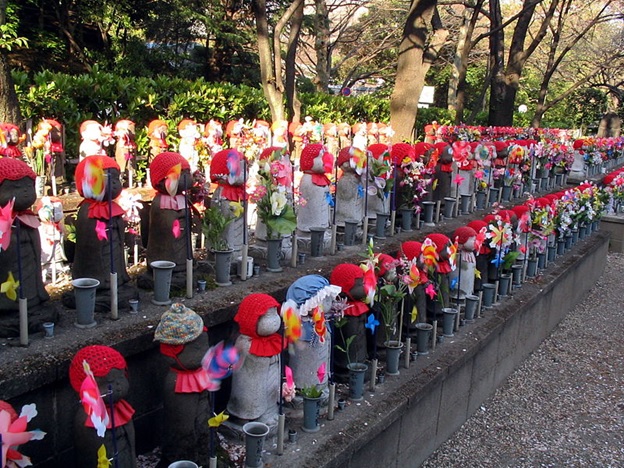
Jizo statues
Samuel Coleman, in Family Planning in Japanese Society, notes that several shrines to Jizo, the guardian of aborted children’s souls, have been constructed in Japan since World War II, three in Tokyo-area temples. A common practice is for mothers who have had abortions to place small Jizo statues at these shrines, in memory of their children. The Hase Temple in Kamakura began offering such statues to worshippers in 1974; three thousand statues marked the temple grounds by 1976.
One reporter described these mourning rituals from the 1990s:
They dress up the mizuko figurines like little newborns, wrapping them with bibs, hand-knit sweaters, booties or hats against the cold. And they pour water over the childlike figurines to quench their thirst.
“I pray for its spirit to safely enter the other world, which it can’t do easily because it died from my own negligence, my mistakes,” said a middle-aged Japanese woman who has been coming for the last 10 years to comfort her mizuko jizo.
The father of an aborted child commented, “The fact that you have murdered someone will be with you all your life — it will not disappear.”
Clouded Future
Viewed 70 years later, the Eugenic Protection Law (revised as the Maternal Protection Law in 1996) appears to have fulfilled post-war policymakers’ intentions all too well. Japan’s birth rate is now so low—fewer than one million Japanese children were born in 2016, in a country of 127 million—that the country’s future is clouded. Japan’s population is projected to fall by one-third in 50 years, when almost 40% will be over 64 years old. The country is now grappling with labor shortages and elder care costs.
The growing elder population means more Japanese must fend off neglect and loneliness. Cleaning out apartments of elderly people who died alone is now a professional specialty in Japan. Chieko Ito, a 91-year-old widow whose only daughter pre-deceased her, observed “If this child were here now . . . there would be nothing to worry about.” Of how many other children, who were killed before birth, could that also be said?
Japan isn’t unique in having low birth rates and an aging society—many nations face similar conditions. Nor, of course, is Japan the only nation plagued by abortion. Japan is striking, however, for the extent to which low birth rates are the result of abortion becoming legally available.
In contrast to many other countries, legalized abortion in Japan was the direct result of war. We can see that the now 70-year-old Eugenic Protection Law, even more than the bombs dropped at Hiroshima and Nagasaki, has proved to be a weapon of mass destruction.
Would My Grandparents Have Died in the Pogroms?

Lisa Stiller staffing a table
by Lisa Stiller
As I watch the events that have unfolded over the past several weeks, I can hardly believe I live in the same country as I did a year and a half ago. No, things weren’t perfect before. Our immigration system was broken, and the process used for granting asylum and refugee status was cumbersome, time consuming, and not carried out with much consistency or compassion.
But over the past 18 months we have sunk to a low that I never thought we could get to. Instead of trying to wrestle with the immigration system’s problems, which is at least what we were trying to do before, there has been a very concerted, intentional, overt effort to reverse course. The current administration is intent on doing what it can to turn our country back to other times when we closed our doors and sent migrants and refugees to their deaths.
Watching the administration actually take the children of undocumented immigrants away from their parents, place them in detention centers (some of which had the appearance of cages, as they were surrounded by chain-linked fences), and give parents very vague, if any, information about the location of their children was shocking. The reversal of the child separation order has been followed by a policy to just incarcerate all undocumented immigrants, contrary to the 1997 court ruling called the Flores Agreement that prohibits detaining immigrant children for more than 20 days. Since according to that ruling the detentions are illegal, Republicans in Congress have proposed legislation that could make this detention indefinite. Now the administration wants to take away due process for asylum seekers and immigrants. Meanwhile, over the past year and a half, U.S. Immigration and Customs Enforcement (ICE) has rounded up tens of thousands of people, documented and undocumented, who are working hard to support families, get an education, and live productive lives.

This subject has personal significance for me. My grandparents came to this country in the very early 20th century, most likely fleeing persecution and lack of economic opportunity in eastern Europe. They got here before the immigration restriction laws of 1921 and 1924, which ended what was (except for Asians) a relatively open immigration system. Like today, these anti-immigrant policies were largely the result of rising nationalism, fueled in part then by the Ku Klux Klan. The quotas put in place by these acts especially affected immigrants from eastern and southern Europe. Immigration quotas for various countries were set at 2% of the number of Americans in 1890 who had been born in those countries. These quotas intentionally discriminated largely against Jews, Italians, and other people with origins in eastern and southern Europe. These acts removed protections for immigrants who had been fleeing religious and political persecution, a population that consisted largely of Jewish refugees escaping the pogroms of eastern Europe.
What if these laws had been in place earlier? Would my grandparents and their parents have died in the pogroms?
The immigration restrictions of the 1920s had terrible consequences later. In the 1930s, when the world knew what was happening to the Jewish people in Germany, America closed its doors. We have all heard of the St. Louis, a ship carrying over 900 Jewish refugees, which after being turned away from Cuba and the United States, brought its passengers back to Europe, where hundreds perished. Hundreds of thousands of Jewish refugees fleeing Germany and Austria were not able to come to the United States. A large number of these refugees probably perished. It’s likely that some of my distant relatives were among them.
The parallels are mind-boggling. Asylum seekers from Mexico and Central America have been coming here fleeing persecution, violence, and poverty for decades. In 1965, quotas were placed on Latin American immigration for the first time under the Immigration and Nationality Act. Yet immigrants from Mexico and Central America continued to come, if not legally, then as undocumented immigrants; the need for cheap labor kept enforcement inconsistent. But over the years, efforts have grown in Congress to address the continuing flow of undocumented immigrants, while the immigrants keep arriving in the United States, still fleeing persecution, violence, and poverty, many from countries experiencing violent civil unrest and exorbitantly high crime rates.
And in addition, the present administration has attempted to enact travel bans and restrict immigration, as in the 1920s, from countries where people are fleeing from wars and poverty that leads to death by starvation and illness. Trump campaigned as a hard liner on immigration and is fulfilling what he sees as his promise to his base by enacting executive orders and policies that are cruel, inhuman, and racist.
As we once again try to close our doors to people seeking asylum and refuge, turning them back to possibly face persecution or death in their countries of origin, I’m stunned to see us moving backwards in time. Where is our sense of compassion, decency, and humanity? The last I heard, the Statue of Liberty still says “Give me your tired, your poor, /Your huddled masses yearning to breathe free.” According to U.S. law, immigrants who apply for asylum cannot be deported back to countries where they face torture or serious human rights violations. And Article 14 of the Universal Declaration of Human Rights says “Everyone has the right to seek and to enjoy in other countries asylum from persecution.”
Let’s not accept a repeat of 1930s America when we were responsible for the deaths of hundreds of thousands of European refugees trying to flee Nazis in Europe. We have been hearing stories of the deaths and arrests of immigrants we have sent back to their countries over the past decades. And who knows what the immigrants fleeing the violence of the Middle East and Africa, and unable to find refuge anywhere but immigrant camps, are facing.
Middle Eastern, African, Central American, and Mexican immigrants coming to the United States seeking refuge and asylum and escape from poverty must be welcomed. Congress has failed to pass humane immigration laws, and the election of an overtly racist president has allowed this failure to give rise to the present-day horrors we are seeing play out at our border and around our country.
This is why I cannot remain silent.
========================================================
See the list of all our blog posts, put in categories.
The Future of Fake Social Conservatism
by James R. Kelly
James R. Kelly is a professor emeritus of sociology at Fordham University.

Susan Bevan (left) and Susan Cullman (right)
Susan Bevan and Susan Cullman, co-chairwomen of the political action committee Republican Majority for Choice, wrote a much commented-on op-ed in the June 24 New York Times entitled “Why We Are Leaving the G.O.P.” For their abandoned party, for the upcoming elections, and for responsible thinking about abortion, I thought it highly significant that Bevan and Cullman never ask the key political question, “Why did the Republican Party come to support opposition to abortion in the first place?”
The Republican Pro-abortion Tradition
After all, Ronald Reagan brought legal abortion to California when he was governor, Nelson Rockefeller did the same in New York, Barry Goldwater became an outspoken advocate for abortion, and Donald Trump’s anti-abortion advocacy (let’s be civil here) is belated. Meanwhile, the first political allies for abortion opponents (just check the congressional record) were mostly Democrats.
After all, support for legal abortion is utterly congruent with Republican fiscal conservatism, which includes a plethora of positions dovetailing with access to completely legal abortion, such as unrestricted economic markets, limited federal regulation, limited government interference in business, and no support for families that have children they can’t afford.
Why the Change?
Let’s succinctly answer the unasked Bevan-Cullman question: Republican fiscal conservatism loses elections; social conservatism wins elections.
Republican fiscal conservatives can’t win elections unless they attract the votes of the non-wealthy, who are more likely to be social conservatives who think that the government has responsibilities to contribute to the common good. This includes the needs of family and children for health care, schooling, job training, and support for those with disabilities.
We’ll soon see if fake social conservatism can continue to win elections. As our history teachers insisted, if we don’t remember the past we won’t understand the present. So, let’s do a brief memory check of the contemporary abortion wars.
 The pro-life movement’s initial post-Roe v. Wade political hopes resided largely with the Democratic Party, which included a disproportionate number of Roman Catholics. Ellen McCormack, the housewife leader of the Long Island, NY, “Women for the Unborn” ran a knowingly quixotic 1975 campaign for president in twenty Democratic state primaries. Regarding abortion opposition, the Republicans were politically passive but also politically attentive to the fact that powerful grassroots mobilization contesting legal abortion had outlasted the 1973 Supreme Court decision legalizing abortion.
Among his presidential campaign promises Ronald Reagan included efforts to reverse Roe. The Republican elite was not pleased. In her 1996 “insider’s” account of this period, The Republican War Against Women, Tanya Melich reports that the 1976 Republican Convention delegate vote to include an anti-Roe constitutional amendment in the party platform was scheduled after midnight, with debate limited to four speakers. There was no state roll-call on the proposed amendment. The convention chairman, John Rhodes, called for a voice vote and then immediately declared Convention approval for the unlikely Republican position of reversing legal abortion, thus conflicting with what all previous polls of Republican voters and donors had shown, namely that fiscal conservatives are overwhelmingly social liberals, conjoining unrestricted legal abortion with free trade and consumer choice.
It’s the opposite with social conservatives. Polls have shown that the second most common reason women give for abortion is that they can’t afford the baby. It’s harder to welcome new life when life itself seems unwelcoming to parents if they face cuts to medical care, growing economic inequality, and job insecurity. It’s significant that the subgroup with the highest abortion rate is also the subgroup with the highest rates of disapproval of abortion – Black Americans.
Although for most Republican office seekers the best abortion word is “mum,” prominent pro-choice Republicans abound – think Arnold Schwarzenegger, Christine Todd Whitman, George Pataki, and the never-fully-disappeared Rudy Giuliani.
Republican Party fiscal conservatives can be expected to continue to attract the votes of working class and lower-middle class moral traditionalists – the “Reagan Democrats” the Party sorely needs. However—and this is key—they can do this only by supporting moral-social issue positions that require no appreciable tax revenues, such as school prayer, the teaching of creationism, and the promotion of conservative Supreme Court justices.
Where Are We Now?
Let’s look at the now-dominant issue of the future Supreme Court. At first glance it would seem that President Trump’s opportunity to replace retiring Anthony Kennedy with Brett Kavanaugh, a fifth conservative judge, thereby making it possible (though not inevitable) to reverse Roe v. Wade, will ensure that a significant number of “Reagan Democrats” vote for the party Bevan and Cullman have abandoned. But politics is tricky, especially Republican abortion politics. So, let’s give some space to another insider’s revealing account of Reagan’s not-so-exemplary fidelity to his campaign promises to oppose abortion.

Douglas W. Kmiec
Douglas W. Kmiec directed the Office of Legal Counsel during the first Regan administration, and he observed that while the Justice Department contested Roe’s extension of the privacy doctrine to abortion and promoted a state’s right to protect the unborn after viability, the Reagan administration briefs never explicitly challenged a right to legal abortion (detailed in Kmiec’s 1992 book, The Attorney General’s Lawyer). Here’s why: Kmiec recalls that on numerous occasions he was unsuccessful in persuading the Reagan Justice Department briefs to use the term “prenatal life,” rather than using the Roe Court’s phrase “potential life.” Kmiec ruefully recalled that his effort to explicitly raise this core right to life principle in the Reagan administration’s Supreme Court abortion law interventions resulted only in finding himself “out of the loop.”
While Kmiec’s account is complicated, it again shows the altogether simple point that social conservatives can’t trust fiscal conservatives to embrace their pro-life aspirations to help women bravely choose life rather than abortion. Both hard empirical facts and prayerful hopes point to the efforts of the just over 20-years-old Democrats for Life of America to win back the Reagan Democrats and to the even more central efforts of the Consistent Life Network.
The stakes are high, and not just for this year’s midterm election. The effort to continuously challenge American society, to grasp the connections among the violence of abortion and the violence of poverty, and the violence of war, will take several generations.
================================================
For more of our blog posts from Jim Kelly, see:
The History of Framing the Arguments
See the list of all our blog posts, put in categories.
Does Planned Parenthood Reduce Abortions by Preventing Pregnancies?
by Rachel MacNair
We’re aware of people whose hearts sincerely ache at the killing of unborn children, and who take action to educate about the horrors of abortion and otherwise try to prevent it, who ask: if PP is a major provider of contraception, and this prevents pregnancies, doesn’t PP therefore prevent abortions? PP certainly declares so.
Many consistent-life sympathizers are most familiar with the peace and social justice movements, and PP advertises its views in these movements’ venues quite effectively. So we have sympathizers who wonder if cutting off funds to PP wouldn’t actually increase abortions, as PP claims.
One point is that re-allocating the funds elsewhere, as opposed to simply cutting them off, helps address this concern. We at the Consistent Life Network are working on this directly with our campaign of finding good health-care alternatives already available near each specific PP location, and where those are insufficient, encouraging pro-lifers to think of establishing such alternatives or improving those available.
Yet there’s more to the story.
Is PP a Major Provider of Family Planning?
PP currently has roughly 600 locations in the United States, according to the listings on their own website.
There are thousands of Community Health Centers, and thousands of Rural Health Clinics, and they’re only some of the sources for family planning and similar services.
So PP’s contribution is relatively small. If the federal taxpayer money spent on PP were spent elsewhere, there’s plenty of elsewhere to spend it.
The major sources of PP’s taxpayer funding are Title X and Medicaid. Title X family planning grants go to different medical centers to help them provide family planning. Medicaid pays directly for services received at whatever eligible place the patient chooses to go. Most Title X grants and Medicaid payments right now go to medical facilities not associated with PP.
(If you’ve heard a higher figure for how many PP centers there are, other figures are outdated. In 2017 alone, PP centers had a rush of closings – 32 closed, mainly in rural areas, with 5 opened, mainly in large urban areas.)
Is PP a Major Provider of Women’s Health Care?
Here’s a statistic for pap smears, and other forms of medical care have similar ratios:

More than this, though – PP’s women’s health services have been dramatically declining in recent years:

Graphic from screenshots of video: Le$$ Care, No Matter What
For recently updated figures, see their new chart/fact sheet.

PP’s Abortion Priority
Of the roughly 600 PP locations, around 350 do surgical and chemical abortions, as listed on their own website. Though sources differ on how many abortion clinics there are overall in the U.S., we know there are well under a thousand. So we know that, unlike their small share of contraception availability, PP is responsible for a very large portion of abortion availability.
The remaining roughly 250 PP centers all refer for abortions – usually to the nearby PP abortion center within their own affiliate (set by region). All affiliates have at least one abortion center.
PP is a major political force for abortion. Money is fungible, and any they get from taxpayers will end up in abortion advocacy indirectly. The pro-life movement is at a major disadvantage in its work because of this huge behemoth getting millions of dollars.
PP pushes abortion internationally, too.
But, Still – Doesn’t PP’s Contraception Work Lower Abortion?
Not according to any empirical studies; see Chapter 16 of Peace Psychology Perspective on Abortion, which covers studies and explanations for why they turn out the way they do.
The figures PP cites are just speculative projections based on how much contraception they dispensed. They don’t offer controlled experiments to back up their case.
There’s also a piece of possible contrary evidence. A natural experiment (where no one set out to do an experiment, yet the conditions for one are in place) comes from the Texas Panhandle, At first, Planned Parenthood facilities operated there on a large scale. In 1999, five of its facilities closed; in 2001, seven more. Four more shut down later, so by 2008, none remained in the Texas Panhandle. If you check out Table 14B of Texas statistics of teenage pregnancies, you can see that in PP’s absence, the teenage pregnancy rate went down.
That doesn’t really bear on the direct impact of contraception on abortion, which is a much more complicated question. But it bears on PP’s approach to promoting contraception, at least to the 13-17 year age group.
Yet – Don’t They Still Provide Some Good and Needed Services?
Carol Crossed responds to this question:
I like to use the argument about the Nestlé boycott. We received all sorts of angst from those who believed that Nestlé provided good products (which they did) and provided good jobs (which they did). The same can be said of any boycott, any government, any targeting of a capitalistic business. Their evil is disguised by the good they do.
In PP’s case, the violence is so egregious that it dwarfs what might be good services. It’s not simply that PP is the largest chain of abortion clinics in the US and a major abortion promoter globally. Former PP workers have brought to light how much abortion is PP’s best money-maker. See these articles from CLN board member Sarah Terzo:
Former Abortion Workers Reveal “Abortion Counseling” is Really Manipulation
Planned Parenthood Discourages Options other than Abortion, Say Former Workers
Even worse, see this May, 2018 report:

Planned Parenthood’s Cover-up of Child Sexual Abuse.
PP is the Walmart of abortion clinics, and every bit as inclined to assure us of the goodness of their products as the tobacco industry is. Accordingly, I think their claims should be examined carefully, and not taken at face value.
==========================================================
This post was slightly revised and updated August 20, 2019.
For other posts addressing questions on abortion from a consistent-life view, see:
Why the Hyde Amendment Helps Low-Income Women
A Pro-Life Feminist Critique of the “Rape and Incest Exception”
See the list all our posts put in categories
Children in Cages
There’s been an outpouring of outrage over the policy of separating young children from their parents who have crossed the United States southern border without US government permission. Another recent policy is to restrict asylum-seekers and deny asylum for women suffering from domestic abuse, which is also commented on in the remarks below.
We include below a few excerpts, with links to the full statements or articles, from Consistent Life Network member groups, endorsers, and others.
Consistent Life Network isn’t a religious organization, though many of our member groups are. We hope atheists and people from other religions can appreciate the analogies to religious stories as poetic images and cultural references, particularly relevant when officials proposing the policies are quoting the Bible in their rhetoric.

Pax Christi USA
Pax Christi USA Deeply Disturbed by Vile Treatment of Immigrants
June 15, 2015
The detention centers are concentration camps, separating children from their parents and keeping children indoors for 22 hours a day is torture, and rejecting asylum seekers is a death sentence.
Immigrants are human beings. Never is it acceptable to separate families and keep parents and children from knowing where the other is being detained.
Red Letter Christians
Separating Immigrant Children from Their Families is Torture
by Jennifer Butler, June 9, 2018
Right now, the Trump Administration is using child separation to punish parents who courageously seek to protect their children from dire threats in their native lands. These children have already faced trauma most of us cannot imagine. Separating children as young as infants and toddlers will carry with it emotional scars that have long reaching effects on their lives. Threatening and harming children, say many, is tantamount to torture.
Like the United Nations, people of faith must also condemn a policy that punishes children for their parents’ attempts to protect them.
Evangelicals for Social Action
The Mothers at the Border Are Named Jocheved
by Hannah Shanks, June 19, 2008
I know the mothers at the border.
I know them because they could be me in an instant, should my home turn violent, should my home be bombed, should my country fall to despotism.
I know them, too, because they are in my Christian Scriptures. They are Mary and Jocheved—mother of Jesus, mother of Moses. Mary, whose family fled to the desert to escape the command of Herod, who demanded that the children of Israel be slaughtered to maintain his power. Jocheved, who knew that her child was no longer safe in her arms due to the command of Pharaoh, who demanded that the children of Israel be slaughtered to maintain his power.
Perhaps you, too, see a theme here. Men in power, leading nations whose grasp on wealth was predicated on the oppression and terrorization of the marginalized in their midst, were afraid of children. And they mobilized their forces against those children.
Children, deemed a threat.
Children, kept in cages.
Children, forcibly removed from their parents.
Children.
. . .
The mothers at the border are named Jocheved.
Pharaoh has issued his decree.
We know the outcome of this story, dear ones.
We know who we are called to be.

Samuel Rodriguez, Endorser
Letter signed by Samuel Rodriguez and other prominent evangelicals
As evangelical Christians guided by the Bible, one of our core convictions is that God has established the family as the fundamental building block of society. The state should separate families only in the rarest of instances. While illegal entry to the United States can be a misdemeanor criminal violation, past administrations have exercised discretion in determining when to charge individuals with this offense, taking into account the wellbeing of children who may also be involved. A “zero tolerance” policy removes that discretion—with the effect of removing even small children from their parents. The traumatic effects of this separation on these young children, which could be devastating and long-lasting, are of utmost concern.
US Conference of Catholic Bishops
A Statement from Daniel Cardinal DiNardo, June 13, 2018
At its core, asylum is an instrument to preserve the right to life. The Attorney General’s recent decision elicits deep concern because it potentially strips asylum from many women who lack adequate protection. These vulnerable women will now face return to the extreme dangers of domestic violence in their home country. This decision negates decades of precedents that have provided protection to women fleeing domestic violence. Unless overturned, the decision will erode the capacity of asylum to save lives, particularly in cases that involve asylum seekers who are persecuted by private actors. We urge courts and policy makers to respect and enhance, not erode, the potential of our asylum system to preserve and protect the right to life.
Additionally, I join Bishop Joe Vásquez, Chairman of USCCB’s Committee on Migration, in condemning the continued use of family separation at the U.S./Mexico border as an implementation of the Administration’s zero tolerance policy. Our government has the discretion in our laws to ensure that young children are not separated from their parents and exposed to irreparable harm and trauma. Families are the foundational element of our society and they must be able to stay together. While protecting our borders is important, we can and must do better as a government, and as a society, to find other ways to ensure that safety. Separating babies from their mothers is not the answer and is immoral.
Sojourners
(two of three verses; sung to the tune of “O Sacred Head Now Wounded; see with music)
by Carolyn Winfrey Gillette, June 12, 2018
When Jesus went to Egypt,
Safe on his mother’s arm,
His parents stayed beside him
To keep him safe from harm.
And when they crossed the border,
They were allowed to be
Together – seeking refuge –
A Holy Family.
O God, we pray for children
And families coming here
Now facing separation,
And filled with grief and fear.
For children, loved and treasured,
Are ripped from loving kin.
This deed, by any measure,
Is torture. It’s a sin!
Text: Copyright © June 2018 by Carolyn Winfrey Gillette. All rights reserved.
Email: bcgillette@comcast.net New Hymns: www.carolynshymns.com
Permission is given for free use of this hymn to churches seeking to support Sojourners and immigrant families. Please share this hymn with others. Thank you.
=====================================================
See the list of all our blog posts, put in categories.
Where Does Martin Luther King Jr. Fit into the Consistent Life Ethic?
by Rob Arner
First, if there’s anything we know, we know where Martin Luther King Jr. stood on racism and poverty – for all of his public life. We know that he came out strongly against war as well, toward the end of his public career. And we know that he saw the three as connected.
His stand on the death penalty wasn’t so prominent, but in his “Advice for Living” column in Ebony magazine, this from the November 1957 issue:
I do not think God approves the death penalty for any crime—rape and murder included. God’s concern is to improve individuals and bring them to the point of conversion. Even criminology has repudiated the motive of punishment in favor of the reformation of the criminal. Shall a good God harbor resentment? Since the purpose of jailing a criminal is that of reformation rather than retribution—improving him rather than paying him back for some crime that he has done—it is highly inconsistent to take the life of a criminal. How can he improve if his life is taken? Capital punishment is against the best judgment of modern criminology and, above all, against the highest expression of love in the nature of God.

But abortion? Because King was murdered in 1968, nearly five years before Roe v. Wade struck down all U.S. state laws banning abortions, he never lived in a post-Roe world. Whether King would have supported or opposed the legalization of abortion is a hotly debated question.
Hilary Shelton, Washington bureau director and senior vice president for advocacy for the NAACP, said that he believed King would have supported “a woman’s right to control her reproductive life . . . What I know of Dr. King’s vision is Dr. King held a very strong position that didn’t speak to the issue of abortion at all. You can try to read into it if you like, but his position was that women should have control of their reproductive lives” (August 25, 2010 interview on CNS News).
King’s family members fall on very different sides. King’s wife Coretta Scott King was well-known as a supporter of abortion in her later years, and says though they never discussed it explicitly, she believes King would have agreed with her. But another side of King’s family, led by King’s niece Alveda King, argues King’s profound words of respect for personhood and human dignity would place him within the pro-life movement had he lived to see its rise. Alveda argues that Coretta “knew that her husband, Dr. Martin Luther King Jr., was pro-life” with respect to abortion, even though Coretta herself was not. MLK himself, according to Alveda, was pro-life, a stance she says was “supported fully by everything he always said” (the same August 25, 2010 interview on CNS News).

Left: Coretta Scott King. Right: Alveda King
But what did King himself say? The facts are difficult to discern. He doesn’t use the word “abortion” in any of his published books or articles, nor in the six volumes of his published papers, or anywhere yet found by King scholars. Nor, according to my research, does he clearly discuss the subject at all. In all likelihood, he never had occasion to opine publically because, as far as researchers can tell, he was never asked. The public debate over the issue was still years in the future.
The one possible exception may be in his June 1958 “Advice for Living” column in Ebony. King was asked by a young man, “About two years ago, I was going with a young lady who became pregnant. I refused to marry her. As a result, I was directly responsible for a crime. It was not until a month later that I realized the awful thing I had done. I begged her to forgive me, to come back, but she has not answered my letters. The thing stays on my mind. What can I do? I have prayed for forgiveness.”
King’s pastoral reply makes no explicit mention of an abortion, instead speaking of forgiveness in general terms: “You have made a mistake. This you admit. Your admitting this fact is very wholesome, for it is the first step in the process of repentance and personality integration. . . . This sense of penitence and this creative living will do more to cause the young lady to forgive you than anything you can say in words.”
King is known to have had an affiliation with Planned Parenthood, which is known today as the largest abortion provider in the United States. But this doesn’t indicate support for abortion because for the duration of King’s affiliation, Planned Parenthood was itself opposed to abortion.
One related subject on which King definitely had an opinion was birth control, a topic increasing in the public eye, especially after the birth control pill was introduced in 1960. In his discussion of poverty, King was concerned, as were many thinkers in the mid-20th century, about excessive population, and the resulting competition for finite resources leading to violence and unnecessary human suffering. In his December 1957 “Advice for Living” column, he fielded a question from a woman who was pregnant with her eighth child and mentioned practicing birth control to her husband, but her husband told her artificial birth control is sinful— God would stop them from having children when they had enough. King replies:
I do not think it is correct to argue that birth control is sinful. It is a serious mistake to suppose that it is a religious act to allow nature to have its way in the sex life . . . A final consideration is that women must be considered as more than “breeding machines.” It is true that the primary obligation of the woman is that of motherhood, but an intelligent mother wants it to be a responsible motherhood— a motherhood to which she has given her consent, not a motherhood due to impulse and to chance. And this means birth control in some form.
But King didn’t believe that just indiscriminately handing out condoms and birth control pills was the best answer. Rather, characteristically for the way King’s moral mind worked in seeing the big picture, he connected the issues of birth control with economic justice, maintaining that the underlying issues of poverty and lack of resources needed to be addressed before people would even consider having a smaller family.
The debate over King’s stance on abortion is therefore ultimately inconclusive, given the paucity of evidence. There’s too little evidence to conclude decisively what King’s attitude toward abortion would have been.
Though it makes the most sense to me after my study of King to think that rather than supporting easy access to abortions, he would have instead sought more community-based solutions, such as well-funded pregnancy resource centers, or advocating that government mandate free or reduced-cost childcare for poor working mothers and require that workplaces accommodate women’s maternity and their needs in raising children. These are methods that respect the inherent dignity of both born and unborn children and their mothers. I must ultimately admit that I don’t know for certain what King would have done, and that given the current state of available evidence, such knowledge is impossible.
However I do know that Martin Luther King, Jr. believed deeply in what he called “the sacredness of all human personality,” that all human lives have inestimable value. Given his absolute convictions about nonviolence, it stretches my imagination to believe that King ever would have been a supporter of abortion’s violence.
==========================================
For more of our blog posts on notable people in history, see:
Celebrating the Life of Daniel Berrigan
Courageous Woman: Elizabeth Anscombe (1919-2001)
Is it too Late? 1971 Speech of Fannie Lou Hamer
See all our posts put in categories.