A New Pro-Life Movement
by Shane Claiborne

Note: Shane Claiborne founded The Simple Way in Philadelphia and heads up Red Letter Christians (people who are committed to living “as if Jesus meant the things he said.”) His books include The Irresistible Revolution and Executing Grace: How the Death Penalty Killed Jesus and Why it’s Killing Us.
We need a new pro-life movement in America.
Too often “pro-life” has come to mean anti-abortion, as if abortion was the only LIFE issue. Life does not begin at conception and end at birth, but if some pro-lifers were left in charge of things, the womb would be the safest place to be – and as soon as you were born you’d be in trouble. You’d want to stay in the womb as long as possible.
It’s not enough just to be born – we also need to support the babies, the kids, the youth. And that means making sure everyone has the things they need to thrive – education, food, health care, housing, and all such things.
Wouldn’t it be beautiful to have a pro-life movement that stood against abortion, but also stood just as passionately against the death penalty, gun violence, militarism and war, the degradation of creation, police brutality, and all other things that destroy life? That would truly be a pro-life movement. To be prolife is not only about protecting the unborn, but also about supporting folks after they are born.
One of the most important things we can talk about today is the need for a consistent ethic of life. I like to say that I am pro-life from the womb to the tomb.
Every human being is made in the image of God, and any time a life is lost we lose a little glimpse of God in the world.
This language of the consistent ethic of life, the seamless garment, has been a helpful ethical framework for many people over the centuries. The early Christians stood consistently against all killing – and spoke passionately against abortion, the death penalty, murder, and war. And today a consistent life ethic is resonating with a new generation of evangelicals, especially young folks.
We are tired of death. We also are tired of a two-party system that is very inconsistent when it comes to this ethic of life. Neither the Democrats nor the Republicans have a consistent ethic of life. Many Republicans are against abortion. Many Democrats are against gun violence. But both parties promise to increase military spending. It creates a quagmire for those of us who are tired of death and for whom a value for LIFE is our ethical framework.
 I also want to suggest that we need more than ideologies and hubris in this movement. We need action. I recently met a man after a speaking event who told me he has always been pro-life. But he said, “I began to realize I was pro-life but I wasn’t pro-active. I wasn’t really doing anything other than protesting.” He went on to share with me that he has now started a counseling service for young women and an open adoption agency to help find homes for new babies who need families.
That’s what I love about Mother Teresa. She didn’t just say she was pro-life – she showed us she was pro-life. She took in 14-year old moms, and picked up orphans abandoned in the train stations of Calcutta. I had the privilege of working with her in India.
While I was there, I learned that folks called her “Mother Teresa” because she was their mother. She had raised them.
I remember meeting a young man, about thirty years old, who said to me, “You know why we call her Mother Teresa, right?” I shook my head curiously. He went on, “Because she’s our mom.” He showed me things she had given him over the years, just as any mom would give her kids. That’s the sort of integrity that the pro-life movement needs today.
I want to be pro-life like Mother Teresa was pro-life – and that means taking in teenage mothers, and walking alongside families in poverty. It means creating support groups for people who have chosen to have abortions and are living with the pain of that decision. It means getting involved in the lives of folks facing execution and standing against all killing, both legal and illegal.
Mother Teresa didn’t just picket abortion clinics. She didn’t just have t-shirts and have an “Abortion is murder” bumper sticker. She had young people whom she had raised who called her “mother.” If we are truly pro-life we had better have some teen moms and foster kids living in our homes.
And Mother Teresa knew that abortion was not the only life issue. She was just as passionately against the death penalty and made some personal phone calls to governors in the U.S. to stop executions. She told them, “Do what Jesus would do.” She even wrote a letter to John Dear who was in a North Carolina jail for protesting war and asked him “to proclaim the love of Jesus even to the poor in prison.”
Mother Teresa consistently spoke out courageously for life. She’s a great model for us today, as we seek to be pro-life – and not just in word, but in deed.
So let us reimagine the pro-life movement today as a movement that stands consistently for life, and against death. And let us move beyond stale rhetoric and ideologies to action. What’s just as important as whether we are pro-life or pro-choice is how we are pro-active.
All of us who seek to be pro-life should continue to care about abortion – but we should just as passionately care about the death penalty, gun violence, the movement for black lives, the crisis of refugees and immigrants, the environment, healthcare, mass incarceration And all the other issues that are destroying the lives and squashing the dignity of children whom God created and loves so deeply.
=================================================================
See the list of all our blog posts, put in categories.
Those who like this post may also enjoy:
The Consistent Life Consensus in Ancient Christianity
Nukes and the Pro-Life Christian: A Conservative Takes a Second Look at the Morality of Nuclear Weapons.
Does the Consistent Life Ethic Water Down Life Issues?
The Marches of January
We’re usually especially busy in January, but much more this year. More to the point, consistent-lifers and pro-life feminists have gotten way, way, way more coverage than usual. This is easily done, since in the past we rarely got any. We were delighted to get one quotation into one article. There is something about current circumstances that lends itself to getting more attention. Clues to that can be found in the wording of the headlines.
So we offer links to coverage in the mainstream media, plus lots of photos of the highlights of participation. There were also people who engaged in local actions around the country.
Women’s March, January 21
Washington DC, San Francisco, and all over the U.S.

Karen Rose and Kate Sills
The Washington Post: Opinion: Susan B. Anthony would never have joined the Women’s March on Washington, by Carol Crossed and Eric Anthony
The Washington Post: Opinion: I’m an anti-abortion feminist. I’ll walk at the Women’s March, whether organizers like it or not, by Aimee Murphy
The Washington Post: Is there a place at the Women’s March for women who are politically opposed to abortion?, by Perry Stein
CNN: I’m a feminist against abortion. Why exclude me from a march for women?, by Erika Bachiochi
The Atlantic: These Pro-Lifers Are Headed to the Women’s March on Washington. Is there room in the movement for people who morally object to abortion?, by Emma Green
The New York Times: Views on Abortion Strain Calls for Unity at Women’s March on Washington, by Sheryl Gay Stolberg
The Daily Beast: SHORT-SIGHTED: March Organizers Must Welcome Pro-Lifers. If ever there was a time when pro-choice and pro-life feminists need to find and fight for common ground, it’s now, by Keli Goff

Life Matters Journal Meet-up in San Francisco / Terrisa Bukovinac and Aimee Murphy
We don’t have photos of the D.C. contingent, nor the ones in Los Angeles or Kansas City.
West Coast Walk for Life – San Francisco, January 21

March for Life – Washington DC, January 27
(Expo with exhibits January 26-27)

Tom Taylor, Rachel MacNair, and Richard Stith
RealClearPolitics: Pro-Life Feminists’ Broader Message Is Nonviolence, by Melissa Cruz
BuzzFeed: These People Marched Against Abortion — And Against Trump, by Ema O’Connor, January 28, 2017, “You can call yourself pro-life as much as you want,” one March For Life attendee said, “but if you are keeping refugees out while bombing their countries, if you are sexually assaulting women and … bragging about it, it’s not enough.”
National Public Radio (NPR), Connections with Evan Dawson. Discussing the March for Life and the Movement’s Next Steps. Guests include Audrey Sample of Feminists for Nonviolent Choices and Rosemary Geraghty of Life Matters Journal. February 1, 2017.


John Whitehead with a visitor to our table / Rachel MacNair PhD and Martha Shuping MD at Students for Life Table
At Students for Life, 80 copies of Peace Psychology Perspectives on Abortion were distributed.
And people in our member groups chat with people at their tables:

Kristen Day & Matt Tuman, Democrats for LIfe / Kelsey Hazzard, Secular Pro-life

C.J. Williams & Lisa Twigg, Life Matters Journal/Carrie Dodge, And Then There Were None
Also:
Consistent Life endorsers Shane Claiborne and John Dear were among the 18 people arrested at a protest in front of the US Supreme Court on January 17, marking the 40th anniversary of the court allowing executions to resume: The Action to Stop Executions.
======================================================
See the list of all our blog posts, put in categories.
Hollywood Movie Insights I
Now that the Golden Globes have passed and the Oscars are coming up, we’ll comment on past Hollywood movies from a consistent-life point of view.
The Giver, 2014
This movie is based on a book for young people by Lois Lowry that sold over 10 million copies, so the story has huge appeal.
Prolife commentators note its dystopian world is a controlled one, with infanticide and euthanasia and the euphemism of “release to elsewhere” for executing troublemakers. But consistent-lifers notice another theme: the reason for the colorless controlled world was revulsion against war, a graphic revulsion that the rebellious hero shares.

But he’s startled to realize his world hasn’t abolished murder; only given it another name. People are committing murder without realizing this is what they’re doing, because their deep emotions are blocked, love is regarded as imprecise and problematic, and they’ve lost memories. The Hollywood ending restores their memories and emotions and the gentle execution stops right away; the stopping of ongoing infanticide and euthanasia as well is implied.
Doesn’t this fit the world the oncoming generation has grown up in? Their parental and grandparental generations were full of people active against the American war in Vietnam, but with the left-wing/right-wing dynamic also insisted on abortion as a “right” with infanticide possible on the reasoning’s slippery slope. Working against one kind of killing and then promoting another, these were people who rebelled against war but then forgot what murder is.
The ending where the characters are reminded what murder is would make this a therapeutic story for young people, helping to account for its popularity.
The Whistleblower, 2010
 This is not a movie to see for entertainment. The graphic images are truly disturbing, because this is based on the true story of sexual trafficking in post-war Bosnia. Rachel Weisz (pictured) plays the title character, investigating the corruption and shocking brutality of this modern-day slavery.
The connection of war to sex trafficking, while not stated explicitly, is portrayed so obviously that it serves as public education about how this effect of war works in real life.
Abortion is not portrayed at all, but watching the vicious behavior of the traffickers who “own” the women leaves no doubt that if any of them get pregnant from the activities they’re forced to do, the traffickers would think nothing of forcing abortions to make the women re-usable.
This movie helps in understanding one of the vicious connections between war and abortion: war causes sexual slavery and that causes forced abortions. All three practices are intolerable each by themselves, but here we see once again how violence is connected to more violence.
Ides of March, 2011
This Hollywood movie is a biting satire on hypocrisy in presidential campaigns; the discerning viewer can see the road to lethal results when the candidate gets power.
 Here direct lethal results come earlier, during the candidacy: in the presence of the normal “women’s-right-to-choose” rhetoric, in painful contrast to that rhetoric, powerful men manipulate a young woman into pregnancy and then abortion. Pictured is a scene in which a campaign staffer insists on abortion as a cover-up and drives the mother to the clinic. In his view, she has no say.
With the candidate being the father, it could be foreseen the baby would be doomed unless the mother rebels. In this case, after the abortion she commits suicide, which becomes an occasion for yet more power games.
Despite the movie featuring many actors and real-life pundits known to take the “pro-choice” position, the dynamics of abortion as violence connected to a sea of violence are clearly portrayed.
====================================================
For a short list of movies intentionally about nonviolence, see a past holiday issue of our weekly updates, Peace & Life Connections. Our Advisory Board member John Whitehead has written an article on movies with anti-war themes in Peacemaking for Life.
Other movies covered in our blog posts:
The Darkest Hour: “Glorifying” War?
Movies with Racism Themes: Gosnell and The Hate U Give
Hollywood Movie Insights II (Never Look Away, The Report, and Dark Waters)
Anyone who wants to offer a movie or book review from a consistent-life viewpoint for us to consider for publishing, here are the guidelines.
Nat Hentoff, Rest in Peace
 One of our earliest endorsers, Nat Hentoff passed away January 7, 2017 at the age of 91. The photo to the right comes from when he appeared as one of four interviewees in our video from the 1980s, back when we were still the Seamless Garment Network, which is why the video was called The Seamless Garment. (The seamless garment and the consistent life ethic are the same thing).
He was a writer for the Village Voice and frequently had pieces in such places as The Progressive magazine. He was especially well-known for his free-speech absolutism, including writing a delightful book called Free Speech for Me, But Not for Thee. Listing a variety of places where speech was censored not by government but by intolerance, pro-life feminists and consistent-lifers had their stories told.
It startled his progressive friends (and wife) when he became pro-life. It lost him some writing gigs, but he stuck to his principles.
It happened because he was shocked by the Baby Doe cases, in which infanticide of babies with disabilities was advocated by means of denying needed medical care. The care would have been offered a non-disabled child. The child’s death was the goal.
Nat came to realize that feticide for the same reason was just as much an outrage. Then he reasoned that feticide for any other reason wasn’t acceptable either. People in the circles he ran around in were quite startled. We were delighted to have a good friend.
In October of 1986 he gave an excellent speech explaining his views, now a consistent-life classic, called The Indivisible Fight for Life.
He also wrote about his experiences in an excellent piece called “Pro-Choice Bigots: A View from the Pro-life Left”
We encourage everyone to read the full articles on-line. To give you a taste, here are quotations of his which we ran as the Quotation of the Week in our short weekly e-newsletter, Peace & Life Connections:
∞ ∞ ∞ ∞ ∞ ∞
 From The Indivisible Fight for Life, 1986:
I remain an atheist, a Jewish atheist . . . For me, this transformation started with the reporting I did on the Babies Doe. While covering the story, I came across a number who were convinced that making it possible for a spina bifida or a Down’s syndrome infant to die was the equivalent of what they called “late abortion.” These infants were born. They were entitled to at least the same rights as people on death row – due process, equal protection of the law. So for the first time, I began to pay attention to the “slippery slope” warnings of pro-lifers. And I began to find out, in a different way, how the stereotypes about pro-lifers work. When you’re one of them and you read about the stereotypes, you get a sort of different perspective.
∞ ∞ ∞ ∞ ∞ ∞
From “You Don’t Have to Believe in God to Be Prolife,” U.S. Catholic, March 1989, 28-30.
A primary objection, I was told, to the seamless-garment approach was that it would dilute the anti-abortion message, and that was more important than any other because the unborn were being killed right now . . . I understand the point, but the anti-abortion movement would be stronger if it had more members — members across the spectrum of American politics, religion, and no religion . . . It’s worth remembering that even if the Supreme Court does in the years ahead add more restrictions to abortion and even if it were to reverse Roe v. Wade, the abortion battle would continue. All the more so if Roe v. Wade were overturned because then each state would have to decide whether or not it would permit abortion.
==================================================
After reading the above, John S. Walker added the following tribute:
Nat Hentoff was far more than you stated in your response to his passing at age 91. For as long as I can remember Nat Hentoff advocated for the liberation of black people in America from white tyranny. Most of us felt this in his uncanny knowledge and advocacy of black music and the artists who performed. From 1946 until 1980 his essays, criticisms, liner note forays were stimulating, enticing and visceral; always keen enough to reveal the essence of the music both melodically and political. Like Mr. Hentoff, I , too was hypnotized by the music of Charlie Parker.
Self-acclamations of atheism mean very little when such a life is guided by principle and the belief of human justice. So we bid adieu to another crucified Jew. May he now enjoy his renewed acquaintance with Mr. Parker, John Coltrane and all the others who praised God with their music.
===============================================
See the list of all our blog posts, put in categories.
A Tale of Two Cruises
by Rachel MacNair
The National Review is a magazine founded by William F. Buckley in 1955 to give intellectual heft to conservatism. The Nation is a magazine that was founded in 1865 as a successor to William Lloyd Garrison’s The Liberator and it offers progressive thought. Each of them regards the other as being on “the other side” – the Right and the Left.
Both held post-election Caribbean cruises that were one-week seminars digesting where we are now because of the elections. Both hold these seminar cruises annually, but timed this year’s to be after elections results were known. They were three weeks apart, and both had around 350 passengers participating.
And I, being as perverse as I am – or to say it more positively, being the bridge-builder sort – went on both of them. When it had reason to come up, I told people on each that I was also going on the other, and the reaction was usually positive and sometimes led to interesting conversations.

Being with the same cruise company, they were quite similar in format. There were some trivial cultural differences – The Nation gave t-shirts to all registrants, and I don’t think that idea even occurred to the National Review (NR) people. Most of what the speakers said was about what you’d expect if you read the magazines they write for.
Seminar Panels
When processing the election, NR panels focused at length on what they thought was wrong with Hillary Clinton. They were pleased with Trump winning, though they had opposed him during the primaries, because that meant Clinton was defeated. The Nation, on the other hand, focused at length on why Trump might have had any appeal, and got to a few remarks about Clinton herself later on. But one theme about Clinton was common to both groups: that her elitism had been a turn-off.
They have different takes on opposing racism, though both clearly do. Both had a good portion of non-whites among the speakers on their panels, and as far as I could tell both had an entirely white audience. On the NR panels, Jonah Goldberg did a several-minute diatribe against the Alt-Right, saying that while NR does like to do coalitions among various kinds of conservatives, the Alt-Right people were too far beyond the pale. He got enthusiastic applause.
Euthanasia never came up. When the death penalty came up in conversation, I was the one mentioning it. The difference on abortion, though, was substantial.
For NR, they held an entire session on the topic. The person introducing it noted that there were differing opinions on this in the audience – a comment made in no other session – but the session focused entirely on explaining the pro-life case. It was a straightforward educational session. But it was one that could have been held ten years ago just as well; it didn’t discuss current news or movement strategy.
Then there was hardly any comment on the issue at all in the other sessions. Not even on the question of why Clinton narrowly lost, where a good case could be made, at least at the level of speculation, that her extreme abortion views had an impact. Those views weren’t listed among the things that they found wrong with her.
The Nation sessions, on the other hand, mentioned the issue fairly frequently in its euphemistic terms, “reproductive rights” and so on. These were peppered throughout the comments, added to lists of what would need to be defended, with remarks based on the assumption that everyone agreed (and I never found any evidence otherwise, except for me). Yet in those main sessions, I don’t recall hearing as much as an entire paragraph on the topic, and usually not even a full sentence. It was frequent, but it was shallow.
The Nation staff did encourage me to put out some consistent-life handouts on a table with other handouts near the main sessions, since they were encouraging participation and spread of ideas. A handful of each of the three I put out were taken, and of course I don’t know how many were read and then put back down again.

Rachel MacNair with parrot friends, shore excursion in Honduras
Small Group Discussions
For NR people, individuals and small groups were usually eager to discuss the finer points of the pro-life view, I being well-practiced in that and have written books on the topic. I told them I was trying to get the peace movement to understand the pro-life view, because if any people should understand nonviolence to unborn children, peace movement people should. In addition to abortion itself, trying to squelch alternative views are unhealthy for the peace movement. So I was helping to strengthen the peace movement with the pro-life work. This generally made sense to people, and those who did want to discuss peace movement ideas had it framed for them to make more sense.
With The Nation cruise, on the other hand, I could be quite chatty on other issues, but had to tread lightly when abortion came up. I did essentially get accused of heresy at one point (my word, not hers) and told to shut up. That’s likely with that group, but I was pleased it was only once. Others were much friendlier.
I’ll end with my favorite conversation, because it fit so well. At a lunch table I overheard a man saying how hypocritical it was for Republicans to say they cared about unborn children and then let them die in wars. I went over and they welcomed me into the discussion, as was custom, and I re-iterated the point: unborn children in war don’t even need to take direct hits, but are harmed by the very vibrations of bombs. Then I acquainted them with the consistent life ethic, where pro-lifers included opposition to war and war opponents were pro-life. Having ascertained I was pro-life – framed just right – they asked a series of questions. What about this situation, what about that situation? I easily answered and they went on to the final one: what about overpopulation? I said if we were going to kill human beings for that reason, wouldn’t it make more sense to kill those adults causing the problems? Little tiny babies weren’t the ones causing problems. They immediately picked up on that. Starving people in India weren’t the ones responsible for any “overpopulation” problems, and how much did the average American waste? While they were on a roll on that topic, I excused myself. My work on that occasion was done. That’s the most satisfying kind of conversation.
=======================================================
See the list of all our blog posts, put in categories.
The Tragedy of Carrie Buck: A Review of Imbeciles by Adam Cohen

Mary Lou Bennett
by Mary Lou Bennett
In his 2016 book, Imbeciles: The Supreme Court, American Eugenics, and the Sterilization of Carrie Buck, Adam Cohen recounts one of America’s great miscarriages of justice—the Supreme Court’s 1927 ruling in Buck v. Bell. This dark moment in history upheld a statute instituting compulsory sterilization of those deemed unfit “for the protection and health of the state.” The ruling allowed for Carrie Buck, a perfectly normal young woman, to be sterilized.
 The sad road that delivered her to this fate was strewn with influential men in positions of power who falsified information and continually conspired against her to meet their own agenda, be it to satisfy career goals or quench a growing desire to save the nation from what they perceived to be a growing threat posed by “defective people.” Whatever the case, their ugly efforts resulted in an 8-1 decision against Carrie; the lone dissenter was Judge Pierce Butler, a Catholic. Justice Oliver Wendell Homes Jr. coldly declared that Carrie should indeed be sterilized because “three generations of imbeciles are enough.”
With painstaking detail Cohen acquaints the reader with the history of the eugenics movement and the large following it had with many notables of the time. Through five mini biographies, Cohen introduces Carrie herself and the multiple difficulties she faces throughout her life.
Cohen also introduces the respected, highly influential lawyers, doctors, and judges seeking to use her in their quest to make government sterilization of “undesirables” the accepted law of the land. In this way, Cohen gives the reader an honest, accurate portrayal of Carrie, while examining the motivation driving the men who want her sterilized.
Imbeciles is hard to put down once you begin reading it. This is especially true for someone like me, who admittedly, had little idea of the magnitude of the injustice brought about by the eugenics movement. It was thoroughly unnerving to learn that so many intelligent and highly regarded individuals could manipulate facts and tirelessly dedicate themselves to a cause that would strip a poor, unprivileged woman of her rights.
When Dr. Priddy, Director of the Virginia State Colony for Epileptics and Feebleminded, wanted to determine if a new law authorizing the sterilization of the intellectually disabled for the purpose of eugenics would pass a legal challenge, he chose Carrie Buck as a suitable candidate to further his cause. But as Cohen gives biographies of the views of each man seeking to sterilize Carrie, it quickly becomes evident that those passionate about eugenics were not content with sterilizing a small number of people like Carrie. Rather, one leading eugenicist, Harry Laughlin, believed that to “save the nation from the threat posed by ‘defective’ people, there would need to be millions of sterilizations.” Indeed, various races and ethnicities were seen as inferior and there was a clear desire to diminish them from American society, along with any, like Carrie, who were considered “feebleminded.”
It made me shudder to learn that one of Laughlin’s friends, Madison Grant, a fellow American eugenicist, wrote theories about racial superiority and the need for dealing with the weak that greatly influenced the Nazis. One of Grant’s books was even found in Hitler’s personal library and Hitler is said to have written Grant a “fan letter.”
Imbeciles offers great insight into a troubling time in American history. It manages to successfully serve as an intellectual account of history, as well as an intimate case study of a young woman treated unjustly by those in a position to help her. It leaves the reader continuously asking how such events could have happened less than one hundred years ago and why more people didn’t vehemently speak out against such injustice. Ultimately, it is an excellent piece of literature and a must-read.
Cohen’s book will undoubtedly speak to the heart. Hopefully, people will read it, talk about it, and become resolute in their conviction to fight for the underprivileged that have no voice.
Additional comment from Carol Crossed:
Today, we are less likely to sterilize the poor or the insane or the criminal. We abort them. We try to convince them it’s their right. Graciela Olivarez, as a Carter appointee to the President’s Commission on Population and the American Future, said “The poor cry out for justice and we respond with legalized abortion.”
Additional comments from Rachel MacNair:
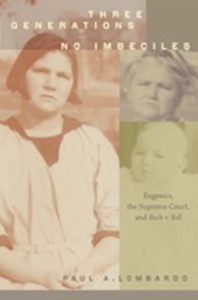
An older book on the Buck v. Bell case is Three Generations, No Imbeciles, by Paul A. Lombard, published in 2002. It also tells the tale well, emphasizing that the “three generations of imbeciles is enough” remark was not merely cruel, but in this case, inaccurate. This book in some spots relates the case to Roe v. Wade in what we would see as the wrong direction – Buck as an attack on reproductive rights and Roe as a defense of them. But it’s a good read for more thorough knowledge of the case, and also has some of the complete documents.
Carrie Buck was involuntarily institutionalized by her foster parents in order to cover up the fact that her pregnancy was caused by their nephew raping her. But the fact that she had had a baby made her a prime target for men who wanted a test case for their eugenic ideals. Adding to the tragedy, she was kept away from baby Vivian, whom she loved dearly, and who died of measles at the age of 8. Vivian was the only child Carrie was ever allowed to have.
Buck v. Bell has never been overturned. But Cohen’s book (and Lombard’s as well) are clear denunciations of it. And all of the reviews I’ve seen are sympathetic with the books’ point of view: that this is an exceedingly shameful chapter of history.
I hope that one day, Roe v. Wade will be put in the same category. So it’s a good idea to study the past to see what might work well for the future.
========================================================
See the list of all our blog posts, put in categories.
For more on Carrie Buck and the Supreme Court, see our blog post:
The Good Grandma
by Bill Samuel, President, Consistent Life Network
This Thanksgiving, a story about a Mesa, Arizona, grandmother named Wanda Dench went viral on the Internet. Wanda had texted family members about coming over for Thanksgiving dinner. One grandson had changed his number, which was now owned by 17 year old Jamal Hinton of nearby Phoenix.
When Jamal received the text, he didn’t know who it was from. When he texted back, Wanda said she was his grandma. They then exchanged photos, verifying that the text was not sent to the intended recipient. But Jamal then asked, in jest, if he could still get some dinner. Wanda replied, “Of course you can. That’s what grandmas do…feed everyone!” Jamal had dinner with Wanda and her family, and everyone had a good time.

A grandson of Wanda’s said he was not surprised by her invitation to Jamal, because they always had an open door policy. To me, Wanda symbolizes the Good Grandma. The Good Grandma welcomes the variety that comes with families, and the loved ones and friends of later generations. The Good Grandma isn’t concerned about the color of their skin, their background, their politics, their nationality, their religion or lack of it, the way they dress, or any of these things. She values each person and welcomes them all. And if there’s a surprise guest; well, there’s always room for one more. Her heart won’t allow her to turn anyone away.
I’m a pretty simple person. Sometimes more sophisticated CLN Board members lose me when they’re explaining their values in sophisticated philosophical language. To me, the things we’re against are natural byproducts of a simple understanding that all human beings are connected. In some sense, we are all family, whether we recognize it or not. So I want the best for all of my brothers and sisters. And certainly it is unthinkable to kill any of them.
It reminds me of a conversation I had decades ago with five-year-old Maria, whose mother I was dating. She asked me if they were killing little children over there in Vietnam. I had to admit to her that they were. “That means they can come over here and kill little kids like me, doesn’t it?” was her response. Her question helped move my commitment to peace from my head to my heart. I realized in my gut that a child on the other side of the world was just as precious as the one I knew and loved who was sitting beside me.
The consistent life ethic isn’t hard to understand. It’s as simple as a good grandma and recognizing that we are all family.
================================================
See the list of all our blog posts, put in categories.
Our Experience with Overturning Terrible Court Decisions
by Rachel MacNair
Several US Supreme Court decisions have been horrifying. What lessons can we learn from history?
Dred Scott v. Sandford, 1857
Dred Scott was an enslaved man who petitioned the Court for his freedom and that of his wife and their two daughters, because they had been moved to a state without slavery. Chief Justice Roger Taney infamously wrote that Blacks were “so far inferior, that they had no rights which the white man was bound to respect; and that the negro might justly and lawfully be reduced to slavery for his benefit.”

Dred Scott and Harriet Robinson Scott
Consequences? The foreseeable one was that African Americans continued living under cruel slavery laws, and free states couldn’t help them. Unforeseen was that this decision is commonly seen as one of the events that led to the US Civil War (1861-1865), the bloodiest war in American history.
Overturned? Yes, by the 13th Amendment to the US Constitution, in 1865. Being only eight years later, this was remarkably quick. But this was due to the Civil War, so it’s not a good model for quick resolution of bad court decisions.
Also, quasi-slavery practices (sharecropping, vagrancy laws, debt peonage, lynching) were established and widespread for a century. So the amendment didn’t really resolve the problem, though it was a help and worth celebrating.
Plessy v. Ferguson, 1896
Homer Plessy was 7/8 European descent and 1/8 African descent. By the standards of the time, this made him colored, and his state of Louisiana had passed a racial segregation law. Challenging the part that applied to trains, he deliberately bought a first-class ticket and boarded to challenge the law. The Court ruled against him with the idea that “separate but equal” was constitutional.

Homer Plessy
Consequences? The foreseeable one was that segregation laws were more firmly established. This also strengthened various forms of mistreatment of Blacks and Hispanics, the lethal forms of which included lynching and deaths through deliberate medical neglect.
Overturned? Yes, by the Court itself, in Brown v. Board of Education of Topeka, in 1954 – that is, 58 years later. Court-favored segregation laws lasted a long time.
Once Plessy was overturned, desegregation efforts still brought violent reactions from a large portion of the population. The decision allowed for further action to bring the change about, rather than being a direct cause of change by itself. A major social movement using nonviolent action – the Civil Rights Movement – plus government action over the course of well over a decade were required to make true progress. Lethal forms of racism (as well as non-lethal forms) still need to be countered today.
Buck v. Bell, 1927
Carrie Buck desperately needed the Court to keep her from being involuntarily sterilized. The reason she was sent to an institution by her foster family was that the foster parents’ nephew had impregnated her through rape. This gave her baby Vivian, but also led to powerful men seeing her as an immoral breeder and therefore a perfect test case for eugenic sterilization laws. The Supreme Court upheld the decision to forcibly sterilize Buck. Justice. Oliver Wendell Holmes said “three generations of imbeciles is enough” – the three generations are pictured below.
But Carrie was average in the few years of school she was allowed to attend, and showed every sign of functioning well throughout her life. Vivian was only a baby at the time of the case, but once she later went to school, she did well. This doesn’t matter, of course, since people who actually are well below average in intelligence are as valuable as anyone else. But being so sloppy with the facts is a recurring theme in eugenics.
In a 1921 letter, Holmes had expounded on his eugenic philosophy by saying it would require “restricting propagation by the undesirables and putting to death infants that didn’t pass the examination.” This eugenic reasoning for infanticide would be one of the currents for the tidal wave of feticide that the Court would unleash in 1973.
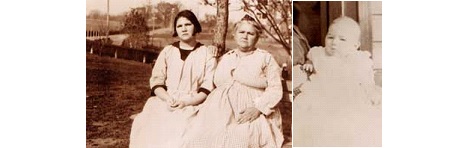
Carrie Buck with her mother Emma Buck; her baby Vivian
Consequences? The foreseeable one was that the eugenics movement had a major victory and cruelly imposed involuntary sterilization on thousands of Americans. At the Nuremberg trials in Germany, Nazis who had carried out over 375,000 registered forced sterilizations defended themselves by citing this case. It had been used as a model for their program, whose ideas were foundational to the Nazis’ massive euthanasia program and the Holocaust.
Overturned? No. However, it merely allowed laws rather than requiring them. The laws of 30 of the 32 states that had them are formally repealed, in a wave mainly from the 1960s to 1980s, and the laws are no longer invoked in the remaining two. Therefore, it’s commonly seen as outdated now, and public opinion is mainly against eugenics. Sterilizations without consent are still reported happening under the radar in scattered places, and especially in “population control” programs.
Roe v. Wade and Doe v. Bolton, 1973
These companion cases, decided the same day, had a major difference from the above cases. Instead of the court deciding against the plaintiff, the plaintiff’s legal argument prevailed, knocking down abortion restrictions in all 50 states.
But for Sandra Cano, being the plaintiff of Doe v. Bolton was a technicality. She acquiesced to the lawyers to get help in getting her children back out of foster care. She was immediately horrified at the decision. Norma McCorvey, on the other hand, the plaintiff in Roe, was very pleased at first. She spent years promoting Roe and even worked in an abortion clinic. But in 1995, she had a change of heart, and is now quite active in the pro-life movement. She wants the decision which bears her pseudonym to be overturned.
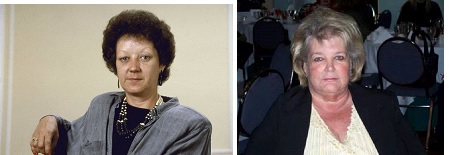
Jane Roe” – Norma McCorvey and “Mary Doe” – Sandra Cano
Consequences? Most clearly, millions of unborn babies have been killed. For more on how abortion relates to other kinds of socially-approved killing, see any consistent-life literature; for more on how it hurts women, see any pro-life feminist literature. Targeting of unborn babies from racial minorities, those with disabilities, and fetal females for elimination has sabotaged the assumption that all people in such groups should be treated with respect.
Overturned? No, and it still has widespread support in the population. This is the only one on this list that isn’t widely recognized as a horror story. Yet.
Conclusion: Dealing with Roe v. Wade
Pro-lifers have of course been eager to overturn the Roe v. Wade decision since the second it was announced. Here are four approaches:
A constitutional amendment, as with Dred Scott. This requires much more of a societal consensus than we now have.
The court overturning itself, as with Plessy. This has been the main anti-Roe strategy, to work to elect presidents who will appoint Justices to overturn it.
Update 06.24.22: Dobbs v. Jackson showed that this method of overturning Roe turned out to work after all, despite the twists and turns of all these decades. Comments below have been edited by deleting what’s outdated; added words are in blue.
But when thinking of this possibility, this is crucial to understand: when Plessy was overturned by Brown, many years of intense work for desegregation had to follow. There was a passionate backlash. That is the case with overturning Roe. Far too many people see such overturning as something wrong with the Court, rather than something wrong with Roe.
The decision working its way to irrelevance, as mainly happened with Buck v. Bell.
This is still all necessary. Several states will continue to promote abortion for some time, and between travel for abortions and medication abortions, the only way to stop them will be to reach hearts and minds.
This is where the grassroots excel. Fortunately, the pro-life movement has known all along how to be effective this way, with pregnancy help centers, post-abortion therapy, public education, protesting, raising scandals, and more.
This is also where the consistent life ethic excels. While single-issue pro-lifers in the U.S. have focused on a situation where abortion was mainly illegal (yet widely practiced) and in one fell swoop was legalized everywhere, consistent-lifers are familiar with how several different social movements work. We’re active in more of them.
Activists against all kinds of socially-approved violence have observed that there’s no magic button – no amendment, court decision, or legislation – which will solve the whole problem.
In the case of war, the Kellogg-Briand Pact of 1928 outlaws it. We see how well that turned out. It has a positive place in the long-term struggle against war, but it certainly wasn’t a magic button.
Update: Also, in the case of nuclear weapons, the United Nations Treaty on the Prohibition of Nuclear Weapons has been ratified and went into effect January 22, 2022. So nuclear weapons are now against international law, but that obviously hasn’t by itself solved the problem.
It’s up to us to make that social change happen. Get to work!
====================================================
For more of our blog posts on abortion and the law, see:
Why the Hyde Amendment Helps Low-Income Women
For more of our blog posts post-Roe, see:
Reflections on the Alito Draft Leak of May 2, 2022
My Ideas for Post-Roe Legislation
Post-Roe Stats: the Natural Experiment
The Parable of the Bridge
by Carol Crossed
There was a village and a river ran through its center. Every day at 4:00 people would go to the church to pray for those who were drowning in the water.
The farmers put aside their plows, the students put down their books, the mothers took their children by the hand and they would go into the church to pray.
This went on for years, and a wise person came along and was so impressed with the faithfulness of these people, but said, “Why don’t you also go to the edge of the water and pull the people in who are drowning?”
So every day at 4:00 the farmers put down their plows, the students put aside their books, and the mothers took their children by the hand, and some went into the church to pray and others went down to the river. Some made inner tubes. Others had the idea of teaching swimming lessons.
 This went on for many years, until a wise woman came along. She marveled at the dedication and steadfastness of love of neighbor. But she had another idea: “Why don’t you go upstream and find out why these people are in the water?
These are the 3 ‘p’s of ministry: the Priestly, the Pastoral, the Prophetic. The priestly is our spiritual life together. The pastoral is charitable works of mercy: our soup kitchens, crisis pregnancy centers, drug and alcohol addiction programs, and other direct charities. We see face to face the poor we serve. We dry them off and see their smiles.
Going upstream is the prophetic approach.
Justice always asks the question why. Does the bridge need repair? Are there too many people on the bridge? Why are so many going hungry? Why are parents, by aborting their children, throwing them overboard? Why is the military’s budget so high that it takes from social programs? Why is it killing people, including civilians, in drone warfare? Why are the elderly and the disabled at greatest risk for assisted suicide?
Could it be that we are running across the bridge with reckless abandon, intent to get to the other side, and others are in our way?
It’s my lifestyle, my body, my life. There are too many children in the world, too many single moms, we are taxed out of sight. Keeping prisoners on death row is expensive, so let’s have fewer levels of appeal. Let’s throw them overboard.
But while we are up on the bridge asking the question “why,” we cannot be blind to the people falling overboard. What do we do? We involve ourselves in the peace and nonviolent movements of justice: We build human guard rails on the bridge and we work for laws that will build guardrails. We stand on the sides of the bridge and hold signs that say “Stop Drone Warfare!” at Griffiss Air Force Base rallies. “Don’t abort your child” at the 40-days for Life Vigils. “Assisted Suicide: Another name for killing!” at the State Courthouse.
There are all sorts of people holding signs on the edge of the bridge: the progressive, the conservatives, the religious, the humanists. Because of our differences, huge gaps in the guardrails exist because we do not join hands. Your-issue-is-not-my-issue breaks the chain on the bridge and people fall overboard. Do we not threaten our own vulnerable group because the guardrail is not continuous? Can we drop our fears and work together, no matter if the person we want to save is a refugee from Syria, or an aborted child, or a person on death row? The consistent life ethic challenges us to go beyond our ideologies and love all human beings.
=====================================
See the list of all our blog posts, put in categories.
For more blog posts written by Carol Crossed, see:
The Creativity of the Foreclosed Option
by Rachel MacNair

Worf, from Wikipedia
In an episode of Star Trek, The Next Generation, the Klingon Worf was in an accident leaving him paralyzed. According to Klingon tradition, this meant he should commit ritual suicide. He was intent on doing so.
The doctor was appalled. She tried to research Klingon physiology to find treatment, but Klingons had no advice to give. Since they always committed suicide on such occasions, they had no information.
Various creative things were tried for allowing him to live and function with dignity even if not with full use of his legs. Finally, the doctor found a procedure which cured him. Solutions could be found because one option – the option of suicide – was, in the doctor’s mind, foreclosed.
When a specific option is unavailable, others must be sought. Medical breakthroughs, along with treatment options and other caring options for those with disabilities, require that the option of suicide be off the table.
Once a violent solution is on the table, it precludes the development of alternatives. Violence as a problem-solving technique has the apparent advantage of being quick and efficient. One need only ignore the long-term aftermath and other negative impact on society.
Nonviolent alternatives must take more care, attention, resources and time. They have obvious advantages in the long run. But the short-term consequence is more work.
This leads to the ironic outcome that foreclosing an option, taking it off the table, means more options available, rather than fewer.
Vegetarians, for example, who foreclose the option of eating meat, actually have more variety in their diets than those eating standard fare. There’s no reason in theory why those who eat meat can’t also eat the variety of vegetarian options. Often they do. But excluding meat seems to open up creativity in the diet.

Those who oppose abortion have a much more extensive and complex set of services offered through pregnancy help centers, maternity homes, mentoring, and government social services than the relative simplicity of the abortion clinic.
In the case of war, those who by definition foreclose it as an option entirely – pacifists – have offered a wide array of ways of dealing with problems of violence and injustice: conflict resolution, diplomacy, solving problems when they’re still small and haven’t yet blown up in violence, and a wide variety of other approaches. People inclined to resort to weapons are less likely to be creative in finding alternative ways of resolving problems. Those who oppose war must come up with such alternatives.
Therefore, creativity is another of the side-effects of assertive nonviolence. In the psychology of creativity, this is called “divergent thinking.” Many possible solutions are generated when people don’t limit themselves to the obvious or conventional.