Worthiness Concept Threatens Equality
by Ms. Boomer-ang
 In George Orwell’s Animal Farm, animals take over a farm and paint on a wall “an unalterable law by which all animals” there “must live forever.” This law was a list of commandments, one of which was: “all animals are equal.” But eventually the only commandment remaining read: “All animals are equal, but some animals are more equal than others.”
Likewise, many of those who loudly sign on to human rights, protections, and respect for everybody nevertheless designate some humans as less worthy of these rights and therefore less equal.
The concept of worthiness and unworthiness arose when Noam Chomsky and Edward Herman observed the media considering some murdered activists more “worthy” of praise and attention than others.1 In addition, Dr. Jacqueline H. Abernathy’s June 6, 2023 Consistent Life blog post noted that different political parties consider different people more “worthy” of government support. Meanwhile society and policymakers tend to consider some people less worthy of respect and human rights than others.
Examples follow:
Ethnic and Racial Minorities
In 2009, I visited a prestigious European Union secondary school. One corridor displayed student artwork and posters, in English, for a project on diversity, equity, inclusivity, and tolerance. Along with their calling for accepting all sexual habits, some also recited phrases against racial and religious prejudice. The posters could have passed for products of a North American school.
But people in the same European school repeatedly warned me to avoid Roma. They blamed all crime on Roma.
And when I traveled around the area, a stationmaster warned me to keep my possessions in sight, because “the Roma steal.”
Back in the US, I would have guests from an international peace organization that boasted about embracing all nationalities and lifestyles. One who came from the European Union (a different part than that school) also called Roma dangerous and claimed they prefer stealing to working.
Orphanage Children
In 2011, I took a class at New York University School of Continuing Education about Keeping Children Healthy and Safe, where we did presentations about discipline opportunities we had experienced. I did mine about an episode in a foreign orphanage four years earlier. The orphanage stood in a field where wild descendants of housecats were as ubiquitous as squirrels are in some American neighborhoods. One day, a little boy in the orphanage grabbed a cat, punched it, and threw it roughly on the ground. I tried making him know his action was wrong.
To my surprise, the NYU teacher and a few fellow students said things like: “This class isn’t about children like him,” and “orphanage children are out of our scope.” Really? The course description implied it was about all children. The teacher and fellow students weren’t sympathetic to the cat either.
Did they consider half of the problem that the cat’s mother was not spayed and the other half of the problem that the little boy had been born? Despite the fact that it happened in a place where abortions have exceeded live births for decades?
In about 2018, I told an informal amateur writing group in upstate New York the story of the boy and the cat. I then told how the NYU class had responded to the story. And one of the group’s participants reacted, “Those Nazis!”
Political Prisoners or Criminals?

Angela Davis
Once I attended a lecture by lawyer Alan Dershowitz, where he recalled playing a role in getting American Communist Party leader Angela Davis acquitted. She had gone on trial in 1972, officially for buying guns which other people had used in a fatal courthouse raid. At that time, her allies had been calling her a political prisoner.
Then in 1979, Mr. Dershowitz continued, the Soviet Union awarded Ms. Davis the Lenin Peace Prize. As she went to Moscow to accept it, Mr. Dershowitz reported, he asked her to asker her hosts to free specific individuals imprisoned in the Soviet Union for political reasons. In response, her office told him that the Soviet Union had no political prisoners and that those people were criminals and deserved to be in prison.
The United States also has political prisoners, whom officials designate criminals. People are sentenced for non-violent pro-life activism.
Refugees
United States policy classifies some people fleeing oppression as either “political” or “economic” refugees. It considers people from “favored” countries less worthy of the label “political refugee” than those from “disfavored” countries. And it considers “political” refugees more worthy of asylum than “economic” ones.
People Society Declares Never Should Have Been Born
At first, as countries imposed abortion, they gave total amnesty to people born before the axe date. But by 1989, with the brutal aggressive overnight imposition of abortion on Romania, American media portrayed Romania’s already-born children whose mother they implied would have aborted them if they could have as if subhuman and potentially dangerous. It suggested that the fact they are alive is a crime against humanity. How have teachers, governments, potential employers, the European Union, the UN, and human rights groups treated them?
In Singapore, children born to women who have already borne two children have been denied schooling. In the 1990’s an “illegal third child,” by the time she was 24, had walked to Cambodia, spent 3 years in Spain, and finally arrived in the United States seeking asylum because in China, she was a “non-person,” “denied many rights of Chinese citizens.”2
In the US, how will public schools in abortion-promoting states treat a child showing up who was born in an abortion-restricting state after Dobbs from a pregnancy retroactively declared unworthy of carrying to term?
And what about children with “flaws” detectable before birth?
People Society Wants Dead
Disturbingly, the media, popular culture, pundits, and officials are embracing the concept that individuals in certain physical conditions need to be dead.
Under this mentality, people proclaim that “there is no abuse” in places that allow death-hastening. Do they mean that officials and authorities do not proactively suggest death-hastening for people who do not meet the MAID-recommended criteria?
But what about families, friends(?), social workers, caregivers, creditors, relatives’ creditors, insurers, nursing homes, hospices, and clergy people pressuring a person who does meet the criteria to submit to death-hastening? Claiming “this isn’t abuse, because these people need to die” (i.e., are unworthy of life) brings to mind apologists for a regime claiming that it has no political prisoners and anybody it incarcerates deserves to be locked up.
Blaming the high consumer price of medical insurance on the elderly, the disabled, the chronically ill, and the “slowly” dying encourages society to see these individuals as “our affliction.” That is one thing the Nazis called the Jews.
Praising a relative or friend for “choosing death over suffering” brings to mind Herman Goring’s endorsement of Austrian Jews committing suicide after the Anschluss.3
How will people who are declared better off dead but who refuse death hastening be treated, legally and socially? Examples of involuntary euthanasia in America and Europe could fill an essay. In a work party early this millennium, when someone brought up the topic of euthanasia, and I asked what about people who met the criteria but refused death-hastening, one of them promptly answered, “Shoot them anyway.”
When laws and treaties are meant to protect everybody, does “everybody” mean only those considered “worthy?”
REFERENCES
1. Noam Chomsky and Edward Herman, Manufacturing Consent: The Political Economy of the Mass Media, 2002.
2. Teresa Puente and Tribune Staff Reporters, “Bid for Asylum a Tortuous Path,” Chicago Tribune, August 2, 1998.
3. Piers Brandon, The Dark Valley. Vintage Books, 2000, p. 539.
===========================================
For more posts from Ms. Boomer-ang, see:
Political Homelessness is Better than a Wrong Political Home
“Shut Up and Enjoy it!”: Abortion Promoters who Sexually Pressure Women
The Danger of Coerced Euthanasia: Questions to Ask
Oh My, How the Election Conundrum Has Changed
by Rachel MacNair
A reminder: The Consistent Life Network doesn’t necessarily endorse everything said in its blog, since we encourage individual writers to express a variety of views. This is especially so when analyzing elections.
I’ve been through several presidential elections now. Consistent-lifers have this conundrum (as this post details for 2020): The Republican is terrible on many things but at least better on abortion. The Democrat is better on many of those things but absolutely horrendous on abortion. People who vote for a minor party instead may stay cleaner, but they aren’t helping to decide which one wins.

But as I posted and documented earlier, several conservatives who would normally be enthusiastic about supporting Republicans have noted that Trump is sabotaging the pro-life movement. Since then, the situation has gotten even worse, to the point that mainstream media is taking notice.
Which Candidate is Worse This Time?
Here I expand this with comments from people who would normally assertively support the Republican for president on anti-abortion grounds.
Ramesh Ponnuru asks this cogent question in The National Review:

Ramesh Ponnuru
I’m also wondering how the political parties will interpret the election results. If Harris wins, will they take it as a vindication of the Democrats’ strategy of being all in for abortion? If Trump wins, will both parties take it as a vindication of his strategy of running as far and fast as he can from the issue? Which would be worse for the pro-life cause in the long run?
The National Review also quotes Lila Rose of Live Action:

Lila Rose
“Vance has come out and said that [Trump] would veto an abortion ban, that he supports abortion pills, that he supports ‘reproductive rights’ without clarifying what that means,” Rose said, adding that Trump “was behind the RNC platform being weakened on this, which for four decades was strong on life, and now it’s been weakened.”
The activist said that she, as it stands, would not cast a vote for either Trump or Democratic nominee Kamala Harris. It’s “not the job of the pro-life movement to vote for President Trump,” she said, but it is “the job of the pro-life movement to demand protection for pre-born lives.”
Other Republicans disagree . . .
But Rose said she doesn’t buy the “idea that you are morally responsible to vote against Kamala Harris by voting for someone like Donald Trump.”
“In some cases, you can make the argument that it can be the right move to vote for the lesser of two evils,” Rose said. “But part of our job is not to just accept whatever position we’ve been handed — especially from a politician who, in the past, has counted on our vote and has indicated that he is pro-life [before] changing his position. It’s our job, if we want to be an effective lobbying group in any way, to demand more and to say, ‘If you want my vote, I need to see more from you.’”
“This is how politics works,” she continued. “This is how any advocacy or movement works . . . if you will always be happy to support a candidate provided that they are just a fraction better than the next candidate, you will never achieve your goals for the group that you’re fighting for.”
The Babylon Bee, a humorous satire site like The Onion, explicitly for conservative Christians, put it this way: Pro-Lifers Excited To Choose Between Moderate Amount Of Baby Murder And High Amount of Baby Murder.
Another important point is that the Trump administration couldn’t have arranged for a stronger backlash to the overturning of Roe if such a backlash had been its plan. We can count on it that any repeat Trump administration would provide extra energy to keep that backlash going.
Euthanasia
Meanwhile, on euthanasia – which I don’t recall Trump ever expressing opposition to – is now an issue on which he’s made especially cringe-worthy remarks against a member of his own family – William Trump, the son of his nephew Fred Trump III. From The New York Times,
Fred Trump’s son was born with a rare medical condition that led to developmental and intellectual disabilities . . . he was able to convene a group of advocates for a meeting with his uncle . . .
After the meeting, Fred Trump claims, his uncle pulled him aside and said, “maybe those kinds of people should just die,” given “the shape they’re in, all the expenses.”
The remark wasn’t a one-off, according to Fred Trump. A couple of years later, when he called his uncle for help because the medical fund that paid for his son’s care was running out of money, Fred Trump claims his uncle said: “I don’t know. He doesn’t recognize you. Maybe you should just let him die and move down to Florida.”
Other than Trump
As for the other major candidate, extreme abortion advocacy is just one of the problems. Biden has been rightfully subjected to intensive war protests on sending weapons being used against Palestinian children, and Harris shows no signs of having better policy. And that’s only one of the horrific wars being supported by the U.S. now. The 2024 Democratic platform has dropped previous opposition to the death penalty and support of reduction in military spending. Moving away from anti-violence positions is happening in both parties.
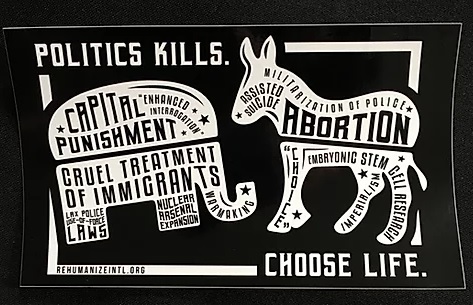
graphic from our member group Rehumanize International
I’m thinking the third-party option (say, for our member group the American Solidarity Party) has the advantage of clearly communicating why the major parties lost your vote. That may make more sense this year than usual.
Meanwhile, we can certainly feel comfortable working on referendums – while they’re generally single-issue by nature, there are quite a few that cover several of the consistent-life issues.
===========================
For more of our posts on election dynamics, see:
What History Shows: The Consistent Life Ethic Works for Pro-life Referendums
Elections 2020: Three Consistent-Life Approaches
Pro-life Voting Strategy: A Problem without an Answer
My Difficulty in Voting: Identifying the Problem (about the American Solidarity Party)
How Consistent-life Advocacy Would Benefit from Ranked-Choice Voting
The Problem of Selective Concern about Injustice
by John Whitehead
A recent op-ed in the New York Times reminded me of how policymakers, journalists, and activists can be selective in the injustices they pay attention to and how this selectivity can attract criticism. How useful is this criticism, and what can we learn from it?
I think some aspects of criticizing such selectivity are worthwhile and important, but it’s a type of critique that can also be used disingenuously to discredit rather than broaden efforts to address injustice. Distinguishing between helpful and harmful forms of this argument can be relevant to Consistent Life Ethic advocates and their work.
Why So Much Attention to Gaza?
In his piece “Can We Be a Little Less Selective with Our Moral Outrage?” columnist Bret Stephens points out that the Gaza War, which has provoked such impassioned protest on college campuses and elsewhere over the past year, is not the only severe humanitarian crisis unfolding in the world. He mentions other cases of repression, war, or similar human rights violations in countries such as Venezuela, Turkey, Sudan, Ethiopia, and Iran. Stephens exhorts “morally energetic college students from Columbia to Berkeley” to direct their energies to protesting these injustices.
The selectivity Stephens describes, in which some injustices or crises provoke significantly more attention and outrage than others, is an issue that has interested me for a while. Such selectivity is real.
For example, from 2020 to 2022, Ethiopia endured a civil war as bloody as the Russia-Ukraine war and yet attracted far less media attention. Sudan has been wracked by its own catastrophic civil war for more than a year now, but remedying Sudan’s agony has not become a cause célèbre in the United States.
One possible explanation for such selectivity among Americans is that because the United States is Israel’s most important supporter, with Israel being the leading recipient of US military aid, Americans have a special responsibility to stop Israel’s military campaign in Gaza. This explanation is plausible up to a point, but it doesn’t explain why other humanitarian crises for which the United States bears responsibility haven’t generated the same kind of protest movement as the Gaza War. Stephen’s column mentions US support for Turkey’s repressive regime as a counter example, but I think there is a more apt comparison.
For over seven years, from 2015 to 2022, a coalition of Middle Eastern countries, including two close US allies, Saudi Arabia and the United Arab Emirates, waged a devastating war against Yemen that created a massive humanitarian crisis. US support for Saudi Arabia and the UAE during the Yemen war generated a certain amount of controversy, but not a response comparable to what Israel’s war on Gaza has provoked.
Campuses did not erupt in protest over the Yemen war. The war did not become an issue in the 2016 or 2020 presidential elections. According to the Tyndall Report on network newscasts, Yemen never broke into the top 20 TV news stories of 2015-2019.
To offer a crude but telling comparison of the relative amounts of media coverage these conflicts generate, a search for “Yemen” in Gale General OneFile (a database of more than 14,000 periodicals, newspapers, and other media sources) turns up 12,560 mentions during the war’s first year, from March 2015 to February 2016. A search for “Gaza” in General OneFile turns up 77,427 mentions in the roughly 10-month period from October 2023 to the present.
The Yemen war is perhaps the most significant case of contrasting reactions to destructive US-support wars, given how analogous it is to the Gaza war. Other cases could be highlighted, though.

To take one other example, since the Taliban’s takeover of Afghanistan in 2021, the United States—not Israel, Turkey, Saudi Arabia, or some other close American ally, but the United States itself—has imposed sanctions and other economic penalties on Afghanistan that have contributed to that country’s severe food insecurity and related humanitarian problems. American policymakers have imposed these hardships on Afghanistan while also dragging their feet on providing a haven in the United States for Afghan refugees.
The human suffering in Afghanistan, for which the United States bears direct responsibility, would seemingly be an even more pressing issue than suffering caused by American allies. Yet Afghanistan seems to be a low priority these days. (A General OneFile search turns up 24,805 mentions in the past year.)
Given the current situation, I would like to see at least some of the violent conflicts and humanitarian crises that are apparently such a low priority receive greater investments of attention, funding, and political will from policymakers, journalists, and activists. To that extent, I agree with Stephens’ column.
Why Not So Much Attention to Gaza?
While I recognize the value of broadening our concern for the many people beyond Gaza affected by injustice and deprivation, though, I also recognize a crucial point needs to be made: the fact certain injustices around the world receive relatively little attention does not make the injustice of the Gaza war any less worthy of attention.
Student protestors and others who focus primarily on the plight of Palestinians in Gaza may have a relatively narrow scope of concern—but they are not wrong. Israel’s campaign in Gaza is unjust, and large numbers of people are suffering and dying as a result of it. Protestors are right to say so and to campaign against this injustice, regardless of any other crises in the world.
Does Stephens hold this view? I cannot read his mind but given the rather snide tone of his column and his past expressions of support for Israel’s policies, criticism of the campus protestors, and hawkish views generally, I suspect not.
I think Stephens’ point about how little attention certain injustices receive is intended more to deflect criticism from Israel and to discredit the pro-Palestinian protestors than to call for broader human rights activism. This is the impression I also get from similar commentary I have read on the theme of how Israel is selectively targeted for criticism.
When raised in this spirit, pointing out how narrowly defined certain activists’ concerns are is not a legitimate call to expand activists’ circle of concern, but instead a kind of rhetorical trick. The aim is to change the subject from the suffering caused by the Israeli military to the character and motives of pro-Palestinian activists. This kind of critique of narrowly defined activism should be rejected.
Relevance for the Consistent Life Ethic
The good and bad ways in which a critique of ‘selectivity’ can be made contain lessons for Consistent Life Ethic advocates. The Consistent Life Ethic stands for defending life against a variety of threats. This broad concern for life means cultivating awareness of the many ways life is under threat in our world. As I wrote previously, “no commitment to any one issue exhausts the work that needs to be done to protect life.”
For a Consistent Life Ethic advocate, activism that focuses exclusively on countering just one threat to life—whether abortion, the death penalty, war, or another threat—is a good but an incomplete response to the varied demands of defending life. In that respect, such narrowly focused activism is like activism exclusively focused on stopping the Gaza war.
The appropriate response to activism that’s limited to a single threat to life or to a single crisis in the world is: 1) to provide recognition and encouragement for the activists doing this good work, and 2) at the same to time highlight the many other ways life needs to be defended. Reminders about the array of legitimate concerns for those committed to defending life can guard against an excessively narrow focus on a single concern and serve as encouragement to become informed about and engaged with a broader spectrum of ongoing injustices.
This approach can also avoid the cynical way calls for a ‘broader perspective’ can be used to attack activists doing good work, as I think is the case with some commentaries on pro-Palestinian activists. Pointing out that defending life means defending it against a variety of threats should not be an occasion to condemn those defending it against just one threat. Rather, promoting a broader perspective should be an occasion to support those already doing important work to defend life from specific threats while extending an invitation to work against other threats as well.
==================================
For more of our posts on recent wars, see:
Abortion Workers Speak Out
by Sarah Terzo
Sometimes former abortion workers come forward with their stories, and these stories can shed light on what goes on in abortion facilities.
First-Trimester Surgical Abortions
In the Fall/Winter 2016 edition of Feminists for Life’s The American Feminist magazine, former abortion workers spoke about working in abortion facilities., former abortion worker Julie explained how she and other workers kept people having surgical abortions from seeing their aborted children.
In first-trimester suction aspiration abortions, the abortionist inserts a tube attached to an instrument called a cannula into the woman’s uterus. The doctor also connects the tube to a suction machine and a small jar. When the doctor activates the suction machine, it forcefully tears apart the preborn child and the pieces travel down the tube into the clear glass jar.
See a former abortion doctor, Beverly McMillan, explain this procedure:
Seeing (and Hiding) a “Head, Body, Limbs”
If the pregnant person is in the ninth to tenth week of pregnancy (the seventh to eighth week after conception) or beyond, one can observe recognizable body parts in the aftermath.
Abortionist Dr. Willie Parker describes this:
I inspect what has just come out of the woman’s body: what I’m looking for is the fetal sac, which, at a later gestational age, becomes the placenta, and, after nine weeks, every one of the fetal parts—head, body, limbs—like a puzzle that has to be put back together.
I make sure I find every part, and I place them together, re-creating the fetus in the pan. I have done this so many times that it is has become routine…1
In Julie’s abortion facility, the workers wanted to prevent people having abortions from seeing the contents of the jar.
To hide the blood and body parts, the workers covered the jar with a “cute calico cover.”2
This way, post-abortive people wouldn’t glimpse a dismembered arm or leg. The abortion workers could maintain the illusion that a preborn baby is just a clump of cells.
Lies About Body Disposal
Former abortion worker Margo spoke about a lie abortion workers told those having abortions at a different clinic:
We lied to patients all the time! … People asked, ‘What’s going to happen to my baby [after the abortion]?’ We were told to tell them whatever made sense, that it’s like, if someone is in a bad car accident and lost a leg. It’s medical waste, and it goes into an incinerator …
Instead, they ground up the remains and sent them down the sewer.3
Dr. Susan Poppema, in her 1996 book Why I am an Abortion Doctor, wrote about how she thought flushing aborted baby remains down the sewer was the best way to dispose of them.
Poppema commits abortions through sixteen weeks. She refers to the dismembered bodies as “tissue,” and this sanitized language hides the reality.
She says:
Realistically, the best and safest way medically to dispose of tissue from the uterus is to put it directly into the general sewage system.
Waste of every kind, after all, eventually winds up being disposed of in one manner or another, and short of sacred burial rites it is safe to say that disposal of organic matter (which uterine tissue is) is generally a fairly straightforward proposition. The matter leftover from surgery is all natural tissue and blood.4
She does say, “Could it be infected? Yes.”5
The Problem with Flushing Aborted Babies into the Sewers
Poppema concedes there may be one problem, though. She says, “[T]he obvious problem is presented when considering that the larger pieces of tissue can block disposal pipes.”6
Below is a sonogram of a sixteen-week-old preborn baby.

These “larger pieces of tissue” are arms, legs, etc.
Poppema ordered an industrial-strength garbage disposal for her abortion facility to grind up fetal parts. The man who came to install it broke down in tears and refused to complete the job.
Poppema says, “[M] y colleagues and I found the poor man on the floor literally sobbing at the thought of a disposal system at an abortion clinic.”7
Someone else finished the installation. The man reported Poppema’s clinic to the health department, which led to added hassles for her. She complains about this in her book.
People having abortions do sometimes ask abortion workers what they do with the bodies. In Pregnancy and Abortion Counseling, a manual for abortion workers, it says that “How do they get rid of it, it is burnt?’ is one of the “difficult” questions patients ask. 8
Former Abortion Workers Who Come Forward
Margo also commented on the guilt she felt at being involved in abortion for so long. She laments that she took part in “tens of thousands” of abortions and says, “It literally took my breath away … I helped murder almost a football stadium of people.”9
Because of the emotional trauma they experience and the difficulty of coming to terms with their actions, many abortion workers have a hard time discussing what went on in their clinics.
This is similar to soldiers who suffer PTSD and don’t like to talk about what they experienced in war. When veterans come forward and speak about atrocities they witnessed or the details of battles they took part in, it’s valuable, as it is when former abortion workers speak.
Expected to Book Forty Abortions a Day
Two former Planned Parenthood workers, Rhyan and Annette, said Planned Parenthood expected them to book forty abortion appointments a day.
Rhyan, who worked for Planned Parenthood in Kansas for four months in 2016, was hired as a receptionist, but says her actual job turned out to be “selling abortions.”
According to the article:
The sales began with the automated answering system that picked up all calls first. The pleasant, recorded voice invited callers to press one number if they wanted birth control, another for a well woman exam, and another for abortion. All abortion calls were automatically jumped to the front of the calling queue.10
Rhyan says, “If you were calling for birth control, you could wait 20 minutes to get a phone operator.”11
Rhyan was required to schedule women’s appointments before discussing costs. There also appeared to be an unwritten rule to ask Black-sounding callers if they needed financial assistance, but not white-sounding ones.
Annette found herself getting in trouble when she took extra time counseling ambivalent pregnant people or sending them home to think about their decision. According to her interview:
Annette observed the clinic director meeting with a client. To Annette, the woman was asking endless questions and seemed anything but certain about her decision. The patient kept repeating, ‘I’m really not sure.’
When Annette and the director left the interview room, the director told the staff that the patient was ‘just fine’ and ready to proceed. Annette spoke up and said she didn’t see it that way.
The director responded, ‘She’s here. If she doesn’t want it done, she’ll say so.’ Annette got such heat for speaking up she did not do it again.11
Annette says, “We were always told that it’s all up to the woman.”12 But that was not what she saw in practice. “The emotional manipulation of others,” she says, “is what got to me the most.”
At a staff meeting, she challenged the higher management, and asked if Planned Parenthood had an abortion quota. Annette says, “I just kept saying, ‘This really feels like you’re running a herding clinic.’ All of the other staff chimed in and said, ‘Yes, that’s exactly how we feel…’”13
By the end of the conversation, Annette had learned that “Yes, they expect a certain number of procedures a day, but no, this is not a quota.”14
For all intents and purposes though, it was.
Substandard Medical Care Puts Patients at Risk
A nurse named Jayne wrote about the lack of medical training manuals in one abortion facility. She was asked to administer strong medications intravenously without detailed instructions and no manual to refer to. Without this vital medical information, she didn’t know the proper way to administer the medication.
Jayne, who had been a nurse for twenty-eight years, spent twenty-three days at Planned Parenthood in Wilmington, Delaware before quitting because medical care at the facility was so substandard.
According to the article:
The obligatory crash cart was filled with medicine that was not just out of date but “way out of date.” The oxygen mask on the cart was so old, it was no longer pliable.15
All of these abortion workers who have come forward with their stories are showing courage. They (and others like them) should be supported by the pro-life movement.
Footnotes
- Willie ParkerLife’s Work: from the Trenches, A Moral Argument for Choice (New York: 37INK, Atria, 2017) 95-96
- Ellen J Reich “An Insider’s Look into the Abortion Industry” The American Feminist Fall/Winter 2016
- Ellen J Reich “An Insider’s Look into the Abortion Industry”
- Susan T. Poppema, M.D. and Mike Henderson. Why I am an Abortion Doctor (New York: Prometheus Books, 1996) 162-166
- Ibid
- Ibid
- Ibid
- Joanna Brien, Ida Fairbairn Pregnancy and Abortion Counseling (London: Routledge, 1996) 94
- Ellen J Reich “An Insider’s Look into the Abortion Industry”
- Ibid.
- Ibid.
- Ibid.
- Ibid.
- Ibid.
- Ibid.
======================================
For more of our post on workers in violent institutions, see:
Healing for the Perpetrators: The Psychological Damage from Different Types of Killing
Abortion Doctor Says: We are the Executioners
“But I was Empty”: The Story of a Doctor Who Left Planned Parenthood
Disability Rights – Babies, Women, Numbers
by Rachel MacNair
This was originally written for a referendum to allow late-term abortions on our project website Peace and Life Referendums. The measure never made the ballot, but we don’t let write-ups go to waste, so it became one of several topic pages.
Fetuses with Disabilities
One of the most common reasons given for making late-term abortions available is that the unborn child is diagnosed with some form of disability. (Around the world, that “disability” can often mean being female; this is much less common in the U.S., but not unheard of).
Studies show a troubling impact of disability-selective abortions. In the United States, after the Americans with Disabilities Act (ADA) passed in 1990, this anti-discrimination and pro-accommodation legislation should have had a positive effect on how people with disabilities were seen. For those well beyond infancy, it did. However, one study noted a dramatic decrease in the birth rate for Down Syndrome babies after its passage. With no reason to believe they were conceived at different rates before and after passage of ADA, and prenatal screening abilities being the same, authors attributed the decrease to demeaning and negative portrayals in the media.
Another study showed how this worked, looking at newspapers from 1998-2006: disability was presented negatively. It was because of positive portrayals of prenatal testing. The reports were commonly positive about terminating the pregnancy when there was a disability diagnosis. Therefore, the ready availability of abortion and its positive portrayal sabotages the cause of disability rights.
Pregnant Women with Disabilities
Women with disabilities are already subjected to many forms of discrimination. Telling them they can’t handle a life event such as pregnancy can involve having disdain for them. It’s also discriminatory. Abortion availability can be used as an excuse to avoid providing pregnant women with disabilities the extra services they need and deserve. Stigma associated with having disabilities is increased when it’s used as a reason to avoid reproducing.
Numbers
A figure of 13,000 yearly abortions over 20 weeks in the U.S. is based on applying the CDC report of late-terms being 1.3% of abortions to the Guttmacher Institute’s report of around a million abortions. The Guttmacher Institute itself, however, has reported 15,000. Official figures have been as low as around 10,000.
These figures are comparable to gun-related homicides in the entire United States. Few people think such homicides are “rare.”
====================================
For more of our posts on defending people with disabilities, see:
Abortion and People with Disabilities
How Ableism Led (and Leads) to Abortion
How Euthanasia and Poverty Threaten the Disabled
Bigotry against Babies with Down Syndrome
Bigotry against Babies with Down Syndrome: International Experiences
A Lawyer’s Turnaround on Baby Doe with Her Own Down Syndrome Baby
Kate Cox and Stories of Trisonomy 18
“Oh, the Hateful A-Bomb!”: Survivors’ Stories from Hiroshima and Nagasaki
collected by John Whitehead
August 6 marks the 79th anniversary of the atomic bombing of Hiroshima and August 9th the anniversary of the bombing of Nagasaki. Below are some testimonials from hibakusha [bombing survivors] about their experiences.
These stories serve as a reminder of both the evil done in 1945 and the fate that may await all of us if we don’t check the threat of nuclear weapons.
Stories from Hiroshima
 The stories and drawings of hibakusha from Hiroshima were collected in Unforgettable Fire: Pictures Drawn by Atomic Bomb Survivors (New York: Pantheon, 1977). The excerpts below describe their experiences from the moment of the bomb’s impact onward:
Haruko Ogasawara:
As I looked up at the sky from the backyard of my house, I heard the faint buzzing of a B-29 but the plane was not visible….I looked up and suddenly saw a strange thing. There was a fire ball like a baseball growing larger becoming the size of a volleyball. And then something fell on my head…
I found myself lying on the ground covered with pieces of wood. When I stood up in a frantic effort to look around there was darkness…When I came to my senses I found my clothes in shreds…
I discovered my mother in a water tank. She had fainted. Crying out, “Mamma, Mamma,” I shook her to bring her back to her senses…
[My sister] was crushed under the collapsed house and only her head could be seen… Mother and I worked desperately to remove the plaster and pillars and pulled her out with great effort. Her body had turned purple from the bruises and her arm was so badly wounded that we could have placed two fingers in the wound. Strange to say, my mother was thankfully not hurt…
We three ran away, heading for Mt. Eba. A crowd of people were running along the street car track. All were wounded. There was a man with his skin trailing; another man was breathing faintly, all blood-stained; a third man had blood spurting out his head…
The sky was red with flames. It was burning as if scorching heaven. (43-44)
Yoshiko Michitsuji:
Everywhere was a sea of fire. No road was open for us anymore except for a narrow path and that was barely passable…We dipped our clothes in the water that was stored in an air-raid shelter and dashed through the fires desperately.
“Awfully hot! Is this the end of my life?…Oh God!…Help me!” I murmured and prayed.
When we managed to come to a safer place…even at this safer place, I found many dead bodies lying in the air-raid shelter, under fallen trees, and everywhere. (29)

Hiroshima Memorial
Terumi Nishida:
A woman with her jaw missing and her tongue hanging out of her mouth was wandering around the area of Shinsho-machi in the heavy, black rain. She was heading towards the north, crying for help. I wonder if she survived. (49)
Masato Une:
A first year junior high school student asked me to give him some water. I heard that if people who had been exposed to the A-Bomb drank water, they would die. So, I would not give him water.
The next day, when I passed by the place, he was lying on the ground dead. I wished then that I had let him drink some water, even if he would have died sooner. I clasped my hands and chanted a prayer to [Amitabha Buddha]. I started to worry even more about my own child, for whom I was looking. He might have died in such a miserable condition or be suffering pain. I left there wiping away the tears which welled up in my eyes.
I heard in the evening that my child had been calling “Daddy,” “Mommy” and that he had taken his last breath alone without seeing us. That was the short life of a thirteen-year-old!
It is twenty-nine years since my son died, and his memory, and the miserable image of the junior high school boy asking for water always haunts me.
Oh, the hateful A-Bomb! (68)
Stories from Nagasaki
Dr. Takashi Nagai, a hibakusha from Nagasaki, recorded the stories of fellow survivors, including his relatives, in We of Nagasaki (1951).
Kayano Nagai:
Dr. Nagai’s four-year-old daughter witnessed the bombing from the countryside outside the city:
All of a sudden there was a great big flash, like lightning. I didn’t know what it was—I was so surprised! Then there was a big noise, then a big strong wind came and pushed me. I was scared. I got on the floor and stayed there with my hands over my ears…
From the other side of the big green mountain [Mount Kawabira] there was a great big red thing like a tree sticking up into the sky. It was a big big tree made out of fire. The top of it kept opening and opening and it looked as if it was alive. It kept swelling and swelling and it went up and up, higher and higher, like smoke from a chimney, all the way up to the sky, and then it kept going up even higher, right past the sky. First it was all red but it began to be different colors—oh, so bright! It made my eyes hurt!
I kept watching it and after a while the colors weren’t so bright any more, then the whole thing turned grayish and spread all over the sky. (11)
Fujie Urata:
As I came nearer to Urakami [a Nagasaki neigborhood], I began to meet many injured people. They must have been workers from the [factory], young men and women, all of them naked…They were stumbling along unsteadily, trying to escape behind Mount Kawabira, weeping crazily, forgetting even to be ashamed of their nakedness. Their faces, necks, and hands were blistered and on some of them I could see sheets of skin that had peeled right off and hung down flapping, all black with dust. The hair of the women was singed and frizzled. Many of these people had been wounded and were smeared with blood.
I tried to find out what had happened to them, and cried “For heaven’s sake, what is it! What’s happened!” Always the same answer—“I don’t know, all I saw was a sudden flash, then everything went to pieces!” Some just stared with blank expressions, unable to answer at all.
Sometimes one of them would stumble in the road and sprawl on his face, lying there without trying to get up. (32-33)
Sadako Moriyama:
Ms. Moriyama took cover, along with teachers and students, in an elementary school air-raid shelter in the city:
I was blown into the far corner of the shelter. I lost consciousness at once. I didn’t see the flash everybody tells about, or hear any noise, or feel any pain.
I came to quickly…A little light was beginning to come in the entrance…I got up and went outside, stepping over the people on the floor. There was no sun. It was like dawn, or twilight, and chilly. Near the mouth of the shelter lay a woman teacher from the school, dead and completely naked. Her body seemed relaxed and her face was peaceful…
Four children were lying in the sandpile…They were all naked and they were skinned. The skin of their hands had been torn away about at the wrists. It was hanging from their fingertips just behind the nails, turned inside-out like a glove. In the dim light I thought I saw many other children lying about the yard. (135-137)

Nagasaki Memorial
Matsu Mariuchi:
Ms. Mariuchi, a member of Nagasaki’s Catholic community, had to care for her pregnant niece, Hatsue, in the aftermath of the bombing:
All of a sudden Hatsue complained of pains in her belly. She groaned, “Oh, oh!” then she gasped, “The baby must be coming!” I rushed out to find a midwife, but what chance was there of that?…
I stood there in the ashes. The sun was going down behind Mount Iwaya and the sky was red as blood…I was standing there all alone when a Mrs. Yamaguchi came along… “What’s the matter?” she asked.
I said, “It’s my niece Hatsue, she’s having labor pains!” Mrs. Yamaguchi cried, “Oh, my! What a fix to be in! I’ve just come from helping a woman. Goodness, how many miscarriages and premature births!” She said it had happened to practically all the women around there. “I guess the atom bomb even killed the babies inside them! What an awful thing! War is war, but after all!”…
I went back to the shelter and found Hatsue sound asleep. Evidently the pains hadn’t come again. I watched her. It was long after dark when she suddenly awakened and screamed, “Auntie Matsu! The baby! It’s stopped moving!…
She sobbed and sobbed, weak as she was. Death had entered Hatsue’s womb and sooner or later it would take Hatsue too. She knew it. She kept praying, “Jesus, Mary, Joseph, I commit my body and my soul into your hands…”
Past midnight I heard a loud sound like a snap—it was the child being born. Before I could light a candle the afterbirth came out and it was all over; there was no bleeding after that. The child was a little boy. There had been one big light and this child was robbed its life before it had even been born. (127-129)
The mother, Hatsue, died shortly afterwards.
Makoto Nagai:
Dr. Nagai’s son reflects on the world after the bomb:
Down to my father’s generation, everybody considered bravery in battle something to be proud of. Everybody admired that and tried to be that way. It’s up to my generation to make the courage to stop war something to be proud of—that’s what we should admire and that’s the way we should all try to be. (29)
=====================================================
For more of our posts on Hiroshima and Nagasaki, see:
“Everybody Else in the World Was Dead”: Hiroshima’s Legacy
The Danger That Faces Us All: Hiroshima and Nagasaki after 75 Years
Rejecting Mass Murder: Looking Back on Hiroshima and Nagasaki
SNAP Cuts? More Poverty, More Abortion
by Sarah Terzo
The Supplemental Nutrition Assistant Program (SNAP), also known as food stamps, allows poor individuals and families to buy food they need. A proposal by the chair of the U.S. House Agricultural Committee has been made to cut these benefits drastically.
Myths Vs. Reality
Many conservatives claim programs like SNAP allow lazy people to avoid working. They imagine a “welfare queen” who lives high on the hog on government benefits while refusing to work. They resent their tax dollars going to help such a person.
People aren’t eating lobster and steak on SNAP. The average monthly benefit is $157 per person. Next time you go shopping, check your grocery bill to get an idea of how much that covers.
Second, only a tiny fraction of people on SNAP are nondisabled adults who aren’t working. Let’s look at some statistics.
The Majority of People on SNAP are Disabled, the Elderly, or Children
Here are some numbers. In 2022 in the United States, nearly 40% of those receiving food stamps were children (with 11.6% of those younger than five). People 60 or older made up 18.3% of recipients.
And in 2015, 28% of adults under age 60 who received SNAP were disabled, meaning either they received disability-related benefits or reported health problems.
Using available numbers from 2015 about the total number of people who receive SNAP and specifically adults 18-59 without disabilities who receive SNAP, we can estimate that about 36% of SNAP recipients are non-disabled adults of working age. This means that a majority of SNAP recipients are disabled, over 60, or children.
Now, let’s look at households. In 2019-2020, 36% of households that received SNAP benefits contained at least one member who was older or disabled, according to the Center on Budget and Policy Priorities.
In addition, 65% of households receiving SNAP had children in them.

Most Nondisabled Adults on SNAP Are Working Full-Time
According to the US Government Accountability Office, 51% of adults on SNAP (between the ages of 19 and 64) were working full time in 2018. An additional 21% were working full-time part of the year (49 weeks or less). Thus, over 70% of those on SNAP between the ages of 19-64 were working full time at least part of the year. The remaining 30% would include at least some of the 28% of people on SNAP who are disabled.
And these numbers don’t include those working part time.
Wages are so low, and the cost of living so high, that many people working full-time can’t afford food.
My friend who worked in a homeless shelter told me many people she worked with had full-time jobs, but still couldn’t afford housing. They slept in their cars, showered at the shelter, then went to their jobs.
These were all single men only trying to support themselves. A single parent trying to raise kids would have an even harder time making ends meet.
It’s impossible to get an exact percentage for people on SNAP who aren’t disabled, are of working age, and aren’t working. Statistics are from different years, some disabled people work, and some people work part-time and aren’t included in any of these percentages.
However, if only around 36% of people on SNAP are nondisabled adults of working age to begin with, and we know that 70% of working age people on SNAP are working full time at least part of the year, and at least some of the remaining people are working part time, we can guess that the percentage of able-bodied people on SNAP not working at all is very low.
We can surmise that the vast majority of people on SNAP are disabled, older, children, or working.
Most People Are on SNAP Only Temporarily
In contrast to the myth of the lazy person living on food stamps, most people are on SNAP only for a short time.
According to data from 2012, over 30% of SNAP participants were off benefits within a year. Almost 50% were off them within two years. And over 60% were off within three years.
SNAP is often a temporary safety net utilized only until people or families get back on their feet.
The Proposed Cuts
The new proposal would freeze benefits, so the increasing cost of food is no longer considered. This would lead to $30 billion in cuts over the next decade. These cuts would affect everyone on SNAP, including children, the elderly, and the disabled.
The proposed cuts to the SNAP program would affect:
- 6 million individuals aged 60 or older.
- 4 million disabled people
- 17 million children.
- 5 million young children under age 5.
Hunger interferes with a child’s education and cognition, inhibiting their ability to learn and leading to lower grades, which can impact a young person for a lifetime. A lack of nourishment during a child’s formative years can also lead to long-term physical and cognitive problems.
SNAP and Abortion
Many pregnant people have abortions because they can’t provide for a child or another child. In a study by the Alan Guttmacher Institute, 73% of people having abortions gave not being able to afford a baby as a reason.
Only 16% of women of childbearing age live below the poverty line. But in 2014, they had 49% of all abortions. Thus, about half of all abortions are done on the country’s poorest women. Sixteen percent of women are having half of all abortions.
Additionally, 26% of women having abortions had incomes of 100% to 199% of the poverty line. They are the second-poorest women in our country. Yet they make up only 18% of the population.
A relatively small proportion of the population is having the majority of abortions, and they are the poorest groups in our society. The 66% of American women who are not poor or close to poor account for only about a quarter of women having abortions.
In other words, for every abortion a middle class or wealthy person has, there are three abortions among the nation’s poor.
Having a child is something many poor people feel they cannot afford. Researcher Laura Hussey, in her book The Pro-Life Pregnancy Help Movement: Serving Women or Saving Babies? (Lawrence, Kansas: University Press of Kansas, 2020), asked women who had abortions the following question:
Other countries provide a lot of assistance to women and their families that the government, employers, and schools in the US do not provide. These countries give women things like free childcare, free healthcare, money they can use to pay their family’s expenses, and the chance to take months or even years off of work with pay after giving birth.
Would you have made a different decision about your pregnancy if you could get that kind of help? (pp. 207-208)
Twenty-two percent of the women who responded said that if such programs had been available, they would have rejected abortion and had their babies. Another 34% said they were unsure.
Only 44% of the woman said they still would have aborted. This means more than half of people having abortions might have changed their mind if the United States had a better social safety net.
Government programs to help the poor, then, would save the lives of roughly between 22% and 56% of babies being aborted today.
Overturning Roe v. Wade, it should be said, didn’t do that. Abortions are more common now than they were before Dobbs. The abortion rate has not gone down since Roe was overturned—it’s gone up.
For those of us who hoped overturning Roe would prevent most abortions, we have been sorely disappointed. When you factor in people who are ordering the abortion pill online (an unknown but likely high number), the situation is even more dire.
Dobbs has barely made a dent.
Twenty-two percent of one million abortions is 220,000. We pro-lifers have the power to save at least 220,000 babies a year just by creating a more robust social safety net.
 And this is something we could easily do. Most pro-abortion people won’t fight us on it.
Those conservatives who propose such cuts must choose which they want more. Either they can know for sure that not one, single undeserving person gets government assistance, or they can save the lives of over 220,000 preborn children every year.
Is the fear that someone will get benefits they don’t deserve really more important than saving 220,000 innocent babies? Are there conservatives who are so determined that not a penny of their tax dollars go to help poor children, disabled people, the elderly, working families, and a tiny fraction of nonworking adults that they would let all those preborn babies die?
I don’t want to believe so.
Some conservatives have pointed out problems with government safety net programs. The answer is to reform them, not eliminate them.
Cutting SNAP could lead to more babies being aborted as parents struggle to put food on the table. It’s a step in the wrong direction.
To send an email to your congresspeople opposing cuts to SNAP, go here. All you have to do is click a button.
====================================
For similar posts on our blog, see:
Social Programs to Help the Poor are Pro-life
The Impact of Family Caps on Abortion
Home of the Brave? A CLE Response to City of Grants Pass, Oregon v. Johnson
Threats to the Unborn Beyond Abortion
Successes We Never Know About
by Sarah Terzo
Being an activist can be discouraging when we don’t seem to have an impact. But sometimes, victories happen – hearts and minds are changed, and lives are saved—but we never know it.
A Fetal Model Saves a Life
In a 2021 article in Newsweek, Jessica Riojas says that in 2017, as a sophomore at Fresno State University, she visited the table of a pro-life student group. The group was handing out little models of 12-week-old preborn babies, small but fully formed.
At the time, Riojas didn’t consider herself “either pro-life or pro-choice,” but she thought the models were cute. She took one of them and hung it from the rearview mirror of her car as a decoration.
Time went by, and Riojas didn’t think about the abortion issue. But then she found herself pregnant.
Riojas says:
Like most other college-age women in my situation, I felt alone, scared, unsure of my future and incredibly underprepared.
I visited a local Planned Parenthood, where a counselor tried to convince me that I was irresponsible, that I wasn’t ready to be a mom, and that abortion was my only option.
Troubled by the Planned Parenthood “counselor’s” words, Riojas went back to her car. While sitting in her car, wondering what to do, she looked at the fetal model hanging from her mirror.
Riojas says:
Its features, so similar to my own, reminded me that the baby in my womb was a fellow human being. After speaking with my boyfriend, I decided to choose life for my child.

Jessica Riojas and daughter Eden
A few months later, Riojas gave birth to her daughter.
Being a new mother didn’t slow Riojas down. The same semester she gave birth, she earned a 4.0 GPA. She graduated and then got her Master’s in Speech Language Pathology. She now works full time as a speech language pathologist.
Riojas told her story in Newsweek to show that women don’t need abortion to succeed. Riojas says, “My daughter motivates me to do my best in every aspect of my life. She is the reason I excelled in college and graduate school, and now in my career.”
As an undergraduate, Riojas joined the pro-life group on campus that had given her the fetal model and told them her story. She eventually took a leadership position in the student group and got involved in helping provide resources to pregnant and parenting students on campus.
The pro-life students at the table who gave Riojas the fetal model did not know that months later, a baby would be saved because of their efforts. Members of the club who hadn’t graduated by the time Riojas joined the group would eventually learn her story.
But there may have been people who were involved in the pro-life outreach who never knew their efforts saved a life.
A Life-Saving License Plate
A pro-life couple wrote about a woman they knew of who decided to have an abortion. But:
On her way to the abortion clinic, she followed a car with a “Choose Life” license plate. As she got closer, she could not bring herself to keep her appointment. The message on the plate spoke so loudly to her. She followed through with her pregnancy and now has a nine-month-old son.1
The owner of the car with the license plate never knew that his or her message saved a life. Because of the simple act of putting a pro-life license plate on a car, a pro-lifer changed the world—every human being this child’s life touches in the future will be directly affected by the unknown pro-lifer’s actions.

This little boy may grow up to have children of his own. Even if not, his impact on the world and the people in it will reverberate through the years. Like ripples in a pond, the pro-lifer’s actions will echo down the generations. This is the case whenever a life is saved.
The pro-life person in this story doesn’t know. By the same token, whenever we share the pro-life message, whether face-to-face, on social media, or through any other type of outreach, we don’t know the impact it has.
This also goes for changing hearts and minds on other life issues.
Initial Anger, a Life Saved Later
In his 2017 book, Seeing Is Believing: Why Our Culture Must Face the Victims of Abortion, Jonathan Van Maren makes the case for the effectiveness of showing pictures of abortion victims. This remains a controversial tactic, and analysis of it is beyond the scope of this article.
Van Maren, along with others, shared photos of aborted babies on college campuses. His observations are also relevant for other forms of outreach.
He discusses how some people, when shown photos of aborted babies, become very hostile and angry. One would think that people who yell and swear at pro-lifers would be the last people to accept the pro-life message.
In fact, one might think that people who are infuriated by pro-life activism would become even more entrenched in their pro-abortion views, hardened and pushed away by a message and tactics they find repulsive.
However, Van Maren has found that this is not necessarily the case.
He tells the story of one woman:
One girl who yelled and swore at us during one campus display came up to us a year later and revealed that when she found herself pregnant several months later, she couldn’t go through with having an abortion – even though she hated us for showing her the pictures, she couldn’t escape the truth those pictures conveyed. Her baby was saved as a result.2
If Van Maren hadn’t returned to the same campus and if the woman who had her baby didn’t run into him when he was there, or hadn’t wanted to share her story, neither Van Maren nor anyone else who took part in activism that day would ever have known they saved a baby’s life.
Another time, a nursing student argued with Van Maren and his fellow pro-lifers for hours on campus, defending the pro-choice position. At the end of the lengthy discussion, she showed no signs of changing her mind.
But three years later, Van Maren ran into her again. She told him:
I remember when you were here about three years ago. And I was like a lot of the angry people out here. I walked by and I was so furious. I was pro-choice . . .
But what it comes down to is very basic: We don’t want anyone to impose feelings on us. And these pictures make you feel guilty and sad and they’re bad feelings, and someone else is putting those on you, and it’s a stranger, but you can’t look at that and really, seriously support it.
I saw these pictures and I went home and looked up a video of an abortion, and I cried until I thought I was going to puke. And I changed, because of this, to pro-life . . .
[Seeing the pictures] changed my life. I support it, and I appreciate it.3
Van Maren says he has had this experience many times, where people who initially showed no sign of accepting the pro-life argument later told him they changed their minds.
The Impact of Dialogue
This phenomenon isn’t limited to the showing of graphic photos. It can also apply to dialogue.
Any time one engages in dialogue on a life issue, whether online or off, they are exposing people to new ideas and new information. Or, perhaps, they are sharing information a person already knows but in a unique, new way.
Even people who argue with you and show no sign of changing their minds might continue to think about the conversation in the days and weeks that follow. Something you say may inspire them to do their own research, as it did in this case. Whether the person gets angry or experiences “bad feelings,” every conversation plants a seed.
People who teach marketing often say that a person needs to see an ad multiple times before they buy a product. One conversation can plant a seed that bears fruit in the future.
Sharing your beliefs respectfully may make a difference even when you don’t witness it.
In my pro-life work, I have emailed back and forth with pregnant women considering abortion, then had them stop writing, leaving me not knowing the outcome. Every once in a while, though, I have gotten an email from someone I spoke to months earlier with a picture of her new baby and a thank you.
You never know what impact you’ve had. Don’t give up when you don’t see results. You might be making more of a difference than you realize.
- From Judy Madsen Johnson Stories from the Frontlines: The Battle against Abortion (Independently Published, 2014) 97
- Jonathan Van Maren Seeing Is Believing: Why Our Culture Must Face the Victims of Abortion (Fort Collins, Colorado: Life Cycle Books, 2017) 89-90
- Ibid.
- Ibid.
=====================================================
For another take on success we didn’t know about, this time with the peace movement, see:
Documentary Review: The Movement and the Madman
For more of our blog posts on persuasion, see:
Two Practical Dialogue Tips for Changing More Minds about Abortion
Dialog on Life Issues: Avoiding Some Obstacles to Communication
Assisted Suicide is Inequality, Just Like All Legal Violence
by Jacqueline Abernathy

Gov. John Carney
As I write this, Governor John Carney has the fate of generations of citizens at his mercy should he sign HB 140 making Delaware the 12th U.S. state where assisted suicide is legal. I wrote a letter urging him to veto HB 140 which I documented from my scientific research as a scholar and author of peer-reviewed studies on assisted suicide on the significant dangers that come with killing rather than caring.
I cited a recent journal article detailing cases where people were not terminally ill but subverted safeguards to obtain lethal medications by refusing food and fluids until they would die of dehydration if not given a deadly prescription. I explained how these abuses inspire reforms –
but not to protect citizens. Rather, they create more victims when used as a rationale for reforms that expand access to euthanasia for more desperate people. Rather than close loopholes meant to keep people safe, safeguards are simply eliminated.
Any provision in the law that might mistakenly assuage the governor’s concerns about abuse is a mere illusion. There is no safe way to kill someone. Those citizens the governor might be okay with killing according to HB 140 as written won’t be the only casualties. I warned him that he wouldn’t be disregarding only those lives he thinks aren’t worth protecting, but that it would likely cost the lives of people he believes still matter.

Jacqueline Abernathy
I urged the governor not to legalize killing for some by warning him about the risks to others, just in case that might inspire him not to kill anyone. I certainly don’t hold an ableist viewpoint on whose lives are worth saving from suicide, but public opinion polls show the majority of Americans now do. They support assisted suicide for those with catastrophic physical illness, but suicide prevention for the healthy.
Informing them of misdiagnosed patients like Jeanette Hall who sought assisted suicide nearly 25 years ago and is still alive today can get through to people about the perils of helping people end their lives prematurely when hit with a devastating diagnosis. Jeannette needed to be asked why her life was still worth living despite having cancer. This inspired her to fight just long enough to see her son graduate from police academy. Instead, she beat cancer completely. The truth remains that Jeanette Hall would still deserve to live even if she only had a few months left instead of decades. But her story reminds us that doctors can be wrong. It inspires many to wonder who would still be with us if assisted suicide wasn’t a legal option.
Pleas made to avoid taking a human life that someone doesn’t value by appealing to their desire to protect lives they do care about are beyond disturbing. But sadly, they’re sometimes necessary. Any form of legal killing requires placing some humans below the rest, deeming them less human and valuable than others.
It’s not just assisted suicide that implies the old and ill are less human and valuable than the young and well. Abortion suggests the unborn are less human and valuable than the born. Capital punishment declares death row inmates are less human and valuable than the unconvicted.
Some people are restrained from hurting others by self-interest and avoiding punishment. Someone must hold some humans’ existence in lesser regard to justify killing them, and those willing to kill another or themselves clearly think some criteria make human life worthless. Knowing this means we sometimes have to appeal to concerns for the humans whose humanity they still acknowledge in hopes of saving humans they would kill.
We wouldn’t have legal killing if all lives were considered equal. A sidewalk counselor urging a mother of twins to spare her unwanted unborn daughter with Down syndrome because the abortion could cause her to lose her non-disabled son (the baby she still wants) might save the little girl.
To convince an enraged gunman to put the rifle down because if he shot his cheating wife, the bullet could hit their son in the next room – that might be the best hope of saving the hostage. If it did, I doubt the freed wife would take offense to that argument, nor think her rescuer honestly believes her child’s life is more valuable than her own, even if her captor does. I think she would just be relieved and grateful to be alive.
Likewise, those who preach about how the sanctity of innocent human life demands murderers face the ultimate punishment could be moved by concerns about accidentally executing the innocent, because innocent lives are precious to them. Any doubts about the inmate’s guilt can compel a stay of execution where arguments against the immorality of capital punishment probably wouldn’t work at all. Desperate times call for desperate measures, and sometimes the only way to protect a powerless human from death is to highlight the equal worth of those the powerful still think worthy of protection.
While I attempted to make an objective case in favor of a veto, not from my subjective and personal convictions as a consistent life ethic adherent, but as a scholar, detailing that this bill could cost the lives of people beyond those it intentionally destroys assaults my conscience. Because I certainly don’t think the terminally ill in Delaware are any less human and deserving of human rights than anyone else, I departed from my fact-based argument and rebuked this form of human inequality.
I wrote:
Governor, the bottom line is that you should not be at peace with signing any law that declares entire groups of human beings as disposable. My goal here is to inform you that what supposed safeguards may comfort you in the current draft of HB 140 are more than just arbitrary criteria for determining what lives don’t matter: these limits for who may access poison are clearly fungible and changeable for the worst. History proves it. On principle, you should reject any unjust law that relegates any population to a lesser status as second-class citizens who get suicide assistance vs. everyone else who gets suicide prevention when they cry out for help. You may be okay with how HB 140 decides what Delaware residents in desperate circumstances get pushed off the ledge on request to fall to their death (rather than talked down from the ledge as we usually do), but I assure you that the qualifications on which lives don’t matter will likely expand to other populations if you make the mistake of signing HB 140 and opening this Pandora’s Box.

In sum, regardless of what violence a consistent life advocate is trying to prevent, testifying to be equal worth of every human being is vital so we don’t undermine our message even if the intention is to save lives. If arguing against abortion exceptions includes the point that some other babies could also die or that mothers might make false reports of sexual assault, it is still necessary to reiterate that human beings are entitled to exist regardless of how they were conceived.
Abortion is wrong not because a mother refuses to take responsibility for her child who she freely created: it is wrong because her child is a human being entitled to their life and limbs. I made my case to spare all lives at risk from HB 140 by informing Governor Carney of how it endangered more than just the terminally ill, but I ended my letter to him by reminding him that terminally ill humans deserve protection too.
In a world rife with bigotry and oppression where the powerful routinely destroy the powerless, we must combat the most lethal forms of inequality without abandoning our witness to this fundamental truth that all humans deserve the basic human right to exist free from violence.
=============================
Update: Good news! Delaware Governor Carney did veto the the bill, so assisted suicide in Delaware is not legalized for the time being.
For more of our posts focused on euthanasia, see:
Figuring out Euthanasia: What Does it Really Mean?
Testimony Opposing the End-of-Life Options Act.(Maryland)
Beneath Layers of Lies: The Surge in Efforts to Legalize Euthanasia
Euthanasia by Poverty: Stories from Canada
How Euthanasia and Poverty Threaten the Disabled
What’s Cruel for the Incarcerated is Cruel for the Terminally Ill
Will I be Treated the Same Way Now?
The Danger of Coerced Euthanasia: Questions to Ask
Home of the Brave? A CLE Response to City of Grants Pass, Oregon v. Johnson
by Sonja Morin
(published July 2, 2024)
Americans everywhere are preparing to celebrate the United States’ 248th anniversary of independence this Thursday. Many recall their own history of living in the U.S., or their families’ reasons for calling this land their home. The national anthem’s famous line “o’er the land of the free, and the home of the brave” echoes in concerts, sports events, and celebrations everywhere. Yet for many in the same country, this July 4th arrives with a fear that they will be deprived of their freedom to find a home in this land.
Last Friday, the U.S. Supreme Court announced its decision in City of Grants Pass, Oregon v. Johnson. The 6-3 decision declared that cities may choose to criminalize homeless people for sleeping in public spaces. Forty-eight states and Washington, DC already have some form of statewide law criminalizing homelessness , in addition to hundreds of city-wide ordinances. Grants Pass v. Johnson now gives these laws the highest judicial grounds for enforcement.
In his majority opinion for the case, Associate Justice Neil Gorsuch identified that people who endure homelessness “cannot help but undertake” last-resort measures (such as sleeping outside) to survive. He maintains that, since laws like the Grants Pass ordinance prohibit sleeping in public places for everyone, that it therefore must not be a case of discrimination against a certain group based on their status. To the judicial majority, it does not count as a case of “cruel and unusual punishment” under the Eighth Amendment of the U.S. Constitution.
No one expects the Supreme Court to solve the increasing plight of homelessness. After all, the primary task of the Court is to determine whether or not laws are constitutional. However, the Grants Pass v. Johnson decision was not only contradictory to the Constitution, but is poised to worsen the crisis facing homeless people in America.
The Eighth Amendment’s phrase “cruel and unusual punishment” has been typically interpreted as ensuring that a penalty for a crime is proportional to the crime itself. In the case of Grants Pass v. Johnson, the crime is sleeping in public space, and the penalties are steep fines (up to $1,250) and jail time (up to 30 days).
While ordinances like the one upheld in Grants Pass ban everyone from sleeping outdoors in a public space, it stands to reason that the majority of people who are doing so are experiencing homelessness. No one intends to become homeless, or to stay in the state of homelessness. Regardless of the circumstances that led them to that state, people are often forced to stay in that state based on external factors out of their control (such as overcrowded shelters or job-hunting difficulties).

In a just society, penalties for crimes are lessened or removed if the person was forced into the crime itself. With that in mind, penalizing people who sleep outside when they have no other feasible options seems excessive. The SCOTUS majority giving the green light to the Grants Pass ordinance (and, by extension, other ones like it across the country) defies the same Amendment it claims to protect.
The issues with Grants Pass v. Johnson don’t stop at its flaunting of constitutional intent. Instead, it permits the proliferation of violence and discrimination against people facing homelessness throughout the U.S., and perpetuates the cycle of poverty and human rights violations.
For starters, public encampment bans are not the end of “cruel and unusual punishment” for people experiencing homelessness. According to a nationwide study, an estimated 14-21% of homeless people are victims of violence, in comparison to 2% of the general population. They are also much more likely to be subject to “excessive force” by police, even if they are not suspected to have committed a crime. If sleeping outside is an arrestable offense, it gives even more opportunity for these violent incidents to happen, and to protect the perpetrators under law. Most people who are homeless do not know of or have access to resources that will protect them in unjust cases like these. They will be brutalized, have their dignity ignored and unprotected, and have no ability to protect themselves from continued abuse.
Homeless people are already much more likely to be imprisoned, solely for the “crime” of being homeless. Shelters and resources are severely underfunded and overcrowded. When one has no home or transportation, and cannot be admitted into a shelter, their only other option to exist is outdoors. When this last option is an arrestable offense, many end up in what is called the homeless-jail cycle. Time in prison not only makes people far less likely to be able to get a job or obtain housing once released, but predisposes them to be thrown back into prison, often for the same “crime” of being homeless.
The crisis of poverty worsens the likelihood of other injustices against life. In neighboring Canada, people suffering from poverty or homelessness face much stronger pressure to choose euthanasia via the country’s Medical Assistance in Dying (MAiD) Program. As more U.S. states consider or authorize euthanasia, the possibility for the same situation in this country grows. Three-quarters of people seeking abortion are below or at the federal poverty level. A Guttmacher Institute study surveying women who had abortions found that 73% chose it because of financial concerns. If homeless criminalization makes the path to financial stability all the more impossible, and the reaches of homelessness more broad, then it will force countless people into literally choosing between life and death.
Many people who have lived in the United States, including myself, are proud to be Americans. This approaching holiday is always a reminder of the privilege it is to live here, and enjoy the freedoms therein. But it is also a call to action to do our part to enshrine those freedoms for everyone here. And when there is a whole segment of the population in this country who cannot exist or sleep without being criminalized or violated, it demands soul-searching and change on our part. There is no “land of the free” or “home of the brave” without the equal opportunity to find a home without fear.
======================================
For our posts on similar topics, see:
Social Programs to Help the Poor are Pro-life
Euthanasia by Poverty: Stories from Canada
Threats to the Unborn Beyond Abortion
The Deserving and Undeserving Poor vs. the Worthy and Unworthy of Life: How Both Major Political Parties Pick and Choose Who They Help and Whom They Kill