Peace & Life Referendums
by Rachel MacNair
For updated information starting January 6, 2020, see this constantly-updated website:
The original post was published September 3, 2019, and revisions were added until January 6, when the website took over the function

A reminder: The Consistent Life Network doesn’t necessarily endorse everything said in its blog, since we encourage individual writers to express a variety of views. This is especially so when analyzing elections.
It used to be that when people said campaign season started on Labor Day (first Monday in September), they meant the Labor Day of the year of the election. But in the U.S. our election season has become so long that there are media remarks about the 2020 season starting in earnest now. Certainly, many referendums being put on ballots by initiative petition are already in full swing as far as gathering signatures (and could use help).
I think consistent-lifers have a special contribution to make on referendums. We have insights that can be valuable to the public dialog and education.
Also, there are fellow peace and justice activists who think abortion opponents are in an opposing camp, and of course we aren’t. So activism on referendums could be part of our work to break stereotypes with them and with the media.
And there are fellow prolifers who think we exist to give pro-abortion Catholic politicians a pass on the suppose grounds that “while they may be bad on abortion, at least they’re better on other issues.” This has always been backward, of course; we instead challenge such politicians on their inconsistency. But still, we also challenge politicians who oppose abortion to also consistently oppose other violence. Many of us aren’t as enthusiastic for candidates that other pro-lifers are excited about. Being active on referendums is a way to participate in policy through elections.
We’ve given information about such referendums in previous years in our weekly e-newsletter, Peace & Life Connections, but perhaps more can be done. With some creative juices flowing, we consistent-lifers may find some more marvelous opportunities to offer insight and education through the web, social media, and in our communities.
This list was mainly collected from Ballotpedia for U.S. states; local measures aren’t up yet. There will be some added as legislatures put measures onto ballots, and others subtracted if they get insufficient signatures. Referendums in other countries are also of interest, of course, and I invite people to send us information on them.
Links are included for the sponsoring organizations when I think passing the referendums would advance the goals of the consistent life ethic. I encourage people in those states to consider being active in getting those on the ballot.
I also include referendums I’d like to see get a strong “no” vote. Defeating objectionable referendums is as important as supporting worthy ones. Defeating them by larger margins is better than defeating them by smaller margins, in order to set the tone for what society finds acceptable. I don’t provide links to supporters on those. It’s too early for them to have opponents.
If the creative juices flow and you have ideas or want to write more on any of the topics addressed by these referendums, or if you’re aware of positive or negative information that would be helpful to share with the consistent-life community, then add comments below on this blog page or e-mail them to weekly@consistent-life.org.
Potential Ballot Measures – U.S. States
To Be Decided November 3, 2020
Abortion

Colorado
The Colorado 22-Week Abortion Ban (gathering signatures). Sponsored by Due Date Too Late.
Florida
Added 11.20.19: Human Life Protection Amendment (gathering signatures). Sponsored by Protect Human Life Florida
Kansas
The Kansas Supreme Court has decided that the Kansas state constitution gives an abortion “right,” so Kansans for Life is sponsoring a drive to have the legislature put a state constitutional amendment on the ballot. The signatures on the petition aren’t for directly putting it on the ballot, but for persuading legislators to do so. This allows Kansans to sign online.
Louisiana

Katrina Jackson
Added 09.19.19: Louisiana No Right to Abortion in Constitution Amendment. Called by supporters the Love Life Amendment. It adds to the state constitution: “To protect human life, nothing in this constitution shall be construed to secure or protect a right to abortion or require the funding of abortion.” Promoted by the Louisiana Pro-life Amendment Coalition. Definitely on the ballot, absent a court order otherwise, as it was passed by the state legislature. It was sponsored there by Katrina Jackson, a Democrat.
Michigan
Michigan pro-life groups are divided on these two measures; since I’m only offering information rather than taking a position, I simply offer the information on both.
The Michigan Fetal Heartbeat Abortion Ban Initiative (gathering signatures). Sponsored by the Michigan Heartbeat Coalition.
The Michigan Dismemberment Abortion Ban Initiative (gathering signatures). Sponsored by Michigan Values Life.
Missouri
There had been a plan to put a “veto” measure on the ballot to overturn a pro-life law passed by the Missouri state legislature. But such measures have a 90-day deadline and the planners gave up.
The Missouri Medicaid Expansion and Planned Parenthood Funding Initiative (gathering signatures). Filed by a private individual. In addition to Medicaid expansion it provides for the state of Missouri to replace federal funds that Planned Parenthood has lost. There’s another effort for Medicaid expansion without this feature, currently collecting signatures.
Washington
The Washington Parental Notice for Abortions Performed on Minors Initiative (gathering signatures). Sponsored by Parents and Students Protecting Minors (PSPM).
Assisted Suicide / Euthanasia

Florida
Added 11.20.19: Human Life Protection Amendment (gathering signatures). Sponsored by Protect Human Life Florida (covers both abortion once a heartbeat starts and euthanasia, though explicitly excludes the death penalty)
Death Penalty

So far, no referendums on this topic have been found.
War

War is never directly on the ballot, of course, but there are occasionally issues related to war that could be suitable for our attention.
Arizona
The Arizona Prevent Mining at Oak Flat Initiative (gathering signatures). Sponsored by Save Oak Flat. Section 3003 of the National Defense Authorization Act 2015 allowed for the copper mining of Apache land of cultural and religious value; the idea was to swap other land for this land that’s to be mined, but the Apache were never asked. Much of the copper would be used in military equipment, which is one reason it went into the military procurement bill.
Missouri
Missouri No Removal of Historic Memorials without Legislative Approval Initiative (gathering signatures). Submitted by state Republican officials. Called the “Right to Remember” amendment, it would prevent localities from making democratic decisions about such things as war memorials, or even changing names of schools and streets named after war participants. This is not merely glorifying war, but compelling people to do so after they’ve objected. When it’s a Civil War memorial honoring the Confederacy or its officials, an element of racism may also be present.
= = = =
While gun control in general is beyond our purview, having military-style weapons available to civilians can be regarded as a war – the mass shootings are mini-wars, and often based on similar reasoning to war. Three relevant referendums in two states:
Florida
Florida Ban on Semiautomatic Rifles and Shotguns Initiative (gathering signatures). Sponsored by Do Something Florida
Oregon
Oregon Ban on Assault Weapons Initiative (gathering signatures). Submitted by a private individual.
Oregon Constitutional Right to Own Semiautomatic Firearms Initiative (gathering signatures). Submitted by two private individuals.
Racism

While referendum sponsors don’t admit to racism, the possibility of racism on the part of at least some supporters exists when offering policy against immigrants. Given the cruelty and lethality of current immigration policy, we need to continue taking action. This last July, Kendra Stanton Lee wrote an op-ed entitled The “Pro-Life” Movement Is Silent about Children Dying at the Border. Just a week later, she said instead: I Called the Pro-lifers Silent. Then I Heard Them Roar.
These two measures would add to the cruelty and danger, so if they get on the ballot I think we’d do well to explain what’s wrong with them from a life-affirming point of view.
Massachusetts
Massachusetts Prevent Sanctuary Cities Initiative (gathering signatures). Submitted by state Republican officials.
Missouri
Missouri Cities Required to Cooperate with ICE Initiative (gathering signatures). Submitted by state Republican officials.
And for some clean-up of racism bequeathed by U.S. history, two similar measures:
Nebraska and Utah
Added 09.19.19: The state legislatures of Nebraska and Utah have placed state constitutional amendments on the ballot. Where their constitutions have sections prohibiting slavery and involuntary servitude, there are exceptions for those duly convicted of a crime. The amendments would delete that exception.
Poverty

Oklahoma has enough signatures validated to put a Medicaid expansion initiative on the ballot; Missouri is currently gathering signatures.
Florida and Idaho have possible minimum wage increase initiatives, and Missouri might have one that would allow localities to raise the minimum wage without the state legislature preempting this.
A War on the People: A Review of One Child Nation
by John Whitehead
Draconian Measures
To curb population growth and supposedly promote national prosperity, China’s ruling Communist Party in 1979 launched an effort to ensure most Chinese parents would have only one child. For roughly the next 36 years the authorities would enforce this One-Child Policy through measures that included intense propaganda, forced sterilizations and abortions, punishments for disobedient households, and perhaps even kidnapping illicit “extra” children. The documentary One Child Nation illustrates the impact of these draconian measures by telling the stories of an array of people affected by them. Interviewees include officials responsible for upholding the One-Child Policy, parents who abandoned their children or had a child taken away by authorities, and human traffickers who dealt in such children.

Adding to the One Child Nation’s power and poignancy is its focus on how the One-Child Policy affected the family of Nanfu Wang, the documentary’s co-director and narrator. Having been raised in China before moving to the United States, Wang returns to her native country to ask relatives about their experiences of the policy. The stories are sobering. An aunt gave up an infant daughter to human traffickers. An uncle abandoned his baby daughter in a market—no one claimed her, however, and the child died. Her immediate family was comparatively lucky: Wang’s parents benefited from an exception to regulations and were allowed to have a second child after her, as long as they waited five years. (Nevertheless, she remembers being embarrassed by the presence of her younger brother, as her family departed from the national ideal.)
Wang also speaks to locals in her family’s village, with notable stories of their own. A former village official recalls having a family’s house demolished as punishment for not accepting sterilization. A former midwife admits to having carried out sterilizations, abortions, and even infanticides. At a higher governmental level, an important member of China’s family planning apparatus freely acknowledges the practice of forced abortion as part of the One-Child Policy but professes no regrets.
Much of One Child Nation’s final third is devoted to untangling connections between family planning regulations and international Chinese adoptions. Drawing on the work of the group Research-China.org and the journalist Peng Jiaoming, the filmmakers present evidence of state-sponsored human trafficking. In some cases, children who weren’t permitted under the One-Child Policy may have been forcibly taken from their families by government officials and given to orphanages that would then put the children up for adoption under the fiction that they had been abandoned. In effect, some in China may have directly profited from the One-Child Policy by selling children on the global market.
Connections
For a consistent-life-ethic advocate, One Child Nation illuminates the many ways injustices and threats to life are connected. A major theme running through the documentary is how the One-Child Policy’s effects were shaped by a widespread preference for sons over daughters. The fact that the children given up by Wang’s aunt and uncle were both daughters is hardly coincidental. Wang’s mother recalls that when she was pregnant with her second child Wang’s grandmother produced a basket in which they could abandon the second child, if it were another girl. Indeed, as the filmmaker wryly notes, her given name, which literally means “man pillar” (as in “pillar of the family”) was chosen for her before birth in the hopes she would be a boy. As these and other details show, the One-Child Policy’s effects weren’t distributed equally but fell especially hard on those already discriminated against: sexism and population control fed each other.
Other connections among threats to life appear in the language used by interviewees. The midwife who killed children before and after birth refers to herself as an “executioner.” This same midwife also notably shares with some executioners and war veterans the characteristic of being haunted by her actions. She explains how she changed her practice to helping men and women struggling with infertility and does other charitable deeds to make up for her enforcement of the One-Child Policy. Meanwhile, the high-ranking family planning official, while apparently not haunted by her actions, justifies them by likening them to killing in war, invoking the oft-used slogan of “fighting a population war.” In her narration, Wang comments that this war on population growth turned into a war by the Chinese regime on its own people.
To be sure, One-Child Nation doesn’t accept the consistent-life-ethic by explicitly recognizing preborn children’s right to life. Toward the end, Wang criticizes American efforts to restrict abortion access, characterizing both such efforts and the One-Child Policy as attempts to limit women’s freedom. Nevertheless, the frequent references to violence and killing in connection to abortion give a very different impression
Art
The documentary’s most remarkable interview is with the artist Peng Wang While exploring garbage dumps, the artist discovered the bodies of aborted children, in bags labeled “medical waste.” He created a series of photographs and paintings of these dead children and even preserved some of the bodies in jars, which he displays during the documentary. These bodies and the resulting artwork convey the humanity of the One-Child Policy’s smallest victims, regardless of the filmmakers’ intentions. Indeed, the children’s remains seem to have made an impression on the filmmakers, as footage of one aborted child is used in the opening credits, significantly intercut with footage of a Chinese military parade. This editing choice memorable illustrates the theme of a “war on the people.”
One Child Nation is valuable for how it gives the injustices of the One-Child Policy human faces. Indeed, some of the documentary’s most affecting moments literally do this, with the camera holding for a long time on someone’s face even while she isn’t speaking, allowing her emotions to play out in real time.
Limitations
Despite its strengths, One Child Nation has notable limitations.
The focus is almost entirely on personal stories, with minimal historical, political, or social context given. No academics or other specialists in China or demography are interviewed. This makes the full significance of the documentary’s anecdotes harder to understand. We see footage of Wang arguing with her mother about the One-Child Policy, with the mother justifying the policy by invoking China’s past poverty. But is there any basis to this justification? Did the One-Child Policy contribute to China’s more recent economic transformation and relative prosperity? Or were the two largely coincidental? For that matter, was the One-Child Policy even necessary to slow population growth or would birth rates have fallen in China over the past 40 years regardless? The documentary presents little evidence either way.
Also, despite the emphasis on sexism and son-preference, One Child Nation says nothing about one of the policy’s most dramatic effects, the prevalence of sex-selective abortion and China’s resulting massive gender imbalance. Further, while forced abortion is mentioned several times, no women who were subjected to this violence are interviewed (although one scene implies the filmmakers might have been under political pressure not to speak to such women).

A final important omission is that the documentary doesn’t consider how the One-Child Policy relates to the repressive nature of the larger Chinese Communist regime. Wang laments the fatalism of her relatives and other interviewees, who act as if they had no choice but to accept the policy. Yet in a one-party state with limited political freedoms, precisely what does she think her family or other Chinese should have done to resist? Perhaps some means of resistance were open to them, yet the documentary doesn’t elaborate on what they might have been.
These questions aren’t merely academic. The Chinese regime continues to impose its will on the people in draconian ways, as we see today in Xinjiang or Hong Kong—or for that matter in continued population control policies. The One-Child Policy may be gone, but the government continues to set limits on children. Placing the One-Child Policy’s history in the context of a broader analysis of Communist Party rule would be useful to human rights activists in China and elsewhere.
Finally . . .
Despite the omissions, One Child Nation is a powerful expose of one of the great injustices of our time. It deserves to be widely seen, especially by advocates of the consistent life ethic.
=================================
For posts on similar topics, see:
The Wages of War, Part 1: How Abortion Came to Japan
Wages of War, Part 2: How Forced Sterilization Came to Japan
Gendercide: Millions of “Missing” (Dead) Women
Abortion and Violence against Pregnant Women
Abortion and Violence Against Pregnant Women
by Martha Shuping, M.D.

Dr. Martha Shuping
This is based on a handout Dr. Shuping made for widespread use; she sent it to us and we adapted it with her approval. Martha Shuping is a psychiatrist, and wrote several chapters of the book Peace Psychology Perspectives on Abortion, edited by Rachel MacNair.
Intimate Partner Violence
Intimate Partner Violence (IPV) occurs so frequently during pregnancy that the American College of Obstetricians and Gynecologists (ACOG) recommends screening for violence “at the first prenatal visit, at least once per trimester, and at the postpartum checkup.”
IPV and seeking abortion: “The prevalence of IPV was nearly three times greater for women seeking an abortion compared with women who were continuing their pregnancies.”
Reproductive coercion is a form of IPV in which the male partner uses threats and coercion to enforce his decision regarding the pregnancy outcome (see this article). This can include “forcing a female partner to terminate a pregnancy when she does not want to, or injuring a female partner in a way that may cause a miscarriage” (says ACOG).
An example of reproductive coercion: Valarie Luckenbihl was repeatedly beaten by her partner, Timothy Kindle, who admitted he was trying to terminate the pregnancy. The unborn child died at 22-24 weeks gestation. Kindle was charged with felony assault (see an account here).
A systematic review of 74 studies from all over the world confirmed that intimate partner violence is associated with abortion, and even more strongly associated with repeat abortion. “Women seeking a third abortion were more than 2.5 times as likely to have a history of . . . violence than women having their first abortion.” The editors stated: “Overall, the researchers’ findings support the concept that violence can lead to pregnancy and to subsequent termination of pregnancy, and that there may be a repetitive cycle of abuse and pregnancy.”
Though some women are pressured to abort, others have abortions without telling their partner. But since repeat abortions are even more highly associated with IPV, the abortion doesn’t solve the problem, but perpetuates it. In the U.S., about half of all abortions are repeat abortions; this is similar in many countries.
Screening for violence and coercion during pregnancy and offering resources helps women stop the violence without feeling that she must end of the pregnancy. The study of 74 studies stated that women are rarely screened for violence during pregnancy, but that women say they would welcome this.

Rachel MacNair and Martha Shuping at Students for Life table, January 2018.
Intimate Partner Homicide
Homicide is a leading cause of death during pregnancy. (See articles listed below). In the majority of cases, the murderer is the woman’s intimate partner.
One example is Niasha Delain, who was stabbed to death on Oct. 25, 2008, the day her son Aidan was due to be born. The child’s father, Derrick Redd, was convicted of the murder. He told police he was angry with Delain because she refused to have an abortion. (see stories on the arrest and conviction).
Another example is Tiffany Gillespie, who was killed, along with her unborn child, by Aaron Fitzpatrick. He killed her because of the pregnancy and was convicted of first-degree murder of Gillespie, and third-degree murder of the unborn child (see stories on the arrest and conviction).
“Death records alone identify only a fraction” of these homicides during pregnancy. Poor data collection methods lead to underreporting.
Full articles of interest:
American College of Obstetrics and Gynecology, Committee on Underserved Women. (2013). ACOG committee opinion: Reproductive and sexual coercion. Committee Opinion (Number 554). Washington, DC: American College of Obstetricians and Gynecologists.
Bourassa, D., & Berube, J. (2007). The prevalence of intimate partner violence among women and teenagers seeking abortion compared with those continuing pregnancy. Journal of Obstetrics & Gynaecology Canada, 29, 415–23.
Chang, J., Berg, C.J., Saltzman, L.E., & Herndon, J. (2005). Homicide: A leading cause of injury deaths among pregnant and postpartum women in the United States, 1991-1999. American Journal of Public Health, 95(3), 471-477.
Cheng, D., & Horon, I.L. (2010). Intimate-partner homicide among pregnant and post-partum women. Obstetrics & Gynecology, 115(6), 1181-1186.
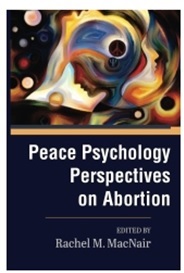 Coyle, C. (2016). Intimate partner violence. In R. MacNair (Ed.), Peace Psychology Perspectives on Abortion (pp. 9-15). Kansas City, MO: Feminism and Nonviolence Studies Association.
Hall, M., Chappell, L.C., Parnell, B.L., Seed, P.T., Bewley, S. (2014). Associations between Intimate Partner Violence and termination of pregnancy: A systematic review and meta-analysis. PLOS Medicine.
Horon I.L. (2005). Underreporting of maternal deaths on death certificates and the magnitude of the problem of maternal mortality. American Journal of Public Health, 95(3), 478–482.
Horon, I.L., & Cheng, D. (2005). Underreporting of pregnancy associated deaths. American Journal of Public Health, 95(11), 1879.
Horon, I.L., & Cheng, D. (2011). Effectiveness of pregnancy check boxes on death certificates in identifying pregnancy-associated mortality. Public Health Reports, 126(2), 195-200.
==========================
For more from the book, Peace Psychology Perspectives on Abortion, see:
Excerpt – Peace Psychology Perspectives on Abortion
Excerpt — Peace Psychology Perspectives on Abortion: Wars Cause Abortion
On a similar topic, see:
Does Socially-Approved Killing Increase Criminal Homicide?
What Does It Mean to Be Inconsistent?

Julia Smucker
by Julia Smucker
CLN President John Whitehead recently put a question to fellow consistent-lifers: does it necessarily make sense to call people “inconsistent” for not fully adhering to the consistent life ethic (CLE)? After all, the reasons people give for approving of some forms of killing and disapproving of others often follow their own internally consistent logic. John provided the following examples of common distinctions made by people objecting to the CLE:
“A fetus isn’t sufficiently developed to have consciousness, so killing a fetus by abortion isn’t morally equivalent to executing or killing in war someone who has been born and is conscious.”
“Helping someone kill themselves isn’t the same as other types of killing because assisted suicide is done with the person’s consent while other forms of killing involve coercion.”
“Executing a murderer isn’t the same as abortion or assisted suicide because the murderer is genuinely guilty of a terrible crime, while those other forms of killing involve killing innocents.”
None of these arguments are consistent in opposing killing, which is what we CLE advocates often mean when referring to “consistency” as a kind of shorthand for the CLE itself. They are, however, consistent with the speakers’ stated criteria of consciousness, non-coercion, and innocence. To John’s point, then, we risk talking past those who raise specific objections to the CLE when we call people inconsistent for not adhering to principles they haven’t expressed.
On the other hand, inconsistencies do sometimes arise with life and peace principles as they are expressed. For example, in certain pro-life circles, especially Christian ones, one commonly hears phrases such as “sanctity of life” and “conception to natural death.” Sometimes these phrases are used with all the robust commitment to the CLE that they imply, but other times they’re invoked by people who vehemently defend many unnatural deaths between birth and old age. Similarly, among those who talk about principles of nonviolence in absolute terms, or about particular concern for the weak and voiceless, some truly apply these principles without exception, while others explicitly exclude vulnerable prenatal lives, even while otherwise making a point of connecting issues.
In such cases, where exceptions are made within language that wouldn’t seem to allow for exceptions, it’s not incorrect to note inconsistencies. Being strongly familiar with different milieus in which both of the above types of no-exceptions language are used, and having often used them that way myself, I’ve also heard them applied inconsistently, often enough to cause me much frustration.
I often want to say, “Do we really believe human life is sacred from conception all the way to natural death or not? If the answer is yes, why wouldn’t we protest all violent, unnatural deaths with equal fervor – and why especially would we ever cheer some of them?”
Or, “Do we really believe in absolute nonviolence or not? If we accept the termination of a human life at any stage of its existence, our opposition to violence isn’t absolute after all.”
Even when people express internally coherent reasons for opposing some forms of violence while supporting others, in practice the rationales aren’t always applied with total consistency. Someone whose primary moral criterion is innocence could logically be firmly opposed to abortion but generally favor war and the death penalty. And the same person, by the same criterion, should be gravely concerned about possible indiscriminate killing in war or wrongful executions. Even if this criterion is only applied to the unborn by virtue of their complete and unassailable innocence, it should provoke as much concern for unborn lives dismissed as “collateral damage,” miscarriages resulting from domestic abuse, or mistreatment of pregnant migrants in detention centers (whose unborn children, at least, cannot reasonably be accused of breaking any laws), as for those killed directly by abortion.
Likewise, someone concerned about coercion may be against most violence with an exception for assisted suicide, but should still be disturbed by the possibility of anyone being coerced into accepting it, and should be at least as concerned with safeguarding against abuse as with making euthanasia available. On the flip side, approval of uncoerced killing would logically allow one to be undisturbed by any suicide, yet few (thankfully) would go that far. And if consciousness or development is the criterion for a life worth sparing, this could raise serious questions about its application to those with mental impairment or developmental abnormalities.
This doesn’t mean we should assume everyone who makes exceptions to the CLE fails to follow their own reasoning to its logical conclusions. Rather, even rationales with exceptions can be used as starting points to nudge people toward less approval of violence. Perhaps requesting clarification on others’ positions in a dialogical way, and expanding on the implications of their own stated reasons for opposing specific kinds of violence, can raise questions about accepting other kinds in understandable ways.
In other words, whether or not it’s accurate to call someone’s position inconsistent (which in some cases it is, though not all), it’s probably more persuasive to start with reasoning that’s consistent with their framework.
============================
For more of our blog posts from Julia Smucker, see:
The Price of Violence: When Dehumanizing the Vulnerable Hurts One’s Own Causes
Amnesty International’s Blind Spot
Defining Reproductive Justice: An Encounter
The Redemptive Personalism of Saint Oscar Romero
Media Stories on Abortion Access
“Everybody Else in the World Was Dead”: Hiroshima’s Legacy
(compiled by John Whitehead)
The American atomic bombing of Hiroshima was 74 years ago today, August 6th. To mark the anniversary, we share stories from bombing survivors, in Japanese hibakusha (“bomb-affected people”).
Hibakusha Stories

Sadako Sasaki, the young girl who died of leukemia (probably caused by the atom bomb) after completing her 1,000 crane origamis, 1955
Dr. Michihiko Hachiya was at home that morning, which was “still, warm, and beautiful. Shimmering leaves, reflecting sunlight from a cloudless sky, made a pleasant contrast with shadows in my garden as I gazed absently through wide-flung doors opening to the south . . .
“Suddenly, a strong flash of light startled me—and then another. So well does one recall little things that I remember vividly how a stone lantern in the garden became brilliantly lit…
“Garden shadows disappeared. The view where a moment before all had been so bright and sunny was now dark and hazy.” (Hiroshima Diary)
Mrs. Hatsuyo Nakamura, a widowed seamstress with three children, was in her house when “everything flashed whiter than any white she had ever seen…[T]he reflex of a mother set her in motion toward her children. She had taken a single step (the house was 1,350 yards, or three-quarters of a mile, from the center of the explosion) when something picked her up and she seemed to fly into the next room over the raised sleeping platform, pursued by parts of her house.
“Timbers fell around her as she landed…everything became dark, for she was buried…She rose up and freed herself. She heard a child cry, “Mother, help me!,” and saw her youngest—Myeko, the five-year-old—buried up to her breast and unable to move. As Mrs. Nakamura started frantically to claw her way toward the baby, she could see or hear nothing of her other children.”
Mrs. Nakamura “crawled across the debris, hauled at timbers, and flung tiles aside, in a hurried effort to free [Myeko]. Then, from what seemed to be caverns far below, she heard two small voices crying, “Taskukete! Tasukete! Help! Help!” (John Hersey, Hiroshima)
A first-grade girl tried to help her mother, who was trapped under their house’s burning wreckage:
“I was determined not to escape without my mother. But the flames were steadily spreading and my clothes were already on fire and I couldn’t stand it any longer. So screaming, ‘Mommy! Mommy!’ I ran wildly into the middle of the flames. No matter how far I went it was a sea of fire all around and there was no way to escape.
“So beside myself I jumped into our [civil defense] water tank. The sparks were falling everywhere so I put a piece of tin over my head to keep out the fire. The water in the tank was hot like a bath. Beside me there were four or five other people who were all calling someone’s name.
“While I was in the water tank everything became like a dream and sometime or other I became unconscious…
“Five days after that [I learned that] Mother had finally died just as I had left her.” (Quoted in Richard Rhodes, The Making of the Atomic Bomb)
Mikio Inoue remembers “We were walking along the streetcar line at the foot of Hijiyama. Wherever we went we saw dead horses and bodies lying here and there. The remaining fires were giving off a lot of smoke. Not a soul was in sight. It was when I crossed Miyuki Bridge that I saw Professor Takenaka standing at the foot of the bridge. He was almost naked, wearing nothing but shorts, and he had a rice ball in his right hand. Beyond the streetcar line, the northern area was covered by red fire burning against the sky. Far away from the line, Ote-machi was also a sea of fire.
“That day Professor Takenaka had not gone to Hiroshima University and the A-bomb exploded when he was at home. He tried to rescue his wife who was trapped under a roofbeam but all his efforts were in vain. The fire was threatening him also. His wife pleaded, ‘Run away, dear!’ He was forced to desert his wife and escape from the fire….
“His naked figure, standing there before the flames with that rice ball looked to me as a symbol of the modest hope of human beings.” (from Unforgettable Fire: Pictures Drawn by Atomic Bomb Survivors)
A five-year old girl recalled that
“The whole city…was burning. Black smoke was billowing up and we could hear the sound of big things exploding…Those dreadful streets. The fires were burning. There was a strange smell all over. Blue-green balls of fire were drifting around. I had a terrible lonely feeling that everybody else in the world was dead and only we were still alive.” (Quoted in Rhodes, Making of the Atomic Bomb)
Yasuko Yamagata remembers “[The morning after the bombing] I started from school toward the ruins of my house in Nobori-cho. I passed by Hijiyama. There were few people to be seen in the scorched field. I saw for the first time a pile of burned bodies in a water tank by the entrance to the broadcasting station. Then I was suddenly frightened by a terrible sight on the street… There was a charred body of a woman standing frozen in a running posture with one leg lifted and her baby tightly clutched in her arms. Who on earth could she be?” (from Unforgettable Fire)
More hibakusha stories are available online.
Hiroshima’s Legacy
People have drawn notable lessons from the Hiroshima bombing and the additional nuclear bombing of Nagasaki on August 9th:
“Reference was made to my agreeing that abortion is taking a human life, which it is. However, let us remember that war is also legalized killing, that the pilot that dropped the atom bomb on Nagasaki and Hiroshima killed human life. He got medals for it. We bless our troops when they go into battle to kill human beings, so that the taking of human life…is not a strange behavior in a society.” (Dr. Frank Behrend, whose practice included abortions).

“Presidents, members of Congress, and other leaders have made life or death decisions that resulted in thousands of deaths. Some of these decisions – such as the bombing of Hiroshima and Nagasaki – are justified by many Americans, even if many deaths occurred…Somehow we can tolerate our leaders making life or death decisions affecting many lives when they are faced with difficult situations such as international aggression. We find understanding and empathy for them if they make a mistake – even if their decision brings death to other human beings, yet we don’t want to let a woman make a decision affecting only her own life and the life within her.” (Beverly Wildung Harrison, Christian ethics professor, Union Theological Seminary)
“How do we know our own identity? By limits; by boundaries; by law; by order. And I think we lost all of these at 8:15 in the morning August the 6th 1945 when we dropped the bomb on Hiroshima. That bomb blotted out boundaries of life and death, civilian and the military; and trust among nations. And so abortion from that point on is defended on the ground that one may do whatever he pleases.” (Archbishop Fulton Sheen, “The Approach of Midnight”)
“[The atomic bombing’s] proponents even now justify it primarily . . . not by denying the intention of killing the innocent, but by reference to casualties prevented, a consequentialist justification. . . . [thus passing over] the subsequent history of our nation, a history that includes further acts of indiscriminate killing during the Vietnam War, a standing resolution to destroy the Soviet Union if it were first to attack us with nuclear weapons, and the eventual adoption by the nation in its domestic affairs of death as a solution to be embraced for its consequences—before birth, as in abortion or human embryo destructive research—or at the end of life, in [Physician-Assisted Suicide] and euthanasia. These are, sadly, natural choices for a country swayed by consequentialist justifications; the way to those choices was paved by the literally catastrophic choice to destroy Japanese cities (as before them, German cities) for the sake of military gain.” (Christopher O. Tollefson, “On the Dangers of Thanking God for the Atomic Bomb”)
“I was sitting in the wrong end of a police wagon the first time I questioned nuclear weapons . . .
“We had been protesting abortion. I was thinking about nuclear weapons because a couple of those in the bus were peace activists who had long rap sheets from years of anti-war protests. I, on the other hand, was a Republican-voting, independent Baptist church-attending, conservative-leaning, law-abiding (well, until now) kind of Christian. I was awed—and grateful—that these peaceniks would join the likes of me in common cause against another kind of violence. My new friends adhered to the ‘seamless garment’ philosophy, also called the consistent life ethic, one committed to the protection of all human life, whether from war, poverty, racism, capital punishment, euthanasia, or abortion.” (Karen Swallow Prior, “Nukes and the Pro-Life Christian”)
================================================
For more from John Whitehead on similar topics, see:
Rejecting Mass Murder: Looking Back on Hiroshima and Nagasaki
The Wages of War: How Abortion Came to Japan
See Karen Swallow Prior’s article in our blog, with a link to the full article:
Nukes and the Pro-Life Christian: A Conservative Takes a Second Look at the Morality of Nuclear Weapons
Activists, Beware: Burnout is a Very Real Danger
by Rachel MacNair
Part 2 of 2 posts responding to Ward Ricker’s essay, “Prolife – Not.” Here’s Part 1.
Ward Ricker’s main point is: haven’t pro-lifers been ineffective because we’ve sent mixed messages? Mainly, we’re proclaiming an abortion to be the murder of an innocent child, and yet our behavior shows we’re not taking it that seriously. We’d drop everything to pull people we can see out of a burning building, after all. So why are we so cheerful and nice about it, when at the same time, we’re asserting this is mass slaughter?

Philosophy: Our Musings
I copy here comments responding to Ward’s point from other members of the Consistent Life Network board of directors and advisory board:
Carol Crossed:
I believe Ward’s words are insightful. I recall when a bunch of 40+ were arrested at the Pentagon with Daniel Berrigan in 1995 on the 50th anniversary of Hiroshima Nagasaki. We were on this bus being taken away to the detention center and we were chatting and laughing. This woman stood up and said something to the effect that can we not be reflective? Do we really treat this as a picnic outing? The bus fell silent. After a few minutes, Berrigan said in his deep slow way, well, she has a point. Are we doing this because we want to feel good, or are we doing this because we have just witnessed evil?
Richard Stith:
. . . If your social view is in general perceived to be that of the Establishment or at least be winning, you can be as angry and mean and hateful as you like and you won’t suffer for it. But if your social movement is perceived to be non-Establishment or even to be losing ground, you have to be extra-extra nice in order to be heard. That is why most anti-slavery people in the north were not fire-breathing abolitionists. They couldn’t show rightful outrage against slavery and still be respectable. . . .
The bottom line strategically and tactically for us is this: We should never neglect to state and show the full horror of abortion while at the same time being hopeful and friendly. That’s tough to do. So we should be tolerant of fellow pro-lifers who err in one direction or the other.
Lisa Stiller:
I’m having trouble with this whole discussion, as it’s like saying you have given up on opposing war because protestors aren’t angry enough. Or given up opposing the death penalty because opponents are too calm.
If you don’t oppose violence because you don’t like the way people are opposing it, you really don’t oppose violence. It’s about the concept and morality of opposing killing. Nothing else.
Philosophy: My Musings
 My first reaction is that I would in fact drop everything and focus on a woman who was considering an abortion, if I saw it as possible I could prevent it. Sidewalk advocates, of course, put themselves deliberately in that situation all the time. Yet the last-ditch effort when an abortion process is already in motion isn’t as good as getting there long in advance, so the woman never considers abortion or so that she tells those people trying to pressure her into one to quit bugging her. So all the nonviolent and honest actions of the entire pro-life movement are needed. But those are all long-term, constant, steady – not an immediate emergency.
I would make a comparison to how the media extensively covers mass shootings, which only happen now and then. Yet currently many times as many people will have been killed in Yemen that same day. And every day. There’s a war there. Wars don’t get the day-to-day coverage that an isolated incident does. When something that would be an emergency if it happened only once becomes commonplace, then opposing it becomes part of your lifestyle.
And there’s never been a time in history when there weren’t massive numbers of killings. Feticide and infanticide have been common in most places throughout history, as have wars, executions, and lynchings, to name a few. Anyone in any historical period who cared about people not getting killed has always had to include that opposition as part of her or his lifestyle.
Which leads us to what happens when opposing killing must be a life-long commitment.
Psychology: Burnout
Burnout has three components:
Emotional exhaustion — feeling overwhelmed by emotional demands. Ward’s argument that we should treat the constant killing as a constant emergency is bound to provoke this.
Depersonalization — development of a detached, callous response. So, as an example, when a client complained about not having Christmas presents for her children, the social worker snapped at her to go shoplift something – a markedly unhelpful response, and a sign of burnout. And Ward similarly snaps at fellow pro-lifers. He makes valid points and illustrates them with pertinent experiences, but we’ve all had those frustrations. As I said in Part 1, all social movements have the problem of being less effective than they could be, because they’re run by human beings. When the response isn’t to try to improve that problem but to drop out of the movement, that’s a sign of burnout.
Feeling of reduced personal accomplishment —and reduced social movement accomplishment. Given the high stakes, the sense that we’re just not getting anywhere is a sign of burnout.
What I see is that Ward has offered a recipe for burnout, and then unsurprisingly shows that he’s suffering from it.
Ward, you haven’t asked my advice, but this I offer anyway: you need a good long break, which you should regard not as stopping work on the movement but replenishing yourself for the long haul.
Then, when ready to get back in, follow the advice for everyone below. I think you’d be especially well equipped to address your concern that the balance of atheists in the pro-life movement is insufficient. Atheists are obviously better suited to appeal to other atheists than non-atheists are.
For Everyone: Avoiding and Coping with Burnout
These are the basics, as those studying the problem (mainly, Christina Maslach) have figured out:
1. Work smarter, not harder. As when going uphill, it’s better to shift gears than to use more gas.
a. Set specific, realistic steps.
When a step is done, one can see that progress has been made. The final goal may be years, decades, or perhaps centuries away. Define accomplishments in concrete terms. Have daily, weekly, or monthly goals that can reasonably be done in that time frame.
b. Do the same thing differently.
Avoid ruts. Find what can be varied, and experiment with what’s effective. The change may improve effectiveness, and can be abandoned if not.
c. Take breaks and rest periods.
In addition to needed relaxation, this gives a chance to get some mental distance to get some perspective, to see things more coolly.
d. Take a “downshift.”
Not a full break, but doing other aspects of the work. Do paperwork or read; organize files; do some cleaning.
2. Caring for Oneself. The best way to help others is to be in good shape.
a. Accentuate the positive.
Finding the good makes the bad less overwhelming.
b. Small talk is important.
It may be irrelevant, but helps people manage.
c. Ask for positive feedback.
d. Know yourself.
Be in tune to inner feelings.
e. Use relaxation techniques.
The best to use is the one that fits you well.
f. Use humor.
It helps you keep perspective and lifts spirits.
Yet all this is exactly what goes against Ward’s point: how can we be humorous when babies are being killed? How can we relax and engage in small talk? What positive things don’t pale in comparison to the horror of it all? Doesn’t that communicate that we don’t really believe what we say when we say it’s massive slaughter?
But the results are in: those of us who use these techniques to keep ourselves sane are still working, and Ward has dropped out. The very fact that he feels the need to drop out shows the inadvisability of his approach.
Burnout is something all activists on every issue need to be aware of. We need to take care of ourselves – not for selfish reasons, but because it makes us more effective. We’re in it for the long haul.
“Why Haven’t We Ended Abortion?”
by Rachel MacNair
Part 1 of 2 posts responding to Ward Ricker’s essay, “Prolife – Not”
Ward Ricker has been active in opposing abortion, but has recently written an essay expressing alienation from the pro-life movement. In Part 2, I’ll address that feeling of alienation more directly, but first I was challenged by his complaint that when he googled the question – Why Haven’t We Ended Abortion? – his own previous essay on the topic was the only one that came up. He thought the question deserved more attention.
As seen with my outpouring of reasons below, I’ve certainly thought about it. But first, I want to make the question more specific and realistic: “Why haven’t we ended abortion being legal, socially approved, and practiced widely and openly?”
First, a reminder that the CLN blog welcomes diverse views, so the reasons I offer below are my opinion and not officially that of the organization.
Some Suggestions on Why

1) Courts in those countries with a court-imposed “right” to abortion are, for the most part, engaged in bizarre reasoning from which they either refuse to budge or they budge only slightly.
2) Mainstream media too often cover negative stereotypes of abortion opponents rather than giving an honest view of the debate. Most mass media tend to avoid covering those of us that don’t fit the stereotypes. As Ward has pointed out, they also only cover the debate – they rarely cover abortion itself, nor the gory details of how it’s practiced. And mainly they don’t even do much to cover the debate.
3) In the U.S., the Republicans have talked smoothly on the topic, but many politicians don’t have behavior showing they mean it. Pro-lifers spend so much of their time working for them, only to be betrayed. Over and over. A prime example is President Ronald Reagan’s appointment of Sandra Day O’Connor to the U.S. Supreme Court.
4) In the U.S., Democrats have become bigoted on this topic. The intolerance of pro-life views is truly astonishing. Even simple efforts to have a “big tent” philosophy of allowing people to be pro-life Democrats has met with massive resistance and in most places isn’t the current policy.
5) Because of this Republican/Democrat divide in the U.S. and similar rifts in other countries, and because of the courts, and also the media, abortion has been presented as a right-wing/left-wing divide. So people move to the wing they agree with on other topics rather than thinking about it.
6) We have the same problem with societal apathy that absolutely every social movement that has ever existed has had.

7) Abortion promoters have way more money. They make money from abortions themselves. They also have more rich people and foundations donating, plus government grants.
8) The lead-up to Roe v. Wade arose during the cauldron of the American war in Vietnam and when Cold War anxiety over having a nuclear holocaust was high. The negative vortex of violent energy fed off the horrific violence of the era.
9) The Abortion Distortion Factor – when abortion is the topic at hand, many people dispense with the moral principles they normally abide by. I explain this as cognitive-dissonance-induced belligerency.
10) Human society has a long-standing habit of using killing as a problem-solver. We’re struggling against millennia of massive slaughter.
And Yet . . .
Abortion numbers in the U.S. are falling and have been for years, and there’s an even more dramatic downturn in first-time abortions. The repeat abortions are keeping the numbers up, but they’ll fall by attrition eventually as women hit menopause, so we’ve got a more dramatic downturn coming. I’ve written about how we can use psychology to our advantage with this observation.

But this also means that our work all these years has in fact been highly effective.
It’s of course heart-wrenching that it isn’t more effective – half of a huge number is still a huge number, and just one is one too many – but we are in fact making progress, and it’s absolutely crucial that we continue.
Final Question: Why this Question?
Ward was taken aback that he seemed to be the only one posing this question, and wondered why. My quick answer is that pro-lifers are very well acquainted with the many obstacles we face and are more likely to complain about those obstacles than to ask the question in this way. These are longstanding frustrations, after all.
But being inclined to connect issues of violence, I’ll also ask:
Why haven’t we ended war? Though we’ve made progress in that people generally only think it allowable for defense and not aggression, they’re nevertheless awfully easily convinced a given war is defensive when that’s highly questionable or just plain silly. Or they’re unconvinced but apathetic.
Why haven’t we ended the death penalty? It’s a mere shadow of what it used to be in numbers of executions and numbers of places it’s used, but why is it still happening at all?
Why haven’t we ended poverty? There’s a far smaller proportion of human society mired in it than used to be, but we have the resources to end it entirely, and stop the many deaths it causes. So why haven’t we?
Why haven’t we ended racism? Again, we’ve made more progress over the decades, but far too much of racism is still rearing its ugly head.
And why haven’t we ended nuclear weapons? Unlike all these others, we’re not dealing with centuries of human practice. While nukes were prevalent when I was born, my own parents were born into a world without them. There are far fewer than there used to be, and we now have an international treaty to ban them (signed by nations that don’t possess them). Given the demise of the Cold War and the clear danger of having so many and actually “modernizing” them, why is there so much apathy?
The answer to all these questions is: all social movements to stop violence have obstacles of the kinds I mentioned above.
Also, all of them aren’t working as effectively as they could, what with being run by human beings.
Additionally, these are some of the forms of socially-approved killing that we still have left, out of a once far greater number. We pretty much ended duels, gladiator games, witch-burnings, crucifixions lining the roads for public display, and various other forms of killings that used to be quite legal. We can learn lessons from those successes.
To my mind, the practical question isn’t why the killing of various kinds hasn’t ended. The practical question is: What are we going to do, or what will we keep doing, to end them?
All hands on deck.
Oppressors of Women Scapegoat Fetuses to Preserve Patriarchy
by Richard Stith
[Originally published in The New Human (Vol. VI, No. 5, June 1977), newsletter of the National Youth Pro-Life Coalition,, under the title “Abortion Proponents Are Often Exploiters of Women.” Lightly edited.]
We’re all familiar with the argument that racism is fomented by those who exploit poor whites, in order to generate a convenient and often dehumanized scapegoat and thus prevent oppressed white workers from realizing who their real enemies are. The upper-class white in effect says to the lower-class white whom he is oppressing, “Hey, don’t blame me for your miserable existence. It’s those ‘n . . . .s’ who want your job and keep wages down by flooding the market with cheap labor. Get them. Lynch them. Kill them.”
Well, similarly, those in our society who oppress women are given a convenient scapegoat in the frequently dehumanized unborn child. The male says to the female he gets pregnant and abandons, “Hey, don’t blame me for your problems. It’s that ‘fetus’ inside you. Get it. Abort it. Kill it.”
Or, again, those who stigmatize unwed mothers instead of reacting with compassion can say, “Don’t blame us for your ostracism from the community. We’ll be glad to take you back, if you cover up what you did by getting an abortion. That ‘fetus’ is your enemy. Get it. Kill it.”
Or, again, the businesses that pay women less because they get pregnant, that don’t provide paid maternity leave and even fire pregnant women, that don’t in any way (that is, by part-time jobs) try to help men and women accommodate their family responsibilities—all these businesses can say with abortion available, “Hey, don’t blame us for your economic problems. It’s that damn ‘fetus.’ We’ll treat you just like always if you’ll get rid of it. Kill it.”
And, finally, abortion lets the government tell the poor and the black (at home and abroad): “Hey don’t blame us or U.S. capitalism for your troubles. It’s your own kids. They are your real enemy. You’ll see how happy you’ll be if you just get rid of them. Kill them. We’ll even pay for it!”
In none of these cases are the oppressed (poor whites, blacks, women) forced to turn to racism or to abortion. But the dehumanization and scapegoating of blacks and of the unborn nevertheless are used as tools of systematic oppression. The mere fact that women in theory have “freedom of choice” in regard to abortion doesn’t stop them from being exploited by abortion, because the parameters of that choice are strictly limited by the interests of sexism, racism, and capitalism, and because the consciousness of this limitation is ideologically suppressed by the use of the “fetus” as a scapegoat.

Blacks in Africa have long regarded abortion “as the white man’s new(est) form of genocide,” stated Dr. Margaret White of Croyden, England at the annual meeting of the National Federation of Catholic Physicians Guilds. The United States Agency for International Development has financed a spokesman who attacks the antiquated laws of the colonial masters and at the same time is calling for more contraception and abortion. “I find this . . . a nastier form of colonialism than ours,” she stated. The U.S. Center For Disease Control and Prevention lists the abortion rate for non-whites as twice that of whites in America. (Ob-Gyn News, 3-15-77).
The [National Youth Pro-life Coalition] NYPLC Board of Directors, in a letter to U.S. Secretary of State Cyrus Vance, has condemned the U.S. government’s plan to sterilize one-fourth of the world’s fertile women, and has called for an end to the plan’s covert funding of the International Planned Parenthood Federation . . . . The NYPLC pointed out that such a massive program must necessarily involve heavy one-sided propaganda, if not coercion. The real motive behind federally-financed abortion and sterilization, keeping down the demands of the poor for social justice, is now out in the open and must be resisted, the NYPLC declared. . . .
Interestingly, the leftist press in the U.S. and abroad has for a number of years agreed with the pro-life movement about the often regressive nature of the government push for abortion and sterilization, even though the left has not generally been against abortion per se. For example, the cartoon below appeared on the cover of a journal called Science for the People in January, 1977. The remark by Che Guevara is a warning that abortion may be used to kill the unborn poor before they have a chance to grow up to be revolutionaries. The artist is Wen-Ti Tsen of Cambridge, Massachusetts.

=====================================
For more of our posts from Richard Stith, see:
Equal Concern for Each Human Being, Not for Each Human Issue
Open Letter to Fellow Human Rights Activists
Misogyny vs. Patriarchy
by Rachel MacNair
Before I get into why I think it’s important to understand the difference between misogyny and patriarchy, I want to explain how they fit into the Consistent Life Network’s set of issues.
We identified six issues of violence involving socially-tolerated killing of human beings, as listed on this banner:

Each of the issues is overarching. Nuclear weapons and military spending are covered under war. Destructive embryonic stem cell research is covered under abortion. Infanticide is included under euthanasia. And so on.
I’ve always regarded racism as also covering misogyny and lethal discrimination against people with disabilities. In all cases, entire groups are being targeted for dehumanizing words and actions. There just isn’t really a good word to cover all of the groups. Bigotry is the closest, but it doesn’t quite capture the point we want to make.
But why is racism the one to cover all three?
It’s more clearly related to all issues: the racism of the death penalty is a major problem, whereas women are less subjected to executions and people with mental disabilities are in some places explicitly exempted. Women and the disabled are also explicitly excluded from being subjected to the military draft, which we would regard as a benefit for them.
Still, our focus on abortion should bring misogyny to the forefront, and our focus on euthanasia brings bigotry against people with disabilities to the forefront. Yet racism clearly has lethal impact in both those areas as well.
Misogyny vs. Patriarchy
There’s a further complication: many people confuse misogyny and patriarchy, but they’re not the same. Misogyny means being against women. Patriarchy means ruling over women. An example to illustrate the difference:
During the original run of the sitcom Roseanne, Jackie was Roseanne’s sister and Dan was Roseanne’s husband. Dan didn’t particularly like Jackie; when he came home and saw Jackie there, he wasn’t happy. But Jackie was family, and therefore entitled to be there. Jackie moved in with a man named Fisher. Fisher beat her. She wasn’t willing to go to law enforcement for fear of making things worse. Jackie’s father had died, she had no brother, and the husband-surrogate was the problem. In patriarchal terms, the next in line for male “protection” was her brother-in-law. So Dan went and beat Fisher.
Here’s the difference:
Fisher beats Jackie / motivated by hatred for women = misogyny.
Dan beats Fisher / motivated by protection of women = patriarchy.
Both led to violence. Both are, shall we way, poor at problem-solving. Both treat women as unequal. Yet the motivation is so opposite that a different analysis applies.
Applying this to abortion:
Misogynists can regard women as receptacles for the next generation for whom abortion is disallowed. Conversely, they can regard themselves as entitled to consequence-free sex and therefore launch unwanted pregnancies and push for aborting them.
Patriarchs – while they can, of course, also be misogynists – can instead have a sense of beneficent rule over women that would protect women and children from abortion. Conversely, they can also rule that abortions should happen. Discussing the Roman Empire in the first three centuries of the Christian era, sociologist Rodney Stark observes:

Once married, pagan girls had a substantially lower life expectancy, much of the difference being due to the great prevalence of abortion, which involved barbaric methods in an age without soap, let alone antibiotics. Given the very significant threat to life and the agony of the procedure, one might wonder why pagan women took such risks. They didn’t do so voluntarily. It was men – husbands, lovers, and fathers – who made the decision to abort. It isn’t surprising that a world that gave husbands the right to demand that infant girls be done away with would also give men the right to order their wives, mistresses, or daughters to abort.
Discovering God, HarperCollins, 2007, p. 321
Both misogynists and patriarchs can be on either side of the abortion issue.
Patriarchy and the Pro-Life Movement
It’s impossible to be a misogynist consistent-lifer; it would be like being a racist consistent-lifer. Both are a contradiction in terms. But is it possible to believe in patriarchy of a non-misogynist type and still be a consistent-lifer?
Technically, yes. You don’t need to beat the wife-beaters to protect women. If protecting women and children is your motivation, then the issue of whether society is better off if men rule women is a side-issue – perhaps a question of strategy.
But, I must say, I’ve never met a patriarchal consistent-lifer, and would be surprised if I ever did. Many of our member groups are pro-life feminists, and pro-life feminism is so enmeshed in our literature that we pretty much regard it as integral to the consistent life ethic. I’ve never known of an instance when anyone thought that bringing up pro-life feminism was off-topic. (I myself was president of Feminists for Life, 1984-1994). The point that greater equality and more genuine choices for women is one of the prominent solutions to abortion is a point we make frequently.

March for Life, 2019
What about the pro-life movement as a whole? This is a female-dominated movement, and always has been. While there might be a difference in multi-issue groups such as the Knights of Columbus, in activist right-to-life groups, any man who wants to participate has to be accustomed to working with women, taking our ideas seriously, and taking instruction from us.
Just this last time at the March for Life Expo, two men gave me literature showing a Roman centurion outfit and having clear patriarchal wording, of the men-are-supposed-to-protect kind. Nevertheless, they listened to me intently as I explained the finer points of boycott strategy. Their idea of male obligations on protection didn’t include discounting female expertise. It couldn’t. That’s just not the dynamic of how the pro-life movement works, or ever has.
This was one of the things that struck me when I joined the pro-life movement back in the 1980s. I was well-versed in peace and anti-nuclear activism at that point, and those movements weren’t nearly as good at including women as the pro-life movement was. There was much talk about how women had been expected to get coffee while the men did the decision-making, and this was no longer acceptable. Yet the effort to do otherwise in the groups I was involved in was very conscious and deliberate. I got pushed into a lot of leadership based on the need to address gender balance in leadership; fortunately, my predilections worked well with this.
When I joined mainstream pro-life groups, though, female participation in leadership was natural and never required attention to ensure.
Male politicians, of course, are another matter.
Book Review: “Resisting Throwaway Culture”
by Mary Lou Bennett

Resisting Throwaway Culture: How a Consistent Life Ethic Can United a Fractured People, by Charles C. Camosy.
Anyone living in the United States today is acutely aware of the pain and decay that permeate society as a result of contemporary moral issues. With such awareness, feelings of sadness, despair, and disbelief can become paramount. Hence, Charles C. Camosy’s book, Resisting Throwaway Culture, becomes a very important read.
Camosy not only writes with a profound understanding of what plagues society, but he also offers hope and a clear approach for setting the foundation for a better tomorrow. With knowledge and a straightforward approach that’s easy to read, Camosy explains that the American tendency has become to solve problems with violence. This, in turn, has resulted in what Pope Francis calls our “throwaway culture.”
Such a culture is enabled (if not fueled by) constant consumerism, and has resulted in humans becoming increasingly ignored, rejected, and disposed of. Camosy urges individuals to put aside political debates and reflect intently on their deepest values, while also embracing a Consistent Life Ethic (CLE). In doing so, people who have found themselves in a polarized culture war can finally begin to unite.
Camosy discusses the contemporary hook-up culture, reproductive technology, abortion, euthanasia, poverty, immigration, and mass incarceration. I was pleased to see he even goes a step further to also address the CLE’s concern that non-human beings are also being treated with cruelty and extensive violence. The CLE acknowledges that such brutal treatment of animals, like all violence, speaks to the fact that the world revolves around consumerism, diminishing the value of all life, human and otherwise, to “mere things” in order to generate a profit.
As I read Comosy’s theories and arguments, there were many eye-opening moments for me. For example, though I know of various state laws about the death penalty, I didn’t realize that more than 170 countries have abolished the death penalty, but the U.S., and a handful of other countries (including Iran and Saudi Arabia) continue to keep it.
I was also disturbed by some of Camosy’s information relating to reproductive biotechnology. He explained that, in the near future, embryos created through in vitro fertilization will have some chosen, while the “excess” will be thrown away. The embryos will then be edited to eliminate what those in power have decided are genetic diseases.
In each chapter, there’s a discussion on consumerism and autonomy, and how each, coupled with the use of language, serves to marginalize the sanctity of life, making it easy to discard the vulnerable. Indeed, each chapter is a reminder of how lost our country, the United States, has become.
At times I teared up, thinking about the countless loss of life, particularly that of the most innocent and helpless,the unborn. Other times, I became frustrated and enraged by what I learned. To discover that there’s a pervasiveness of abortion in many African American communities, and then read that abortion clinic owners often target communities with large percentages of racial minorities when deciding where to build their facilities, is truly infuriating.
Additionally, reading that abortion is promoted in some cities through billboard campaigns with slogans like, “Abortion is Necessary” is unnerving to say the least. Prior to reading Resisting Throwaway Culture, perhaps I could have said I found such information unfathomable, but now I understand that consumerism and autonomy apparently drive all aspects of existence, and some people have no shame. How utterly sad
This certainly all sounds bleak and disturbing. So, where is the hope that I spoke of earlier? According to Camosy, it can be found within the values of the Consistent Life Ethic itself. These values are: the inherent dignity of every person, nonviolence, hospitality, encounter, mercy, conservation of the ecological world, and offering priority to those in society who are the most vulnerable.
Beyond reminding us of these important values, Camosy reminds us that we must act–all of us. We cannot simply expect change, we must work to implement it, by first changing the way we live.
At the end of his book, Camosy’s appendix serves to highlight all the issues he discusses throughout. These issues are presented in a chart form, along with the various principles that serve to fuel them.
Though you may not agree with everything that Camosy has to say, you’ll certainly find that he has coherent arguments that get you thinking about the sanctity of life. He responds with compassion to the cultural fracturing that currently exists, while also providing a unifying framework, the Consistent Life Ethic, to protect the most vulnerable members of society.
Hopefully, Camosy’s book will be successful in its call to challenge each of us to create a culture of encounter capable of resisting what Pope Francis calls a “globalization of indifference.” If so, our society will undoubtedly become a better place for all to live.
-==========================================

Mary Lou Bennett
For more of our posts from Mary Lou Bennett, see:
The Tragedy of Carrie Buck: A Review of Imbeciles / Mary Lou Bennett (book by Adam Cohen)
Mothers and Daughters / Mary Bennett (movie)