An Open Letter to Fellow Human Rights Activists
From Richard Stith J.D.(Yale), Ph.D.(Yale), Professor of Law Emeritus & Consistent Life Board Member

Richard Stith at annual March for Life
I think any endorsement of abortion rights to be a mistake, for two reasons: Endorsing abortion rights causes further harm to already oppressed women, particularly in the developing world. And endorsing abortion rights hurts our important work for human rights in general.
(1) If a woman is dominated by others, the freedoms she is given will be exercised against her by those who dominate her.
We all know that many women are simply unable to effectively negotiate the terms and conditions of their sexual interactions and reproductive choices due to pervasive discrimination, coercion and violence against them. Unfortunately, legalization of abortion provides those coercers with another weapon that they can use against the women they dominate.
In other words, abortion rights may truly be liberating for powerful women whose careers cannot easily accommodate children, for women who are truly free to choose without outside pressures and for whom the opportunity costs of children are very great. Polls indeed show that such women overwhelmingly support a right to abortion. By contrast, poorer women, even in the USA, are the group most hostile to abortion. Why would they want abortion available if it’s only going to result in a boyfriend, a parent, a husband, or an employer coercing them (even by violence) to forego one of the few satisfactions they have in their oppressed lives, the love of a child? Or just think how the availability of abortion can facilitate raw sexual exploitation: A college student told me once: “I’m really pro-choice, but you can bet I tell my boyfriend I’m 100% pro-life.” She knew that the option of abortion could easily make him less careful. But not all young women are so clever. (Consult the great feminist thinker Catherine MacKinnon for more on the effect of making abortion a “privacy” right. She points out that it is precisely in women’s private lives that male dominance is most extreme.)
The developing world is much, much worse for most women. Except for a tiny elite segment of women (which unfortunately may be the only non-male presence at international conferences set up to propose new laws) abortion hurts women because it empowers husbands, sweatshop owners, and pimps to use them with impunity. The rule is very simple: Those who make real life choices for women are the real rights holders, regardless of who may have the formal legal right to make decisions.
Even seemingly obvious rights to abortion, such as abortion after rape or incest, may backfire against women where they are weak. After all, in most societies rape and incest are viewed very negatively, if they are discovered. Male predators ordinarily want their victims to have abortions so they won’t be exposed and punished, and so that they can continue their sexual exploitation. Only in a modern nation, with a good police force, can predators regularly be caught and punished, so that the abortion decision can more truly be that of the woman. This is a tough call I admit, but the uncertainty of the real-life impact of laws permitting abortion should give one second thoughts about making even abortion after rape into an international right, applicable in all circumstances in all countries.
In summary, to proclaim rights to abortion around the world is to adopt a first-world, or an upper-elite, view of the beneficiaries of such rights. A down-to-earth look at poor and oppressed women’s actual lives will lead one to conclude that women would first need to be empowered before they could truly benefit from any rights to abortion.

2) No organization can proclaim complete support for Human Rights if it endorses abortion.
As a teacher of comparative law, I can tell you the right to life of the fetus is explicitly protected by a number of international treaties and national constitutions. Fundamental rights to abortion are recognized far less extensively.
I’m not saying that only a few nations permit abortion. Many do. But very few treat it as a basic human right. Abortion is permitted simply because the legislature of the nation has decided to pass such a law, but that law could be repealed tomorrow without violating any treaty or constitution. Nowhere in Europe (with the possible exception of abortion for severe health reasons in Italy) is there a clear constitutional right to abortion, to my knowledge. But various countries’ constitutions or constitutional court decisions contain a right to life. Germany is one. The unborn child has a constitutional right to life throughout pregnancy there, recognized twice by the Constitutional Court in lengthy decisions in 1975 and in 1993. [Do not rely on the over-simplified report that Germany does not punish abortion in the first 12 weeks, as long as the pregnant woman has undergone solidly “pro-life” counseling and has waited three more days to think it over. That is true, but the Court’s reasoning is that the counseling will save more unborn lives than threats of punishment. Strange as it may seem to us, abortion goes unpunished in Germany in furtherance of a fetal right to life, not of a maternal right to abortion.] And why does Germany care about unborn life? The answer given by the Court is that to permit abortion is to head once again down the path to devaluation of individual human life followed by the Nazis. When we proclaim a right to abortion, according to German human rights doctrine, we are attacking life, the most basic human right of all, and following again that dreaded path.
The regional human rights treaty for the Americas, the American Convention on Human Rights (Pact of San José, 1969) explicitly proclaims “Every person has the right to have his life respected. This right shall be protected by law and, in general, from the moment of conception.” [Art. 4(1)]. It also emphasizes that “’person’ means every human being.” [Art. 1(2)] Thus we see that the unborn child is recognized as a person with a right to life from the moment of conception. When it comes to legal protection of that right, it is true, the signatory states have a little flexibility (presumably to deal with any clash with the mother’s equal right to life) because of the words “in general.” But this is not phrased as a limit on the right itself, but only as a permitted (but not required) minor exception to the legal enforcement of that right. Do we really want to proclaim a right to violate the core of a major human rights treaty? Does it want to have to say from now on: “We’re for many recognized human rights, but we’re opposed to others”? [A recent American human rights court decision twisted the above words to escape their impact, but please remember that court decisions are not binding precedents in Latin America. The words of the Treaty remain the law, despite the contrary court decision.]
 It is true that the Protocol to the African Charter endorses a very limited right to abortion—the first such treaty right in the world. This is quite ironic, however, since black Africa may be the most anti-abortion part of the globe. A Pew poll, for example, found that 64% of Nigerians and a whopping 81% of Kenyans said women should be stopped from having abortions (USA: only 32%, according to Pew). How much does that Protocol represent the African peoples as opposed to representing NGOs and other elites? Do we want to be part of what may well be a shoving of elite Westernized interests down the throats of Africans?
Lastly, and most simply: The Human Rights movement has long had one clear message: Human Dignity. We have proclaimed that rights are not just for the strong, or just for citizens, or just for non-criminals, or just for adults. We have always said that just being human is all one needs to have human dignity and human rights. But no one seriously doubts that the unborn offspring of two humans is also human. So if we endorse a right to abortion, we are saying that merely being human and alive is no longer enough for dignity and rights. We will either have to make a deep change in our self-understanding and abandon our foundation in the dignity of simply being human, or else constantly face the charge of hypocrisy from many opponents and erstwhile supporters—the sort of charge leveled at Thomas Jefferson for proclaiming that all persons “are created equal” while he held onto his slaves.
For the two reasons I have explained above, I believe it to be highly unwise for our Human Rights movement to endorse rights to abortion. Such rights may benefit powerful elites, but they harm many of our most vulnerable sisters in the developing world. And they clash head-on with the internationally recognized human right to life of the fetus, and even with our own foundation in universal human rights.
=================================================
For more of our blog posts from Richard Stith, see:
When “Choice” Itself Hurts the Quality of Life
Equal Concern for Each Human Being, Not for Each Human Issue
A Way Beyond the Abortion Wars?
 Beyond the Abortion Wars: A Way Forward for a New Generation, Charles C. Camosy, William B. Eerdmans Publishing Company, 2015.
Ever since Roe v Wade, abortion has been a major political issue in the United States, and we don’t seem to be making much progress in coming to some solution that would quiet down the “abortion wars.” Charles Camosy, Professor of Theological and Social Ethics at Fordham University and a Board member of CL member group Democrats for Life of America, has been deeply concerned about this for a long time. He was one of the key organizers of the 2010 Conference, Open Hearts, Open Minds and Fair Minded Words: A Conference on Life & Choice in the Abortion Debate, held at Princeton University. This brought together people from across the spectrum of views on abortion in an atmosphere encouraging respectful and fruitful dialogue on the issue.
Camosy seeks in this book to move the dialogue forward by outlining where we are in the abortion controversy in the U.S., describing key approaches to a better understanding, and presenting a proposal for moving forward. He presents an outline of The Mother and Prenatal Child Protection Act (MPCPA), which he proposes as federal legislation. In the course of the book, he also engages in considerable discussion of Catholic theology as it relates to the issues discussed in the book.
Camosy is to be thanked for his considerable effort to find a way to move the country forward on this difficult issue. His book, which includes extensive footnotes and a bibliography, shows evidence of the enormous effort he has made to gather information and perspectives helpful in moving forward. There is much in the book which will be helpful to people interested in making progress on this issue.
In looking at the present state of the abortion debate, he indicates that confusion and polarization have created the illusion of a hopeless stalemate. However, he maintains a majority of Americans actually agree in many respects about abortion morality and law. He supports this with the results of numerous polls which show that most Americans are not on either end of the spectrum of views on abortion and the law. And he notes that it’s only been a few decades since abortion was identified with party and ideology in the way it often is today. He writes of a “Costanza strategy” in which ideological and party positions on abortion seem to be in contrast to their general political approach. Republicans seem to take a “big government” approach in focusing on legal regulation, while Democrats seem to take an individualistic approach rather than protecting the vulnerable.

Sidney Callahan
Relying heavily on the work of feminist scholar (and CL endorser) Sidney Callahan, Camosy extensively looks at the effects of abortion on women. In looking at the main principles of “pro-choice” feminists, she (Callahan) realized they were not feminist at all but simply borrowed from men. Camosy also notes that current American policies on abortion are largely a product of men. Men such as Dr. Bernard Nathanson and Hugh Hefner were key figures in the early days of a strong push for “abortion rights.” Roe v Wade was decided by an all-male Supreme Court, and Justice Blackmun’s majority decision particularly focused on the concerns of male physicians. Because women’s choices are made in the context of social structures created by powerful and privileged men, making abortion an option also results in pressures on women to have abortions rather than leading to greater freedom for women. A study found that only 28% of American women having abortions said they were sure about the decision, and 64% said they were pressured by others to have the abortion.
Camosy notes some important reasons for hope that the country can move forward. There are significant demographic factors in play here. The rising proportion of Latinos in the population is important because this population is more inclined to favor protecting the lives of prenatal children regardless of their party identification. Another factor is the generational shift in which younger age groups are more skeptical of abortion than older age groups. He also notes that, despite the “war on women” rhetoric of “pro-choice” groups, poll after poll has shown that a larger proportion of women than men support restrictions on abortion.
What Is Abortion?
Camosy posits that there are “direct abortions” and “indirect abortions.” In doing so, I think he is blurring important distinctions. To most people, abortion is an act taken with the deliberate intention to end a fetal life. If you Google “abortion definition” you are presented immediately with the answer of “the deliberate termination of a human pregnancy.” This is what Camosy calls “direct abortions” (with an important qualifier described in the next paragraph). Medical procedures taken for other reasons which might result in an undesired side effect of the death of a prenatal child are not considered by most people (for good reason) to be abortions, and Camosy confuses things by labeling them “indirect abortions.” One reason this is important is that even the most strongly pro-life people who want all abortions to be illegal will generally oppose making such medical procedures illegal. Overall, he is seeking to blur the lines between “pro-life” and “pro-choice” which has value in trying to come to common ground on ways forward, but I don’t think broadening the term abortion to include cases where there is no intent to terminate a human life is an appropriate way to do that. Prenatal children die for a variety of reasons, but it seems to me that intent is critical to defining abortion.
 But Camosy goes even further. He includes in “indirect abortions” cases where there is a deliberate decision to end the life of a prenatal child, but the means used is RU-486 (mifepristone) rather than surgical abortion. His argument for considering chemical abortions “indirect” is based on an analysis of the exact means by which the drug results in a death which he holds puts it in the category of “refusal to aid,” a distinction based upon common categories used by professional ethicists. However, to most people it is not the means used which is critical, but the intent to end the life of the prenatal child.
A Way Forward?
 Camosy proposes federal legislation with provisions he divides into four categories:
- Equal Protection of the Law for the Prenatal Child. Direct surgical abortions would be prohibited except to save the life of the mother.
- Equal Protection of the Law for Women during Pregnancy. A pregnant woman would have the “right to defend herself with deadly force against a clear and present mortal threat.” Direct abortion would be permitted if the pregnancy poses a “clear and present” threat to the mother’s life, and “indirect abortion” would not be effective.
- Support of Mothers and Their Children during and after Pregnancy. He proposes to protect the civil rights and social equality of women through a number of measures, including: equal pay for equal work; increased protection for women and mothers when it comes to hiring and firing; universal access to postpartum maternal health care; dramatically increased paid pregnancy leave with complete job protection; two years of universally available prekindergarten and increased availability of affordable child care; attempts to reform the both the huge cost of adoption and the stigma of adoption; and improvements in collecting child support along with prosecution of those pressuring women into having an abortion.
- Refusal to Aid for a Proportionately Serious Reason. “Indirect abortion” would be banned except to save the mother’s life and in these three cases: 1) in the first eight weeks of pregnancy using RU-486; 2) after eight weeks of pregnancy where nonconsensual sex is demonstrated by a preponderance of evidence; and 3) clear and unambiguous terminal diagnosis and the likelihood that the prenatal child will die in utero (to allow mother and other family to baptize, cuddle, or otherwise bond with the child).
Key here is Camosy’s framing of an important aspect of the seemingly intractable nature of the abortion debate being that on the one side of the issue the focus is on the prenatal child and on the other side the pregnant woman, often without giving much consideration to the other party. This results in people on opposite sides of the issue talking past one another. Camosy seeks to bridge this gap by incorporating the basic civil rights of both mother and child in the proposal. Whatever one might think of some of the specific elements of the proposal, it seems to me that Camosy is right on target on the need to incorporate protections for both the mother and the child.
There are certainly barriers to such a proposal, some of them intrinsic to the political and cultural environment in the country and some which may be related to how Camosy framed his proposal. I see some of these as:
 How the media/corporate/political-industrial complex, as Camosy describes it, has framed the abortion debate. I believe Camosy is correct that the people are not nearly as polarized on the issue as this complex would have us believe, but the reframing of the issue in ways that foster real solutions is going to face difficult going.
- Those on either end of the spectrum of views on abortion will need to compromise to some extent if we are to reach some societal agreement which will substantially abate the abortion wars. This is difficult, and those with a more nuanced perspective are less likely to try to lead movements related to the issue than those with the strongest views on each side.
- Camosy rests significant parts of his proposal on making or blurring distinctions in ways which will not seem to make sense to most Americans. The idea that medical procedures not intended for the purpose of ending the life of a prenatal child can nevertheless be considered abortions, and the idea that whether an abortion is surgical or chemical is a key distinction seem like non-starters to me.
- The differences which exist in America on the role of government in general and the relative roles of different levels of government create difficulties in accomplishing all this through Federal legislation aside from the question of the basic merit of the ideas included. So we will have some objections on the basis that a provision should not be a matter of government mandate at all, and some on the basis that the provision should be decided on the state or local level not the Federal level.
- On the more specific level, it seemed to me a glaring omission that Camosy does not mention paid maternity leave, despite the importance of this to the mother (and family as a whole) and the fact that the U.S. is one of only two countries in the world which do not mandate paid maternity leave. This seems a more critical matter than the increased paid pregnancy leave he does include.
However, I think Camosy has provided a great service in seeking to outline such a comprehensive way forward. Few people would agree 100% with anyone’s attempt to outline such a comprehensive proposal, but this does not negate the value of doing so. I hope that his effort will stimulate thinking on what is needed, and it should help in moving forward in developing some legislation which can obtain sufficient support to be enacted. So I heartily commend Camosy for drafting and publishing the proposal.
It’s Not Just a Catholic Issue
There is a problem in the structure of the book which can cause confusion. Camosy is quite explicit that the theology of a particular faith group should not be the basis of legislative action. Yet he has been accused of seeking to impose Catholic theological positions on the nation. While the charge is false and he has presented arguments for what he proposes which are not dependent on any particular theological point of view, the interweaving of detailed expositions of Catholic theology in parts of the book can confuse people. He does present material and a proposal which is valid for Americans regardless of their faith perspective or lack of it, but the interjection of Catholic academic theological arguments in the book can nevertheless mislead some readers.
Camosy seemed to me to be always looking over his shoulder at the Catholic hierarchy to try to ensure that his status as a Catholic theologian is not threatened by what he writes. In a couple of footnotes, he even says that his viewpoint should be disregarded should the Church ever define its doctrine in a way which is inconsistent with it. To someone like me who is not a Catholic, that’s a real turn-off and can even lead to wondering how sure he is of the views he expresses.
I wish he would have largely refrained from arguing Catholic theology in the front of the book, and instead had a Part 2 or an Appendix which detailed how his arguments and proposal were consistent with Catholic theological understandings. Such a separation would made it easier for those who do not adhere to Catholicism to evaluate his arguments and proposal more on their merits. However, that was not his choice and we who are not Catholic need to seek to avoid being put off by the Catholic theological reflections interweaved in the book.
Conclusion
 I heartily recommend that people read this book. There is much valuable and well documented information in it. Despite some quibbles I have with its content and structure, I think it is groundbreaking in seeking to set out a possible direction to move beyond the abortion wars. It can serve to stimulate a much-needed dialogue.
Bill Samuel has served as President of Consistent Life since 2005.
Figuring Out Euthanasia: What Does It Really Mean?
By Rachel MacNair, Vice President of Consistent Life, and Director, Institute for Integrated Social Analysis
A lot of people when asked their position on “euthanasia” will assume you’re talking about animals being “put to sleep.” Proponents will call it “death with dignity.” The phrase “assisted suicide” is more common when it’s presented as a political issue, but that only covers one kind of euthanasia.

Source: The Child Who Never Grew (1950), Ch. 2
Picture credit: Wikimedia Commons; Quote from izquotes.com

So, for definitions:
- Involuntary euthanasia means the targeted person doesn’t want to die but is being killed anyway; it only specifies that the motivation for the killing is beneficial (or at least it’s being presented as such).
- Non-voluntary euthanasia means the targeted person isn’t in a position to say yes or no. That person is either not considered mentally competent or is unconscious in a long-term way. It’s presumed that being killed would be good for this person without needing to consult her or him.
- Voluntary euthanasia is where a person (with safeguards, presumably unpressured) desires to be killed. This is where current debate mainly is, with some countries and U.S. states legalizing it.
Another classification that applies to all three types above is:
- Active euthanasia means deliberately killing someone by means of an act – shooting, smothering, giving a lethal injection, etc.
- Passive euthanasia means intentionally bringing about someone’s death by omitting something necessary to keep her alive.
Passive euthanasia is the trickiest, because it’s the most ambiguous. So here are some parameters:
If a person could survive just fine if, say, his or her diabetes or pneumonia were treated, but would die if it isn’t, and the reason for withholding treatment is the person has disabilities or for any other reason her or his death is desired, then that’s passive euthanasia. It’s killing, and pretense otherwise is playing with words.
But if a person is not treated due to medical neglect, with apathy about whether that person lives or dies, and the motivation is racism or misogyny or disdain for those with disabilities, or quite commonly that the person lives in poverty, then that’s an outrage, but it’s not passive euthanasia. Being callous about causing death is not the same as deliberately intending to cause death – though of course they’re connected.
If a conscious person who’s terminally ill is quite firm that she doesn’t wish to eat, in full knowledge this makes death inevitable, force-feeding is not required. People do have a right to turn down medical care or any other impositions on their bodies. If she’s refusing to eat because it makes her feel sick, or even simply because she’s not hungry, then this isn’t passive euthanasia. But if her refusal to eat is intended to bring about her own death, then she is committing suicide by passive euthanasia. But she still has a legal right not to eat, if she is competent.
A DNR Order – Do Not Resuscitate – can be a reasonable decision if a person makes it for herself and is days away from dying. It can become passive euthanasia if decided by other people for a person who could live several more years if resuscitated, and especially if that person didn’t want the DNR.
If a person decides that she’d rather have laughter therapy instead of the chemotherapy her doctor recommends, her doctor may take the attitude that this is suicidal. But it isn’t suicide by passive euthanasia if she has no intent to die. People have the right to select what treatment they will and won’t have, doctors’ opinions notwithstanding, and the best we can do is educate and do further research; in some cases, after all, the laughter therapy may actually work better.
If a person does something incredibly dangerous in order to help other people, as for instance happens all the time with firefighters, this is admirable and doesn’t constitute any form of euthanasia or actual suicide — as long as surviving the event is desired, even if it isn’t a likely outcome.
If a person jumps out of a high-rise window to escape a burning fire, that’s not suicide the way jumping out of a window normally would be. The purpose is to avoid death by fire. If some quirk were to occur and the person survived the fall, the response would be one of delight and good fortune, not disappointment at not having died.
And, finally, deciding that the medical care is not working and is more of a burden than a help, and therefore stopping it, is not necessarily passive euthanasia. It’s done in hospices all the time. People who decide to go home once the doctors say there’s nothing more the doctors can do because those people prefer to die at home rather than in a sterile hospital are making a reasonable choice. Death is not what they want; they are handling the inevitable.
This is what makes this issue more difficult than others – executions and abortions, after all, are much more clearly defined. Involuntary euthanasia is clearly wrong, non-voluntary is liable to be an exercise in bigotry, and “voluntary” can so often be pressured as to make its voluntariness questionable. But truly voluntary does mean the death isn’t inflicted by others, which is quite qualitatively different. Active euthanasia is, by definition, clearly killing, and so opposing it is clear cut. But whether “pulling the plug” in any given instance constitutes passive euthanasia or is instead a reasonable medical decision is much murkier and way more complicated. In this case, intent matters crucially.

Cartoon used with permission of Dave Lupton, aka Crippen
So here are the connections to the other issues:
- The targets of any kind of euthanasia have been shown over and over again to be disproportionately ethnic minorities, women, the poor, and especially people with disabilities.
- The reasoning of “choice” and “bodily autonomy” is so closely connected to the rhetoric on abortion that the connection comes up frequently among both proponents and opponents.
- The death penalty can be understood as active euthanasia for the (presumably) guilty. There have indeed been convicts who request euthanasia in Europe as an alternative to spending life in jail, which would be a back-door way of re-introducing the death penalty there. In the USA, it is not uncommon for capital offenders to abandon further appeals and “volunteer” to be executed, in effect requesting active euthanasia rather than more life in prison.
- The connection of euthanasia to the Nazis and World War II is so blatant as to help account for why people are nervous about legalizing it – and it’s crucial that we never forget. We must learn from experience.
- Common dynamics for all socially-approved violence apply, especially euphemisms to cover the brutal reality, and the slippery slope whereby small beginnings lead to greater and greater violence until people have gotten acclimated and no longer regard as shocking what used to be seen as shocking at the beginning of the process. Once killing people for “good reasons” comes to be accepted, the boundaries of what constitute good reasons become debatable. CLN urges that we not take that first step.
===========================================
For others of our blog posts on euthanasia, see:
How Euthanasia and Poverty Threaten the Disabled
What’s Cruel for the Incarcerated is Cruel for the Terminally Ill
Reflections on the Charlie Gard Case
Historical Black Voices: Racism Kills
The Creativity of the Fore-closed Option
A President for Life and Peace?
[Administrator’s Note: This is a guest commentary by Mary Meehan, a writer and speaker who was present at CL’s founding conference and has remained a friend of ours ever since. This was originally published at her site on The President We Need. It is reproduced here with her permission.]
Defend Life and Peace
We need a president who will be brave and consistent in defending our lives. All of our lives: Born and unborn. Young, old, and in-between. Healthy, sick, and disabled. The free and those under arrest or in prison. The men and women of our military. Citizens of other nations who suffer deeply when we wage war.
The Need for Consistency and Honor
With the exception of former Rep. Ron Paul (R-Tex.), our recent presidential candidates and presidents have not been consistent in defending human life. Indeed, some have been far more involved in taking lives than in defending them. Most have been hawkish on foreign policy, supporting our recent wars or even calling for more war. Many have been hawkish on abortion, too, rejecting even small efforts to restrict it. Most have supported the death penalty.
Both at the presidential level and below it, some politicians claim that they are “personally opposed” to abortion or doubtful about the death penalty, yet still vote to support those practices. Some claim that they “hate war,” yet vote consistently to support it.
Politicians–and the rest of us–should not try to have it both ways. Especially on matters of life and death, our personal and our political positions should be the same. We should live out in our lives the many-splendored words of “honor” and “integrity.” We should speak out for those whose lives are endangered–especially those who cannot defend themselves.

Why the President Must Defend Life
Our Declaration of Independence says that “life, liberty, and the pursuit of happiness” are unalienable rights. It makes sense that life is first on the list, because taking someone’s life destroys all of their rights. Congress long ago recognized the Declaration as part of the “organic law” of the United States. The Declaration is the first document in the U.S. Code, the official collection of federal laws.
The Fifth and Fourteenth Amendments to the U.S. Constitution provide that no person may “be deprived of life, liberty, or property without due process of law.” And the Constitution assigns the power to declare war to Congress–not to the president. It says that treaties we make with other nations are part of the “supreme Law of the Land.” This is a key point, because treaties such as the Geneva Conventions require protection of both civilians and military prisoners in wartime.
All of this means that the president, who swears an oath to “preserve, protect and defend the Constitution of the United States,” has major obligations to protect human life. Sometimes the president can defend life and the Constitution by challenging the government’s judicial branch. One example is urging the Supreme Court to overturn a previous Court decision when the president is convinced the decision was wrong.
The Supreme Court has interpreted “due process of law” with increasing strictness in death-penalty cases, thus giving some protection to death-row prisoners. Yet in Roe v. Wade, it stripped unborn human beings of the right to life–essentially by suggesting they are non-persons, or else partly persons and partly non-persons.
Roe is based on many errors of both fact and legal interpretation. It has major mistakes about both English common law and American law. Roe should be at the top of the list for review and overturn.
No More Regime Change
and No More Torture
The president can protect life in our foreign policy by:
✓ Rejecting any effort to overthrow the government of another country, or intervene in its civil war, unless we are openly at war with that country–in a war declared by Congress, not by the President
Many Americans don’t realize that our problems with Iran date back to 1953, when a coup organized by our Central Intelligence Agency overthrew an Iranian prime minister. The U.S. then supported the repressive regime of the Shah of Iran for many years. Another example: The CIA’s 1961 Bay of Pigs invasion and its plots to assassinate Fidel Castro poisoned our relations with Cuba for over 50 years.
The CIA overthrew–or helped overthrow–leaders of Brazil, Chile, the Dominican Republic, Guatemala, and South Vietnam. It made failed attempts to overthrow governments elsewhere.
Presidents use the CIA when they don’t want to admit what they are doing. Although many Americans are only dimly aware of U.S. overthrow efforts, citizens of target countries know about them and deeply resent them.
Presidents have seen coups as quick and relatively cheap ways to solve foreign-policy problems. Actually, though, each new president inherits problems–sometimes huge ones–that trace back to the supposedly quick-and-easy overthrows.
After the end of the long Cold War with the Soviet Union, emboldened U.S. leaders turned more toward open efforts to overthrow rulers of other nations. They now use economic sanctions, war, and bombing raids to achieve “regime change.” Meanwhile, the CIA is still quite active and now runs its own bombing raids, using drone planes armed with Hellfire missiles.
We Americans have always taken pride in our self-government. How, then, can we deny other nations the right to their own governments? What gives us the right to toss their leaders in or out of power? Or to bomb their countries at will?
✓ Emphasizing that, unless we are in a just and declared war with another nation, overthrows “will not happen on my watch.” Besides keeping that promise, the president must press Congress to write into law an explicit and permanent ban on them. The CIA must give up its war-making and focus only on its original mission: providing first-rate intelligence to government leaders. That is a major job all by itself, and a crucial one.
Also needed is repeal of the 1973 War Powers Resolution. That law gives presidents power to start wars–a power that the Constitution gives to Congress alone. We must end presidential wars.
✓ Making it clear that the United States strongly opposes torture and will not use it again
The use of torture against terrorism suspects after 9/11 was, as Sen. John McCain has said, a “stain on our national honor.” It was also a violation of our Constitution, federal law, and treaties we have ratified. The president has to make sure that all key personnel, both civilian and military, understand that any involvement with torture will result in criminal charges.
The “Obey the Constitution” page offers more ideas about preventing torture and presidential wars.
Use Diplomacy in a Constructive Way
Instead of starting more wars, the U.S. should focus on ways to prevent them. The president can pursue this course by:
✓ Offering the assistance of U.S. diplomats in negotiating cease-fires and peace settlements in disputes where the U.S. is not involved and thus can be an “honest broker”–and encouraging other nations to do the same
President Theodore Roosevelt negotiated an end to a war between Russia and Japan, and President Jimmy Carter achieved a peace agreement between Egypt and Israel. A president need not be the actual mediator, but can have the Secretary of State assign first-rate U.S. diplomats to help where they are wanted. The president should suggest that other heads of state make their best diplomats available in the same way.
The Chinese-Japanese dispute over ownership of islands in the East China Sea is a case in point. Expert mediators might help the two nations reach a settlement that both can live with–perhaps a split of the territory or one side’s buying out the other. But if there is no settlement and the dispute festers, it might lead to a war. That war could involve the United States, which has a mutual defense treaty with Japan.
✓ Working with other nations to negotiate an end to the nuclear weapons that threaten every nation and every person on earth
While there has been success in placing some limits on nuclear weapons, a huge number still exist and are ready to be launched on command. All nuclear nations should be able to reach agreement to phase them out by using the “trust but verify” principle that has worked in U.S.-Russian nuclear agreements. The United States should take the lead in making it work on a worldwide scale
Defusing the major danger spots in the world, as suggested above, would greatly help efforts to get rid of the nukes. And getting rid of them would be a huge step forward for all humanity.
Defend Unborn Children
In domestic policy, the president should protect human life by:
✓ Strongly urging Supreme Court reversal of the 1973 Roe v. Wade decision, which prevents states from protecting the unborn
That decision is so wrong in fact and in law that it’s a classic example of a “result-oriented decision”–one in which judges decide the policy result they want and then rummage around for anything they can think of to justify it. Overturn of Roe would free the states to protect the unborn, as most of them did before Roe.
✓ Urging Congress to end federal funding of abortion and of research on prenatal testing that’s oriented toward eugenic abortion
The president must use the veto power on these issues if needed. The funding is a corruption of medicine, which is supposed to protect human life and health. Eugenic abortion (that is, ending the lives of unborn children because they have handicaps) also undermines our efforts to end discrimination against people with disabilities. Taking someone’s life is, after all, the most radical kind of discrimination.
✓ Making the case to libertarians, feminists, liberals, and non-religious people on why they should protect the unborn
There is a compelling case to be made to these groups. Explaining it will greatly enrich a debate that has grown stale and repetitive.
Libertarian pro-lifers emphasize that parents, having brought their children into existence, have a responsibility to protect them when they are too small and weak to defend themselves. They stress that this responsibilty applies to men as well as women. That’s a crucial point, because many abortions result from a man’s pressure or his abandonment of mother and child. Sometimes abandonment is the worst, most devastating form of coercion.
Pro-life feminists say that women are strong enough to handle pregnancy and children. They stress the pro-life views of early American feminists such as Susan B. Anthony, Dr. Elizabeth Blackwell, Elizabeth Cady Stanton, and Alice Paul. With the leadership of Feminists for Life of America, they call for changes in universities and workplaces to make them more mother-friendly and child-friendly.
Pro-life liberals stress the liberal tradition of always standing up for the little guy/little gal and of protecting children against abuse. There is also a liberal/left tradition of optimism about life. This need not be naive optimism, but just confidence that tough problems can be overcome when we have the will and the courage to overcome them.
Non-believing pro-lifers use reason to conclude that human beings have both the right to be free from assault and the obligation to do no harm to others. Because they don’t think that injustice done today can be remedied in an afterlife, they have a special sense of urgency in protecting this life that is at stake right now. As civil-libertarian Nat Hentoff has said, it is “a lot easier for an atheist–at least, this atheist–to be against abortion because all I have is life, this life. All I can believe in is life.”
End the Federal Death Penalty
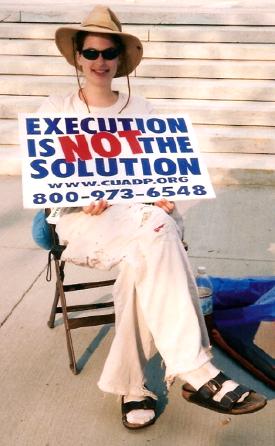
✓ Urging Congress to end the federal death penalty
This would end, at the federal level, one type of government violence. The most widely-accepted abolition argument is based on the many cases of death-row prisoners who eventually were found innocent on the basis of DNA or other evidence. The risk of executing innocent people is just too great, and there is no way to correct a wrongful execution.
Abolition also would respect the consciences of prison staff who believe they should not take part in executions. And federal abolition would give a good example to the 31 states that still have the death penalty.
✓ Using the presidential power of clemency to commute death sentences of federal prisoners to life in prison without parole
This certainly does not mean a life of leisure. Except when security problems interfere, able-bodied federal prisoners are required to work. And when courts have imposed fines or have required restitution to prisoners’ victims, that money must be deducted from prisoners’ wages, which usually are quite low in any case.
Stress Positive Alternatives to
Suicide and Euthanasia
The president should emphasize the dangers of efforts to legalize assisted suicide and euthanasia. Those dangers include the likelihood that some heirs will encourage deadly choices in order to protect their inheritance or to end burdens of care. Some medical professionals and insurance companies might encourage–and even pressure–patients toward suicide.
The president’s main emphasis, though, should be on positive alternatives. For example:
✓ Meeting with and encouraging staff who are working on the National Strategy for Suicide Prevention (a program of the U.S. Surgeon General’s office)
There is need for special stress on what friends and family members can do when they see signs that someone is considering suicide (including assisted suicide). Professional help often is needed–but is not enough by itself. Help from family and friends is also crucial.
✓ Ensuring that Medicare and Medicaid reimbursements go only to home-healthcare and hospice agencies that provide the services they promise
News reports indicate that some hospice agencies, especially for-profit ones, are not meeting their ethical and legal obligations. Those agencies should be penalized rather than paid! On the positive side, there should be recognition and honor for the agencies that do their work well.
✓ Encouraging the good work of the Eden Alternative and other programs that change nursing homes into real homes.
The Eden homes, and others like them, have gardens and pets. They encourage residents to engage in cooking, quilting, gardening and similar activities. Some have child-care centers so the seniors can talk and play with children and read to them.
✓ Having the Department of Health and Human Services research ways that hospital intensive-care units can make the ICU experience less of an ordeal for patients and their families.
Is the constant beeping of machines really necessary? Could chimes be used instead? Shouldn’t there be a place for gentle, soothing music in ICU? Is there so much focus on record-keeping that caregivers don’t have enough time for actual care?
✓ Ensuring that federal health and medical-research programs follow high ethical standards in respecting life, yet do not promote unneeded tests or treatment
Sometimes unneeded testing and treatment occur for the financial gain of health professionals, and sometimes just because the technology is there. Patients should know they have a right to reject tests and treatment they don’t want and that, when they are dying, they will have good pain control and be able to die in peace.

A presidential candidate who champions the consistency ethic can put together a powerful coalition. It should include both individual voters and organized groups who oppose abortion, the death penalty, euthanasia, suicide, torture, and/or war. What each group cannot accomplish on its own might be done if all the groups back one candidate.
It would be hard to find a better campaign slogan than a phrase we celebrate on the Fourth of July: “Life, Liberty, and the Pursuit of Happiness.”

Beth Baker, Old Age in a New Age: The Promise of Transformative Nursing Homes (2007 review)
Radley Balko, “Why Conservatives Should Oppose the Death Penalty,” Washington Post, May 1, 2014
Ira Byock, “Democrats Shouldn’t Endorse Suicide,” politico.com, June 7, 2015
Daily Caller News Foundation, “Innocent Man Wrongly Jailed for 39 Years Becomes Cleveland’s Newest Millionaire,” March 20, 2015 (includes video)
Death Penalty Information Center
Kevin Fitzpatrick,
“Euthanasia: We Can Live Without It…” CNN.com, Nov. 27, 2013
Serrin M. Foster, “The Feminist Case Against Abortion,” America, Jan. 19-26, 2015
Doris Gordon, “Abortion and Rights: Applying Libertarian Principles Correctly” International Journal of Sociology and Social Policy (1999)
Stephen Kinzer, Overthrow: America’s Century of Regime Change from Hawaii to Iraq (2006; see Amazon.com customer reviews)
Mary Meehan, “In Harm’s Way: Childen, Born and Unborn, Trapped in Wartime,” America, Jan. 16, 2012
Mary Meehan, “Why Liberals Should Defend the Unborn,” Human Life Review, Summer 2011
Justin Raimondo, “We’ll Never Limit Government Unless We Ditch Foreign Interventionism,” Antiwar.com, April 15, 2015
Peter Whoriskey and Dan Keating, “Dying and Profits: The Evolution of Hospice,” Washington Post, Dec. 26, 2014
Supporting the dignity of every life
When I was five years old, my parents felt a call to go to the Deep South. So, without any job to go to, our family of six packed important belongings into an old truck, and our caravan of the truck and our car headed from South Dakota to Georgia. We stayed temporarily at Koinonia Farm, an interracial Christian community outside Americus, Georgia.
After a short time, we found an old farm four miles outside Plains to which we moved. My parents put up a sign saying Brotherhood Acres. This did not initially cause any issues, but eventually people realized “they mean everybody” in the words reported to us of a local resident. That’s when we began to have problems like the local Ku Klux Klan threatening to burn us out.
Consistent Life takes a similar approach to the one my parents were taking. We aren’t selective as to whose lives are worthy of dignity and protection. All lives are. So we oppose the direct, deliberate taking of human life through such sometimes socially approved means as war, abortion, the death penalty and euthanasia. We also oppose the systemic structures of violence such as racism and poverty.
It takes a variety of people to bring about the changes needed in society to protect the value and dignity of each human life. So we are a network of groups and individuals with a range of religious affiliations or none, different political identifications and different emphases. Some concentrate their work on just one or two aspects of protection of life, and some work more across the board. We have supporters who focus on educational efforts towards the end of protection of human life, those who focus on nonviolent direct action and those who focus on within-the-system approaches such as lobbying. We seek not to have our differences divide us, but to view each more as other parts of the framework of building respect for all life.
We are starting this blog to provide an avenue to share reflections which are longer than what we can publish in our weekly e-letter, Peace & Life Connections. There will be various contributors to this blog, sharing their own reflections. Blog posts are not official statements of Consistent Life, and sometimes may contain views that do not represent an organizational consensus.
Bill Samuel has served as President of Consistent Life since 2005.
=============================================================
For more blog posts on personal journeys, see:
Nukes and the Pro-Life Christian: A Conservative Takes a Second Look at the Morality of Nuclear Weapons (Karen Swallow Prior)
Coming to Peace and Living a Consistent Life After Military Service
Off the Fence and Taking My Stand on Abortion (Mary Liepold)
Sharon Long: My Personal Pro-life Journey
On Being a Consistent Chimera (Rob Arner)