Suffering and Injustice Concern Us All
by Vasu Murti

Vasu Murti
Do you feel like you’re being forced to practice Quakerism, because the government does not allow you to own a slave? Did the Quakers impose their morality on the rest of American society when slavery was abolished, or was it social and moral progress for all mankind?
Animal rights should not be solely aligned with a particular political party. Neither should they be tied to a particular religion.
In past decades, the stereotype of “religious vegetarians” was that they are all followers of Eastern religions, believing you might be reincarnated as a cow in your next life if you’re not careful. Now people are gradually becoming familiar with the strands of vegetarianism within Judaism, but many are unaware of the long history of animal advocacy, concern for animals, and vegetarianism in Christianity.
As I told Dr. Richard Schwartz (author, Judaism and Vegetarianism) via email in 1997: arguing as some Christians do that animal rights and vegetarianism are solely “Jewish” concerns is like saying, “It’s only wrong to own a slave if you’re a Quaker.”
No. Suffering and injustice concern us all. Like the abolition of slavery or the emancipation of women, animal rights and vegetarianism are moral absolutes and apply to everyone, including atheists and agnostics.
Richard agreed with me that churches should have animal issues at the top of their agenda as well.
The sad irony here is a lot of liberals see abortion as sectarian, too! They dismiss it as a “Catholic issue” or a fundamentalist Christian issue or say if you’re not born again, you don’t have to be pro-life.
If vegetarianism were solely about “fit” or following a peculiar set of “dietary laws” why would pro-lifers be offended by pro-choice vegetarians and vegans?
They’re offended because they know vegetarianism involves the animals’ right to life, and thus these pro-choicers appear to value animal life over human life under some circumstances.
And issues like animal experimentation, circuses, and fur have nothing to do with diet, eating, nor food, but do involve the animals’ right to life.
Sometimes being lighthearted gets the point across to Christians that vegetarianism is not about “dietary laws” but about the animals’ right to life, like Steve Martin in the ’70s asking, “How many polyesters did you have to kill to make that suit?”

Animal rights activist B.R. Boyd writes in The New Abolitionists (1987):
“Seventy to one hundred million, including lost and abandoned pets, are quite literally injected, infected, mutilated, driven insane, strapped immobile for years on end, blinded, concussed, burned, mechanically raped, dismembered, disemboweled, mutilated, and otherwise violated–often without adequate anesthesia–in order to test shampoos, oven cleaners, make-up, and scientific hypotheses; to advance medical science or personal careers; to develop and test nuclear, biological, chemical, and conventional weapons; or for general scientific curiosity, and because public funding is available.
“Twenty million unwanted pets undergo euthanasia every year and countless others are abused by their owners. Spay-neuter clinics get little or no public funding, while the pet-breeding industry continues to enrich itself by pumping out living, disposable toys.
“Seventeen million wild fur-bearing animals (and twice as many ‘trash’ animals) are mangled in steel jaw traps and 17 million more factory farmed, then gassed or electrocuted, that we may wear furs.
“170 million animals are hunted down and shot to death in their habitats, mostly for sport, often leaving their offspring to die of exposure or starvation.
“Industrial pollution, habitat destruction, and our transportation system kill and maim untold millions, while we kidnap and imprison others for our entertainment in zoos.
“Ten billion animals are killed in America every year; 95 percent of them are killed for food. We force-breed, cage, brand, castrate, and over-milk them, cut off their beaks, horns, and tails, pump them full of antibiotics and growth stimulants, steal their eggs, and kill and eat them.”
“I have no doubt,” wrote Henry David Thoreau, “that it is part of the destiny of the human race in its gradual development to leave off the eating of animals, as surely as the savage tribes have left off eating each other when they came into contact with the more civilized.”
Like pacifists and/or pro-lifers, vegetarianism, in itself, is merely an ethic and not a religion. As an ethic, vegetarianism, like the pro-life ethic, has served as the basis for entire religious traditions: Buddhism, Jainism, Pythagoreanism, and possibly early Christianity all immediately come to mind. As an ethic, vegetarianism has attracted some of the greatest figures in history: Leonardo Da Vinci, Count Leo Tolstoy, Mohandas Gandhi, George Bernard Shaw, Susan B. Anthony, Sir Paul McCartney, Rosa Parks, etc.
At the end of 2007, shortly before moving to Israel, Pete Cohen of Veggie Jews in San Francisco said to me, “PETA’s not Jewish.”
When I told Jim Frey of Berkeley Pro-Life, a Catholic, that animal issues are secular and nonsectarian and thus applicable to everyone including atheists and agnostics, he said, “Well, just like with abortion.”
Pro-lifers must not play a sectarian game with animal activists. Saying, “your religion says it’s wrong to kill animals, mine doesn’t” is pointless when someone from a differing denomination could just as easily say, “Your religion says it’s wrong to kill the unborn, mine doesn’t.” There are pro-choice Protestant denominations, like the United Church of Christ.
As an animal advocate and a secularist, I’ve never understood the attempts of pro-life Christians to unsuccessfully deflect the issues of animal rights and vegetarianism by depicting them solely as someone else’s “religious belief” which they think doesn’t apply to them.
A lot of people look at abortion that way, too, you know!

Vasu Murti is the author of
The Liberal Case against Abortion
and
They Shall Not Hurt or Destroy: Animal Rights and Vegetarianism in the Western Religious Traditions
Violence Bolstered by Professional Contradictions

Rachel MacNair
by Rachel M. MacNair, Ph.D.
Director of CL’s research arm, The Institute for Integrated Social Analysis
I’d like to regale you with my adventures in what ought to be a stuffy professional organization but is actually a prime field for countering the push for some kinds of violence.
In his classic book about how a war of words shows remarkable similarities against different targeted populations — Dehumanizing the Vulnerable: When Word Games Take Lives – William Brennan observes:
 “Contrary to popular belief, although despicable language is often primarily associated with crazed individuals or mobs in the streets, it is far more likely to emanate from highly educated, respectable circles. Eminent people throughout history rank among the most steadfast purveyors of demeaning expressions. In The Republic, Plato’s advocacy of infanticide (book 5) proceeded from a perception of handicapped children as ‘inferior creatures.’ Louis Agassiz, founder of the Museum of Natural History at Harvard University and a leading nineteenth-century scientist, called black people a ‘degraded and degenerate race.’ . . . The successful waging of semantic warfare on the contemporary unwanted unborn can likewise be largely attributed to the heavy participation of influential and respectable individuals and organizations.”
Thus we come to two task forces of the U.S.’s largest professional association in psychology, the American Psychological Association (APA). Both started around 2005.
Foundations of Torture
The task force on Psychological Ethics and National Security (PENS) was designed by its advocates to make interrogations “safe” and “effective,” but in fact was in collusion with the Bush administration’s push for “enhanced interrogation,” a euphemism for torture. With this and with behind-the-scenes secret activities, the administration got the needed professional expertise for pretending it had legal authorization. The report was railroaded through without proper procedure from the representative Council. Several years of oppositional activism ensued, some of which was successful in getting reforms, including a membership referendum and a substitute policy that rescinded the original PENS report. Yet none of them took care of the entire problem.
There was a large rally in 2005 to protest the PENS task force at its beginning at the APA convention in San Francisco. I naturally attended as an active member of APA’s Division 48, which covers peace psychology. At that rally, I passed out a leaflet pointing out the PENS parallels to APA’s recently-established abortion task force. A major parallel was that rather than having a proper balance of views, the group was select for having a conclusion that favored the APA’s position.
I later became the peace psychology division’s membership chair and then served as president in 2013, so I was privy to the actions against the PENS report over the years.
Task Force on Mental Health and Abortion
I volunteered and was accepted to be one of 20 reviewers on the abortion task force’s report. I spent a good 30 to 40 hours working on explaining why one argument after another was not sound. The second draft was much improved, but never went through another review by experts (though a later updated version published in the APA’s main journal did). In many places, where I had offered alternative explanations, instead of offering both ways of looking at the evidence, the point was simply dropped. I was left with the impression that  my job was to let them know which arguments for their position wouldn’t fly.
The meeting where the report was approved was a sight to see. I thought it resembled a pep rally more than a sober scientific assessment. I saw a smirk on the face of the person who mentioned the letters of concern from various organizations – Consistent Life was one of many.
I had heard from several individuals that they knew how biased the report was, but no one other than me was willing to get up to say so. One person told me I was brave for doing so. In a psychology crowd, that should bring flashing red lights of alarm for “groupthink.” As it was, because I wasn’t a councilmember I had to ask for permission to speak; I think I got it only because I was already at the microphone and had started talking.
In another sign this roomful of psychologists had forgotten Psychology 101, they actually took the vote by a show of hands in front of everyone. Experiments showing conformity where people will agree to clear factual errors that the whole group is making should have made those psychologists know better. In fact, APA’s President-Elect at the time admitted as much to me in a personal conversation after the meeting, saying that they were going to change that procedure. Later.
So here’s the main conclusion of the APA report on abortion:
“The best scientific evidence published indicates that among adult women who have an unplanned pregnancy the relative risk of mental health problems is no greater if they have a single elective first-trimester abortion than if they deliver that pregnancy.”
My perception after reading the full report was that this was a foregone conclusion in search of a rationale, failing to find it, and asserting it anyway.  There is plenty of evidence in the report itself that doesn’t fit it.
Note that they deliberately make no claims here about adolescent women, late-term abortions, or multiple abortions. And any claim that abortion would actually be beneficial to mental health has long since been abandoned.
I informed the APA Council that the press release announcing the Council’s decision to accept the report had already gone out the previous day. That’s how sure they were of the next day’s vote. No one said anything to indicate that they thought this was a problem.
Do we start to get a sense of the attitudes that allowed the collusion with torture to happen?
Down the Road
But here we go on divergent paths. In the case of the torture issue, reporter James Risen wrote a book called Pay any Price: Greed, Power, and Endless War in 2014. It included a chapter on APA’s collusion with the Bush administration on torture.
Suddenly, the veneer of professionalism, of psychologists’ presence making the interrogations safer or more ethical, disappeared.
While those of us who had been paying attention knew of the problem, the bulk of the membership paid little attention, and some APA officials regarded the protesters as hotheads. But with this new publicity, APA knew it needed to protect its reputation quickly. The American Medical Association and the American Psychiatric Association had both refused to participate in Bush’s program; they’ve had scandals in the past and so they knew better from bitter experience.
APA decided it would fund an independent investigation. Staff was sure this would clear APA of any charges of wrongdoing, and that would settle down any influence the hotheads had.
 It didn’t work out that way. David Hoffman was hired, and so last July offered the Hoffman Report. It was explosive throughout the whole organization, with discussion lasting for months. People who were assertive about APA having done the right thing before are more defensive now, offering apologies and assuring us that the board of directors had been kept in the dark and didn’t know all this was going on. Various actions are being pursued to remedy this scandal and see to it that it can’t happen again.
Meanwhile, the APA’s report on abortion is still be cited in the media as evidence that the women’s voices that were precluded from a seat on the task force do in fact not count. That women grieve or are traumatized by abortion is still denied with the use of this professional report.
 A more detailed chapter on the APA abortion report is in Achieving Peace in the Abortion War, a book in which Rachel MacNair applies peace psychology principles to the current abortion situation in the United States.
Available from the publisher, Barnes & Noble, and amazon
Spice things up with the Consistent Life Ethic

Carol Crossed
By Carol Crossed, Consistent Life Board Member
The consistent life ethic is like salt. You don’t need a whole lot to be effective. But it’s essential to have it present…spread out here and there to spice up politics, to add a little flavor to dull single-issue groups.
But it stings, like when you wash out your mouth to cure a canker sore. It smarts on the wound. It makes you sit up straight and take notice that something’s different here. And then it heals if you leave it there long enough. The “liberals” need it to cure contradictions and the “conservatives” need it for incongruities. And we all need it to cleanse and purify us from self-righteousness. Yes, consistency is good for what ails the Left and the Right.
Salt forms new compositions and breaks up ice. Like the consistent life ethic it warms cold and hardened opinions and makes slush…soft and malleable. The fragile unborn child becomes the person on death row. We abandon our stale ideologies that leave somebody out. The homeless on the war torn streets of Baghdad become the homeless unwanted child in the womb. Home. That’s where the consistent life ethic brings us. No hidden agendas. It allows us to be whole, to be ourselves again.
Originally published in Harmony, December 1991
The Consistent Life Consensus in Ancient Christianity
by Rob Arner, CL Board member
Adjunct Professor of Religion at Reformed Episcopal Seminary and Chestnut Hill College, Philadelphia, PA
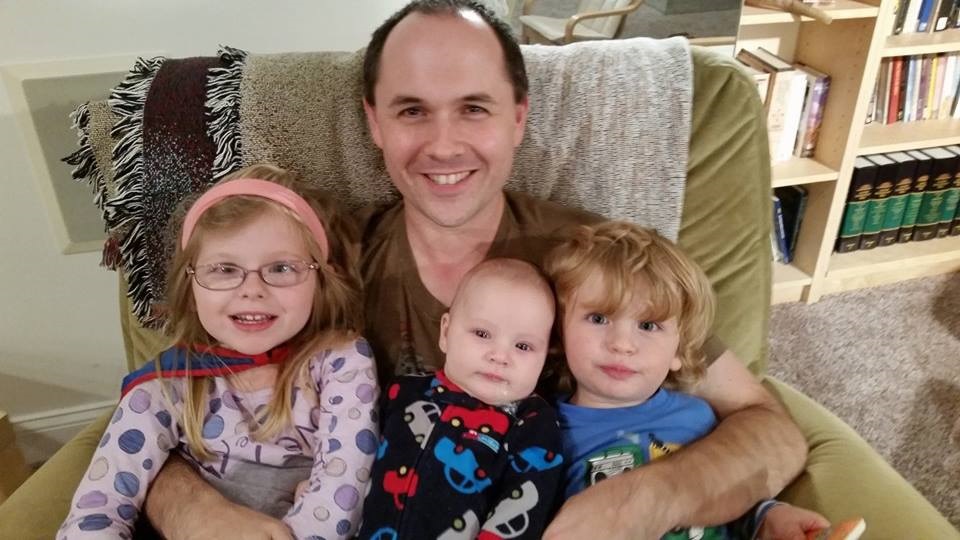
Rob Arner with kids Grace, Josh, and Luke
When measured against the standard of the ancient Christian church, contemporary American and European Christianity is in a moral mess. When it comes to what have been called the “life issues,” Christians are no less sharply divided than members of secular society. Some Christians, called “conservative” by conventional narratives, believe abortion is a grave moral evil. Yet often these same Christians will fall in line to support the latest war proposed by the nation’s chief executive. Other Christians tend not to view abortion as such an intrinsic evil, but rather a tragic “choice” for mothers in difficult circumstances. These Christians, sometimes called “liberal,” are more concerned with systemic and social evils, such as poverty, and are critical of the ready recourse to war. These two groups far too often find themselves talking past one another at best, and actively working against one another at worst, so significant progress isn’t made toward addressing either group’s moral concerns.
But imagine if this were not so. Imagine the impact if there were instead a united witness, an ecumenical consensus surrounding the thorny question of whether and in what circumstances a disciple of Jesus might take a human life.
Such a consensus actually existed in the ancient Christian church, stretching from the time of the apostles until the Christianization of the Roman Empire with the conversion of the emperor Constantine.
In my investigation into the ethics of the ancient Christian church, I read every surviving orthodox Christian sermon, treatise, letter, and apology from that period (about 90-314 C.E.) and discovered a startling consensus on this issue. As diverse as the ancient Christian church may have been on wealth and poverty, sexuality, church governance, theology, and a host of other issues, when it comes to the subject of killing other human persons, the ancient Christian writers were startlingly in accord with one another. Without exception, the church strongly condemned the taking of human life in any form whatsoever.
Neither homicide, nor feticide, nor infanticide, nor suicide, nor capital punishment, nor killing in war were considered acceptable. Put more precisely, no surviving orthodox Christian writing dating from before Constantine ever approves of Christian participation in human bloodshed.
In the Roman Empire, life was cheap. Not only was the “peace” of the empire secured and maintained through brutal conquest, but everyday life for Roman citizens, even during times of “peace,” was filled with violence. Killing was sport in the gladiatorial conquests and chariot races.
The value of individual human persons was deemed subordinate to the good of Rome. This was true at both the upper levels of society — witness how many Roman emperors met with violent deaths at the hands of their rivals (or loved ones!) — as well as at the bottom strata, as the life of a slave was all but worthless to his or her master, and unwanted children of the poor were either aborted or abandoned in the countryside to die of exposure. The glory of Rome was built on the broken backs of enslaved peoples and the blood of those deemed expendable. It’s into this milieu the ancient church brought its message that was decidedly on the side of life— in every case.
Both abortions of unborn children and the killings of unwanted or disabled born children were widely practiced in ancient Rome. The early Christians stood forcefully against these practices. For instance, the ancient discipleship manual commonly known as the Didache, which dates from around the turn of the second century CE, and therefore may actually have been written at the same time as some of the New Testament, contains an explicit prohibition of infanticide and abortion: “A further commandment of the Teaching: Do not murder; do not commit adultery; do not practice pederasty; do not fornicate; do not steal; do not deal in magic; do not practice sorcery; do not kill a fetus by abortion, or commit infanticide” (Didache 2.1–2).
Another explicit statement:
 But with us, murder is forbidden once for all. We are not permitted to destroy even the fetus in the womb, as long as blood is still being drawn to form a human being. To prevent the birth of a child is a quicker way to murder. It makes no difference whether one destroys a soul already born or interferes with its coming to birth. It is a human being and one who is to be [an adult], for the whole fruit is already present in the seed. (Tertullian, Apology, 9)
Just as with “private” issues of abortion and infanticide, the early church offered an adamant “no” on the most “public” kinds of killing. The early Christian discussions on killing in war, and on military service more broadly, are so numerous and multifaceted that I can only scratch the surface.
The church’s broad condemnation of killing made the military profession deeply problematic. In the Apostolic Tradition, how the church prepared new initiates for baptism:
(9.) A soldier in command must be told not to kill people; if he is ordered so to do, he shall not carry it out. Nor shall he take the oath. If he will not agree, he should be rejected [from the baptism preparation].
(10.) Anyone who has the power of the sword, or who is a civil magistrate wearing the purple, should desist, or he should be rejected.
(11.) If a catechumen or a believer wishes to become a soldier they should be rejected, for they have despised God. (Apostolic Tradition, 16.9–11)
For many soldiers, quitting the army before their terms expired would entail an almost certain death sentence. Therefore, those who were already soldiers at the time of their conversion could stay in their posts as long as they did not swear the military oath or kill anyone.
Military imagery of discipline and order was converted to positive imagery of peace, as in this example:
But when the shrilling trumpet blows, it assembles the soldiers and proclaims war; and shall not Christ, think you, having breathed to the ends of the earth a song of peace, assemble the soldiers of peace that are his? Yes, and He did assemble, O man, by blood and by word His bloodless army, and to them He entrusted the kingdom of heaven. (Exhortation to the Greeks, 11)
Numerous ancient Christian writers go on record as opposing all killing period. Their words express a strict ethic that was pervasive across the church of that era, not just isolated to one city or region. Origen, for example, said of Jesus:
He taught that it was never right for his disciples to go so far against a man, even if he should be very wicked; for he did not consider it compatible with his inspired legislation to allow the taking of human life in any form at all. (Against Celsus, 3.7)
Lactantius wrote:
 So, neither will it be permitted a just man, whose service is justice herself, to enter military service, nor can he accuse anyone of a capital crime, because there is no difference whether you kill a man with a sword or a word, since the killing itself is prohibited. Therefore, in this command of God, no exception whatsoever must be made. It is always wrong to kill a man whom God has intended to be a sacrosanct creature. (Lactantius, Divine Institutes 6.20)
The church before Constantine consistently rejected killing—whether in the womb, in the arena, on the battlefield, or anywhere else.
Might this ethical and moral clarity be relevant today, in our time of polarizing culture wars? Might it have the power to bridge the gap between “conservatives” and the life-issues dear to their hearts, and “liberal/progressives” and the peace and justice issues dear to theirs?
I submit that the way of Jesus Christ as lived by the early Christian church is decidedly a “third-way” that defies these two conventional categories and has tremendous potential for healing a broken world by uniting ideological opponents in common cause with one another— to work alongside, rather than against one another. At this hour of history, it may be the most effective and necessary means by which we can become ambassadors of reconciliation and protect the vulnerable persons in our world today.

Editor’s note: For a book-length version and extensive documentation of this thesis, see
Consistently Pro-Life: The Ethics of Bloodshed in Ancient Christianity.
====================================================================
For more blog posts on the history of the consistent life ethic, see:
First Stirrings in Connecting the Life Issues
Ancient Roots of the Consistent Life Ethic: Greece
The Adventures of Prolifers for Survival: Scorned by Mobilization for Survival
Reminiscing on the Founding Meeting of the Consistent Life Network
Adventures of Organizing as a Consistent Lifer
by Lisa Stiller (written September 10, 2015)
In the past month and a half, one of the many things I’ve been busy with is helping to organize rallies on issues as divergent as “Defunding Planned Parenthood” and “Support Diplomacy for Iran.” I’ve been sending press releases for organizations such as Students for Life of America/SFLA (the Woman Betrayed rally organizers in Portland, OR) and MoveOn.org (the Iran diplomacy rallies).

Left: Constance Cooper & daughter Fia Ewing with Lisa
Right: Lisa with Peg Wills
Do I feel kind of schizophrenic?
Well, yes. Today I just finished sending out a revised press release for the MoveOn rally, which has now morphed into one that will thank our Oregon Senators for voting for diplomacy. And tomorrow I’m working with another member of Democrats for Life of America (DFLA) to put together a press release about a quiet protest we’ll hold outside of an event where a top Oregon Planned Parenthood official will be speaking. I’m waiting for someone in the media who gets these press releases to ask me how I support both causes.
A few of my friends get it. Most don’t.
They say, “How can you claim to be a liberal and advocate defunding Planned Parenthood?” I say, “How can I not?”
As a “liberal”, or someone on the “Left” (I’m really growing to hate these labels), I believe in providing the funding and support for whatever it takes to help people and families out of poverty. I support those things that work to promote the dignity of all life, peace, and an end to violence.
Abortion defeats all these. It does nothing to address the root causes. Why do so many women feel they need to turn to abortion, why do so many women end up with unintended pregnancies? We’re supporting the quick fix, rather than tackling the larger problem.
Same with Iran. It’s much simpler to explain about promoting policies that lead to war and the use of aggression. The Iran deal was in no way a quick fix, and implementation will be complex.
So I will continue to stand up for life, in every form, with a Consistent Life Ethic. Hopefully my friends will someday “get it.”

Photos:
Top Left: Bill Samuel and Lisa at Wild Goose Festival
Top Right: Lisa, Richard Stith and John Whitehead at March for Life table
Middle Left: Lisa at West Coast Walk for Life
Middle Center: Lisa and Tony Masalonis at Call to Action conference
Middle Right: Lisa and John Whitehead at Cardinal O’Connor conference
Bottom Left: Lisa opposing war with Syria (sign reads: Syria – Let’s seek a nonviolent peaceful solution)
Bottom Right: Lisa protesting in the Trayvon Martin case
Nukes and the Pro-Life Christian: A Conservative Takes a Second Look at the Morality of Nuclear Weapons
By Karen Swallow Prior
from Sojourners, August 2015
I WAS SITTING IN the wrong end of a police wagon the first time I questioned nuclear weapons. Technically, it was a school bus, but it served the same purpose: hauling scores of protesters to the county holding center where we would await booking for our trespasses.
We had been protesting abortion. I was thinking about nuclear weapons because a couple of those in the bus were peace activists who had long rap sheets from years of anti-war protests. I, on the other hand, was a Republican-voting, independent Baptist church-attending, conservative-leaning, law-abiding (well, until now) kind of Christian. I was awed—and grateful—that these peaceniks would join the likes of me in common cause against another kind of violence.
My new friends adhered to the “seamless garment” philosophy, also called the consistent life ethic, one committed to the protection of all human life, whether from war, poverty, racism, capital punishment, euthanasia, or abortion. One of them gave me a button that read “Peace begins in the womb,” and I pinned it to the bottom of the black leather motorcycle jacket I used to wear in those days.
A few years and many more abortion protests later, I was starting a local chapter of Feminists for Life, attending an Episcopal church, heading up a small private school in the inner city, teaching at a Jesuit college, and reading the poetry of Father Daniel Berrigan, the famous Vietnam-era anti-war activist who was now being arrested for protesting abortion.
– See more at: https://sojo.net/magazine/august-2015/nukes-and-pro-life-christian#sthash.URc7MaLr.dpuf

Karen Swallow Prior, a professor of English at Liberty University in Lynchburg, Va., is the author most recently of Fierce Convictions: The Extraordinary Life of Hannah More: Poet, Reformer, Abolitionist and a research fellow with the Ethics and Religious Liberty Commission of the Southern Baptist Convention. She is also a Consistent Life endorser.
===========================================================
Another blog post on a conservative look at issues of violence:
Why Conservatives Should Oppose the Death Penalty
For more blog posts on personal journeys, see:
Supporting the Dignity of Every Life (Bill Samuel)
Coming to Peace and Living a Consistent Life After Military Service
Off the Fence and Taking My Stand on Abortion (Mary Liepold)
Sharon Long: My Personal Pro-life Journey
On Being a Consistent Chimera (Rob Arner)
The Myth of Sexual Autonomy

Julianne Wiley
by Julianne Wiley
Note: Julianne Wiley (aka Juli Loesch) was the founder of Prolifers for Survival, the predecessor group of Consistent Life (CL). This is an updated version of an article published in the Spring 1987 version of Sisterlife, then newsletter of CL member group Feminists for Life.
Occasionally on the web we find abortion defenders compelled to admit that the Left and the media are more likely to be won over by the “seamless garment” approach, which includes opposition to abortion in the context of opposition to other kinds of sanctioned killing. Or that prolife feminists have grasped some “essential feminist truths” which make their arguments against abortion more compelling.
With the game beginning to go against them, some will fold the rest of their hand and slap their highest card on the table: sexual autonomy.
No matter what else happens, and no matter what “utopian” changes may come, there will always be the vagaries of sexual passion and the failures of contraception. Thus, come what may, abortion will always be “necessary” if we are to be free to live “sexually autonomous” lives.
Ellen Willis in the Village Voice hurled the following challenge: “I have yet to hear any right-to-lifers take full responsibility for that fact or deal seriously with its political implications.”
On the contrary. I think that it’s the advocates of sexual autonomy who have failed to recognize its political implications.
The opposite of sexual autonomy, or independence, is sexual bondedness, or interdependence. What the autonomous wish to enjoy is precisely unbondedness; and one of the bonds to be rejected is a bond to offspring who were conceived without deliberate choice.
To the defenders of such autonomy I would like to post these questions: Is there such a thing as parental obligation? If so, when and how, and for whom, does this obligation arise?
In the past, people assumed that simply by engaging in heterosexual relations with each other they acquired parental obligations if and when pregnancy resulted. But now, this is to be seen as a denial of sexual autonomy. Obligations now arise, not from the decision to have sex, but from the strictly separate decision to bear the child.
But please note: The decision to have sex is a decision made by both partners. The decision to bear the child is made by only one of them: namely, the woman.
Thus, the woman’s responsibility corresponds to her choice, made at some point during the pregnancy. If she doesn’t want to assume any obligation, she can choose abortion and any question of parental responsibility is foreclosed.
But for the man, parental obligation supposedly arises from the woman’s choices: her choice to bear the baby, and her choice to name him as the father and even to bring legal action to compel his support, if it comes to that.
The problem here is obvious. You can expect increasingly to hear the sexually autonomous male’s just complaint: “How is it that she gets a choice, but I don’t? She chose to be a mother. I didn’t choose to be a father. I just chose to have sex!”
There will always be men who, at any given moment, want sex but don’t want a child; some of these men will get women pregnant. But sexual intercourse now implies for each of them – exactly nothing, no responsibility.
It’s only the woman’s subsequent and separate option that determines everything. That being the case, why should any man feel he’s acquired an obligation if the woman decides to give birth? Because he deposited sperm in the woman’s vagina? Don’t be medieval.
Am I predicting that the elevation of sexual autonomy to the status of a “right,” coupled with the availability of abortion, will cut men loose entirely? That paternal responsibility will sink to zero? That men are not only going to take off, but feel justified about it?
Hell, no. I’m not predicting that. I’m reporting it. I’ve done my share of women’s shelter work. I saw it all the time. A couple has a child. Three years down the line he decides he isn’t cut out to be a father. “But you can’t just walk out. This is your child too!”
“Sure, sure. But it was your choice.”
Well, the gentleman is right, given that the availability of abortion has made procreation a unilateral female decision.

Most male commitment to the long-term responsibility of child rearing is not obtained through court order. It is obtained voluntarily through a man’s sense, bolstered by society, that it’s right and fair. Why? Because the choice that obliges both him and the woman is the choice they made together, in the act that made the child.
The vast majority of women and children in this world rely upon webs of interrelation predicated upon a sexually connected man: a man whose sexuality makes him the husband of this woman, the father of this child. It’s sex that binds him, obliges him to another gender and another generation.
If the act of generation loses this weight, this significance—and the abortion culture simply blows it away—then you end up with fathering that never makes a father, mating that never makes a mate, short-circuited sex that dreams of nothing more than being plugged into its own sockets.
Autonomy—in this sense—is as pro-woman as poverty and as pro-sex as an amputation. And abortion—the dismembered offspring—is not only its program, but its most perfect and fitting image.
Does the Consistent Life Ethic Water Down Life Issues?
Some say the consistent life ethic (CLE) waters down a particular life issue. The harsher critics state, or at least imply, that this is deliberate. This kind of criticism is not new, but this year I’ve been seeing it more than I usually do.
 While some may be insincere about their support of the CLE, we believe a genuine commitment to the CLE strengthens work on each issue. Our Purpose Statement states “We serve the anti-violence community by connecting issues, building bridges, and strengthening the case against each kind of socially-approved killing by consistently opposing them all.” And this synergy among issues works.
People who aren’t convinced on one of the issues often tell us that they respect our position because we are consistent. They are more willing to listen to why the unborn should be protected because we also oppose the death penalty and war, or listen to our arguments against war because we also favor protection of the unborn. They may be much less willing to listen to those not committed to other life issues.
Some people mistakenly believe that we oppose focus on a single issue. In fact, we believe there is a need for some individuals and groups to focus on a particular issue. Some of our member groups focus on one issue, or perhaps on two. They join Consistent Life because they see their work in the broader CLE context. We don’t want to water down the work of any of these groups. We are an inclusive network that encourages and promotes the anti-violence activities of all our group and individual members, working together, each in their own way, to make a difference.
Bill Samuel has served as President of Consistent Life since 2005.
First Stirrings on Connecting the Life Issues
by Carol Crossed, Consistent Life Board member

Carol Crossed
In the 1970s and 1980s and in the midst of raising six children, I was immersed in several activist movements of the day. What began in world hunger and lobbying activity for Bread for the World became more sophisticated with the Nestle Boycott. Understanding the corporate role in world hunger catapulted me beyond soup kitchens and reading how much sugar was in breakfast cereals. Working through the United Nations, I better understood corporate behavior and how to monitor it. But everywhere I turned it was the capitalists (that would be me and the US) who not only marketed infant formula that caused infant deaths, but sold armaments that caused infant deaths. My passion slowly morphed into anti-militarism. And how could one hope to feed the world if 52% of the US discretionary budget went to feed the arms race?
While I tried desperately to fix this equation through rallies and protests and sit-ins, a woman whom I had never met was often quoted in opposition to whatever particular cause I was fighting for, or against. In newspaper articles or letters to the editor, she called me a Marxist or a socialist or a lesbian or a Wiccan. While I didn’t have problems with some of these labels, she clearly thought of them (and therefore of me) in a derogatory way. I decided to find her name and call her, and invite her to have coffee. I took tons of literature and was sure I had a convert on my hands. She couldn’t help but be impressed with how intelligent, peace-loving, and rational I was, right?
After 20 minutes into my spiel, using complex words like cross-fertilization of agri-business and uranium isotopes, Janet interrupted me. “Why don’t you ever say anything about the unborn child in abortion?” It stopped me. Dead in my tracks. I stuttered and said something about certainly not believing abortion was a good thing. “And besides, there are already enough people working on that issue.” She asked, ‘Why don’t you go with me to this right-to-life talk next week?”
I thought to myself that she is the last person I wanted to be seen with, but in the spirit of my exceptional conflict-resolution, peacemaking, tolerant, loving self, I choked out, “Well, ah, OK. But will you go with me to hear Fr. Dan Berrigan who is coming in September to speak about war?”
So we began going to events together. I learned from Dr. Mildred Jefferson of National Right to Life that there were over a million unborn lives aborted every year, not a million since Roe v. Wade, which is what I previously thought. Janet learned about the nuclear arms race and Mutually Assured Destruction. (Janet: “Oh my dear God! That will kill the mothers of the unborn babies too!”) I had a sign that had the Leviticus quote: Welcome the stranger and carried it around in my car. It worked well for Sanctuary rallies and at abortion clinics. And when NYS had hearings on reinstituting the death penalty, I asked Janet to go in my stead because I was doing community service for an abortion sit-in.
We formed a group in Rochester, NY, called Common Ground of Upstate New York. We brought together people by bringing together issues that sought to protect life either on the left or right of the political spectrum.

Juli Loesch (now Julianne Wiley) in 1980s video
What I was experiencing in western New York was identical to what other peace and life activists were coming to grips with. One person was Juli Loesch Wiley, the founder of the precursor of Consistent Life Network: Pro-lifers for Survival.
Pro-lifers for Survival was founded in 1980, a cultural time ripe with escalating violence to the human person. The nuclear weapons build-up and the escalation of abortion made death endemic to our social fabric and less and less likely that nonviolence would be culturally accepted. If violence begets violence, it was no accident that Roe v Wade was decided toward the end of the Viet Nam War.
While some forms of killing were condemned by certain pockets of activists, it was common that some form of killing was accepted, even promoted, by the same group of aforementioned activists.
In 1976 or 1977 Juli Loesch (now Julianne Wiley) was involved in the anti-nuclear-weapons and anti-nuclear-power movements through the Pax Center in Erie PA. She thought when you think about nukes with any depth, you’re obliged to think about the next generation. Juli had done some reading and writing about radioisotopes and genotoxins as a danger to human embryos. This compelled her to think about nukes and intergenerational justice. It also compelled her to question the moral obtuseness of nuclear strategists like Herman Kahn who were willing to sacrifice vulnerable humans by the millions without even perceiving that “they are us,” that they are part of our human family and our human future.
Juli’s group had put out a No Nukes leaflet that looked a lot like a leaflet she picked up on the street from some anti-abortion women, even using the same quote from Deuteronomy, “Choose life that you and your descendants might live.” Since Juli was a feminist who believed, “Women united can never be defeated,” she thought, “Those women are potential anti-nuke allies. Why aren’t we united? I’ve got to find some way to talk to them.”
Somewhere over the next two years, Juli was able to meet prolife people, found them abundantly open to dialogue, and came to respect their sincere commitment to the next generation. She became convinced that pro-life and anti-nuke folks belonged together. “Same values. Same passions. Same sense of solidarity with the tenacity of life and the need to nonviolently accommodate all of us. It seemed like a natural to me.”
Pro-lifers for Survival was born, and later became the Seamless Garment Network, now re-named Consistent Life.
====================================================================
For more blog posts on the history of the consistent life ethic, see:
The Consistent Life Consensus in Ancient Christianity
Ancient Roots of the Consistent Life Ethic: Greece
The Adventures of Prolifers for Survival: Scorned by Mobilization for Survival
Reminiscing on the Founding Meeting of the Consistent Life Network
Rejecting Mass Murder: Looking Back on Hiroshima and Nagasaki
By John Whitehead, Secretary of Consistent Life

Hiroshima after the bombing
The United States devastated the Japanese cities of Hiroshima and Nagasaki on, respectively, August 6th and 9th, 1945, in what were—to date—the only occasions in history that atomic bombs were used in wartime. The atomic bombings killed tens of thousands of people instantly, with many more dying of injuries in the following hours, days, and weeks—by the end of 1945, an estimated 210,000 people had perished as a result of the bombings. Because the use of atomic bombs against these two cities contributed to the surrender of Japan and the end of the Second World War, many have argued that the bombings saved lives that would otherwise have been lost in continued warfare and thus that bombing Hiroshima and Nagasaki was justified. For adherents to a consistent ethic of life, however, these uses of atomic bombs were not justified—they amounted simply to mass murder.
Those who advocate a consistent ethic of life vary in their precise attitudes toward war. Some are pacifists who regard all killing in war as inherently wrong. For these pacifists, destroying a city with an atomic bomb must be rejected in the same way that any killing must be.
Other consistent ethic of life advocates are not absolutist in their opposition to war but adhere to Just War Theory or other ethical philosophies that allow that killing in war could be justified, at least under certain circumstances. For these non-pacifists, the reasons for rejecting the use of atomic bombs against cities are less straight-forward than they are for pacifists. Even viewed from such non-absolutist consistent ethic of life perspectives, however, the destruction of Hiroshima and Nagasaki is difficult to justify, for two reasons.
First, violent means to achieve an end cannot be justified if nonviolent means can achieve the same end. Just War Theory acknowledges this basic principle by requiring that war must be a last resort in order to be justified. In 1945, the end pursued by the United States and other Allied powers—the surrender of their wartime enemy, Japan—could have been achieved by diplomatic means without resorting to the threatened or actual use of atomic bombs against the Japanese.
A major obstacle in bringing the war with Japan to an end through negotiation was the Allied insistence, expressed in the Cairo Declaration of 1943 and Potsdam Declaration of 1945, that Japan surrender unconditionally. Such insistence left the Japanese uncertain about what the fate would be of the Emperor Hirohito, the Japanese head of state who held divine status in the eyes of many Japanese. The Allied Potsdam Declaration, which promised that “stern justice shall be meted out to all war criminals” even left open the possibility that Hirohito might be executed or imprisoned by the victorious Allied powers.
Such a possibility was unacceptable to the Japanese government. Indeed, so unacceptable were threats to the emperor and his position that even after atomic bombs had devastated Hiroshima and Nagasaki and the Japanese government was willing to come to surrender terms, wholly unconditional surrender was out of the question. To the very end, Japan’s rulers insisted that Hirohito remain sovereign, and the war only came to an end when it did because the United States was willing to relent and allow Hirohito to stay, at least provisionally. Had the Allies relented on this point sooner, the war might have been brought to a successful conclusion without atomic bombs ever being used.

Nagasaki bomb mushroom cloud
Even if such diplomatic means of ending the war had not been available, however, the atomic bombings would still not have been justified, for a second and ultimately far more important reason.
A fundamental principle of Just War Theory—and one that even those who do not wholly endorse Just War Theory can appreciate—is that military forces should discriminate between enemy military personnel and enemy civilians when using violence. Enemy citizens who by their status as members of the armed forces are authorized and prepared to use lethal violence in wartime may be reciprocally regarded as legitimate targets of such violence; enemy citizens who are not in the armed forces and are not authorized to play such a violent role are not legitimate targets.
Granted (to echo a point made by Just War theorist Michael Walzer), the line that divides military personnel and civilians can be difficult to draw. Some enemy citizens may belong to military reserves or militias that act as auxiliaries to regular military forces; other citizens work in industries that produce weapons and thereby contribute, at least indirectly, to violence. Nevertheless (again echoing Walzer), some enemy citizens will always fall into categories that place them clearly outside the military realm: children (both inside and outside the womb), the elderly, and the sick and disabled. Further, I would argue that other classes of people who might serve in military capacities but perform clearly nonviolent functions—doctors and nurses, clergy—also fall into the protected category of civilians.
To target these clearly inoffensive, non-military people is unjust. Such people were targeted in the devastations of Hiroshima and Nagasaki and did perish as a result. Using a weapon of such overwhelming destructive power as an atomic bomb against an entire city inevitably involves targeting people who should be protected from violence, even in wartime.
In addition to the pacifist and Just War reasons given above, consistent ethic of life advocates have one more important reason for rejecting the Hiroshima and Nagasaki bombings—and any similar slaughter of civilians. The essential argument made by defenders of the bombings—killing huge numbers of people, including children, ultimately achieved the worthwhile goal of ending the Second World War—can be invoked to justify other forms of violence, including abortion. Don’t worthwhile goals (so the argument would go) such as gender equality, curbing overpopulation, reducing poverty and crime, or preventing child abuse justify the deaths of countless unborn children?
Consistent ethic of life advocates know better than to accept such toxic rationales, whether in the realm of abortion or warfare.
===============================================================
For another of our blog posts about nuclear weapons, see: