Isolating Women and Encouraging Jerks
by Rachel MacNair

Rachel MacNair
I recently received an email from a fellow Quaker in response to my emails on the availability of insights at prolifequakers.org. I think she made points that are important to address.
I mainly focus on her statement: “Preventing a woman who needs one from having an abortion is in many cases a more violent act than an abortion.”
Point 1: What Abortion Availability Causes
My observation is that advocates of women having access to abortion tend to be considering the woman in isolation. They see her situation as a given, without taking into account something very important: is the ready availability of abortion a part of what causes the situation?
At the extreme, we have cases of rape and incest – many people who otherwise oppose abortion will make an exception for pregnancies resulting from these causes. Yet we need to take into account that men inclined to commit rape, pedophilia, and incest are keenly aware that the abortion clinic is handy. While in theory those taking under-age girls there should be reported to law enforcement, in actuality, perpetrators often navigate the system with ease. And know in advance that they can.
For some cases where sexual abuse went on after the abortion(s), see Abortion Facilitates Sex Abuse: Documentation. More generally, in How Abortion is Useful for Rape Culture, I ask the question (and give a case as an illustration): “What does having abortion handy do to men who have a sense of male entitlement to female bodies?” For a movie with a realistic story in which the director didn’t catch the implications, I offer the implication I saw: The Message of “Never Rarely Sometimes Always”: Abortion Gets Sexual Predators Off the Hook.
But we don’t need to go to that extreme, since there are plenty of men having a sense of male entitlement in entirely consensual adult relationships. Consider this tweet still available online from a famous comedian several years ago, after the US Supreme Court (SCOTUS) had decided to knock down some abortion regulations in Texas:

Someone who feels a sense of male privilege over women’s bodies, writing only to male readers presumed to have that same sense? What does this say about the connection of abortion to women’s genuine rights?
And if her situation is that the father of the child is vehemently against her continuing the pregnancy and will resist paying child support? This circumstance isn’t merely a given; abortion makes it more likely. As Julianne Wiley put it:
There will always be men who, at any given moment, want sex but don’t want a child; some of these men will get women pregnant. But sexual intercourse now implies for each of them – exactly nothing, no responsibility.
It’s only the woman’s subsequent and separate option that determines everything. That being the case, why should any man feel he’s acquired an obligation if the woman decides to give birth? Because he deposited sperm in the woman’s vagina? Don’t be medieval.
Am I predicting that the elevation of sexual autonomy to the status of a “right,” coupled with the availability of abortion, will cut men loose entirely? That paternal responsibility will sink to zero? That men are not only going to take off, but feel justified about it?
Hell, no. I’m not predicting that. I’m reporting it. I’ve done my share of women’s shelter work. I saw it all the time.

Julianne Wiley
Importantly, thousands of women who’ve had abortions have joined the pro-life movement, and hundreds of people who used to work for abortion facilities have as well. That’s pretty amazing when you consider what they have to admit to in order to join the movement.
And the movement wouldn’t have lasted this long, and had the successes it had, if this weren’t true. If a merely philosophical view on when life begins were all that were driving it, it would have folded long ago. It’s because activists keep hearing stories from women that often include feeling trapped in their situations, traps which would not have been there had abortion not been so readily available.
Point 2: Just War and Pacifism
Since this argument comes from a Quaker, from whom a pacifist stance would normally be expected, I point out the parallel to the just war theory. A common argument for just war theory says, “Allowing people to be oppressed is in many cases a more violent act than a war.”
She further says: “I also believe that peace is not simply the absence of violence. To have true peace we need justice and freedom from oppression for all.”
That’s a basic understanding of pacifism. We oppose not only direct violence, but also structural violence – poverty, pollution, and other forms of harming people as a side-effect of the way societal structures are set up.
She develops the thought: “Maybe in an ideal world all women who become pregnant would choose to carry their pregnancies to term without coercion or fear. However, that is not the world we live in.”
That is quintessentially the argument for “just war.” In an ideal world, we wouldn’t have people attacking and oppressing others. But that’s not the world we live in. So, the argument goes, we need a “strong defense.”
Pacifists are aware of the problem, but come up with a variety of nonviolent solutions. A major insight of pacifism is that while nonviolent solutions often take more time and effort in the short term, they work better in the long run. The simplicity of the quick violent solution is deceptive because the damage lasts over time.

Advocates of just war theory think that pacifists are naïve to think that there aren’t times when violence is necessary to protect the innocent. Pacifists think that just war advocates are naïve to think that wars can be done within the strict limits the doctrine sets. It’s in the nature of wars to get out of hand. This is how violence works. Once violence has its foot in the door, it snowballs.
Point 1 above flows from this point: I think abortion availability advocates are naïve to think that, once violence is proposed as a problem-solver, it will stay strictly limited to women who want it. That other people in her life won’t try to push her into it or blame her for not doing it.
I think it’s also naïve to think it won’t spread to other forms of violence as a problem-solver. Are those men who have sex in the knowledge that their own child could die because of it going to remain limited in using violence to solve problems?
I think the image of the woman alone being the one who decides whether or not an abortion happens is about as realistic as any Hollywood movie where the good guys win all the violent confrontations and the bad guys always lose. You’d be more inclined to support that violence if you believed this. But that’s not the world we live in.
======================================================
For more posts from Rachel MacNair engaging arguments from those who favor abortion availability, see:
Is an Embryo More Important than a Woman?
“The Daily Show” Doesn’t Do Its Homework>
What Do Men Have to Say on Abortion?
How Abortion is Useful for Rape Culture
Abortion Facilitates Sex Abuse: Documentation
For more on pro-life Quakers, see the website of our member group:
Friends Witness for a Pro-life Peace Testimony
What Just Happened!?! Becoming Consistent Life Despite Myself, Part 2

by Thad Crouch
This is the second part; the first part is:
Becoming Consistent Life Despite Myself. Part 1
Early May, 1988. Interstate 65, Alabama
A Greyhound bus passenger asked about my “Airborne Infantry HOOAH!” t-shirt.
I proudly inform him, “I’m an army infantryman and just graduated airborne school.”
“What’s an Infantry?” he asks.
“Infantry are combat soldiers. We kill personnel and destroy equipment.” I said with all the false pride and folly of teen who had never been in combat and was convinced that war was awesome like in 80’s combat action movies.
“No!” he interjects incredulously. “What’s your job description?”
“Yes!” I proclaim defiantly, “‘Kill personnel and destroy equipment.’ That is my job description!”
“Could you shoot someone?”
“Shoot someone? Yeah. Booooring! I’d rather look ‘em in the eye and stab them to death!” I actually said that loudly, with intensely aggressive piercing eyes, like a psychopath. In the days before cell phones, half the bus was listening.
As a teen, I studied and taught Filipino knife fighting. I idolized characters portrayed by Chuck Norris, Arnold Schwarzenegger, and Sylvester Stallone. Even at seventeen, I somehow knew money, a mansion, sports cars, and sex couldn’t fulfill me. Life seemed pointless until I decided great purposes are fulfilling. I chose protecting American lives, freedom, democracy, and human rights around the world. After all, that’s the purpose of the U.S. military, right?
I took a rare two-year enlistment opportunity. In those two years I got my airborne wings, my Expert Infantryman Badge, and proudly assisted the Army’s School of the Americas (SOA) counter-insurgency training of Latin American soldiers to fight communists and protect freedom, democracy, rule of law, and human rights in Central and South America. I used my MCI long- distance card to call my mother on a payphone to tell her I was training Latino troops who are actually fighting communists. She was tearfully proud.

Thad’s father pins on Airborne wings
I crossed many milestones between infantry soldier and war tax resister. The most shocking milestone came within two years after my life-altering prayer experience described in “What Just Happened!?! Becoming Consistent Life Despite Myself. Part 1,” which resulted in hours of daily contemplative prayer, getting a spiritual director, and becoming more active in the Church. This time it was a vision rather than a Voice. I saw myself as a soldier escorting civilian refugees on a dirt road in a war zone. I don’t recall seeing what lay ahead of us. There were fields on our right, a forest on the left, and a smoldering city in a desert behind us.
Suddenly, an enemy armored personnel carrier (APC) attacked from the tree line on our left flank. This anachronistic APC had horizontal slits in the sides like an old-timey armored wagon. Enemy troops could safely fire at us through the slits and we had a Chuck-Norris-Oscar-performance-as-a-war-tax-resister’s-chance of placing a shot through those slits and hitting those @h0L&$^s. —well, from a distance, anyway. I ordered the refugees to get in a ditch, ran toward the tree line, and I hid behind a tree —without being seen.
When the APC passed by, I put my M-16 on full auto, lept like a panther, grabbed the armored personnel carrier roof with one hand, and stuck the rifle barrel into that slit. I put my finger on the trigger.
At this point it seems like a dream. I’m fulfilling my purpose and former job description. I am totally a like Chuck Norris character in that moment.
At point blank range on full auto with a 30-round clip, it was unnecessarily gratuitous to peer through that slit. I wanted to look ‘em in the eye when I killed them. Just. To. Watch .Them. Die.
When I looked into the eyes of my enemies I saw them. I saw them. I suddenly knew that they were my brothers and I could not kill them. I let go of the vehicle, fell into darkness still clinging to my weapon, and abruptly startled myself awake —or back to normal consciousness.
What Just Happened!?!
This experience didn’t quickly or easily integrate into my life like my previous realization about the death penalty. My moral identity —my very sense of self — was indescribably shattered!!! It seemed like the whole world fell out from under me. I desperately clung to pieces of my identity while feeling an intense mix of cognitive dissonance, fear, confusion, and shock. Writing this, decades later, I started shaking and crying remembering how it felt. I was so discombobulated that I’ve never been able to remember where I was when it happened, or if it was a vision in a prayerful trance or a dream after falling asleep in prayer.
I had been one of 32 men in my regiment — out of the 404 who attempted — to earn that Expert Infantryman’s Badge that year. When the colonel read the award certificate he said, “May they change to combat badges before long.” With no prompting, we all yelled, HOOAH!” For several years, it was my prize possession. My sense of pride, goodness, and accomplishment was largely rooted in being soldier willing to risk his life for a noble purpose. That pride was crumbling and contrasting with my recently deepened identity as a Christian who highly valued human life.
I had so many questions for my spiritual director, Sr. Camille Martinez. She pointed me to ancient and modern nonviolent Catholics. She gave some Pax Christi literature. I transferred to Loyola University New Orleans and chose a Religious Studies major.
I took a class on social & political inequality and learned that U.S. troops often carried out policies for economic and geopolitical gain to the detriment of freedom, democracy, and human rights. I did not want that to be true, so I kept researching while forming moral questions. If this is true that our nation that does such evil things and I value Christ’s teachings, human life, human rights, freedom, democracy, am I culpable as a citizen? As someone with freedom of speech and a right to redress grievances, should I be doing something about this?
My professor offered us extra credit to attend a Pax Christi event with a Haitian asking us to petition Congress and President Bill Clinton to oust the military dictator and restore Jean-Bertrand Aristide, the democratically elected president, back into Haiti. He also asked us to close the School of the Americas. Had I not been studying the use of our military, I would have screamed my defense of the SOA to the crowd, but I was learning to listen. When he told us that SOA graduates were kidnapping, torturing, killing, and disappearing their own citizens — the “insurgents” whom they countered, who struggled for democracy and rights – I began slipping out of my chair. I had only begun questioning my responsibility as a citizen, and now I was suddenly confronted with my culpability for training terrorists. My heart wanted to vomit!
Transformation isn’t always so dramatic. Mine continued slowly as Loyola, Pax Christi, and the poor of New Orleans educated my heart, though it did once again feel like vomiting when confronted with having been blind and done nothing to counter dehumanizing racism so embedded in U.S. society, and to some extent, myself.

Fort Benning protest; Thad on left.
I went on a two-week Christian Peacemaker Teams delegation to Haiti, then under U.N. occupation, at the encouragement of a Pax Christi friend. I shook hands with President Aristide in the Haitian National Palace and met people who were imprisoned and lost loved ones in the coup years. I went to Nicaragua with a Maryknoll campus minister and lived a month with Sandinista peasants who had been my “enemies” in the ’80s. I saw the Haitians, the Sandinistas, the New Orleans African Americans, the homeless men, and the people of Central and South America as my sisters and brothers. The attacks on their lives and dignity by systemic racism, greed, and militarism were as moving to me as the first time I, around the age of twelve, had heard about abortion on TV news and asked my mother what it was. I was eleven when my baby brother was born. I had felt him kick in my mother’s womb. I was horrified that anyone would kill their child, because I didn’t need to do research or have a poignant spiritual experience to know that biological brothers were my brothers.
As I write, I’m newly struck that brothers and sisters we see as enemy soldiers probably see their military purpose as being just as noble as I once saw mine. Perhaps the best thing we can do to promote the Consistent Life Ethic is to peer within, look into each other’s eyes, and help each other see clearly who we are — who we all are.
==================================
For more of our posts from Thad Crouch, see:
What Just Happened!?! Becoming Consistent Life Despite Myself. Part 1
Culture of Conscience: Would You Pay Taxes that Fund Abortions if Hyde and Helms were Repealed?
Mourning After & Hoping for the Future, We Call for a Consistent Life Texas!
For more of our posts from people’s personal journeys with the military, see:
Coming to Peace and Living a Consistent Life After Military Service / Eve Dawn Kuha
Becoming a Catholic Conscientious Objector / Tony Magliano
Comprehending Horror through Animation: The Art of the Anti-War Animated Movie
by John Whitehead
Animation fascinates me. Like painters, animators can create images of stunning beauty. Being free from the limitations of human actors or physical locations, animators can also depart from strict realism and create images that are fantastical, metaphorical, or otherwise stylized.
Animation’s stylization can allow animated films to deal with darker, more serious topics such as war more successfully than live-action films. As peace activist and film critic Dwight Macdonald observed, realistic presentations of war or other violence can lose their impact by overwhelming viewers. “The first corpse is a terrible experience,” Macdonald wrote, “the second less so, and finally one becomes either immune by repetition…or, worse, morbidly fascinated by the spectacle” (from Dwight Macdonald on Movies, p. 447).
By taking a non-realistic, indirect approach to war, animation can perhaps get beyond such viewer defenses and by subtler means bring the horror of mass violence home. Many animated films, both shorts and feature-length films, have tried to do this.
Out of many animated films dealing with war, I have selected a handful that might make for interesting viewing for consistent life ethic or other peace activists. (These films can be found via the Internet Archive, YouTube, streaming services, or on DVD; check your local library for DVD versions.)
Short Films
Peace on Earth (1939)/Good Will to Men (1955). MGM’s Peace on Earth (featured in the 2011 edition of Peace & Life Connections) imagines a future, post-human world now populated by forest animals. An elderly animal recounts to some children his memories of humans and how they wiped themselves out in an apocalyptic war. Made shortly before the United States entered World War II, the film’s portrayal of human war resembles World War I-era combat, with soldier in gas masks fighting in trenches.

After World War II, the noted animation team of William Hannah and Joseph Barbera remade the short as Good Will to Men. While following essentially the same plot, the remake updates the war scenes to include flamethrowers, missiles, and ultimately atomic bombs.
The Hannah-Barbera version boasts more polished animation, but both versions are haunting in their portrayal of war. Both also end on hopeful notes as the animals build a new society and mark Christmastime with resolutions not to wage war again.
The Hole (1962). This Oscar-winning short was made by the husband-and-wife team of John and Faith Hubley. The Hubleys favored minimalist, abstract animation and that approach is on display in The Hole, where jagged lines, fuzzy borders, and bleeding colors make the film resemble a child’s drawing.
In the film, two New York City construction workers (one voiced by jazz legend Dizzy Gillespie) chat as they work below street level. Their conversation turns to nuclear weapons and the very real danger of nuclear war occurring because of technical malfunctions or other accidents. As the men continue talking about a possible catastrophe, the tension and sense of dread grows. The Hole finally builds to an ambiguous but unsettling conclusion.
We Can Do It! (1970). Anti-war animation was not limited to the American side of the Cold War. This Soviet-made film offers a call for world action against war and imperialism, with a distinctly Marxist spin.
Using stark black line drawings against colored backgrounds, We Can Do It! shows a monstrous bird of prey hatching and being nourished by an American general and a greedy capitalist. The bird takes flight and fires feathers from its wings like rockets, devastating the communities below.
However, the world’s peoples respond by rallying for peace and, in a sequence with memorable symbolic imagery, defeat the war bird. Those contributing to the bird’s defeat include a writer at his typewriter and a jazz musician playing a trumpet, in a nice acknowledgment of the arts’ role in peace making.
The Conflict (1983). Another Soviet-made film, The Conflict is less ideological than We Can Do It! and also the simplest film on this list. Directed by Garri Bardin, The Conflict shows a war between the armies of two rival countries, which are portrayed, through stop-motion animation, by two sets of matchsticks.
The conflict between the blue matchsticks and green matchsticks begins with a border dispute and escalates from there. Seeing walking matchsticks chop each other up is initially somewhat comical. When the war reaches its inevitable climax, though, and we see the aftermath, the effect is sobering and eerie.
Feature Films
Major US animation studios such as Disney and Pixar have generally steered clear of making anti-war movies. However, other countries have produced powerful films on this theme.

Anti-war animation
Barefoot Gen (1983; in Japanese with subtitles). Japanese “anime”-style animation about war could fill an entire article by itself, given Japan’s thriving anime industry and searing experience of warfare, including atomic warfare. I will limit myself to one anti-war anime film, though.
Based on a manga (comic book) series by hibakusha Kenji Nakazawa, Barefoot Gen follows a young boy, Gen Nakaoka, living in World War II-era Hiroshima. The film shows Gen and his family’s daily life, what happens to them when the United States drops an atomic bomb on the city, and the family’s struggles in the bombing’s aftermath.
Barefoot Gen stands out among anime movies on war partly for its sheer power. The portrayal of the Hiroshima bombing is not for the faint of heart: the movie shows the carnage in all its horror. Being rendered in exaggerated, somewhat goofy-looking animation prevents the bombing scenes from being conventionally gory yet the contrast between the child-like form and the devastating content underlines the enormity on screen.
The movie also stands out and recommends itself to consistent life ethic activists because its concerns extend beyond war to other threats to life. The humanity and well-being of the poor, children in the womb, and people with disabilities all receive some attention. (For a more detailed discussion of the movie, see this piece for Rehumanize International.)
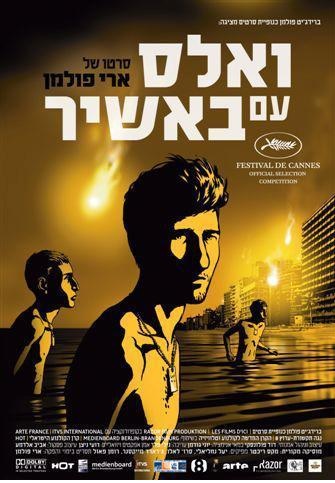 Waltz with Bashir (2008, in Hebrew with subtitles). Israeli filmmaker Ari Holman grapples cinematically with his experiences as a soldier in Israel’s 1982 invasion of Lebanon. Suffering from memory problems, Holman tries to piece together what he witnessed and specifically what he saw on the night when Lebanese forces allied with Israel perpetrated a massacre of Palestinian civilians.
Holman interviews fellow veterans and both the interviews and the veterans’ remembered experiences are recreated using multiple types of animation. Waltz with Bashir’s combination of pop art-style drawings and a limited color palette makes the resulting movie feel like an animated film noir. This look suits the various gritty, downbeat tales presented on screen.
We watch veterans go through harrowing, often surreal, episodes of combat and get occasional moments of respite that are sometimes no less grotesque. We hear them talk frankly and thoughtfully about what they did and saw and the resulting trauma. We also see the many terrible ways civilian life is destroyed in war’s chaos. (Note: Viewers should be warned that Waltz with Bashir concludes with a wrenching, non-animated sequence in which we are shown documentary footage of the Lebanon War’s real-life consequences.)
 The Breadwinner (2017). Parvana, an Afghan girl with a knack for storytelling, lives in Kabul, under Taliban rule. When misfortune befalls her family, Parvana must become their main source of support. Because unaccompanied women are not allowed to leave home, she disguises herself as a boy and tries to help her mother and siblings as best she can.
A production of Irish studio Cartoon Saloon, The Breadwinner rejects any attempt at a realistic visual style, instead embracing a flatness of imagery reminiscent of a children’s storybook. This style is especially pronounced in fanciful depictions of Parvana’s imagined tales, which use paper-cut-out-like characters and brighter colors than are used in the drabber real-world scenes. The filmmakers also rely on an indirect approach to events, often implying what is occurring rather than showing it. This paradoxically makes such moments more resonant.
War hangs over the story. The legacy of the Soviet invasion and subsequent civil war is present in the wreckage of tanks and the continuing threat from land mines. Later, the 2001 US invasion begins and creates a climactic crisis for Parvana and her family. Through it all, she tries to endure, using her storytelling as a coping mechanism. The conclusion is appropriately bittersweet—and seems even more poignant in light of Afghanistan’s ongoing suffering today.
All these animated films, short and long, have the ability to haunt viewers and inspire reflection on war’s toll. Consistent life ethic activists and others interested in peace should consider watching them, perhaps by hosting group screenings with discussions afterwards.
================================================
For more of our posts on art, see:
Right-to-Life Issues in Contemporary Gay and Lesbian Literature
Dickens (Christmas literature)
Recognizing Humanity: Orwell and the Consistent Life Ethic
Act Before We Reach “Midnight”: The Need to Seek a Cease-Fire in Ukraine
by John Whitehead
Introduction
The Bulletin of the Atomic Scientists recently announced that they had adjusted their “Doomsday Clock,” a symbolic measure of threats to humanity, to 90 seconds to “midnight”—that is, global catastrophe. This current status is the closest to midnight the Doomsday Clock has been in its 75-odd-year history. This dire prediction, the Bulletin has explained, is largely “because of the mounting dangers of the war in Ukraine.”

While the risk of worldwide disaster cannot be quantified with the precision implied by measures such as “90 seconds,” the Doomsday Clock’s setting serves as a useful metaphor for current global dangers, especially the danger of nuclear war. I agree with the Bulletin that the risk of nuclear war is now very high, primarily because of the Ukraine war.
Almost a year after Russia’s invasion of Ukraine, the Russia-Ukraine war threatens to spin out of control into some greater catastrophe. Nuclear war between Russia and the United States is the worst of the war’s possible outcomes, although lesser but still dire outcomes are also possible. Averting disaster will require the United States and other western nations to limit their support for the Ukrainian war effort and to pursue a cease-fire or similar diplomatic resolution to the conflict.
The State of the War
Following the Ukrainians’ success last fall in pushing back Russian forces and re-taking some territory, the situation on the ground has bogged down into a stalemate. In Ukraine’s east and southeast, Russian forces still occupy roughly 15-20 percent of the country, including much of the provinces of Donetsk and Luhansk and the Crimean peninsula. Fierce fighting continues around the eastern city of Bakhmut.
While the battle lines have not moved dramatically during the winter, both sides have continued fighting by long-range means. Russia has waged a sustained campaign of missile and shellfire attacks on Ukraine that have devasted the country’s civilian infrastructure, often leaving cities without electricity. The Russian campaign has also caused more direct harm: for example, this January a Russian missile hit an apartment block in the city of Dnipro, killing at least 40 civilians. For their part, the Ukrainians have succeed in striking Russian-occupied territory in Ukraine and even Russian territory with their own long-range attacks.
Various western nations continue to give military assistance to Ukraine, with the United States and other nations recently deciding to send tanks to the Ukrainians. Tanks may allow the Ukrainians to break through the current stalemate and push the Russians further back. On the Russian side, Kremlin spokesman Dmitri Peskov has described the tanks to Ukraine as a sign of western nations’ growing “direct involvement in the conflict.”
Hopes for a diplomatic solution to the Russia-Ukraine war are not bright. Yet pursuing such a solution is imperative, given the alternatives.
Diplomacy: The Best among Bad Options
The ideal resolution to the Ukraine war would be for the Russian people to put sufficient political pressure on their government that Russian President Vladimir Putin is forced to end his aggression and withdraw Russian forces from Ukraine. While this might happen, this outcome is hardly guaranteed: evidence suggests Russian public opinion is ambivalent about the war rather than mobilized against it. Peace advocates should not rely on the Russian war effort being undermined from within.
The resolution of the war presumably hoped for by policymakers in Ukraine and western nations such as the United States is that Ukraine will win a decisive military victory over Russia, pushing the Russians out of all the Ukrainian territory they have occupied since 2014, including Crimea. The Russians would then simply accept this defeat and the war would end. Again, such an outcome might happen: Ukraine’s battlefield successes have been one of the war’s great surprises. I don’t think such a scenario is the most likely outcome, though.

If the war continues unchecked, I suspect the most likely outcomes will be one of the following scenarios:
- The Ukrainians, with western support, continue to win victories over the Russians. To avoid the humiliation of total defeat, a desperate Putin dramatically escalates the war, possibly by attacking a western nation that belongs to NATO or possibly even by using nuclear weapons. (Former Russian President Dmitri Medvedev has explicitly warned this might happen.)
- In a variant of the above scenario, the Ukrainians win a total victory on the battlefield and push the Russians out. This humiliating defeat leads to Putin being overthrown in a coup and replaced by a hardline nationalist who resorts to some dramatic escalation in an attempt to still win the war or exact revenge.
- Ukrainian victory leads to Putin’s overthrow and larger political upheaval in Russia. Such a scenario might seem positive, but it is more likely to prove disastrous. Revolution and regime change has a mixed record, especially in Russia. We should not expect general upheaval in Russia to lead to a more just and humane regime than Putin’s rule. Regime change might well lead to chaos or even civil war, as it did in varying degrees in 1917 or 1991. Chaos and instability in a continent-spanning nation of about 140 million people with a massive nuclear arsenal is not an outcome anyone should desire.
- The war continues and, despite their military successes and western support, the sheer human cost involved—according to one estimate, roughly 100,000 Ukrainian troops might have been killed or wounded to date in the war—takes its toll on Ukraine. Russia benefits from its larger population and prevails through sheer weight of numbers, occupying more Ukrainian territory and forcing Ukraine to accept a worse situation than the current one. (This outcome is probably the least likely, but little is certain in war.)
- In perhaps the most likely scenario, the war simply grinds on and on without resolution, killing huge numbers of Ukrainians and Russians and hurting some of the world’s most vulnerable people in the process.
Faced with such scenarios, a cease-fire that freezes both sides in their current positions and radically reduces the fighting and killing seems like the least-bad option.
The immediate prospects for a cease-fire are unclear: neither Ukraine nor Russia might be ready to negotiate one yet. The goal of a cease-fire should always remain in sight, though, and policymakers from all nations should constantly seek an opportunity to foster cease-fire negotiations between Ukraine and Russia.
Until a cease-fire is in place, western nations would do well to moderate their military support for Ukraine. If the Ukrainians continue to make battlefield gains that push back occupying Russian forces, this could lead to one of possible crisis scenarios described above.
An Appeal for Diplomacy
Even as I argue for a cease-fire, I acknowledge the clear limitations of this approach. Freezing the Ukraine war now would leave Russia in control of a relatively small but still significant swath of Ukrainian territory. Accepting this situation could be seen as rewarding Russia’s brutal aggression.
I understand why many people, even peace-minded people, rebel at such an outcome. I agree that this outcome is very far from satisfactory. However, I think it is preferable to the most likely alternatives.
Sometimes the most prudent policy is to accept a continued injustice if it means avoiding still greater injustices. This was in effect what the United States and western nations did during the first Cold War, accepting Soviet domination over the eastern half of Europe rather than pursuing a destructive, war-mongering policy of “rolling back” the Soviets.
Whatever the limitations of seeking a cease-fire, the alternative of supporting and encouraging a purely military effort by Ukraine to achieve total victory and hoping that this doesn’t provoke a disastrous Russian response is simply not a responsible policy.
Within the United States, we should contact President Biden by phone and email as well as our representatives in the House and Senate.
We should urge our elected representatives to work for a cease-fire in Ukraine. We should also urge them to curtail further shipments of tanks or other military aid to Ukraine that might lead to further Ukrainian territorial gains and an escalation of the war.
Policymakers need to act now, before the Doomsday Clock gets any closer to midnight.
=======================================
For previous coverage on Ukraine, see:
Buy the Time to Make Peace: Seeking a Cease-Fire in the Ukraine War
Untying the Knot of War: Seek Negotiation, Not Escalation in Ukraine
A Catastrophe Decades in the Making: The Russian Invasion of Ukraine
Not Your Pawns: A CLE Examination of the Russia-Ukraine Conflict
For more on the damage of war, see:
The Wages of War, Part 1: How Abortion Came to Japan
Wages of War, Part 2: How Forced Sterilization Came to Japan
The Danger of Coerced Euthanasia: Questions to Ask
by Ms. Boomer-ang
Sometimes strong arguments for the Right to Life do not receive the attention they deserve. For example, an important argument against euthanasia and assisted suicide is that people can be coerced into ending their lives in these ways. I was recently reminded of this strong-yet-sometimes-neglected argument when reading a piece criticizing euthanasia by Wesley J. Smith.
The essay includes both very strong points and points that need strengthening.
The strongest point the essay makes is that a “woman in the Netherlands [was] held down by her family as she struggled against being lethally injected” [emphasis added]. So much for euthanasia being what “everyone” wants.
Apparently, when the woman had been more mentally alert, she had expressed a general willingness to be euthanized if she chose to pursue that option. Whether she wanted that option at the time she was killed is unclear. (In 2016, Dutch authorities took the step of officially allowing euthanasia on people with dementia if the patients authorized such actions when they were still lucid. Dr. Catherine Ferrier has provided a critique of this practice.)

But the following are additional points the essay makes and additional questions worth asking. The answers might make these points stronger.
Mr. Smith laments doctor shopping, meaning that when a doctor refuses to hasten a patient’s death, the patient simply goes to a different doctor who will do it.
Yes, that is lamentable. But what information is available on doctor shopping in the other direction? Do and can patients who want to live until their body dies naturally “shop” for a doctor who will support their wishes, if their doctors (proactively or on request of the patient’s family) suggest speeding their death? Is it as easy to switch from a doctor who participates in death hastening to one who does not as it is to make the reverse switch?
Just knowing that some people “shop” for non-participating doctors could help opponents of euthanasia know we are not alone and promote the idea that one can evade death hastening. Further, publicizing difficulties in finding a doctor who does not participate in euthanasia/assisted suicide can demonstrate the danger of legally allowing death hastening.
Here is another important question: In cases where a patient’s first doctor will not participate in death-speeding, what percentage of shopping for a doctor who would participate is done by the patient’s family without the patient’s request or initial knowledge? If the answer is that a high percentage of such shopping is done by families, that also shows the danger of allowing death hastening. Patients may not share their family members’ impatience for their death.
Smith also mentions euthanasia of children. Some are old enough to know what is happening. Do some of them fight against their killers, do some scream for their lives? If so, pro-life voices should be highlighting these stories.
Smith reports that newborn babies in Holland can undergo a medical evaluation to see if they can be euthanized. According to a 2005 article by the doctors who developed the protocol for such evaluations, 60% of the deaths of children younger than 1-year-old in the Netherlands were preceded by “a medical decision regarding the end of life.” They also cited a survey of Dutch neonatologists who reported euthanizing 15-20 newborns annually. These euthanized newborns had “a hopeless prognosis [and] experience what parents and medical experts deem to be unbearable suffering.” A specific condition cited by the doctors as a reason for such euthanasia is spina bifida.
Do parents ever dispute these evaluations of their newborn children? Knowing more about such cases would be useful.
Smith’s essay is good and valuable, but parts of it give the impression that the greatest concern should be about people who voluntarily choose to die because they are depressed, isolated, homeless, or financially insecure. We should also remember those who really (maybe secretly) want to live but are coerced or bullied into submitting to hastened death by their family, social workers, community leaders, or others. We should tell their stories as well.
====================================================
For more of our posts on euthanasia, see:
Figuring out Euthanasia: What Does it Really Mean?
#SayHisName: The Medical Murder of Michael Hickson
How Euthanasia and Poverty Threaten the Disabled
Will I be Treated the Same Way Now?
Boycott Strategy: CVS & Walgreens
by Rachel MacNair
Now that the United States Food and Drug Administration allows the abortion pill to be dispensed by ordinary pharmacies, CVS and Walgreens are both seeking certification to do so. This would make them the largest chain of abortion providers in the country, surpassing Planned Parenthood. It would further normalize the killing of babies. It would physically harm women while pretending otherwise. And unless conscience provisions are put in place, it may conscript unwilling pharmacy employees into participation in abortions.
Boycotts
Charles Cunningham Boycott was a retired British army captain who managed an estate in Ireland for an English earl in the 1870s. The Land League told him he must reduce rents; there had been bad harvests, and another famine was a real danger. Captain Boycott responded by trying to serve eviction notices.
The Land League urged tenants to stop communicating with those who refused their demand for lower rents. Captain Boycott was the first person against whom they used this tactic. He had to bring workers in from Ulster to work under guard to harvest the crops. But the Land Act of 1881 set fair-rent tribunals, so conditions eased.
The name “boycott” took off as a word to mean non-cooperation with all kinds of things. It usually means not buying a certain product or not buying from a particular merchant. Those who want to make money selling the product need to change the way they act in order to be able to sell. All kinds of causes can be helped in this way.
It’s a powerful tool, but not used all that often. That’s because, to do it right, usually an awful lot of work in a major campaign is involved.
The Splurge
I was active as a teenager when the United Farmworkers (UFW) had a major campaign to boycott head lettuce and grapes. I’m sure there were individuals who opposed UFW and made a point of buying those products, but they weren’t well organized and were surely overwhelmed by the number of people observing the boycott.
On the other hand, the abortion issue has a huge number of people for and against who are all well organized. Both sides are inclined to counter any effort that the other side makes.
A while back there were abortion defenders who were upset about some law passed in Idaho, so they called for a boycott of Idaho potatoes. This was remarkably easy for pro-lifers to counter. Having potatoes instead of rice at dinner for the sake of the cause is easy. Buy a large bag of potatoes, donate it to your local soup kitchen – your charity dollar has done double duty, and you didn’t even spend very much.
So the first rule of deciding on a boycott is: is there an opposition that can simply undo it by buying more of the product?
For CVS and Walgreens, it would be much harder to make a big point of using them for those who aren’t already doing so. It can be done, but mainly, large groups would simply continue to use them as they do already, and those that don’t already have good reasons (such as location) for not doing so. So having abortion defenders try to counter the boycott by buying more than they otherwise would from these stores is probably not as much of a problem. But we can be sure there would be some effort, and this must be taken into account.
The Case
I’ve heard people consider the idea of a boycott against a business that gives money to Planned Parenthood. The likelihood of a splurge in buying to counter the boycott is the first problem. The question of why and how to pick one when there are so many is another. But mainly, the question is whether the considerable effort required to do a successful boycott is a better expenditure of time and resources than any number of other strategies that have a greater immediate impact, especially for directly preventing abortions.
The abortion business and philosophy has its tentacles so deep in society that trying to non-cooperate with it completely might not be possible even for a hermit living off the grid in the woods. The same thing is true of the military. Killing people as a problem-solver is so deeply ingrained that efforts to be pure aren’t workable. We can be conscious in our purchasing decisions, but that’s a separate practice from an organized, narrowly focused boycott.

For CVS and Walgreens, however, we have:
- Two identifiable businesses that can in fact usually be avoided with effort.
- A clear-cut reason that goes beyond funding things: they would be actually participating in abortion, and compelling employees to do so.
- This is a new way of distributing abortion drugs, and nipping things in the bud is always easier than dealing with long-established practices. Abortion itself is long-established, and the drugs have now been used for years; this will make it harder. Yet this form of arranging abortions is new.
Goals
Long-term Goal: Get CVS and Walgreens out of the abortion pill business. A boycott would be one of many strategies that include letters and phone calls, picketing stores and shareholder meetings, and shareholder resolutions.
Short-term Goal: See that the amount of money they lose for taking on the abortion pill is several times greater than the amount they gain. This removes a profit motive, which is the main motive they have. It might serve as a deterrent for others, and it helps maintain or increase the stigma of doing abortions.
Remember, in the early days under Roe v. Wade, abortions were available at all kinds of hospitals and doctors’ offices in addition to clinics. Over the course of time and many protests, abortion practice got consolidated down to mainly clinics. The same dynamic can be applied again.

Strategic Considerations
There would have to be local groups that make the case locally, because they’re the ones that know what alternatives there are.
For pharmacies, those in the states where abortion is already banned will be able to point to local pharmacies. The CVS and Walgreens won’t be offering the abortion pill there either, since it’s illegal, but their stores can still be boycotted and picketed in those states.
In the states where abortion is widespread, the local pharmacies may not be much help; if they offer the pills also, then it’s not much of an alternative. But perhaps Catholic, Baptist, and mom-and-pop pro-life health facilities, among others, can be counted on to help with the pharmacy needs of those boycotting CVS and Walgreens. Knowledge of what those are in each locale would need to be included in the messaging encouraging local people to boycott.
For everything else the stores sell, other alternatives can be mentioned. I’ve already purchased two rolls of packing tape from the UPS store in order to not buy those at CVS any more. Some of this will just be people noticing where else they can get specific items like that. Anything that’s a bigger deal might need some suggestion of alternatives as well.
Large institutions include hospitals and clinics, colleges and universities, churches and other houses of worship. These are not only concentrated places to get the word out quickly to lots of people, but they make large purchasing decisions themselves. Persuading an institution to use an alternative for their purchases – and a lot of Catholic and evangelical groups, among others, are likely to do so – makes a large impact in one fell swoop.
And of course the reason for not patronizing them needs to be communicated to CVS and Walgreens frequently. Their central national numbers are designed for customer service, not for this kind of feedback. This is therefore more likely to work better on the local level, because having it happen in various parts of the country will be the most impressive.
Conclusion
A few years back, abortion defenders were offended at a couple of corporations and called for a boycott. I went to their website to see how they were organizing it. They weren’t. That and their Facebook page were full of kvetching, ain’t-it-awful rhetoric about the companies. Nobody was doing anything practical to actually get a boycott going. So of course one never got going.
The Progressive Anti-Abortion Uprising (PAAU) has already called for a boycott , which fits with their style. However, this is obvious enough that probably several groups will call for it.
But it will only work (and it really needs to work) if many groups on the local level hop in and find the alternatives and get the word out effectively.
Meanwhile, I do encourage everyone to at least boycott these two companies as long as they are still seeking, or actually doing, the dispensing of abortion pills. More effectively, of course, let your local branches know your displeasure – the more who do so, the better. Stay tuned for more organized opposition coming – and if you’re so moved, help organize that opposition. Just remember that to actually have an impact, that opposition needs to think strategically and put the work in.
==============================================
For more on noncooperation with Planned Parenthood, see our website:
Grassroots Defunding: Finding Alternatives to Planned Parenthood
Grieving for John
by Rachel MacNair
My first inclination when I thought about writing this post soon after the event was that I better not. It was a private event and my thoughts shouldn’t be broadcast for fear of invading privacy.
But it’s now been publicized in The Washington Post, which is about as public as it gets. And in that article, I’m conscripted into a supporting role I never agreed to. I wasn’t named, but I was part of a group that was implied to be supportive of what happened (visiting Quakers) when I’m actually appalled. So writing this becomes an obligation.
I listened in great consternation as John, over Zoom to my local Quaker Meeting, read the letter explaining to the Meeting his decision to do VSED – basically, starve and dehydrate himself to death, with medical comfort provided. He mentioned a fear of being stuck on a ventilator in ICU when he didn’t want to be. He listed disabilities he had that he didn’t want to live with.
He had been following the organization Compassion and Choices for years – an organization devoted to euthanasia, though of course they use euphemisms. I had never been able to talk him out of that.
We were good friends, fellow Quakers, and had been so since I was a teenager. He was already a long-time member of our Quaker Meeting when I joined in 1972.

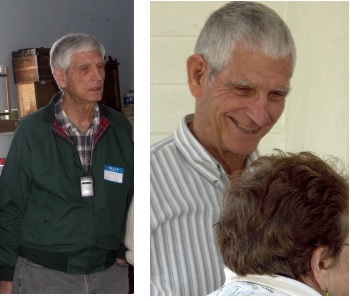
I’m speaking with John at a Quaker Gathering
The jacket I’m wearing is one inherited from his wife.
I know his kids, and I have complete confidence that the idea that they might get their inheritance quicker or that there might be more of it if he did this probably didn’t even occur to them, certainly not in any way that would come out. No pressure whatsoever on him for that.
But of course not everyone is so lucky.
And he never cited lack of resources as a problem. He was White and male. No one was going to disrespect him for being otherwise.
But of course not everyone is so lucky.
I was one of the Quakers mentioned in the article that went and visited him. I was aghast, but I never said so to him. I knew he was determined, and the only thing I could do if I argued would be to make things worse for a dying man.
I visited him because that’s what one does when a friend is dying. The dying person steers the conversation. John wanted to reminisce mainly, and he asked some questions and chatted like normal. He was tired after about 20 minutes or so, so my son and I left.
But I do need to say in no uncertain terms that I am heartbroken. He was a man who went to prison during World War II for refusing to register for the draft because he wouldn’t kill people. He was a man who didn’t want the murderer of his son (in a senseless shooting spree of four people) to be executed, because he didn’t believe in killing people.
And then he ended his life by killing someone – himself.
Disabilities
First, on the fear of ICU, I do understand not wanting extraordinary life-saving measures taken for a 99-year-old man. But his contention that if he went into assisted living he’d be forced into such measures when he didn’t want them is entirely outside my experience. What would otherwise be medical care when consented to is assault and battery without that consent. And particularly for a man that old, hospital staff wouldn’t be surprised that he wanted to die in peace rather than be put on a ventilator and similar measures.
Yet the disabilities he mentioned having at the time were ones that large numbers of people live with.
He was 99 years old. He had mentioned several years back that he won first place for swimming in the 90-93 age group, which was easily done because he was the only person in it. Quite hale and hearty – as can be seen how long it took him to die without food and water.
But that goes along with his inordinate disdain for living with a disability. There is no bigotry greater than saying that someone is better off dead, and there’s no way to make that bigotry stronger than saying that you yourself would rather be dead than be such a person.
How devastating is this to people living with disabilities? How much does it sabotage their ability to make their case that they want to live, and to be treated with dignity? How much does it add to the pressure from others to have disdain for their own lives?
He was a deeply spiritual man. Had he approached the disabilities as a learning experience, and had more solidarity with other people going through such experiences, he would have had the spiritual resources needed to let it enrich his life.
Grieving
And it’s even worse than I realized, once I read the article: while one son was supportive and there to help his father with the medical comfort aspect – which I can testify to, I saw it – his other two sons were opposed to it. That’s all the article said. I haven’t spoken to them, but I do know from recent personal experience that grieving a father is hard, no matter how old.
In general, dealing with the grief when the death was a suicide is harder. I don’t know if it was for the other sons, or if they even saw it as a suicide at all.
But I do know that the topic never came up in all the discussion around “choice.” The callousness of not taking the grieving process for loved ones into account scares me.
Memorial
I couldn’t attend his memorial service (that is, among Quakers, Meeting for Worship with Attention to Memorial). It was blended, both at the Meetinghouse and on Zoom. My son attended on Zoom and said it was beautiful with so many good memories. What I did at the same time was go off by myself and spend the hour with my own good memories of John – there were so many.
But there had already been Friends in the Meeting that had said things indicating they thought what John did was courageous and even used the word noble. If any said that during the service, I would be put in the position of having to either stay silent – and anyone who knows me knows better than that – or to explain parts of what I’ve said above.
One doesn’t do that at a memorial service. It’s just plain wrong to start an argument on such an occasion. And my son confirmed that this problem did in fact come up, and I would have been in that impossible situation. So I was deprived of the proper send-off for a friend surrounded by other friends.
Once again, using death as a problem-solver is also drafting people to support death. The alternative is to refuse cooperation, and face the kind of hostility that noncooperation with killing often brings.
Conclusion
John, I remain so very fond of you. You did so much good in the world. May all that good through 99 years be what you are remembered for. The story of your death is so very much not the story of your life.
================================
For an example of an individual case applied to someone with disabilities, see:
#SayHisName: The Medical Murder of Michael Hickson
For more on this topic, see:
Figuring out Euthanasia: What Does it Really Mean?
How Euthanasia and Poverty Threaten the Disabled
Will I be Treated the Same Way Now?
A Process of Tender Understanding and Loving Closure when Life Ends
Euthanasia by Poverty: Stories from Canada
What’s Cruel for the Incarcerated is Cruel for the Terminally Ill
“She Is a Beautiful Person”: Parents of Children with Down Syndrome Speak Out
by Sarah Terzo
Babies with Down Syndrome are common targets for abortion. Estimates of the percentage of pregnancies involving children with Down Syndrome that end in abortion vary, but one study found that abortion has reduced the number of babies born with Down Syndrome by 30%.
Ethicist Joseph Fletcher described people with Down Syndrome as “sadly non-or un- or subhuman creatures.”1
In 2017, CBS reported that in Iceland, 100% of babies with Down Syndrome were aborted. On April 16, 2019, the Facebook page “Abort Ableism” compiled the following reactions to the news:
“Not everyone wants to deal with a 40-year-old toddler until they die.”
“I mean they aren’t going to contribute much to society, are they?”
“They are not special. They are a drain of families and communities. I worked with special needs children when I was in middle school . . . the world would be better off without them.”
“Once saw a kid with Down’s throw a little dog in some sticker bushes. They’re not all magical lmao.”
“We should follow their example.”
“Good for Iceland for killing the unwanted.”
 In contrast to this hateful ableism, parents of children with Down Syndrome have written about what a blessing their children are.
Patricia E. Bauer’s daughter Margaret has Down Syndrome. At a dinner party, Bauer overheard a college professor say that parents have a moral obligation to abort babies with disabilities to spare their children suffering. When Bauer tried to share her experience as the mother of a disabled child, the professor “smiled politely and turned to the lady on his left.”
Bauer writes:
Margaret does not view her life as unremitting human suffering (although she is angry that I haven’t bought her an iPod). She’s consumed with more important things, like the performance of the Boston Red Sox in the playoffs and the dance she’s going to this weekend.
Oh sure, she wishes she could learn faster and had better math skills. So do I. But it doesn’t ruin our day, much less our lives. It’s the negative social attitudes that cause us to suffer.
Ashley Engele’s first-born daughter has Down Syndrome. While pregnant with her third child, she discovered that baby also had Down. She chose life. She describes her eldest daughter:
Rilynn is just like any other precocious 4-year-old girl. She goes to preschool, loves Trolls, Barbie dolls and her “typical” younger sister. They are best friends, they love each other fiercely, and also have the classic sibling rivalry. We fight over what outfit she’s going to wear, or how she’s going to wear her hair for the day. Most of all, she loves other kids and babies . . .
We know how when we’re having a bad day, one smile from Rilynn can completely turn it around . . . She can make even the grumpiest or angriest people smile and win their hearts over in an instant.
According to Engele, “[O]ur lives are better with Down Syndrome in it.”
 In a booklet encouraging parents of disabled preborn babies to choose life, Ellie describes her son Michael, who has Down Syndrome:
Today, Michael is a 12-year-old boy with a great sense of humor. He attends a regular classroom in his neighborhood school. Michael rides a two-wheeler bike, plays soccer, baseball and basketball and has lots of friends. He is more like any other child his age than he is different. The unconditional love that he gives is an example to all of us.2
She says, “I’m proud to be his mom.”
Jodi Reimer’s 13-year-old son Kellen has Down Syndrome.
In a letter to him, Reimer wrote, ” . . . I didn’t realize how fun and fascinating it would be to see your gifts, talents, and personality develop. Your sense of humor often takes me by surprise.”3
She reminisces about the day Kellen tried to go to school in a life jacket. Another time, right before the school bus was scheduled to arrive, Kellen dressed up as a pirate. She recalls, “Even though there wasn’t any time to spare, I just had to stop and laugh.”4
Tammi Hodson wrote about her son Parker:
Parker is more like my other kids than he is different. Yes, he is much slower in learning how to crawl. He is slower in learning how to talk. But like my other kids, he loves to be cuddled and tickled. He loves to be the center of attention. He wants to do what his brothers and sisters are doing. He loves to roughhouse and be thrown into the air by his dad. And he will do something that he knows is naughty and then try to use his heart melting smile to repent – the same exact smile and attitude that my oldest son uses so effectively to get his way. He is, in more ways than not, just a typical Hodson boy.5
Christine Allison said of her daughter with Down, “Chrissie is a blessing in a way a normal child is not. It is in describing her that the word ‘special’ rises from banality and comes grippingly alive.”
Shelley Burtt, whose son Declan has now passed away, recalls that he had “an infectious enthusiasm for life which illuminated any interaction with him, an ability to give and receive love that was uncomplicated by the egoism, self-awareness, or self-consciousness of a ‘typical’ child.”
Jeanette Bollinger wrote of her son Carter:
I began to notice that people had a very strong reaction when they met him for the first time. It didn’t matter what sort of mood or frame of mind they were in, as soon as they met Carter, they seemed happier and just wanted to be around him as much as possible. All he has to do is smile at a person once, and he has them wrapped around his cute little crooked pinky. He has a peaceful, happy presence that is very contagious.6
Bollinger says that when people ask her if she wishes Carter didn’t have Down, “My answer is always no, because that would mean changing Carter, and I would never want to change him.”7

Nancy Iannone writes of her daughter Gabriella:
Gabriella continues to amaze us as an adorable 17-month-old. She loves to sway to music, splash in the bath or the pool, and squeeze her sisters’ faces . . .
She is learning sign language at a pace that has amazed her sign teacher… Though I delight in her physical and cognitive progress, the true joy I receive is seeing her shining, laughing face, especially when she thinks she is playing a trick on me . . .
My baby is not a diagnosis, not a list of her potential woes. She is a beautiful person, full of laughter and grins.8
Emily Zeid found out that her daughter has Down Syndrome only after she was born. She refers to her six-month-old as “happy and healthy” and says:
She smiles easily and laughs often. She becomes more beautiful with each passing day. I now see the beauty in the differences that I used to believe were flaws. Her upturned almond eyes are filled with wonder, the flat space across the bridge of her nose is a favorite kissing place, and her low set ears show off her ponytails perfectly.9
Jim Hartman, father of Jesse, describes his son’s compassion for others:
[H]ow he just loves up on people, and how he loves them, and he hugs them and he listens, and he has a special intuition about what they need, and what they feel, and if somebody’s sad or they’re happy, he knows these things. [He has] almost an extra [sense] above what we have about those feelings…
Everybody’s his friend, and he’s got to go around – it takes us quite a while to go out of a place, because he has to go and give everybody their hugs, tell them goodbye, tell them how much he loves them. Being so expressive, he definitely is the life and the energy in a party. Just the way that he loves his dad is amazing. And he loves everybody else the same way.
These children are all unique individuals. They are not in any way subhuman but are precious human beings who are deeply loved by their families. Their lives have value and meaning.
- Joseph Fletcher, “The Right to Die: A Theologian Comments,” Atlantic Monthly, April 1968.
- Bernadette Zambri, Hope in Turmoil: A Guide for Decision-Making after Receiving a Difficult Prenatal Diagnosis Regarding Your Baby (2014), .
- Jodi Reimer, “On His 13th Birthday,” in Kathryn Lynard Soper, Gifts: Mothers Reflect on How Children with Down Syndrome Enrich Their Lives (Bethesda, Md.: Woodbine House, 2007), 17–18.
- Ibid.
- Tammi Hodson, in Soper, Gifts, 35, 36.
- Jeanette Bollinger, in Soper, Gifts, 53, 54.
- Ibid.
- Nancy Iannone, “A Hopeful Future,” in Soper, Gifts,
- Emily Zeid, “Loving Emma Jayne,” in Soper, Gifts,
Note: the pictures above came from Microsoft Word clip art; they aren’t photos of the individuals being described.
====================================
For more on people living with disabilities, see:
A Lawyer’s Turnaround on Baby Doe with Her Own Down Syndrome Baby
How Ableism Led (and Leads) to Abortion
Abortion and People with Disabilities
The Christmas Truce of 1914
World War I was starting, and the war that was expected to be over by Christmas lasted for years. But on Christmas Eve and through Christmas Day, up and down the 500-mile front, about 100,000 soldiers out of a million had spontaneous truces. Christmas carols on one side were joined in by the other side, and there were even soccer games.
The culture of life and the culture of peace (which of course are the same thing) benefit from knowing this: people are quite capable of outbreaks of peace even under the most dire pressures from those in authority.
Articles
From Tony Magliano, one of our blog post writers: A Christmas Miracle – When Enemies Became Brothers • AUSCP
The Importance of the December 1914 Christmas Truce – World BEYOND War
This article lists several other instances where informal truces among enemy soldiers happened, showing that while the 1914 Truce is the largest and most well-known example, it’s quite believable it happened because it’s happened other times as well: BBC NEWS | World War I | The Christmas truce
Poetry Set to Music
John McCutcheon: Christmas in the Trenches (1984)
John tells the story of writing this song in this video before singing it. There’s a touching story about men who were part of the event letting him know how much that song meant to them.

Celtic Thunder: Christmas 1915
They have the wrong year for this, but the art of this still has the spirit of it.

Christmas Truce of 1914
Dramas Imagine
Movie: Joyeux Noel
From Andrew Hocking, one of our blog post writers, a reflection on the movie’s significance: A Christmas Truce, Civil Religion, and Refugees.

Audio Drama: Christmas Eve 1914

Faith Communities Call for Christmas Truce for Ukraine
World War I’s Christmas Truce continues to inspire peacemaking efforts today. In the spirit of that earlier truce, the Fellowship of Reconciliation and other groups have organized a petition calling on policymakers to seek “a ceasefire and negotiated settlement” in the Ukraine-Russia war, “before the conflict results in a nuclear war that could devastate the world’s ecosystems and annihilate all of God’s creation.”
The petition signatories are leaders from various religious traditions and include Nicholas Sooy of Consistent Life member group the Orthodox Peace Fellowship. Members of faith communities are encouraged to ask their pastors or leaders to sign on to the petition.
================================
This is a list of holiday editions of our weekly e-newsletter, Peace & Life Connections.
In 2021, there was a somber topic, but one appropriate to the season: the Massacre of the Innocents, and its role in quotations and art that oppose massive violence of all kinds.
In 2020, given what was most on people’s minds at the time, we covered Pandemics Related to Christmas.
In 2019, we showed Christmas as a Nonviolent Alternative to Imperialism.
In 2018, we detailed Strong Women against Violence – Connected to the Holidays.
In 2017, we covered Interfaith Peace in the Womb.
In 2016, we discussed how “The Magi were Zoroastrians” and detailed how good the Zoroastrians were on consistent-life issues. The ancient roots of the consistent life ethic run deep!
In 2015, we had a list of good holiday movies with consistent-life themes – check it out for what you might want to see this season. We also had information on Muslim nonviolent perspectives.
In 2014, we offered a quotation from a lesser-known Christmas novella of Charles Dickens and cited the treatment of abortion in the Zoroastrian scriptures.
In 2013, we shared several quotations reflecting on Christmas.
In 2012, we had a couple of quotes showing the pro-life aspects of two prominent Christmas tales: A Christmas Carol with Ebenezer Scrooge, and the movie It’s a Wonderful Life. We also quote from John Dear about Jesus as peacemaker and Rand Paul about the 1914 spontaneous Christmas Truce; he then related it to the culture of life.
In 2011, we covered the materialism-reducing “Advent Conspiracy” and offered two pieces of children’s art: a 1939 anti-war cartoon called “Peace on Earth,” and the anti-war origins of “Horton Hears a Who,” whose tagline – “a person’s a person, no matter how small” – is irresistible to pro-lifers.
In 2010, we showed “It’s a Wonderful Movement” by using the theme of what would happen if the peace movement and the pro-life movement hadn’t arisen. We also had quotes from Scrooge (against respect for life) and a Martin Luther King Christmas sermon.
Becoming a Catholic Conscientious Objector
by Tony Magliano

Tony Magliano
A few years back, I was doing some serious soul-searching, trying to discern what God wanted me to write about. I walked into my 16-year-old son’s bedroom to discover a military calendar hanging on the wall. It highlighted young men and women in combat fatigues, fighter jets, an aircraft carrier battle group and plenty of American flags.
I knew from personal experience and previous soul-searching that hidden behind this calendar of military glitter was centuries of death and destruction. And as I removed this calendar, I knew exactly what God wanted me to write on.
Many years ago, as young man in my 20s, I found myself in the midst of U.S. military basic combat training at Fort Dix, New Jersey.
While firing my M-16 weapon at life-like pop-up targets, it occurred to me the army was not training me to hit pop-up targets – it was training me to kill some poor guy like me in a far-off country who got caught up in the propaganda of his own country’s war machine.
I came to realize this was all wrong. And I knew that in my desire to imitate the nonviolent Jesus, I could kill no one.
I spoke to my drill sergeant about these deep anti-war feelings I had and my desire to apply for conscientious objector (CO) status. He urged me to wait until I completed basic training and apply for CO status when I arrived at Fort Benjamin Harrison, Indianapolis, for Advanced Individual Training.
At Fort Harrison I was being trained as a broadcaster for Armed Forces Radio in Germany. But that inviting future did not deter me. My broadcast instructors tried to convince me that the chances of my having to shoot someone from a radio station were extremely remote. And although they were technically correct, I knew my role as a military journalist and radio disc jockey would be to boost the morale of those who would be pulling the triggers and dropping the bombs. And I knew that I could have nothing to do with this unholy enterprise.

In my appeal for discharge as a conscientious objector, I had to write a research paper stating my position from the perspective of Catholic teaching on war.
Unfortunately, the Catholic Church for the last 1,700 years – after the Edict of Milan in 313 A.D. made Christianity a legal religion in the Roman Empire – has not fully been what is traditionally known as a peace church, renouncing all war as the Amish, Mennonites, and Church of the Brethren do. This made my case much more difficult. However, since total active nonviolence is at least a part of Catholic doctrine, as clearly exemplified by the first 300 years of its history, I was able to make my case.
After undergoing cross-examinations by a military officer and psychiatrist, being interviewed by three army chaplains, and having my appeal go up and down the chain of command several times, it was finally ascertained that I was a sincere conscientious objector, and I was granted an honorable discharge.
During the many years since then, I have been writing, teaching, speaking, protesting, lobbying, and praying for peace and active nonviolence. I have dedicated much of my life to actively protecting the dignity of all life, especially the vulnerable – that of the unborn, elderly, sick, poor, hungry, war-torn, homeless, migrants, and the earth and its other inhabitants.

Ben Salmon and family
My experience in appealing for conscientious objector status was relatively painless. But many Christians and other people with peaceful consciences have suffered harsh prison sentences like the late American Catholic Ben Salmon. And some COs have even been executed, like Austrian Blessed Franz Jagerstatter, rather than take the lives of others.
A deeply inspiring testimony of nonviolent Christian witness and heroic conscientious objection in the early Catholic Church can be found in the authentic ancient Roman trial of St. Maximilian.
As Maximilian said at his trial, “I will never serve. You can cut off my head, but I will not be a soldier of this world, for I am a soldier of Christ. My army is the army of God, and I cannot fight for this world. I tell you I am a Christian.”

icon with Maximillian in the center
Tony Magliano, a Consistent Life Network endorser, is an internationally syndicated Catholic social justice and peace columnist. He is available to speak at diocesan or parish gatherings. Tony can be reached at tmag6@comcast.net.
=================================
For another of our posts from Tony Magliano, see:
Over 20 Million People Facing Starvation – And We Should Care!
For more on conscientious objection, see:
Conscientious Objectors (objecting to participating in abortion)
The Redemptive Personalism of Saint Oscar Romero
Culture of Conscience: Would You Pay Taxes that Fund Abortions if Hyde and Helms were Repealed?