Presenting about Abortion: Sharing Experiences
by Fr. Jim Hewes
In the early 1970’s, I was on the speakers’ bureau of the Rochester Right to Life Committee, giving talks to many groups in our area. ;where I began the presentation by showing slides/photos of the developing pre-born child. Today, with not only the overturning of Roe v. Wade, but the deep polarization and intense inflammation in society, I am not sure if that same approach will still work.
If roughly 1 in 4 women (according to the Guttmacher Institute) will have had an abortion by the time they are 45, there will be a significant number of people hearing the presentation who either had an abortion or in some way interacted with a woman who has had an abortion. It is more of a problem this way than the death penalty or immigration or some other issue about which one might more easily change one’s view. For this reason, changing one’s position on abortion after hearing a presentation may have far-reaching consequences for people, including changing one’s way of life. Any person hearing a presentation on the evil or immorality of abortion may translate it to herself by saying that “I am bad,” or “I am no good,” or “I am irredeemable.” So, I have come to the conclusion that a modified presentation might be the best way to approach the abortion issue at the present time.
First, I would ask the people present: “How did I come to my position on abortion? What experiences in my life have brought me to my present stance on abortion?” I would give them enough time to reflect on this question, then I would share what has influenced me, because if we are going to persuade others that the pre-born are human, then we are going to have to come across as human as well, and this sharing is an opportunity to show this.
After asking those present to also reflect on this question, I would give them time and ask them to reflect on three other questions:
- If there is such a thing as truth, is there more than just my truth or your truth? Or is there an absolute, universal, objective and unchanging truth?
- What does equality really mean?
- What is the pre-born child? What is an abortion?
I would answer the first question by holding up the front cover of Newsweek for March 3, 1975. In addition, I might also hold up the picture of Samuel Armas, as well as the photo of Sarah Marie Switzer from the December 1999 issue of Life).

I am convinced that these pictures are a powerful instrument in the abortion debate because these magazines are not from pro-life or religious resources but are from secular publications; it brings the discussion from an abstract concept to the actual reality of who the pre-born are.
Second, I would share one of the most powerful experiences of my life, one I will never forget, despite this happening over 35 years ago.
I received a call one day from a couple whom I had married over a year before. They asked me to come to the hospital to baptize their son Jose, who had been born prematurely. I met them in the waiting room and then we went into the neo-natal unit.
My jaw dropped when I saw Jose because he was born at only 22 weeks gestation. Even though I had been involved with the pro-life movement for many years and had seen all the pictures of the pre-born child at various stages of development, this was the tiniest human being outside the womb I had ever seen.
He was so small that I could literally hold him completely in my hand. At the time it made me think of the passage in Isaiah that says that God will hold us in the palm of His hand. The nurse brought me an eye dropper and I baptized this incredible gift of life.
After this experience, I went outside and the cool air hit me. It struck me that in another part of this hospital, the life of a pre-born child at the exact same gestational age could be ended through an abortion and the only difference between the two identical lives was that one was wanted and the other was unwanted.
Third, I would share about being director of Project Rachel, a post-abortion ministry, for 18 years. One woman described her abortion as if her leg was caught in a bear trap and she gnawed part of her leg off to get out. Another woman described her abortion as someone crawling through a field of sharp broken glass and trying to get to the other side.
I saw first-hand the devastation that abortion does to women (and men). I would talk about having the fortune to witness the incredible transformation of many women (and men) from brokenness and despair to healing and peace. I have not been able to find the words to adequately describe this amazing transformation of grace that I have seen in the Project Rachel process. Project Rachel was probably one of the most transforming experiences of grace that I have witnessed.
If I had the time, I might share one particular experience in Project Rachel. A woman came to see me because her sister had recently had a baby. This experience brought to the surface the abortion she had gone through ten years earlier in college with her boyfriend (who had become her husband).
This woman told me that she and her husband had gone through every fertility option that was known of, for all their married years, and yet she had been unable to become pregnant. She said that she felt she was being punished through the abortion, because she had thrown away the gift God had first given her.
This type of situation is not something that can be quickly fixed with words. So, I took her through the loving, non-judgmental, and amazing experience of Project Rachel. We finished this wonderful healing process in early December.
Ordinarily I never hear from these women again because they have brought a deep closure to that part of their life. Yet in late January this same woman called me with such excitement to tell me she was pregnant. Then seven months later I received another call from her. She said that she had to call me first to tell me that she was holding her son, and she found it almost unbelievable that God had given her this second chance. I might end this section by reading one or two of the actual letters written by mothers to their pre-born children.
The fourth reason for my position on abortion would be a personal one. I grew up in a home where the disease of alcoholism was present. After many years in Adult Children-Al anon, I realized that I (along with others in the program) had the experience of being an unwanted child. The priority in the family wasn’t us as children but drinking alcohol and coping with that disease. We felt secondary to the side effects of the disease. In the same way, 97% of abortions are done because the pre-born child, for one reason or another, is unwanted.
That is why Project Rachel would be an important part of any presentation on abortion. But an equally important point is this: with 2,500 pre-born children killed every day, as Bishop Fulton Sheen has stated, “The refusal to take sides on great moral issues is itself a decision. It is a silent acquiescence.”
=========================================================
For more of our posts on dialog and persuasion, see:
Two Practical Dialogue Tips for Changing More Minds about Abortion
Dialog on Life Issues: Avoiding Some Obstacles to Communication
The Logic of Escalation: Nuclear Threats in Belarus and South Korea
by John Whitehead
Twice this year, within the span of roughly a month, two powerful nations issued threats based on their nuclear weapons arsenals. The first was Russia, which is stationing nuclear weapons in neighboring Belarus and training Belarusians in how to use them. The second was the United States, which is sending a nuclear-armed submarine to South Korea and apparently plans to give South Korean authorities a greater role in US nuclear planning. Both policies are intended to intimidate other nations and both worsen the nuclear threat to humanity.
Russian President Vladimir Putin announced his plans to station tactical nuclear weapons in Belarus on March 25. (Tactical nuclear weapons have an explosive power that is relatively low, although still catastrophically destructive.) In mid-April, the Russian Defense Ministry said that members of the Belarusian air force had been trained to use the weapons.
Later in April, US President Joe Biden and South Korean President Yoon Suk Yeol announcement an arrangement in which South Korea would play a role in planning for any possible use of nuclear weapons against North Korea. As the new policy, known as the Washington Declaration, runs, “The United States commits to make every effort to consult with [South Korea] on any possible nuclear weapons employment on the Korean Peninsula.” As a further sign of US willingness to use nuclear weapons in Korea, Biden ordered a submarine armed with nuclear missiles to make a stop in South Korea. The Declaration and comments by administration officials suggest further visits by nuclear-armed US forces may follow.

The governments involved in both these recent decisions have justified their actions by pointing to other nations’ actions. Although Putin presumably is calculating that moving Russian nuclear weapons closer to Ukraine will give him at least a psychological advantage in his war on that country, he also has criticized American nuclear policies.
“The United States has been doing this for decades. They have long placed their tactical nuclear weapons on the territory of their allies,” Putin commented, referring to the American practice of stationing tactical nuclear weapons in countries such as Germany and Italy. US nuclear weapons in other countries have been a target of Russian criticism in the past. The recent Russian decision can thus be seen as following an American precedent.
More broadly, the Russian invasion of Ukraine was influenced by fears about potential western threats to Russia. Policies to gain an advantage in the Ukraine war can thus be understood as a further response to this perceived threat. In this vein, Belarusian President Aleksandr Lukashenko invoked nuclear weapons as protection against “the scoundrels abroad, who today are trying to blow us up from inside and outside.”
Meanwhile, the US-South Korean Washington Declaration is aimed at countering a potential threat from North Korea, which also possesses nuclear weapons and tested a new long-range missile earlier in April.
Yoon commented that “Our two countries have agreed to immediate bilateral presidential consultations in the event of North Korea’s nuclear attack and promised to respond swiftly, overwhelmingly, and decisively using the full force of the alliance, including the United States’ nuclear weapons.” Biden was even blunter, saying “a nuclear attack by North Korea against the United States, its allies or…partners — is unacceptable and will result in the end of whatever regime were to take such an action.”
Granted, both the Russian/Belarusian and US/Korean decisions arguably make only a modest difference on a practical military level. Nuclear weapons are massively dangerous regardless of precisely where they are stationed. Neither Russia nor the United States is sharing actual control of their nuclear weapons with other countries. In those respects, the decisions don’t represent a significant change from the status quo.
However, on a subtler, political level both decisions are significant. The nations involved in these decisions are both following a logic of escalation: facing ongoing conflicts or other circumstances they find threatening, they are responding with nuclear threats.
Such escalation to nuclear saber-rattling has two notable consequences:
First, it increases international tensions and risks prompting some retaliatory response. Will the next step be for western nations or North Korea to respond with new threats and provocations of their own?
Second, it sends the message that nuclear weapons are acceptable tools for achieving a political goal. This message runs contrary to efforts to stigmatize nuclear weapons and build a global consensus that such weapons should never be used. The UN Treaty on the Prohibition of Nuclear Weapons, for example, reflects such an understanding that nuclear weapons are devices humanity needs to leave behind. The recent round of nuclear threats run in precisely the opposite direction.
We need to de-escalate tensions among nuclear-armed nations. We should denounce and oppose the nuclear threats that policymakers in many nations sadly continue to rely on.

To protest the threats posed by nuclear weapons, please join the Consistent Life Network in our quarterly peace vigils outside the White House. The next Vigil to End the Nuclear Danger will be Saturday, May 13th.
======================================
For more of our posts on nuclear weapons, see:
Nukes and the Pro-Life Christian: A Conservative Takes a Second Look at the Morality of Nuclear Weapons
The Reynolds Family, the Nuclear Age and a Brave Wooden Boat
To Save Humanity: What I Learned at the “Two Minutes to Midnight” Conference
Nuclear Disarmament as a Social Justice Issue
Catastrophe by Mistake: The Button and the Danger of Accidental Nuclear War
A Global Effort to Protect Life: The UN Treaty Banning Nuclear Weapons
Better Living (for men) Through Surgery (for women)

This was first published in Sisterlife, the newsletter of Feminists for Life of America, Fall 1989. It was reprinted in the book ProLife Feminism: Yesterday and Today.
by Leslie Keech (1954-1989)
We are all used to it by now: the media establishment portraying prolifers as insensitive, sexist clods, while the noble knights of the proabortion position are the champions of women’s rights. But occasionally the hand slips, and even the mass media reveals that the central right abortion grants is the right to be exploited. Two articles that came my attention recently should cause any thinking person to reexamine legal abortion’s legacy really is.
In the July issue of Glamour magazine an article by Eric Goodman appeared, entitled “Men and Abortion.” It is an account of several men’s experiences with their partners’ abortions. The thread running throughout the article in nearly every instance was that the abortion was his idea—and the woman agreed to follow his lead.
For instance, “Walt’s” account: Instead of advising her to do what she thought best for her own life, Walt allowed his lover to be guided by her strong desire to “save their relationship.” “I said, ‘What do you want to do?’ She suggested abortion, thinking this would make it possible for me to continue to paint, that that in turn would prolong our relationship . . . She’s my age, thirty-five, and it may have been her last chance to have a child. I believe she would be much happier if she’d had it—but I would be unhappy having a child I never saw and didn’t live with. I guess I sound like a real cad. Maybe I was.” Gee, Walt, I had a stronger word in mind . . .
Or how about “Christopher” who got the money for the abortion from his mother, then accompanied his girlfriend to a clinic that he likened to an “abortion factory” (front-alley variety). As he waited for the abortion to be completed, he pondered his predicament. “I think I felt more concerned about her than I really was, because I was there with her?” Kind of amazing what a little trip to the abortion clinic will do for one’s conscience, isn’t it?
“Jack’s” lover had an abortion while he was in law school. They considered themselves too young to have a child, and they were both in the middle of pursuing careers. They broke up some time after the abortion, and he married a woman who was unable to bear a child. He said, “So it turns out my one chance for a biological child was that aborted pregnancy in law school.” The article goes on to admit, “If Jack’s wife had been able to have children, it’s unlikely he would have given much thought to what happened in law school.”
“Jeff” has been involved in two abortions, but it took the second one to make him regret his behavior during the first. “I was afraid of getting snarled up in two kids and a house, so I took the refuge of asking, ‘What do you want to do?’ She was waiting for me to mention marriage, so she opted for abortion.”
The selfish, sexist, irresponsible behavior shown by these and many other men is heightened and encouraged by abortion’s easy way out. Our society expects that fathers should pay child support for their children, but at the same time we make it very easy for a man to simply use the woman for his pleasure, and then buy his way out of the deal for a couple hundred dollars! Why should a man pay child support for eighteen years if he can “get rid of the problem” so neatly?
“Alex” shared his experience: “From the moment she told me, I wanted her to have an abortion. She knew I would. I’m still paying child support for the first three kids, and I don’t make that much. The way things fell out, there’s been a kid under four in my life for the past ten years. I’m tired of waking up in the middle of the night.” Poor “Alex.” It is important to get your rest—no matter what the cost.
Finally, an interview appeared in Penthouse magazine with George Brett, first baseman for the Kansas City Royals baseball team. The interview is extremely enlightening concerning male attitudes towards abortion—and towards women.
George admits to paying for two women to have abortions, and feels that those decisions were the right ones, since he wasn’t ready to get married. (Keep in mind that this is a man who could easily afford to raise a child, marriage or no.) George was rather pleased about one aspect of the abortions, however. It “proved” that he was indeed the stud he purports to be. He candidly states, “I know I’m fertile. I’ve got the checkbook to prove it. But getting a couple of girls pregnant gave me a sense that there’s no sweat. I can have kids anytime I want. I’ve had the security of knowing I’m a proven performer.”
What a wonderful service to humanity those two women have contributed; by subjecting themselves to surgery, they have assured us that George Brett is not infertile. That’s just swell. Did two children really have to die to prove it?
I wonder if the “prochoice” movement really understands how antiwoman abortion really is? It has certainly not brought us forward in establishing equality with men. We need callous, exploitative men to step up to our level, not drag us down to theirs.
================================
 For more of our posts on similar themes, see:
Isolating Women and Encouraging Jerks
Abortion Facilitates Sex Abuse: Documentation
How Abortion is Useful for Rape Culture
Abortion and Violence Against Pregnant Women
“Shut Up and Enjoy it!”: Abortion Promoters who Sexually Pressure Women
Insights from Mennonites

From Article 22 of the Mennonite Confession of Faith:
“Led by the Spirit, and beginning in the church, we witness to all people that violence is not the will of God. We witness against all forms of violence, including war among nations, hostility among races and classes, abuse of children and women, violence between men and women, abortion, and capital punishment.”

Mennonite Official Statement on Abortion:
The 2003 Official Statement on Abortion has commentary on these and addition points, plus an extensive list of suggested reading:
I. We believe
- Human life is a gift from God to be valued and protected. We oppose abortion because it runs counter to biblical principles.
- The fetus in its earliest stages (and even if imperfect by human standards) shares humanity with those who conceived it.
- There are times when deeply held values, such as saving the life of the mother and saving the life of the fetus, come in conflict with each other.
- The faith community should be a place for discernment about difficult issues like abortion.
- Abortion should not be used to interrupt unwanted pregnancies.
- Christians must provide viable alternatives to abortion that provide care and support for mothers and infants.
- The church should witness to society regarding the value of all human life.
- Professionals whose ministry involves dealing with the moral dilemmas of abortion and reproductive technologies need our support.
III. We confess
- We have failed to offer a clear voice affirming life as an alternative to our society’s frequent reliance upon abortion as the solution to problem pregnancies.
- We have failed to show compassion for those who are suffering the consequences of abortion.
- We have failed to work for a just health care system that would assist poor families in caring for their children.
Mennonite Quotations

Beyond the potential physical and psychological harm, our society’s open abortion policies contribute to a social ethos that is not good for women. For example, many women, perhaps even the majority of women, have an abortion in part because someone is pressuring them to do so. The pressure can be relatively subtle, such as withholding emotional support or expressions of love until the woman agrees to have the abortion. Shockingly often, however, the pressure comes in the form of threats, such as threats that the male partner will leave the relationship or that the family will kick the woman out of the house unless she gets an abortion. This pressure, both in more subtle and in explicit forms, comes from parents, boyfriends, friends, employers and even health clinic workers.
When women face this type of pressure, at a time when they are often quite vulnerable, it is unclear what type of “choice” they are making. It certainly is not the empowering, autonomous choice implied by the pro-choice movement. Moreover, while women undoubtedly faced similar pressures in an earlier age, our society’s permissive view of abortion as a “solution” to an unintended, untimely pregnancy lends itself to this type of pressure. After all, those exerting pressure can see themselves as encouraging a socially approved fix to a problem, even viewing the pregnant woman who refuses abortion as acting irresponsibly.
— Joseph J. Kotva Jr., “The Question of Abortion: Christian Virtue and Government Legislation,” The Mennonite Quarterly Review (October, 2005), pp. 490-491
We do not, and should not, view the woman in the image of her attacker [from a rape] or through the lens of the crime against her. Instead, she is to be viewed in the image of God her maker. She is originally a child of God, irreducible to an object of violence, and thus to be cared for as precious rather than cast out as disgraced. Likewise, we do not, and should not, view the attacker primarily in the image of his crime; instead, he also is to be viewed in the image of God. He, too, is seen in light of the redemption and reconciliation possible in Christ. Why, then should we suppose that the unborn child, though conceived in violence, is to be viewed in the image of the attack, and thereby effectively reduced to that act of violence? The unborn child, despite the circumstances of conception, nonetheless presents most originally an embodiment of the face of God.
— Darrin W. Snyder Belousek, “Toward a Consistent Ethic of Life in the Peace Tradition Perspective: A Critical-Constructive Response to the MC USA Statement on Abortion,” The Mennonite Quarterly Review (October, 2005), p. 455
================================
For more of our posts on religion and the Consistent Life Ethic, see:
Why the Interfaith Approach is Important
The Consistent Life Consensus in Ancient Christianity
Fratelli Tutti – Consistent-Life Excerpts
Abortion and War are the Karma for Killing Animals (Hinduism)
Displaced and Brought Together by War: The Tale of Giovanni’s Island
by John Whitehead
 The many ways war and its aftermath can devastate people’s lives, but also the bonds that can form among those enduring such hardships, is the subject of Giovanni’s Island, an animated movie produced by Japanese studio Production I.G.
Although originally released in 2014, the movie became available in North America for the first time earlier this year. Consistent life ethic activists and others concerned with protecting human life, as well as those interested in powerful human stories, may want to take the opportunity to see Giovanni’s Island (which is in Japanese and Russian, with subtitles).
Set in the late 1940s, the movie covers a dimension of World War II that is little known to western audiences. The story follows adolescent boy Junpei and his younger brother Kanta. The two boys live with their widowed father and extended family on Shikotan, a small island in the Kurils, in Japan’s far north, The island is too remote to be directly affected by the war, but after the war ends the inhabitants must deal with foreign occupation: in this case, by the Soviet Union.
Junpei and Kanta soon find their house repossessed by the Soviet commander and his family, while they must relocate to a stable. Their schoolhouse is divided between the native inhabitants and the children of the Soviet soldiers. Food and other goods become scarcer.
Yet daily life continues even under foreign military occupation, and the two brothers, who don’t fully understand what the occupation means, find ways to enjoy themselves. Despite language barriers, they start playing with their new Russian classmates.
Most important, they befriend Tanya, the daughter of the Soviet commander who now lives in their old house. Reasoning, as Junpei notes, that she won’t understand their Japanese names anyway, they introduce themselves to her as “Giovanni” and “Campanella.” These names are taken from their favorite book, the fairy-tale-like Night on the Galactic Railroad (this book’s significance for the characters gradually becomes clear as the story unfolds).
Giovanni’s Island skillfully handles its complicated subject matter. The serious conflicts between the island’s adult residents and the Soviet occupiers are present on screen but are kept in the background. The focus is how the situation affects the young protagonists, sometimes in unexpected ways.
An early scene where Soviet soldiers burst into the boys’ classroom is frightening but ends on a darkly humorous note. Later, the school’s Japanese and Russian students sing in their respective languages in a way that starts out competitive but then takes a different turn. The Soviets initially appear to our protagonists as grotesque giants but Tanya and her family later change their perceptions.
While recognizing the situation’s complexity, though, Giovanni’s Island doesn’t obscure the fundamental injustice or cruelty of the occupation. This reality becomes especially clear in the movie’s intense second half, when the characters’ situation dramatically changes and they must desperately search for freedom and safety.

Although Giovanni’s Island is about a specific historical episode, its story has broader applicability. The movie reminds us of how people suffer for political reasons: from war and its consequences but also from other types of oppression and indifference. For example, aspects of Junpei and Kanta’s plight parallel those of the untold numbers of people forced from their homes by one upheaval or another who must then deal with all the dangers and indignities inflicted on refugees. The movie also reminds us of how families and communities can support each other in desperate times and how people we might stereotype as the “enemy” or the “other” can show unexpected kindness or humanity.
Viewers should be aware that while the movie contains little explicit violence it does deal with emotionally weighty material, including a shattering tragedy that occurs late in the story. The movie would not be appropriate for younger audiences, although teenagers and older viewers could appreciate it.
Despite the inevitably grim nature of this tale, Giovanni’s Island ends on a hopeful note. The movie’s epilogue provides a poignant vision of both homecoming and reconciliation among former enemies. May all wars and upheavals end in similar ways.
==================================
For more of our movie reviews, see:
The Violence That Didn’t Happen (Stranger at the Gate)
Movies with Racism Themes: “Gosnell” and “The Hate U Give”
The Darkest Hour: “Glorifying” War?
Jasmine, Aladdin, and the Power of Nonviolence
The Message of “Never Rarely Sometimes Always”: Abortion Gets Sexual Predators Off the Hook
Justice Littered with Injustice: Viewing Just Mercy in a Charged Moment
Hollywood Movie Insights (The Giver, The Whistleblower, and The Ides of March)
Hollywood Movie Insights II (Never Look Away, The Report, and Dark Waters)
Medicine’s Movement towards Abandonment
by Jim Hewes
We trust ourselves to a doctor because we suppose he/she knows his/her profession. We judge they would not act as they do unless the remedy were necessary, and we must rely on their knowledge and skill. Yet both the medical community and the larger society are moving towards a place of abandonment towards those in their care, instead of providing what is best for them.
We saw this troubling indication happen when Covid hit the United States, before the development of the vaccines. Many doctors did not treat those who came into their office with Covid. They sent them home without much care, and in that sense “abandoned” them and told them to go to the emergency room if they got worse.
Specifically, today’s expanded use of abortion pills (mifepristone and misoprostol) abandons women who are alone, fearful, pressured, and overwhelmed. They are left to go back to their place of residence alone, while taking the chemical abortion pills in the absence of a medical professional. Some women are receiving prescriptions for abortion pills from doctors, without even a medical examination or ever actually seeing a physician, despite the evidence that there can be many serious health risks to women using the abortion pills (nausea, vomiting, diarrhea, abdominal pain, headache, ectopic pregnancies, hospitalizations, blood transfusions, infections and even death).

In addition, it will not be the abortionist taking the life of the patient’s pre-born son or daughter; it will now be a mother actually ending the life of her pre-born child by taking the abortion pills herself. These women, abandoned by the medical personnel, will then have to see the remains of their aborted children (who have been starved or suffocated and who have begun to shrivel).
After witnessing the dead or dying corpse expelled from her, the mother alone will have to dispose of the remains of her aborted child because she took the abortion pills by herself at home. Recall that organs, tissues, and other forms of biological waste must go through medical incineration. Improperly disposing of biological waste can harm the environment. This practice will change her home or dorm room from a place of safety to an abortion facility. It will also cause many women to see something they weren’t prepared to see – their baby, small, yet fully formed and fully human.
Many people who support abortion will be at public protests holding up signs with the drawing of a coat hanger. They are trying to evoke an image of days when an untold number of women were by themselves, using a dangerous instrument such as a coat hanger, to commit a self-induced abortion (taking the life of their pre-born son or daughter), or using other various methods of self-induced abortion, which often resulted in health problems. Currently there is a modern version of the “coat hanger,” a return to a new “back alley,” namely by taking risky and deadly chemical abortion pills by themselves.
The Food and Drug Administration’s summary report of adverse events states that the total number of abortion pill-related adverse events from 2000 to 2022 was 28 deaths, 97 ectopic pregnancies, 3,113 hospitalizations, 604 blood transfusions, and 414 infections (including 71 severe infections), with a total of 4,213 adverse events reported; additionally, the abortion pills do not work for 2-7% of the women who take them. Now in the U.S. just over 50% of abortions are done by the abortion pills. A large Finnish study found that chemical abortions produced “adverse events” in 20% of cases, so one in five women might experience a complication, four times higher than the complication rate for surgical abortions. Chemical abortions take a longer time than surgical ones. This means in 2020 just over 100,000 women in the U.S. may have experienced some type of complication from a chemical abortion.
Also, the inadequacies of U.S. reporting requirements mean that some complications may go unreported. There is the additional problem of rural women who take abortion pills, who live a great distance from the help they would need when serious complications develop.
What is not included in these reports is that many women who take the abortion pills, as with surgical abortions, often experience emotional and psychological harm such as depression, anxiety, risky behaviors, alcoholism, substance abuse and even thoughts of suicide.
Use of abortion pills will also make it much harder to detect and address any pressure and coercion upon women who use them. Many other circumstances complicate a simple dispensing of abortion pills: a pregnancy test may give a false reading and doesn’t determine how far along the pregnancy is; there’s no one to report a statutory rape situation in the case that the mother is under 18 and the father is older; a victim of sex trafficking may have no one to help get her to a safe place away from her abuser and notify authorities; the woman taking the pills may know absolutely nothing about the deaths and severe side effects that have occurred from these drugs (including from tubal pregnancies).
The abandonment is not just by the medical community. A large portion of abortions wouldn’t happen if the father had wanted the child. The mother often first feels unwanted and abandoned by the significant people around her and, sadly, passes this along to her pre-born child. As the saying goes, “Pain that is not transformed is transmitted.”
Chemical abortions don’t take into account what is pressuring women to have an abortion, whether it is unhealthy relationships; feeling unable to raise a child, especially as a single parent; lack of a job; lack of decent affordable housing; transportation needs; the false belief that a baby would interfere with school, work or the ability to care for dependents; mental health problems; living in poverty; or even low self-esteem. Of those seeking abortion, 75% are poor or low-income, so abortion advocates are primarily targeting marginalized women and girls with the abortion pill. So nothing changes for women after a chemical abortion, because society has abandoned them as well.
In addition, abortion providers offer abortion pills as late as 11 weeks’ gestation. The pre-born child already has a heartbeat, detectable brain waves, fingers and toes clearly defined, as well as major body systems that have formed. A window to the child in the womb by ultrasound shows a recognizably human form as each of us once was. So chemical abortions are certainly not safe for the thousands of babies who are destroyed by these deadly drugs.
Medication treats or prevents disease. Pregnancy is not a disease, so chemical abortion is not actually medication, any more than administering drugs to end someone’s life with the death penalty is. It doesn’t restore health or save a life. On the contrary, its sole purpose is to deliberately impair normal healthy functioning in order to end a life.
It also puts many pharmacists in an untenable position toward those who come to them for abortion pills. This policy changes pharmacies from dispensers of health to dispensers of health risks and death, as an extension of an abortion facility.
Pope Francis talks about the importance of accompaniment, especially accompanying those in difficult situations. Prescribing abortion pills for a “quick fix” is the farthest from that, abandoning these vulnerable pregnant women by conveying that they aren’t worth the time and effort to help them navigate their challenging situation. It does not provide a woman a chance of seeing her baby’s ultrasound, or hearing about available help, or learning that there are couples who are ready and eager to adopt, so that she may have a true choice to be able to choose life, not only for her pre-born daughter or son, but for herself as well.
==================================
For more of our posts from Jim Hewes, see:
Consistent Life History: Being Across the Board
Reflections from My Decades of Consistent Life Experience
Abortion and Other Issues of Life: Connecting the Dots
Death Penalty and other Killing: The Destructive Effect on Us
Work and Life
by Ms. Boomer-ang
Claims that having fewer children than one would like and that spending most of the day working away from one’s children (and other dependents) are necessary for the economy and good behavior rule out many occupations that are responsible, are not lazy or idle, and are for some people psychologically enjoyable. Instead, costs should be restructured so that people can have economic security on a lower earned income.

A senior fellow at the American Enterprise Institute, Scott Winship, calls for an end to child allowances, in a December 21, 2022, essay in The New York Times. (Some background: The American Rescue Plan of 2021 expanded the credit to more people, sending out allowance checks to people with children. Now that is expiring.) With such allowances, Winship reasons, some parents would reduce their work hours and/or “have a child they would not have had.”
What does Mr. Winship find so bad about that? Some women want to have more children.
Some parents enjoy playing with their children, reading to them, and engaging them in educational activities. Some parents seek to expand their children’s world with alternatives to screens. And some seek, for their children and themselves, more natural light, more outdoor air, and fewer workplace toxins. Some want time to prepare meals directly from fresh ingredients. Some want to prepare many items for reuse, rather than constantly discarding them and buying replacements. This is not lazy idleness! And it can be better for both the health of people concerned and the environment.
In addition, working fewer hours gives people time for more exposure to opinions less often acknowledged by the mainstream corporate-bankrolled media. Because my mother did not work outside the home (as I was growing up in the 1960’s and 1970’s), she read some books with alternate interpretations of science and society. Even when I disagreed with her opinions, I absorbed that one need not take what the media says is best as best and what it says is settled as settled.
Mr. Winship says that in the long run, such “behavior, no matter however warranted in individual cases, leads to greater poverty in general..” He adds, “low income families that become less attached to work…are stuck in multi-generational poverty,” making upward mobility harder.
But instead of requiring every adult to work in or be looking for work in an “economically approved” job, our society should be structured so that people can avoid poverty and financial insecurity and strain on less money. Only after mainstream society began telling women with children that they should prefer working outside the home (in the 1970’s) did the price of housing leap into unaffordability on one middle-class income (in the 1980’s).
In addition, children should not be bound by their parents’ economic and lifestyle choices. Society should offer children of parents who choose a non-lucrative lifestyle the same opportunities to get education and training for a more lucrative job or lifestyle.
In response to Winship’s article, some people suggest the solution is better jobs and childcare. One woman wrote The New York Times (published January 4): “If the money from tax credits enables working-class parents to quit or reduce [the hours they work in] an undervalued, low-paying job and stay home to nurture and raise their children, [avoiding] the stress and anxiety of…unreliable childcare,…what’s so wrong with that? Let them enjoy the options more financially secure parents enjoy.”
Actually, society should go beyond that. Two-parent households should be able to be financially secure with only one parent working, or with both working half-time, or if one or both chooses to spend their days subsistence farming or creating art or literature writing that doesn’t don’t make them rich or famous. They might have to give up luxury, but they shouldn’t have to give up financial security or the ability to have more children.
After all, said artist and cartoonist Tim Kreider, in The New York Times, July 10, 2020, “One important function of jobs is to keep you too preoccupied and tired to do anything else.”
The doctrine that everyone must “work” has also been used to promote abortion, euthanasia, population control, and accepting the reduction of lifespans through exposure to lucrative but dangerous toxins and radiation.
Matthew Walther in a New York Times essay of May 12, 2022, noted that what abortion supporters “hail as the society-wide benefits of decades of legal abortion” include: more women participating in the labor force, a more “flexible” work force, and “the maximization of shareholder value.” Oh, and a more “dynamic” workforce with less turnover.
But why must we measure a nation’s advancedness by the percentage of its population working a minimum number of hours in Wall-Street-approved jobs or by the value of stock? And must every employee be so “flexible” that they easily change hours, locations, and roles with little notice? In addition, are not some of the biggest corporations powerful enough that they have some control over which events and trends raise and lower the price of stock? Therefore, if the price of stock jumps when something happens, can we not suspect that the powerful directors of these powerful corporations really like what happened?
That a purpose of work requirements is to get parents away from children is illustrated by the following observation made by Matthew Desmond (New York Times Magazine, September 16, 2018):


Actually, what is desirable is women participating in the workforce if and when they want to. But women who want to stay home with their children should be just as respected.
The best measure of progress, the ultimate goal one should measure all society goals against, should be human health, life, and contentment, not shareholder value. The measure of progress by shareholder value has been used to justify harmful exploitation of the environment and living things.
===============================================
More of our posts from Ms. Boomer-ang:
Political Homelessness is Better than a Wrong Political Home
“Shut Up and Enjoy it!”: Abortion Promoters who Sexually Pressure Women
The Danger of Coerced Euthanasia: Questions to Ask
Asking Questions about Miscarriage and Abortion
The Violence That Didn’t Happen
by Julia Smucker
“As long as you can look at them as anything but human, you won’t have any problems.”
This is what Richard “Mac” McKinney recalls being told in his Marine Corps training, recounted in the Oscar-nominated documentary short film “Stranger at the Gate.” (You can watch it here.)
McKinney describes how this advice enabled him first to cope with shooting paper targets, and then to be, in his words, “involved in so many deaths” over a 25-year military career. Of course, the learned dehumanization that’s sometimes instilled in humans to enable them to kill other humans is not automatically switched off once killing is no longer being required of them. “Stranger at the Gate” brings this tragic reality home in a powerful way by focusing on what happened – and ultimately what didn’t happen – in McKinney’s post-military civilian life and the lives of his Muslim neighbors in the United States.
The documentary’s interviews alternate between the perspectives of McKinney and his immediate family members and those of a few members of the Islamic Center of Muncie, Indiana. What begin as separate and seemingly unrelated life experiences gradually converge as McKinney describes his intense discomfort when he found himself living in Muncie alongside people he had been taught to fear and dehumanize – in his words, “being forced to see people I considered an enemy every time I walked out the door.” By the time his story intersects with the stories of members of the mosque, he is plotting to kill as many of them as he can by detonating a bomb during Friday prayers.
What led McKinney to visit the mosque in the first place was seeing his stepdaughter’s reaction to his visceral expression of hate toward Muslims. While he initially went to the mosque intending to find evidence to support his planned violence and even fearing that he wouldn’t make it out alive, his explanation of his motivation for going bears an ironic parallel to his motivation for joining the Marines. That decision, McKinney says, was made in hopes of earning the respect of his father – himself a Marine veteran – which he didn’t feel he had. And when his daughter responded incredulously to his expression of hate, he sought to justify his hate – and as a result, soon began to question it – in order to keep her love.
This very human search for approval, as we see it play out in McKinney’s life, ties in to another human need that also takes parallel forms in his story: the need for community and belonging. McKinney voices a common experience of finding the proverbial “band of brothers” in the military, and of the disorienting void this leaves in the return to civilian life. What makes McKinney’s story so remarkable is that, in his case, this void was ultimately filled by the very community that his military experience and training had conditioned him to hate, who he says “showed [him] what true humanity was about” through their (literally) disarming hospitality.
On one level, “Stranger at the Gate” is a feel-good story of personal and communitarian redemption, of love overcoming hate, and that alone would make it a story worth telling. But it is also a cautionary tale about the damages that war can do to those who participate in it, especially the lasting effects of the psychological conditioning required to overcome the natural human aversion to killing fellow human beings. It’s a story that illustrates how basic human psychological needs – the need for approval from those who matter to us, or the need for belonging to something bigger than ourselves – can be filled in healthy or unhealthy ways and, in some cases, can be directed toward healing or killing (whether that killing occurs in a hate crime or through the state-sponsored violence of militarism). As a story of the violence that could have happened but didn’t, it’s a message of warning and of hope, a story of “true humanity” at both its worst and its best – of how cycles of violence start, and how they can be stopped.

=======================================
For more of our film reviews, see:
Hollywood Movie Insights (The Giver, The Whistleblower, and The Ides of March)
Hollywood Movie Insights II (Never Look Away, The Report, and Dark Waters)
Jasmine, Aladdin, and the Power of Nonviolence

Movies with Racism Themes: “Gosnell” and “The Hate U Give”
The Darkest Hour: “Glorifying” War?
The Message of “Never Rarely Sometimes Always”: Abortion Gets Sexual Predators Off the Hook
Seeing Is Believing: Films to Inspire a Consistent Life Viewpoint
The Death Penalty and Abortion: Perspectives on Connections

Quotation collected by Rachel MacNair
Helen Prejean

Endorsing the book, Consistently Opposing Killing
The societal wounds of racism, poverty, and a penchant for using violence to address problems are intimately connected to the death penalty, to war, to the killing of the old and demented, and to the killing of children, unborn and born. If more people were familiar with the consistent life ethic, as expounded in this book, then the voice of all unseen vulnerable people would be better heard.
Ann Marie Bowen

Nebraskans United for Life (writing on the Retain a Just Nebraska website)
The Sacredness of All Life, April 21, 2016
In debates over life, questions inevitably come up asking whether those working tirelessly to defend life are motivated by a concern for all life. A growing movement of pro-life lawmakers and citizens in Nebraska have left no doubt where we stand: we are committed to ending all policies that unnecessarily threaten life, from abortion to the death penalty to euthanasia. Ultimately, no message is more powerful than this straightforward consistency.
In November, all Nebraskans are going to have a chance to vote on whether or not to bring back our state’s death penalty. I encourage you to think of that vote as an opportunity to vocally proclaim a consistent ethic of life in all we do. I implore Nebraskans to help promote a culture of life and reject bringing back our broken death penalty.
Kathryn Jean Lopez

Stop the Death Penalty, National Review, February 24, 2020
I do think that good Christian pro-life people need to examine the witness of not having mercy for a Nick Sutton. People respond to love. Mercy is for the guilty. We can’t be callous in these circumstances, or our arguments about the life of the most innocent might not be heard. I understand why the governor did what he did, but the death penalty should prompt more of a cultural examination of conscience. It could bring a lot of people of good will — those “pro-life” and “social justice” groups that seem strangely divided — together.
Richard A. Viguerie
When Governments Kill: A conservative argues for abolishing the death penalty, Sojourners, 2009
Conservatives have every reason to believe the death penalty system is no different from any politicized, costly, inefficient, bureaucratic, government-run operation . . . But here the end result is the end of someone’s life. In other words, it’s a government system that kills people. Those of us who oppose abortion believe that it is perhaps the greatest immorality to take an innocent life. While the death penalty is supposed to take the life of the guilty, we know that is not always the case. It should have shocked the consciences of conservatives when various government prosecutors withheld exculpatory, or opposed allowing DNA-tested, evidence in death row cases. To conservatives, that should be deemed as immoral as abortion . . . But even when guilt is certain, there are many downsides to the death penalty system.
Laura Hollis, conservative columnist
Creators Syndicate, August 22, 2019
The embrace of death as solution is not a phenomenon that admits easily of “left versus right” political — or even cultural — divisions. Americans on the right often defend the death penalty just as vehemently as the left cheerleads for abortion. (Euthanasia and assisted suicide seem to have advocates and opponents in every conceivable political camp.) . . .
How easily we accept the conclusion that death is the answer to our most serious problems. Unwanted baby? Kill it. Have an incurable disease? Kill yourself. Commit a heinous crime? The government should kill you. These precedents — and the assumptions about human life that underlie them — should frighten us. Instead, we find ourselves pushed into accepting them as normal — even as positive.
Nicholas T. Wright
former Anglican Bishop of Durham, England and author of several books as N.T. Wright or Tom Wright
September 15, 2011, Washington Post blog
You can’t reconcile being pro-life on abortion and pro-death on the death penalty. Almost all the early Christian Fathers were opposed to the death penalty, even though it was of course standard practice across the ancient world. As far as they were concerned, their stance went along with the traditional ancient Jewish and Christian belief in life as a gift from God, which is why (for instance) they refused to follow the ubiquitous pagan practice of “exposing” baby girls (i.e. leaving them out for the wolves or for slave-traders to pick up).
Mind you, there is in my view just as illogical a position on the part of those who solidly oppose the death penalty but are very keen on the “right” of a woman (or couple) to kill their conceived but not yet born child.
Ron Paul
2008 candidate for U.S. Republican presidential nomination, Libertarian Party presidential candidate, former U.S. Representative from Texas
Liberty Defined, 2011
The consistent right-to-life position should be to protect the unborn and oppose abortion, to reject the death penalty, and to firmly oppose our foreign policy that promotes an empire requiring aggressive wars that involve thousands of innocent people being killed. We would all be better off for it, and a society dedicated to peace, human life, and prosperity would more likely be achieved.
==========================================
More of our posts that are quotations from varying perspectives:
Historical Black Voices: Racism Kills
Roe v. Wade: Legal Scholars Comment
Wangari Maathai, Nobel Peace Prize Laureate
Full excerpt of the section on Wangari Maathi (1940-2011) from Pro-Life Feminism: Yesterday and Today.
(all sections contain an introduction and at least one document)
Introduction by Mary Krane Derr
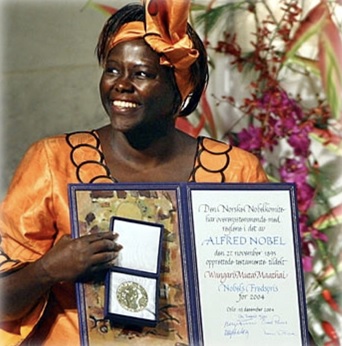
Nobel Committee, CC BY-SA 4.0 via Wikimedia Commons
Wangari Muta Maathai, globally acclaimed environmentalist, human rights campaigner, feminist, and 2004 Nobel Peace Prize recipient, was born in 1940 to a farming couple in a rural area of Nyeri, Central Province, Kenya, near wildlife-rich Mount Kenya. The young Maathai was already sensitive to the start of disturbing changes in the landscape she loved deeply: the replacement of small, eco-friendly farms and forests with commercial monoculture plantations, the drying up of clean, abundant water, soil erosion, the disappearance of familiar plants and animals. Over the past 150 years, possibly 75% of Kenya’s forest cover has been destroyed, first by Anglo colonialists, then wealthy plantation owners and the poor Kenyan farmers they have squeezed out and made desperate for fuel, arable land, food, and water.
In 1960, Maathai was awarded scholarships to study in the United States. She earned a B.S. and M.S. in biology (Mount Saint Scholastica College, 1964, and University of Pittsburgh, 1966, respectively). Her Ph.D. in anatomy (University of Nairobi, 1971) made her the first East African woman to achieve a doctorate. From 1973 to 1980, she directed the Kenyan Red Cross. In 1976, she was appointed chair of the Department of Veterinary Anatomy, University of Nairobi. During the late 1970s, as a leader of the National Council of Women of Kenya, she was deeply affected by the laments of rural women over the countryside’s accelerating degradation, which deprived them more and more of healthy diets, farming income, drinking water, firewood, shelter, and kinship with the living world and one another. In 1977, Maathai founded the Green Belt Movement (GBM), which has pioneered a home-grown approach to overcoming these threats against poor women and their families, and against the ecosystem at the same time: hiring the women to plant and nurture trees.

During the early 1980s, Maathai’s husband left her and their three children, Waweru, Wanjira, and Muta. A judge granted him a divorce on the grounds that she was “too educated, too strong, too successful, too stubborn and too hard to control.”2 Maathai told the judge that he was incompetent, and he sentenced her to a night in jail. She persisted as leader of the Green Belt Movement despite this and numerous other run-ins with Kenyan authorities, especially the heavy-handed, thoroughly corrupt regime of President Daniel arap Moi. Moi and his associates derided her as a “national menace” and an “un-African”—because outspoken and unsubmissive— woman. The nonviolent Maathai endured further arrests as well as death threats and injuries from beatings. Moi has since fallen from power, but the Green Belt women can now celebrate three decades of accomplishment.
Within Kenya, over 600 GBM community groups have planted over 30 million trees in both rural and urban settings, in the process schooling “ordinary” citizens, especially women, in political advocacy skills and inspiring parallel activism in other Two-Thirds World nations. Most recently the GBM has ventured into personal and community empowerment through sexual and reproductive health education in the facts and decision-making skills surrounding abstinence, voluntary family planning, and HIV/AIDS prevention.
Maathai continues to serve on GBM’s board, and those of the National Council of Women of Kenya, the United Nations Advisory Board on Disarmament, the Earth Charter Commission, Green Cross International, and the Women and Environment Development Organization, among others. In 2002, Moi’s abdication made free democratic elections possible, and Maathai resigned as GBM leader to run for office. From 2002 to the present, Maathai has served as Member of Parliament for her hometown district, and since 2003 as Kenya’s deputy environment minister.
The list of Maathai’s honors grows ever longer: the Goldman Environmental Prize (1991), the United Nations Environment Programme Global 500 Hall of Fame (1991), the UN Africa Leadership Prize (1991), the Jane Addams Leadership Award (1993), the Golden Ark Award (1994), the Kenyan Community Abroad’s Excellence Award (2001), the Republic of Kenya’s Eldership of the Burning Spear (2003), the Conservation Scientist Award (2004), the Petra Kelly Environmental Prize (2004), and the J. Sterling Morton Award of the National [U.S.] Arbor Day Foundation (2004), to name only some. In late 2004, Maathai was granted the Nobel Peace Prize, becoming the first African woman ever to achieve a Nobel of any kind. On hearing the news, Maathai planted a Nandi flame tree at the foot of Mount Kenya. She asked admirers around the world to celebrate this honoring of the GBM women and to “secure the future for our children” by planting trees also.
Maathai often says: “What we do to the Earth, we do to ourselves.” These words express her wisdom—drawn from both modern scientific and ancestral knowledge—about many issues, including abortion and its relationship to female disempowerment. The article below comes to us from Lifesitenews (www.lifesite.net), affiliated with Canada’s Campaign Life Coalition.
“Abortion Is Wrong,” Says Nobel Peace Prize Winner
by Lifesitenews (e-mail release, December 7, 2004)
OSLO, NORWAY—Kenyan Nobel Peace Prize winner, Mrs. Wangari Maathai, said “abortion is wrong” in a conversation with Norway’s Dagen newspaper reporter Jostein Sandsmark Tuesday. Professor Maathai is Kenya’s deputy minister of the environment.
“But I am trying to avoid condemning the victim,” she said, referring to the pregnant mother who seeks an abortion. She sees both mother and child as casualties: “Both are victims. There is no reason why anybody who has been conceived, shouldn’t be given the opportunity to be born and to live a happy life. The fact that a life like that is terminated, is wrong,” said Maathai.
“When we allow abortion, we are punishing the women—who must abort their children because their men have run away—and we are punishing the children whose life is terminated,” she continued. “But it is because we are not willing to put the men where they should be, and that is taking up the responsibility.”
“I want us to step back a little bit and say: Why is this woman and this child threatened? Why is this woman threatening to terminate this life? What do we need to do as a society? What are we not doing right now as a society? A part of that answer lies in this House,” Maathai said, pointing at the Kenyan Parliament building. While abortion is still illegal in Kenya, Maathai suggests going further— that the 1960s law making fathers financially responsible for any children they conceive be re-instated.
“That law was removed by men in this Parliament,” she emphasized. “Now I think we are too lenient on men. We have almost given them a license to father children and not worry about them. That is part of the reason why women abort, because they do not want to be burdened with children whose fathers do not want to become responsible.”
Maathai will be awarded the Nobel Prize in Oslo Friday for her involvement in fighting for the environment, human rights and women’s rights.
———————————————–
For more of our posts on environmentalism, see:
Stewardship and the Consistent Life Ethic
Climate Change and the Consistent Life Ethic: An Opportunity to Connect Issues
Lethal from the Start: Uranium Mining’s Danger to the Most Vulnerable
Threats to the Unborn Beyond Abortion

Mary Krane Derr
For more of our posts from Mary Krane Derr (d. 2012) see:
Elizabeth Cady Stanton (another excerpt from the same book)
Progressive Prolifers at the Progressive Magazine 100th Anniversary Celebration
Ancient Roots of the Consistent Life Ethic: Greece
Women’s History Month: Jane Addams