Mother in a Condition and Baby Inside
by Ms. Boomer-ang
When a pregnant woman has or develops certain medical conditions or suffers certain injuries, conventional attitudes too often dictate either she or the baby must die. Actually, treatments that spare the life of both the mother and the child exist, and these approaches should be pursued more frequently.
In addition, when treatment supposedly intended to save the baby results in the death of at least the mother, public voices often blame right-to-lifers. But actually, sometimes the treatment used could suit the pro-abortion viewpoint at least as much as the anti-abortion viewpoint, and the right-to-life treatment would have been very different than the approach used.
Angela Carder
One tragic example of this, leading to the death of both the mother and the baby occurred in Washington, DC, in 1987. As narrated by Jennifer Block, in the book Pushed:
28-year-old Angela Carder, after “fight[ing] off cancer since puberty…. believe[d] she [was] in remission and beg[an] a much-wanted pregnancy.” But at 25 weeks gestation, she had “severe symptoms,” checked into George Washington Hospital, and learned she had a malignant “inoperable lung tumor.” Carder and her family “wage[d] a battle for medical treatment to save her life.” They and “her doctors all agree[d] that they should do whatever they can to keep her alive.” And if she died anyway, they started to discuss the possibility of doing an emergency C-section to save the baby. (pp 254-255)
Then they found out that a judge had ordered Carder to get a Caesarean section immediately. A neonatologist, without first talking with Carder, her family, or her doctor, had gotten a lawyer to declare Carder “as good as dead.”
Carder’s doctor argued that the operation strain could hasten Carder’s death. Her obstetrician told her he would do the operation only if she consented. Though on a respirator, “she clearly mouthed to him, ‘I don’t want it done!’ ” A judge ordered the operation done anyway. Since all the obstetricians present refuse to do it, another surgeon did it.
Although many babies born at 26 weeks survive with neonatal care, Carder’s baby died in 2 hours. Carder died in two days.
Although elsewhere in her book, Block makes valuable points against the over-medicalization of childbirth, for Carder’s death she disappointingly blames claims that the doctors and lawyers considered the life of the baby more important than the life of the mother, because they had heard right-to-life talk too many times.
Actually, the 26-week caesarean could just as easily be the result of pro-abortion and duty-to-die attitudes. They delivered the baby so early its chances of surviving were low. And they proceeded as if Carder had already died and subjected her to an operation they knew could strain her into dying more quickly.
What action would have been taken if the priority had been the mother’s life? The baby’s life? Both of their lives? Conforming to the mistaken doctrine that at least one had to die? What about comparing each of these four directions to each other and to what was actually done?
When the priority is the mother’s life, there are actually several options. In case of cancer, x-rays, chemo, and sometimes surgery have the medical gold star. Other approaches include removing stresses, stopping discomforting medications, letting nature take its course, and/or trying alternate and medical luddite approaches. Was Carder’s condition so “bad” that the only reason to use gold star treatment was for doctors, family, and/or Carder to feel they were doing something? Could Carder have lived at least as long using other approaches?
None of the treatments, gold star or other, would have required removing the baby. From the save-the-mother standpoint, reasons given to remove the baby include: that pregnancy is a strain on the mother; that some treatments work unpredictably, or differently-than-standard on pregnant women; and that ‘dealing with a new baby will threaten the mother’s recovery.’
But the strain-on-the-mother reason must be weighed against the strain that the operation to remove the baby causes. With Carder, doctors admitted the strain of caesarean probably sped her death.
From the right-to-life position, the best course of action would have been the one that would maximize the chance of both the mother and the baby surviving and living as normally as possible.

Pregnancy Strain?
Unfortunately, Carder’s case is the only one I know about where the strain of the operation was admitted to the public. Usually the strain of pregnancy argument is used to perform abortions on injured women without their permission, especially if they have never had an abortion before, manifesting the attitude ‘how can one bypass an opportunity to bring this woman into the club of those who have had at least one child deliberately killed by good guys?’ But would Carder have lived any longer if, before lifting her baby out of her womb, they had strangled, stabbed, cut it up, or sucked out its brain?
In addition, as much as pregnancy puts a strain on the woman, the baby inside her sometimes helps her. A woman “who suffered kidney failure for 22 years was kept alive during her pregnancy by her unborn child, whose kidneys” cleaned her “blood as well as his own . . . This shows [that] . . . the welfare of a mother and her unborn child are . . . intertwined. They contribute to each other’s health. When we help one, we help both; [and] if we hurt one, we hurt both.”
Furthermore, pregnant women have undergone gold star medical treatments and survived, while their baby was born alive. Even with cancer of reproductive organs.
And when baby must come out, would inducing labor and seeing how it progresses really put more strain on the mother than a Caesarean? Moreover, though it is “hard” to handle a new baby at the same time as undergoing treatment or recovery for an illness or injury, (especially without non-resentful help), cannot the joy of watching one’s new child help the recovery?
The Baby
When the priority is the baby’s life, the best thing is to keep it in the mother. Doctors have said that each week more inside the mother means more than a week less in the NICU.
Until labor starts naturally, the best incubator for a human baby is the mother’s body.
During this time, probably the best for the baby is for the mother to take as little medicine as possible. Some non-gold-star care for the mother is better than most gold-star protocols for the baby inside.
However, aggressive gold-star treatment need not be ruled out, because babies have survived it with no obvious damage. In fact, between 1973 and 2003, Dr. Agustin Avilés in Mexico City treated 84 pregnant cancer patients with chemotherapy, and all their babies survived – only 5.8% with birth defects. In a follow up study on 43 of these children, when they were between 3 and 19, “all had normal physical . . . and psychological development.” They “did fine in school.”
So one can weigh the benefits of staying in the womb with the benefits of moving into a medical incubator to avoid the risks of x-rays, chemo, anesthesia, and maintenance medicine.
Of course, if the mother becomes so close to dying her organs are in pre-death shut down, then the baby must be gotten out.
Block and others accuse too much attention to putting-baby-ahead-of-mother ideas for Carder’s treatment. But actually, if the priority had been for putting the baby first, they would have kept it inside, and kept treatments and care to things least likely to harm the baby. At least they would have kept the baby in until 28-weeks gestation, after which the survival chances for premature babies is considered good.
In 1997, Dr. Elyse Cardonick, a perinatoligist, faced a pregnant patient with Hodgkin’s disease who ‘was afraid not to be treated for cancer, but [also] . . . afraid to expose her fetus to drugs,’ and did not want the recommended abortion. Dr. Cardonick did research, found out about Dr. Aviles’ work, and successfully argued to her hospital ethics panel that, “It’s not a choice between you and your baby; we can take care of you both.” As a result, “her patient gave birth to a healthy child.”
Assumptions
Obstacles to maintaining the lives of both the mother and the baby include two unfortunate assumptions that are so widespread that even some right-to-lifers cannot avoid falling for them.
One is that pregnancy and childbirth are or ought to be the most dangerous and suffering-causing thing that can happen to a woman. The other is that in some circumstances somebody must die to give the other a chance of surviving.
One can note that to find cases where a pregnant woman was treated for cancer and her baby survived, a US doctor had to look at results from Mexico. At that time, abortion was illegal in Mexico. As killing babies becomes part of medicine in more countries, will fewer places be willing or even allowed to try save-both treatments?
How can the aim of both the mother and the baby coming through the situation alive be restored to medical attitudes? Bringing up some examples in the references would not hurt. But that might not be enough. What else can be done?
Even when a pregnant woman is injured or ill, the goal should be for both the mother and the baby to survive. Some cases show that this is possible, sometimes with both living normally ever after. A challenge is to publicize and remind people of these cases and to convince courts, policy makers, and medical people to allow and encourage trying to repeat or improve their results.
==================
For another post on this topic, see:
Creating a Loophole on the Life of the Mother Exception
For more posts from Ms. Boomer-ang, see:
“Shut Up and Enjoy it!”: Abortion Promoters who Sexually Pressure Women
Asking Questions about Miscarriage and Abortion
The Danger of Coerced Euthanasia: Questions to Ask
Conviction When Real Guilt is Irrelevant
The complete list is on the Author Page with authors listed alphabetically.’
Abortion and Rape: What Does the Research Say?
by Sarah Terzo
This article originally appeared on Sarah Terzo’s Substack. You can read more of her articles here. Sarah is a member of the Board of Directors of the Consistent Life Network.
Rape is a horrific crime and a terrible act of injustice. A person who is sexually violated suffers a lifelong trauma.
Pregnancies through rape are statistically rare. Most women can only become pregnant 2-3 days out of every month, around ovulation, so the assault would have to happen during that fertile time. Also, many are on long-acting hormonal birth control that would prevent pregnancy.
But pregnancies through rape do occur. And they understandably cause great upheaval in the victim’s life and the lives of those around her. But do rape victims really benefit from abortion?
Many people believe that a pregnant rape victim would automatically want an abortion. They think that having a baby conceived in rape would add to the victim’s trauma. The child, they say, will be a constant reminder of the rape. And how could a mother possibly love a baby conceived in such a violent, traumatic way?
The belief is that an abortion in these cases is compassionate because pregnancy as a result of rape will destroy a person’s life.
Research on Abortion and Rape
Surprisingly little research has been done on the psychological outcomes and aftermath of rape pregnancies. Even less has been done comparing the psychological sequelae of abortion with those of giving birth.
In fact, I’m only aware of three studies that have ever been done on the issue. A set of two studies by a researcher named Dr. Sandra Mahkorn2 was published in 1979 and 1981.
And then there was a survey conducted by David Reardon, Amy Sobie, and Julie Makimaa, herself a birth mother through rape, in their book Victims and Victors, which compiles the testimonies of women who became pregnant after rape and either aborted or had their children. It is the only book collecting such stories that I know of. It was published in 2000.
The results of these two research projects may surprise you.
Most Rape Victims Chose Life
For one thing, all three studies found that a large majority of rape victims rejected the option of abortion and chose to have their children and either raise them or make adoption plans.
David Reardon, Amy Sobie, and Julie Makimaa1 found that 73% of pregnant rape victims chose life. Sixty-four percent raised their children, and 36% placed their babies for adoption. Sandra Mahkorn2 found similar results – 75% of the women in her studies decided against abortion.
It should be noted that during the time these studies took place, abortion was legal in every state. Mahkorn’s studies were published before the court case Planned Parenthood v. Casey, which made it possible for states to enact pro-life laws such as waiting periods, parental notification, and informed consent. There were, then, almost no restrictions on abortion in place at the time of the studies.
When all three studies were conducted, abortion was legal at least up to viability in all 50 states. So, one cannot say these women were unable to choose abortion because of legal barriers. They weren’t prevented from having abortions – they chose to have their babies.
Why Did the Women Choose Life?
So why did they reject abortion? Mahkorn gave the following reasons:
Beliefs that abortion involves violence, killing, or was immoral were the reasons most frequently reported for clients’ decisions against abortion. Client viewpoints such as abortion is a “violent way of ending a human life,” or abortion is “killing” were noted.
Others expressed the belief in an intrinsic meaning to human life, reflected in opinions such as “all life has meaning” or “this child can bring love and happiness into someone’s life.” One pregnant victim related that she felt she would suffer more mental anguish by taking the life of the child.2
Reardon and his co-authors also wrote about the reasons why more women in their study did not abort:
First, approximately 70% of all women believe abortion is immoral, although many may also feel it should be a legal choice for others. Approximately the same percentage of pregnant rape victims believe abortion would be a further act of violence…
Second, many of these women believe that their children’s lives may have some intrinsic meaning or purpose which they do not yet understand . . .
Third, victims of assault often become introspective. Their sense of the value of life and respect for others is heightened. Since they have been victimized, the thought that they in turn might victimize their own innocent children through abortion is repulsive.
Fourth, the victim may sense, at least at a subconscious level, that if she can get through the pregnancy, she will have conquered the rape
. . . Giving birth, especially when conception was not desired, is a totally selfless act, a generous act, a display of courage, strength, and honor. It is proof that she is better than the rapist . . . While he destroyed, she can nurture.1
So right off the bat, we see that the assumption that all people who become pregnant because of rape want to have abortions is false. In both these studies, it was not the chosen answer for most of the women.

Giving Birth vs. Abortion
But what about the emotional aftereffects? Did those who carried their pregnancies to term suffer further trauma?
Mahkorn interviewed therapists who worked with rape survivors. She had them measure qualities such as self-esteem, anxiety, fear, satisfaction with present life situation, loneliness, depression, and contentedness. The therapists were asked to rate the intensity of these feelings.
A measurement was done when a woman first contacted the counselor and then later in therapy.
Mahkorn found that, across the board, the women who gave birth scored better in the later evaluations. They showed improvements in positive traits and decreases in negative ones. This indicated that the women were healing and adjusting. According to Mahkorn:
[This study illustrates] that pregnancy need not impede the victim’s resolution of the trauma . . . rather, with loving support, nonjudgmental attitudes, and emphatic communication, healthy emotional and psychological responses are possible despite the added burden of pregnancy.2
The Reardon survey took a slightly different approach. Rather than asking a third party about the women’s adjustment, surveys were sent out to the women themselves. They were asked whether they regretted their choice and how they felt about it now.
According to the answers, 88% of women who had abortions regretted them and felt they had made the wrong decision. Out of the remaining 12%, just one woman expressed only positive feelings about her abortion and was sure it was the right choice.
The remaining women were ambivalent, feeling they may have made the right decision but acknowledging that the abortion was traumatic for them. They said things like, “It bothers me a lot, but maybe it was for the best.”1
The responses of the women who had their babies stand in strong contrast to those who aborted.
Of those who carried to term, none regretted having their baby or wished they had aborted instead. Over 80% explicitly expressed happiness about their child and their situation. Only one woman expressed any regret, and that was about her choice regarding adoption – she was glad she had her baby. All of them were.
Pressure to Abort
In addition, 43% said that they felt pressured to choose abortion by their family and/or by abortion workers. Family members were deeply uncomfortable with their pregnancies and weren’t supportive about continuing them.
Rape victims do not need reminders that they were raped. The trauma is with them every moment of every day – they will not forget, no matter what happens to the baby.
Often, instead, the pregnancy is a reminder to those around the woman – her family and friends – that she has been raped, and this reminder makes them very uncomfortable. A lot of people cannot understand why a woman would want to continue a pregnancy associated with rape.
They believe abortion will help her “get over” the rape, and that once the pregnancy (the outward sign) is gone, things can return to normal. In reality, it can take many years to come to terms with trauma from sexual assault, and most people are never the same afterwards – the trauma doesn’t disappear if the pregnancy “goes away.”
People’s discomfort and their assumptions can manifest as considerable pressure on the rape victim to conform to what those around her (and the greater society) find acceptable, and “choose” abortion.
Abortion as a “Solution” to Rape?
What about their opinions about what other women should do in the same circumstances? Ninety-three percent of the rape victims who aborted said they would not recommend abortion to someone else who was pregnant due to rape. Only 7% felt that abortion could be a good solution in cases of rape.
Ninety-three percent of the women who had abortions, then, would encourage other rape victims not to make the same choice they did.
Of the women who gave birth, 94% said that abortion wasn’t a good answer to a pregnancy conceived in rape. Of the 82 women in the survey who chose to have their babies, only four said that abortion “might” be a good solution in some cases – even though it wasn’t in theirs. The rest said that abortion would never be the right choice for someone who was raped.
This survey by David Reardon and his colleagues is 25 years old. The Mahkorn studies are even older. It would be good if more studies were conducted. But even though the research is older, it challenges the common assumptions about rape and pregnancy.
According to this research, abortion after rape doesn’t help a rape survivor heal. It only robs an innocent child of life and further traumatizes the victim.
Sources
- David C Reardon, Julie Makimaa, and Amy Sobie. Victims and Victors: Speaking out about Their Pregnancies, Abortions, and Children Resulting from Sexual Assault (Springfield, Illinois: Acorn Books, 2000)
- Sandra Kathleen Mahkorn, MD, and William V Dolan, MD. “Sexual Assault in Pregnancy,” Thomas Hilgers, Dennis Horan, and David Mall, Eds. New Perspectives on Human Abortion (Frederick, Maryland: University Publications of America, 1981); Sandra Kathleen Mahkorn, “Pregnancy and Sexual Assault,” David Mall and Walter Watts, Eds. The Psychological Aspects of Abortion (Washington, DC: University Publications of America, 1979)
====================================
For more of our coverage on abortion and rape, see:
Abortion When it Involves a Rape: See the Faces
Abortion Facilitates Sex Abuse: Documentation
The Message of “Never Rarely Sometimes Always”: Abortion Gets Sexual Predators Off the Hook
How Abortion is Useful for Rape Culture
A Pro-Life Feminist Critique of the “Rape and Incest Exception”
Painful and Disorienting: The Shooter of Two National Guard Members
by Brian Carroll

Department of Justice photo of Rahmanullah Lakanwal
I don’t believe that Rahmanullah Lakanwal drove from Washington state to Washington DC, and then to within two blocks of the White House, only to fire on two young members of the West Virginia National Guard.
I do think the accusations about who did or didn’t vet Lakanwal miss the point completely. Both the Biden and Trump administrations had vetted the shooter. The Biden vetting occurred during the collapse of Kabul. There was a bipartisan race to save the Afghans who had served with US forces. We all understood that our partners and employees would be tortured and slaughtered by the incoming Taliban. Indeed, that was the sad fate of those we failed to get out.
Last year the Trump Administration again vetted Lakanwal, before granting him asylum. Even earlier, I assume the CIA vetted Lakanwal before hiring him at age 15 or 16 for their ‘Zero Unit.’ As much as partisans on each side want to lay blame, nobody scores any points over the vetting.
Vetting can never serve as a crystal ball. Vetting can spot bad associations and poor habits, but identifying the person who is six months away from cracking is only slightly more likely than RFK, Jr. being able to read someone’s mitochondria as they hurry through an airport.
I haven’t spoken with him and don’t know Lakanwal’s mindset, but I do have observations from my own experience.
By definition, a refugee is going to experience great psychological stress. This does not in any way excuse the man or lessen the evil of his crime, but it can reduce some of the silliness that we have seen in response. A refugee or asylum seeker has suffered trauma, lost everything familiar, and arrived in a strange place and culture. I have neighbors who have never been outside of California’s San Joaquin Valley, or maybe as far as Pismo Beach. Many Americans have never experienced culture shock or the trauma of forced relocation.
The closest I can compare came in 1995, when I evacuated from Colombia during their civil war. I had been teaching school at a Bible translation center. Then in short order I lost a lakeside house and garden I loved, the most rewarding job I will ever have, and the kind of close circle of friends that can only develop in a tight community that exists as an island in a foreign country. At the same time, my eldest kids left for college and my father-in-law died. I’m a pretty resilient and optimistic guy, but I responded with about five years of depression. And yet, for me, I was returning to the state where I was raised. I came back to family and friends. I owned a house that I’d rented out while I was gone, I spoke the language, and I held valid professional credentials. I hate to even imagine the experience of arriving without any of that.
The Biden Administration set up Services to Afghan Survivors Impacted by Combat (SASIC), a program that provided job placement, medical, psychological, and social work help to arriving Afghans. A family member of mine worked in this briefly and recalls the frustration over trying to find a trauma therapist who spoke either Pashto or Dari, the most common languages in Afghanistan.
However, soon after taking office, President Trump suspended federal funding for refugee resettlement agencies. This halted several kinds of help to those already in the US and stranded nearly 1,660 Afghans in intermediate countries, even though they had had already been approved for entry into the US. A portion of the 1,660 are family members of US military personnel or have a family relationship with Afghans already in the US. Trump eliminated the Coordinator for Afghan Relocation Efforts (CARE) office, the Enduring Welcome program, and the Temporary Protected Status (TPS) of thousands of Afghans. They could now be deported for no violations of law.
The Zero Unit, in which Lakanwal had served for about a decade, used Afghans to do the dirty jobs that Americans didn’t want to get caught doing (read: extrajudicial killings). Lakanwal’s friends have reported that memories from this work had left him with emotional distress.
I can imagine. I have a friend who served the US military by training soldiers from Central America to, as he was told, ‘Save Democracy.’ Later, he discovered that he had been training death squads. His whole outlook on life changed, as he channeled his feelings of guilt and betrayal into anti-war activism. Lakanwal’s experience would be even more painful and disorienting.
Rules to live by:
Never double-cross the assassins you have trained yourself.
And: Overseas wars never stay overseas. We always bring them home with us.
I don’t believe Lakanwal held any grudges against either of his victims, nor even against the National Guard. His grudge was against — primarily — his experience in Afghanistan while he served with the CIA, and secondarily, against the treatment that Afghans have suffered since his arrival in the US. I suspect he drove across the country hoping to gain access to the White House and the President.
Our Egocentrist-in-Chief was asked whether he would attend the memorial service for Specialist Sarah Beckstrom. Trump responded that he hadn’t thought about it, but then quickly pivoted to how much West Virginia loves him, and how that state voted strongly for him in 2024. Like all of the National Guard personnel in Washington, young Sarah served only as an expendable prop in Trump’s political drama. She was in uniform and took a bullet for Trump, but he didn’t think to order flags to be set to half staff.
Trump also promised to “permanently pause migration” from “third world countries,” and to “end all federal benefits and subsidies to non-citizens.”

In the larger picture, U.S. Army Specialist Sarah Beckstrom and Air Force Staff Sgt. Andrew Wolfe should have been home celebrating Thanksgiving with their families. Soldiers are not trained for police work, and US District Judge Jia M. Cobb had already declared that Trump’s National Guard deployment in DC was unlawful.
Crime could better have been addressed by restoring funds to the police budget.
Funds for the DC police force had been reduced through several Trump/GOP actions. A cut to FEMA’s Urban Area Security Initiative left the city about $20 million below 2024 payments. The termination of DOJ grants made it less likely that DC could have qualified for a share. During Congressional Budget Freezes in past years, DC has been granted an exemption, but not this year. The hit might have meant $1.1 billion for the city. During their stay in the city, National Guard personnel were put to tasks filling in for furloughed city workers, doing park upkeep and such. Less expensive for the government. However, recall that these are people who were pulled away from their families and from regular civilian employment.
Sarah Beckstrom’s former boyfriend reported her describing the National Guard assignment in Washington, D.C. as “pointless.”
Beckstrom and Wolfe were chosen at random as targets. Any of the many National Guard members could have been at hand when Lakanwal began shooting. He did not know either one of them. I think he was shooting, instead, at something — or somebody — they represented. Arguing about how or by whom he was vetted misses the point.
============================
For more of our posts on perpetrators being traumatized, see:
PITS and Operation Southern Spear
“I Became Like a Soldier Going to Battle”: Post-Abortion Trauma
Healing for the Perpetrators: The Psychological Damage from Different Types of Killing
and see the website:
Reflections on Hanukkah
by Rachel MacNair
For several years now, during the eight days of Hanukkah, I have a hanukkiah (like a menorah, only eight branches instead of six because it’s eight days). I do the ceremony of lighting one candle the first night, two the second night, and so on. I’m a Christian rather than a Jew, so I’m not properly putting it in the window. But I’m a Quaker, and doing a meditation while spending 30-45 minutes watching candles burn down is right up my alley. So having some reflections on the Hanukkah miracle is something I’ve done more of because of this.

The Miracle
The miracle of Hanukkah is that when the Jews got back the Temple after having driven away their Greek conquerors in 168 BCE, they found they only had enough consecrated oil for one day. It would take many days to properly consecrate some more. But lo and behold, that one day’s worth lasted a full eight days!
Part of the miracle is that the oil lasted so long – a rather mundane miracle, as miracles go – but part of the importance of it is that they did search for the oil and tried to light it at all. They could have been discouraged, thinking the Temple was so badly defiled that there wasn’t really anything they could do to fix it. But they tried to fix it, and in their own terms, they succeeded. Had they remained discouraged, history would have turned out much differently.
So what really happened? Was it a miracle? Was it a natural good shepherding of the oil that later grew into a miracle in the re-telling? Was it actually a group vision? Was it totally made up?
I don’t think it matters. What we do know for sure, and what matters, is that it was a story that got written down around 50 years after the event and got into the Babylonian Talmud a couple of centuries later. It’s been believed by large numbers of people throughout the centuries and still found inspiring to this day.
Under the name of the festival of dedication, what we now call Hanukkah was apparently observed during the time of Jesus inasmuch as it’s mentioned in the Gospel of John 10:22, celebrated in Jerusalem during the winter. The dedication of the Temple was the named focus, not the military victory.
But we do have to face the part of the holiday that’s hardest for consistent-lifers to take: that re-taking of the temple involved a vicious war. It was impressive that such a small number of ill-equipped people were able to pull it off against such a large and well-trained army, to the point that some think of that military victory as another miracle. See the deuterocanonical books of First and Second Maccabees, which glorify the war.
There’s some thought that the rabbis and proto-rabbis (that is, Pharisees) came up with or emphasized the miracle story at a time when Maccabean-inspired aggressiveness could – and did – lead to dire consequences with the Roman conquerors’ abilities to squelch violent dissent. Focusing on this story became a way of emphasizing a nonviolent aspect of the events.
But those of us who decry the normal dynamics of war also take note. What followed the war is what very often follows wars to liberate from brutal oppressors. The monarchy thereby established became brutal oppressors. Intensely.
This was the Hasmonean dynasty of Jewish kings, which involved one astonishing cruel event after another. One king had his own mother imprisoned and starved to death (Judah Aristobulus, r. 104-103 BCE). One king (Alexander Yannai, r. 103 to 76 BCE) had a group of 800 people, primarily Pharisees, crucified. Their wives and children had their throats cut in front of them while they died.
Deadly intrigue followed down that royal line until it fell apart by being conquered by the Romans in 63 BCE. Its corruption was involved in the dynamics of why the Romans were able to do that.
So this is one of the thoughts that occurred to me while candle-watching: the story of the miracle was not only a more nonviolent aspect to focus on. It was needed to help Judaism continue.
The Pharisees later essentially became the rabbis and thereby survived the destruction of the Temple in 70 CE when Sadducees and monarchs didn’t. They and other devout and sincere Jews would have been badly discouraged if they had simply gone from a war that chased off the Greeks to a kingly line that was one scandal after another. With kings that got them tortured to death.
The story of the miracle wasn’t just some nice fairy tale. It was a way of expressing their understanding that God remembered them and was still with them – they hadn’t been abandoned.

That was a point that really, really needed to be made to them at that particular time. They needed it to sustain them though all the cruelty that the aftermath of war usually generates – to sustain them in a belief system that values all life and obstinately refuses to worship violent gods that approve of violence, as was customary in the influential cultures around them.
Views from Art on Perseverance
I’d like to share an artistic approach by two Jewish singing groups who are playful about the themes of gaining freedom from the Greek oppressors, using take-offs on a medley of songs from musicals. To select one of the many for each: Six13 in West Side Story and the Maccabeats in Hamilton.
Also, a music video I saw years ago and can’t find again is a beautiful version of the positive side of the story – that is, resisting bullies – told all with a Hanukkah song in the background. A high school boy is confronted by other high school boys with Greek letters on their baseball caps. In case that’s too subtle for you, they also have the word “bully” emblazoned on their backs. He’s cowed at first, but then goes to sing with his group that Hanukkah song. He gets some backbone, puts on his yarmulka and goes back to stand up to the bullies – in an admirably nonviolent manner, walking right through them, leaving them confused.
Not Jewish in origin, but a well-known Hanukkah song that focuses on the aspect of “let justice and freedom prevail” and adds “the peacemakers’ time is at hand” was written in 1982 by Peter Yarrow of Peter, Paul, and Mary: Light One Candle.
Australia
The above was all written in preparation for the holiday, but I awoke on Sunday, December 14 to the horrifying news of the mass shooting targeting Jews celebrating Hanukkah at Bondi Beach in Sydney, Australia. While the Seleucid empire is long gone, the targeting of Jewish practices, and lethal targeting of Jewish people that goes with it, is still current.
As Rabbi Jonathan Sacks explains, rather than being about re-dedicating the later-destroyed physical building, the story of Hanukkah became about re-dedicating the living embodiments of Judaism – rather than a military victory, a spiritual and civilizational one. Education marches on, and the cultural victory has lasted millennia.

That cultural victory is alive and well. Millions of Jews all over the world will be lighting those candles and commemorating their resilience in the face of bigoted violence. Many non-Jews will light the candles as well, including participation in public events.
A final point: back at the time of the Maccabean story, Jews were pretty well on their own as far as other people in the vicinity were concerned, and the official government was the problem. Nowadays, the official government did its job in protecting people where it could, and is expected to charge the surviving gunman. There’s been an outpouring of condemnation of the crime all over the world, and an outpouring of individuals giving aid. Jews aren’t on their own – as the Australian prime minister Anthony Albanese put it: “An attack on Jewish Australians is an attack on every Australian.”
==================
This is a list of holiday editions of our weekly e-newsletter, Peace & Life Connections.
In 2024, Christmas carols with backgrounds that have a connection to consistent life issues were explained. (Also the same content in a 2024 post)
In 2023, we covered Kwanzaa.
In 2022, the topic was the Christmas Truce of 1914, when World War I soldiers up and down the line treated each other as friends rather than enemies for the holidays. (Also the same content in a 2022 post.)
In 2021, there was a somber topic, but one appropriate to the season: the Massacre of the Innocents, and its role in quotations and art that oppose massive violence of all kinds. (Also the same content in a 2021 post.)
In 2020, given what was most on people’s minds at the time, we covered Pandemics Related to Christmas. (Also the same content in a 2020 post.)
In 2019, we showed Christmas as a Nonviolent Alternative to Imperialism.
In 2018, we detailed Strong Women against Violence – Connected to the Holidays.
In 2017, we covered Interfaith Peace in the Womb.
In 2016, we discussed how “The Magi were Zoroastrians” and detailed how good the Zoroastrians were on consistent-life issues. The ancient roots of the consistent life ethic run deep!
In 2015, we had a list of good holiday movies with consistent-life themes – check it out for what you might want to see this season. We also had information on Muslim nonviolent perspectives.
In 2014, we offered a quotation from a lesser-known Christmas novella of Charles Dickens and cited the treatment of abortion in the Zoroastrian scriptures.
In 2013, we shared several quotations reflecting on Christmas.
In 2012, we had a couple of quotes showing the pro-life aspects of two prominent Christmas tales: A Christmas Carol with Ebenezer Scrooge, and the movie It’s a Wonderful Life. We also quote from John Dear about Jesus as peacemaker and Rand Paul about the 1914 spontaneous Christmas Truce; he then related it to the culture of life.
In 2011, we covered the materialism-reducing “Advent Conspiracy” and offered two pieces of children’s art: a 1939 anti-war cartoon called “Peace on Earth,” and the anti-war origins of “Horton Hears a Who,” whose tagline – “a person’s a person, no matter how small” – is irresistible to pro-lifers.
In 2010, we showed “It’s a Wonderful Movement” by using the theme of what would happen if the peace movement and the pro-life movement hadn’t arisen. We also had quotes from Scrooge (against respect for life) and a Martin Luther King Christmas sermon.
PITS and Operation Southern Spear
by Christy Yao Pellicioni
As I was sitting down to write on this very subject, I got an alert on my phone from CNN saying four more people were killed by the US striking vessels allegedly carrying drugs. I went to open the news outlet’s main website on my computer, and that news story did not even have top billing. Instead, this article flashed on my screen, describing what an admiral told lawmakers about a September 2 strike on a vessel allegedly carrying cocaine from Venezuela.
After this boat was originally struck and capsized, two survivors were identified. Military officials originally claimed that a second strike in this attack was justified since a radio was seen with the two survivors after their boat capsized. The second strike, they said, was to prevent any communication calling for an attack on the US vessel.
Thursday, December 4, however, Admiral Frank “Mitch” Bradley, who ordered the second strike, admitted there was no radio, giving credence to the claim that the second strike was in fact a war crime, as it is a war crime to kill shipwrecked people. After a video of the attack was shown during the Thursday briefings, there was debate on how desperate the survivors were and their intent following the attack.

This is just the latest twist in Operation Southern Spear, which has been going on since early September. The alleged goal of this operation is to stop illegal drugs from flowing into the US, but the legal murkiness and questionable effectiveness of the operation has made some question that, wondering if the US is trying to overthrow the socialist left-wing Venezuelan government. It is feared that this will escalate into a greater international conflict.
A USA Today opinion piece from Retired Commander Dave Petri, a former Navy Surface Warfare Officer and communications director for National Security Leaders for America, and William Bombgartner, former commander of the 7th (Southeast) Coast Guard District and the military’s former judge advocate general and chief counsel, gives solid arguments against the attacks.
What struck me is the argument that this disrespected the men and women in uniform asked to carry out these attacks. This reminded me a lot of Consistent Life Network Vice President Dr. Rachel MacNair’s theory of “Perpetration-Induced Traumatic Stress,” also called “Participation-Induced Traumatic Stress” (PITS). PITS is a subset of the more commonly known PTSD (Post-Traumatic Stress Disorder). It occurs when the perpetrator of the violence experiences PTSD.
 Dr. MacNair’s book Perpetration-Induced Traumatic Stress: The Psychological Consequences of Killing describes how veterans are often among the largest groups of those who suffer from PITS. The more horrific the killing, the more likely the veteran is to suffer. Killing men who are already shipwrecked sounds like a pretty horrific killing.
The book discusses perhaps the most infamous war crime perpetrators in modern history, the Nazis. Not only did the Nazis suffer from PITS, Dr. MacNair poses the theory that the origins of the Nazis lie in PITS as well. Many of the Nazi leaders’ attitudes about violence and killing were shaped during World War I, where it was thought the best treatment of those who suffer from PTSD were to send them back into battle.
I think I can safely speak for the vast majority of Americans when we say that we do not want to be thought of as committing injustices similar to those of World War I and II era Germany. Even many with favorable views of the military don’t want its members to commit inhumane war crimes. Getting illegal drugs off the street is a noble goal, but we cannot use unethical means to accomplish this.
Of course, from a Consistent Life Ethic perspective, we would like to see the drug flow problem tackled without any violence at all. The lives of others are not more expendable because they are not American or work on a vessel used to transport drugs (even if there were evidence that that’s what they were doing). One’s place of birth or the ethics of their occupation do not determine the value of one’s life.
=========================================
Addendum: Rachel MacNair compiled these recent quotes from media commentators:
David Brooks, PBS Newshour, December 5, 2025
I think what appalls me most of all about it is what they’re posting, both Trump and Hegseth, on social media. You look at the pictures of Abraham Lincoln at the end of the Civil War. You look at the pictures of Franklin Roosevelt at the end of World War II. The burden of sending human beings into battle and causing death and suffering on both sides was something they bore with incredible heaviness. And Hegseth treats it like it’s a video game. And it’s just like a — it’s just morally offensive.
Phil Klay (Marine Corps veteran of the Iraq war)
What Trump Is Really Doing With His Boat Strikes
The New York Times, December 5, 2025
In lieu of careful analysis of the campaign’s legality, detailed rationales for the boat strikes and explanations of why they couldn’t be done with more traditional methods, we get Mr. Hegseth posting an image of himself with laser eyes and video after video of alleged drug traffickers being killed. The cartoon turtle is just one example in an avalanche of juvenile public messaging about those we kill. I suspect the question the administration cares about is not “is this legal,” “is this a war crime,” “is this murder” or even “is this good for America,” but rather, “isn’t this violence delightful?” . . .
The Trump administration’s celebration of death brings us far from discussions of the law of armed conflict, the constitutionality of the strikes or even the Christian morality that would eventually push Augustine to formulate an early version of just-war theory. We’re in the Colosseum, one brought to us digitally so that we need not leave our homes to hear the cheers of the crowd, to watch the killing done for our entertainment and suffer the same harm that injured Alypius more than 1,600 years ago.
David French
Pete Hegseth Is Doing Something Even Worse Than Breaking the Law
The New York Times, December 4, 2025
In fact, when I first read the Washington Post story, I thought of the terrified pair, struggling helplessly in the water before the next missile ended their lives. But I also thought of the men or women who fired those missiles. How does their conscience speak to them now? How will it speak to them in 10 years?
===========================
Our list of all blog posts has an extensive list of similar analyses under the heading “War Policy.”
Another post that involves Pete Hegseth is: Signal Chat: The Media Misses the Actual Scandals
Political Passing in Washington, DC
by Rosalyn Mitchell
What does it mean to pass politically in Washington, DC? To walk through the historical suburbs and think, “Wow, the lights hit in a certain way, the fall leaves against the colonial red brick. How serene.” To me, it felt surreal. Is this America, detached from the strain of data, the crisis on our TVs, phones, apps, the longest government shutdown in United States history?
To hold a consistent life ethic is to master the art of political passing, defying the left-right spectrum. I can speak the language of conservatism to a Christian pro-lifer. I can speak the language of socialism to an anti-war activist. I become a translator between left and right ideologues; everybody thinks I agree with them, even when I don’t. To the liberal, I become a liberal; to the conservative, I become a conservative. The stories of the people I know and the experiences I have witnessed would not be believable to people who are not able to politically pass.
Dena Espenscheid from the Leadership Institute said,
Your intuition is shaped by your education and your experiences.
The Leadership Institute, associated with Project 2025, hosted the Rehumanize Conference. Abe Bonowitz, from Death Penalty Action, lifted the veil. He directly addressed Project 2025. He noticed the vague language on the death penalty. What if the authors are politically passing? Do they hold a skepticism of the death penalty? Project 2025 advised leaving the death penalty to legislative bodies. What else are the authors politically passing on? Do they dissent privately on other issues? The price of political passing is to suppress at least some of one’s true beliefs.
I felt an echo chamber, the unspoken assumption that everyone in the pro-life movement is politically and religiously conservative. Amongst pro-lifers, the community forms a bubble of uniformity.
Similarly, organizing in anti-war communities is to pass in a bubble dominated by liberal and progressive orthodoxy. Everyone assumes everyone else must think and act like them, too. If someone like me opposes abortion and war on the principle of non-violence, one feels the weight of political passing as moving between two orbits.
I think about Christina Bennett’s presentation as a black pro-life woman at the Rehumanize conference. She shared her experience working for Live Action, a coloured voice amongst a dominant white narrative. She herself is conservative and sees this racial gap. Christina knows what it would take to be popular. To say the right things, to be a token. I think the irony is that conservatism values community, which should mean not selling out, not intentionally race-baiting for your own success.
If I wanted to pass in a progressive way, I could say that all pro-life people are bigoted, Trump-supporting racists who hate women. I could easily pass with the same success that earns people the nickname Uncle Tom for being the token black voice in a white conservative narrative. I know that taking positions on life issues is not the same as being born with a certain skin colour. I understand that I am not physically passing.
I am politically passing.
I walked from the Rosslyn, in the suburbs of Arlington, my hotel named after me, to the DC Metro: the harsh mechanical glare, steep elevators, and brutalist bricks screamed modernity. I swear, in a town that decries communism, I felt the bureaucratic weight of the Soviet Union. I visited the Pentagon, specifically the metro station: the war machine beneath my feet churning underground. I spoke at the White House across from Lafayette Square for peace and life for nonviolence against abortion and nuclear weapons, all while passing minutes earlier as an anonymous person riding the DC Metro.

Washington DC Metro
I turned surveillance upon the surveyors, watching Big Brother watching me, as I walked the streets of Washington, DC. Nobody watched me except for the cameras (thank you, Palantir). I observed a well-dressed woman with her child. I passed the academies where the elites, the politicians and diplomats, educate their children behind ivy bricks. The Historic Episcopal Saint Alban’s and the Catholic Cathedral. I thought about the cameras watching me. How I watched them passing through the streets of DC. How does one pass in a crisis? When you can walk in tranquility, suspending your disbelief.

One Pristine Walk through DC
Passing through the pristine neighbourhood of Washington, DC, the NO Kings posters reminded me of the fragility of the bubble of elite control. To feel virtuous while enabling the problem, to fear reality. They do not have to live with the consequences safe from the war. The politicians feel like they’re doing something, political passing in Washington, DC.
I saw a poster of the face of Martin Luther King Jr., advertising a documentary on Civil Rights, playing at the Ford’s Theatre. Honouring American history in the US capital is not unusual. What was unusual was the war machine honouring a man murdered for peace. This is what I observed in Washington, DC, while politically passing through picturesque spaces and faces. Walking down a pristine street, observing the serene knowing that internally, the culture is burning.
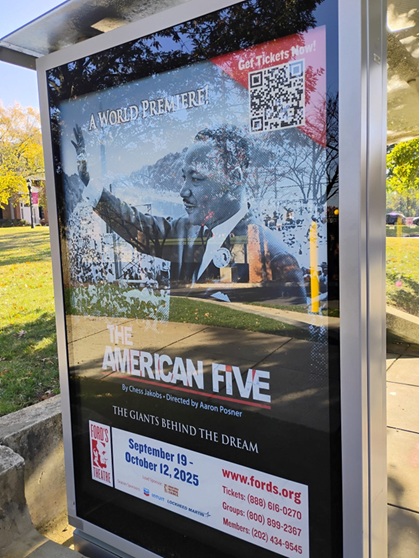
MLK JR (Sponsored by Lockheed Martin)
Do you watch your surroundings too?
==============================
For more of our posts from Rosalyn Mitchell, see:
For more of our posts on a similar topic, see:
Life as a Pro-life Progressive
Making an Activist of the Witch of the West in “Wicked for Good”
by Rachel MacNair
This movie is the second part of the story; I reviewed the first part in Making a Real Person of the Witch of the West. The point that excited me most was reflected in that title.
The famous 1939 movie The Wizard of Oz is a clear literary illustration of how war hysteria works. The audience sympathizes with Dorothy even though she kills two women, because both those women were witches in a good-and-evil fantasyland – the kind of mindset that descends with wars. No such sympathy could arise if Dorothy had killed Miss Gulch. Nasty as Miss Gulch was, she was seen as a real human being.
This kill-the-wicked mindset is also portrayed here – a loud mob and government-ordered assassination. The song celebrating the witch’s demise is more vicious than the 1939 version, where “Ding Dong, the wicked witch is dead” celebrated being liberated. “No one mourns the wicked” is gleefully directed at the witch’s fate.
Elphaba as Activist
The desire of violent systems to paint their opponents as being the ones who are actually atrocious is a well-known tactic. I remember us consistent lifers joking back in the 1980s about how we were communists on Mondays, Wednesdays, and Fridays, but fascists on Tuesdays, Thursdays, and Saturdays, taking Sundays off. We were being hit by both “sides” that way.
In the early 1980s, when CLN’s precursor group – Prolifers for Survival – tried to join an anti-nuclear weapons coalition, the Boston chapter excoriated all pro-lifers as “racist, classist, misogynist anti-choice reactionaries.” We coped with that by seeing it as funny – putting that phrase on t-shirts and singing it in Conga lines. That’s why I can still remember it decades later.
But notice I said “we.” We were a group. If we were battened down with such intense insults, at least we had each other. Elphaba was pretty much alone.
Even the talking animals she was trying to protect, who had more sympathy for her, still decided to flee rather than try to hold their ground. In a moving twist, Elphaba’s rendition of “there’s no place like home” became a social-justice plea for resistance.

But Elphaba had no training in how to do nonviolent revolutions. While we have history and can draw insights from past experience, there’s no sign the fantasy land of Oz had any such thing.
So she took an action that was violent – knocking over guards – and therefore easily portrayed as criminal by those who wanted the public to understand her that way. She did skywriting in a beautiful twist on the 1939 movie – an attempt at an educational message rather than a threat. But it was easily manipulated to say the opposite of what she wrote. Her sense of strategy wasn’t the best, and she didn’t have other people to strategize with, so all the ins and outs of different ideas could be considered.
As I look on with my years of experience, within the rules of this fantasy, I strategize: though she wasn’t getting any help from the press (I presume – it never shows her trying to), that’s what pamphlets are for. She could have done up a series with stories from her own experience, written to get sympathy for her causes. She could have flown in darkness and posted them where other paper postings were, or air-dropped a set of them. This might have gotten a sympathizer or two, and then there’s a base from which to write and distribute more pamphlets, and have conversations, allowing organizing to build. It had the potential to explain more than a bumper sticker in the sky. It would, at the very least, get people the other side of the story.
She had moral courage. She took a stand and, because of it, gave up riches and adoration that were offered to her. She was admirably stubborn about doing what she thought was the right thing.
But one person alone needs a group to work with, and she didn’t seem to have a good understanding of how to build one up. At least, no attempts at doing so were shown.
Burnout
Her situation was just begging for burnout to develop. There are three components of burnout: emotional exhaustion, depersonalization, and a feeling of reduced personal accomplishment. She sings:
No good deed goes unpunished
No act of charity goes unresented
The audience understands her frustration – not only do so many of her attempts fail, but many were deliberately misinterpreted to make them seem bad instead.
But mere frustration can be dealt with by sitting down and calculating with problem-solving. Emotionally, she couldn’t take much more. She says she’ll stop doing good deeds, which shows that depersonalization has set in. And the problem with personal accomplishment is the whole point.
Being in the System
 When we first meet Glinda and Prince Fiyero at the college in the first movie, they’re both rich, self-centered, feel entitled, and are spoiled rotten.
At one point, Glinda says, “Something is very wrong – I didn’t get my way! I need to lie down.”
When Elphaba starts a sentence to Fiyero about his pretending to be shallow and self-absorbed, he interrupts and says, “Excuse me – there’s no pretense here. I happen to be genuinely self-absorbed and deeply shallow.” To which she responds: “Oh, please. No you’re not. Otherwise you wouldn’t be so unhappy.”
Glinda’s song, “The Girl in the Bubble,” shows how getting all the riches and attention and status she wanted didn’t turn out to be as satisfying as she had expected.
Elphaba, though a governor’s daughter and therefore not lacking in material affluence, has spent all her life being scorned and mocked for her green skin. This not only gives her sympathy for others being put down, but also a talking bear was her nanny, who treated her with warmth as she was growing up. That gives her sympathy for those specifically being mistreated.
So Elphaba had a sensitivity to others being put down as she was. Glinda and Fiyero were raised in such a way that they didn’t have a clue. This made Elphaba a good influence on both of them, as they both became more sensitive and more caring through the course of the story.
They were also both good influences on her, since she was otherwise altogether too alone and discouraged.
Street vs. Straight
In my post, Instead of Division, Schools of Thought, I explained the idea that all large nonviolent movements have people with opposing opinions about how the movement should be run. Instead of picking a side, we could see how they’re both right – and not only that, they’re both necessary. The disadvantages of one can be addressed by the advantages of the other.
For this story, the interacting ideas are what I alliteratively call the street vs. straight. The “street” people make a ruckus because the issue is urgent, requires direct action, and requires it right now. The “straight” people want respectability, and are mortified that the street people don’t understand how important it is to work within the system.
We see this conflict during and immediately after the “Wonderful” song. While the wizard is trying to persuade Elphaba to become more respectable and thereby gain acclaim, that’s because he wants to manipulate her for his own ends. Glinda is also trying to make that case, but she sincerely believes it. She thinks she really is doing Elphaba and her cause of helping the marginalized a favor, that this really is the best route – “think of what we could do together.”
Elphaba comes close to going along with it, since it gets the flying monkeys freed, but then the chief of them points her to a room with many animals in cages – including the goat-professor she was so fond of, who could no longer speak. That does it. She frees them all and goes back to the street.
In the end, a burned-out Elphaba couldn’t directly get the changes she was seeking. But she did get them indirectly through her influence on Glinda (and the flying monkeys), and Glinda was able to get those changes because she was in the system.
But Glinda would never have thought of doing that on her own. It was Elphaba’s influence on her conscience, on her maturity, on her anguish, that moved her to action.
When I first wrote the piece about schools of thought, I was thinking only of both schools having people who were already convinced about the cause and simply had different ideas on how to achieve it. But this story adds a point: not merely that the street people give the needed sense of urgency, but they also may persuade people within the system to become advocates for the cause in the first place.
The final song that Elphaba and Glinda sing together makes this point: they both understand that their friendship has changed them both “for good.”
=====================
See more of our movie reviews on magical activism:
The Movie “Wicked”: Making a Real Person of the Witch of the West
Jasmine, Aladdin, and the Power of Nonviolence
Our blog’s movies reviews are listed on our list of all blog posts under “Movie, Television, and Documentary Reviews”
The Concept of Viability Is Not Really Viable
by Fr. Jim Hewes
YouTube has many videos in which “viability” is a major aspect of debates on abortion morality and legality. I have seen such videos as Lila Rose debating Dr. Mary Ann Frank, Trent Horn debating Professor Cecilia Charbaird, Kristan Hawkins presenting on college campuses, etc.
Why is this? For 50 years, the term “viability” was central to the Roe v. Wade decision. The Supreme Court used it to define the point at which a state’s interest in potential life becomes “compelling,” allowing for greater regulation or outright bans on abortion. Roe v. Wade established that states couldn’t ban abortions before this point. The Court defined viability as the point when a fetus “has the capability of meaningful life outside the mother’s womb”.
Also, at least 11 states have laws that use the term “viability,” which effects millions of people.

A PBS article states that reproductive rights activists in Missouri wanted to get a ballot measure before voters in the fall of 2024 to roll back one of the strictest abortion bans in the country and ensure access. The sticking point was how far they should go. The groups have been at odds over whether to include a provision that would allow the state to regulate abortions after the fetus is viable, a concession supporters of the language say was needed to persuade voters in a conservative state.
It’s a divide that’s not limited to Missouri, because in closely divided states, some abortion advocates worry that failing to include limits related to viability will sink the measures. The Ohio state constitutional amendment guaranteeing the availability of abortion, passed in 2022, allowed for limits on abortion after viability (with exceptions).
With thousands of pre-born children killed near or after viability every year in the United States, and hundreds of thousands such abortions in the world each year according to the World Health Organization, this is worth considering.
The Shifting Line of Viability
When Roe v. Wade was decided over fifty years ago, it was rare for premature infants born before 28 weeks to survive. Medical technology has changed that. Today, babies born at 22-24 weeks’ gestation are surviving at increasing rates. Some are even surviving as early as 21 weeks.
The Journal of the American Medical Association published a study called “Survival Trends for Previable Births” (April 26, 2025) which documented treatment and survival rates for preemies born between 2014 and 2024. During the range of time studied, active treatment rates ranged from 28.8% to 78.6%. For 23-week infants, treatment rates were 87.4% to 94.7%, and 53.8% to 57.9% of those treated babies survived.
What does that say about the concept of “viability”? Does it really define whether a human life deserves protection?
Location Determines Viability?
Imagine if a pregnant woman in a city in the United States (such as Washington, Boston, or Philadelphia) that has top-tier neonatal intensive care units (NICU), her child, if born prematurely, would be considered viable. But if she travels to a remote or impoverished area without access to top-tier NICU care, that same child would no longer be viable. Has the child’s humanity changed? Clearly not.
This example shows how the concept of viability is a reflection of external circumstances, not the immeasurable value of the child. Viability concerns the ability to sustain life, not the inherent dignity of that life. The concept of viability reflects a human being’s relation to a certain environment at a certain point of development; it doesn’t change whether that life is human or not.
Medical Advancement Determines Viability?
Dr. Michael Harrison at the UCSF Fetal Treatment Center has temporarily removed pre-born children from their pregnant moms and done surgery on the pre-born child outside the womb, and then reinserted the child into the mother, to be born later perfectly heathy.
Has the humanity of the preborn changed during these past fifty years? No. Viability is technically a measure of the advancement of medical technology and the current availability of neonatal intensive care units. It measures the advancement of external life support systems, not the humanness of the premature infant.
It’s a reminder that medicine and science have come a long way – but also that medicine and science haven’t been perfected yet. The child remains in the mother’s womb up until at least 21 weeks because medical technology isn’t yet able to provide an alternative environment in which he or she can survive.
There are some researchers who predict that if an artificial womb and placenta are developed, as well as further development of the use of oxygen-saturated liquid (instead of air), pre-born infants could survive less than 21 weeks of gestation. By 12 weeks the preborn child’s whole system is developed and fully functioning. Viability isn’t a fixed or definitive line.
Dependency Doesn’t Justify Dehumanization
Defending pre-viability abortion on the basis that the child can’t survive if removed from the womb is logically inconsistent. The child can survive just fine if not removed from the womb until ready to exit it.
But one-day-old or one-year-old babies also can’t survive on their own. They’re no more viable than a pre-born baby; neither can survive alone. This could also be demonstrated with people who have severe disabilities or suffering from some debilitating illness, as well as people who are comatose, unconscious, under general anesthesia or suffer from advanced Alzheimer’s. Yet we don’t deny their humanity.
Dependency is a feature of human vulnerability—not a license to discard a life. Dependency doesn’t affect the status of whether someone is human or not. It reflects the fragile state of the human being’s situation, not their humanity.
Another major problem with viability is that it’s the abortionists who are the final authority in determining whether their intended victim is viable or not. If there was ever a clear example of letting the wolf guard the sheep, this is it.

Conclusion: A Human Life All Along
If viability were the standard, in-vitro fertilization wouldn’t be possible. The new human life created in this process would die immediately.
Once human conception takes place, nothing is added to this human life except nourishment and time to develop. The process of gestation is like a chain that naturally moves to the conclusion of birth, unless this process is interrupted at any point and the chain is broken.
Viability isn’t a moral measure. It’s a fluctuating, circumstantial, and often politically weaponized term. The concept of viability is utterly and completely arbitrary. The humanity of the pre-born doesn’t depend on geography, technology, or timing. It’s inherent. We don’t become human— we are human, from the very beginning.
=======================
Kate Cox and D&E Abortion
Kate Cox and Stories of Trisonomy 18
And the Topic page on our project website, Peace and Life Referendums:
It is Time That the UK Had a National Conversation About the Rights of the Unborn

Irfan Chowdhury
by Irfan Chowdhury
Troubling Legislation
The United Kingom (UK) is currently considering legislation that will decriminalise abortion up to birth; this is Clause 191 of the Crime and Policing Bill, which states:
Clause 191 would disapply the existing criminal law on abortion in England and Wales for women acting in relation to their own pregnancies at any gestation. It would mean women who have an abortion outside of the existing legal framework would not be subject to investigation, arrest, prosecution or imprisonment.
Crossbench peer Lord Alton has pointed out: “The unintended consequences of this abortion up to birth amendment would mean that rather than protecting women, they would be placed at greater risk — to say nothing of the implications for unborn babies, even so very late in pregnancy.” He has further observed: “This radical and disturbing proposal would endanger women by removing any legal deterrent against performing dangerous late-term abortions at home and likely lead to an increase in viable babies’ lives being ended.”
An argument that some people make is that the only reason that a woman would possibly get an abortion after 24 weeks – the current legal time limit in the UK – is out of absolute medical necessity, and hence it is an exceedingly rare occurrence. However, it is incorrect to make a blanket assertion that this is the only reason that women will get abortions at such a late stage – women have had late-term abortions for reasons that have nothing to do with medical necessity.
One example is that of Carla Foster, who self-induced an abortion at 32-34 weeks gestation during the COVID lockdown in 2020 – the reason being that she had become pregnant, and did not want to carry the baby to term after moving back in with her previously estranged long-term partner. She was sentenced to 28 months’ imprisonment in 2023 (this was subsequently reduced to a 14 month suspended sentence); the Judge noted that she was “not suffering from any serious mental illness at the time of this offence” (although she was experiencing “emotional turmoil”).
In 2012, Sarah Catt was sentenced to an eight-year prison term for self-inducing an abortion at 39 weeks gestation; her reason was that she believed the baby she was carrying was the result of a 7-year affair she had been having. The Judge told her in his sentencing remarks that she had “robbed an apparently healthy child, vulnerable and defenceless, of the life which he was about to commence”.
There is moreover a risk that malevolent actors will exploit libertarian legislation to satisfy their perversions. An example is that of r/PlannedAbortions – a now defunct Reddit community (it was eventually banned by moderators for its content) that was made up of men and women who bragged about arranging late-term abortions, including up to birth, because they have a self-described “abortion fetish”; the splash page called on users to “take power over life and death”. Screenshots of some of the posts are available here, while this video evidences the same disturbing fetish; it shows two female podcast hosts – Lauryn Petrie and Adrienne Kuss – discussing how much they get aroused by abortion and potentially producing OnlyFans pornography around it.
Feminist author Katha Pollitt has explicitly denied that abortion is necessarily a morally fraught decision for women, saying:
My aim is to turn the abortion paradigm on its head. We talk about abortion as a bad thing — even pro-choicers fall into this language when we say it’s an agonizing decision, the hardest decision a woman ever makes. Really? A woman who had no thought of becoming a mother before she got accidentally pregnant and is in no position to care for a children [sic] now suddenly thinks, I should have a baby? I argue that legal abortion is a social good.
In Pollitt’s view, abortion is unequivocally a good thing, with no moral complexity. Those who share her view – such as some of the women who are part of the #ShoutYourAbortion social media movement – do not believe abortions should only be carried out for reasons of medical necessity, or indeed that abortions should be a rare occurrence.
In the UK, it is already legal for women to get abortions after 24 weeks in the exceptional cases where this is deemed to be medically necessary – this new legislation will make it so that women will face no legal repercussions for getting abortions after the 24-week time limit for any reason whatsoever.

Image by freepik.
It should also be noted that the 24-week time limit that currently exists in the UK is exceptionally liberal by European standards – as Lord Alton notes, it is “double the average upper time limit for abortion among countries in the European Union, which is 12 weeks.” Babies can in some cases survive outside of the womb at 22 weeks, meaning that under current UK law, viable babies can be aborted. Furthermore, mothers can start to feel their babies moving at approximately 16 weeks gestation, and babies play by doing somersaults at approximately 20 weeks gestation.
Under current UK law, a baby that moves around inside the womb and plays, and that may even be viable outside of the womb, can be aborted. According to the Royal College of Obstetricians and Gynaecologists, evidence shows that babies start to experience pain after 24 weeks gestation; which means that Clause 191 will decriminalise the infliction of pain on babies during the abortion procedure. This is a deeply morally problematic situation.
Broader Moral Questions
In addition, the slaughter that Israel has unleashed in Gaza over the past two years – backed by Western countries including the UK and the US – has thrown into sharp focus the vulnerability of unborn babies and the question of their rights. One emblematic video that emerged over the past two years shows the aftermath of an Israeli airstrike, wherein a pregnant Palestinian mother was brutally killed, along with her unborn baby, whose bloodied remains are held in the hands of a Palestinian medic.
The instinctive reaction that I have while watching this – and this is the reaction of many who have watched this – is that a double murder has taken place; the mother was murdered, and so was her unborn baby. The pro-abortion position would be that only one murder has taken place – that of the mother. The unborn baby would be entirely disregarded as a being deserving of rights in and of itself. This seems to me morally untenable, when faced with the reality of that tiny body.
Furthermore, the UN has documented how Israel destroyed the al-Basma IVF clinic in Gaza City in December 2023, using a tank shell; 4,000 embryos were destroyed in that single strike, without any military targets nearby. The UN concluded that this attack was a “genocidal act”, which carries the implication that even embryos have rights as (potential) human beings. What is so obscene about this attack is that so many parents will have to deal with the unbearable agony and grief of that loss, and that on a fundamental level, life itself has been attacked; those thousands of futures, with many moments and memories waiting to be created, were extinguished in the blink of an eye.
When examining these cases with a clear moral focus, with empathy and compassion for the most vulnerable, it becomes disingenuous to entirely disregard the lives of unborn babies – whether being considered for abortion or as victims of militarism.
The UK must not go down this dark path of decriminalising abortion up to birth – indeed, as a country, we must have a much more honest and serious conversation about the rights of the unborn more generally. Every year, viable babies are aborted while at the same time, couples grieve pregnancy loss and go through multiple cycles of IVF; how can both situations coexist iThe Referendum on Abortion in Ireland: The Violation of Rights / Maria Horann a coherent moral framework? This is cognitive dissonance at a societal level – and must be resolved.
==================
For posts on similar topics, see:
The Referendum on Abortion in Ireland: The Violation of Rights
Sinn Féin and the New Legacy of Violence
Bigotry against Babies with Down Syndrome: International Experiences
For a page on our Referendums site, which includes a video, see:
Disability Rights and Late-Term Abortions
Another Vital Wake-Up Call: ‘A House of Dynamite’ and the Nuclear Threat
by John Whitehead
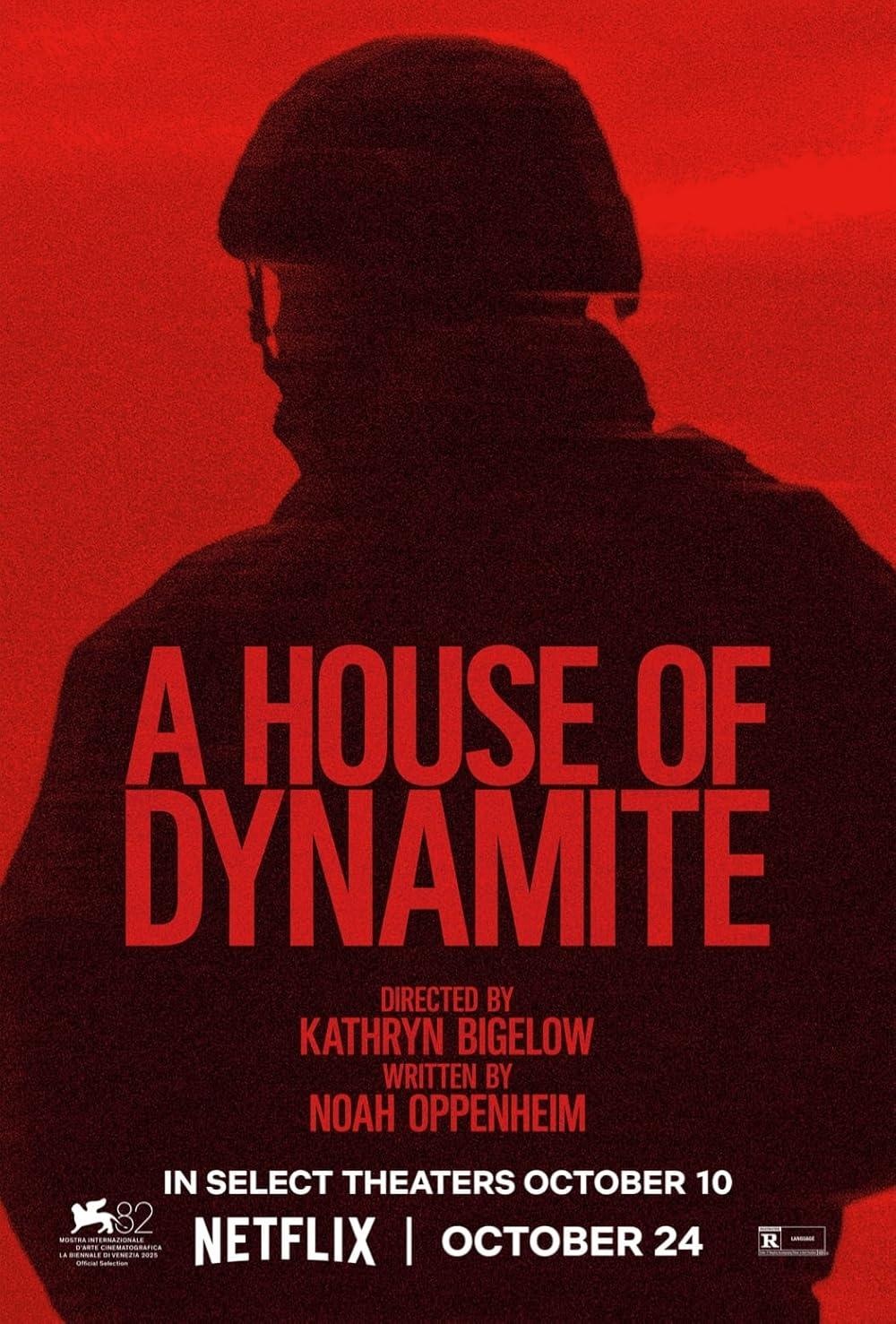
The threat from nuclear weapons seems to be receiving more attention these days. Over the past few years, members of the media and entertainment industry have been raising the alarm in various ways about the ongoing danger to humanity from current stockpiles of thousands of nuclear weapons.
An addition to this growing list of warnings to the public is the new movie A House of Dynamite, which was released onto Netflix on October 24, after a brief release in theaters. A House of Dynamite dramatizes the kind of chain of events, and twisted logic, that could lead to nuclear war today.
How Nuclear War Might Occur
The movie revolves around the (quite realistic) premise that the US government receives early warning that what appears to be a nuclear missile has been launched and is heading toward the United States. As the missile’s brief flight toward its target unfolds, American civilian and military authorities attempt to answer crucial questions: Is this a genuine nuclear attack? If so, is this single incoming missile soon to be followed by many more? Who launched such an attack? Above all, how should the president decide to respond?
This story is told from the perspectives of a variety of people, including military personnel at an Air Force base charged with tracking the missile; civilian officials at the White House and FEMA; and top-level policymakers such as a deputy national security advisor and the president. The movie is structured in three acts, each of which re-plays the events surrounding the incoming missile from the viewpoints of a different set of characters. Every time the sequence of events is repeated, we get more information on the crisis.
The Movie’s Strengths
Purely as a movie, A House of Dynamite works well as a very suspenseful thriller. Beyond that, the movie effectively highlights some of the specific dangers of a world with multiple nuclear-armed nations.
The central problem the movie examines is the very real risk of nuclear war being triggered by accident. The premise is clearly inspired by the many real-life nuclear close calls caused by technical errors, such as the 1983 Stanislav Petrov incident, which one character explicitly mentions. A warning of an incoming attack may or may not prove to be accurate—but if a nation responds to such a warning with a retaliatory nuclear attack, the result will be nuclear war even if the initial warning was incorrect.
Further, the movie demonstrates the extremely limited time frame in which decisions about how to react to a possible impending nuclear attack must be made. If one or more nuclear missiles are launched at the United States or any other nation, top policymakers will have less than an hour—possibly only a few minutes—to decide how to respond.
This time pressure can create a strong temptation to “launch on warning”: that is, to launch a retaliatory nuclear attack as soon as possible, before the incoming missiles damage the military’s ability to retaliate. Such pressures don’t encourage careful reflection or restraint.
Another issue A House of Dynamite raises is a version of what is sometimes called “the security dilemma.” The dilemma is that actions a nation takes to deter or defend itself from an aggressor can easily be interpreted by other nations as aggressive moves directed at them. Those other nations then respond with defensive measures of their own that are interpreted as aggressive moves, and the cycle continues, with accompanying rises in the risk of open war.
We see this happen in the movie, as the warnings of an incoming missile are accompanied by heightened military readiness by nations such as Russia and China. Does this mean one of these nations is behind the attack? Or are they simply responding to the heightened military readiness in the United States prompted by the warnings? The answer is unclear, and characters argue about how to interpret such ambiguous information.
Other issues touched on include the limited value of anti-ballistic missile systems and the challenges of ensuring clear communication in a crisis. The latter problem provides a running bit of gallows humor in the movie, as characters repeatedly struggle, through cellphones or other patchy communications technology, to convey information and advice clearly. Along with communications breakdowns, the movie shows how protocols and discipline start to fracture in a crisis, as panic and a sense of futility begin to take over.
One subtle but potent theme in A House of Dynamite is how military authorities can overwhelm civilian ones in this type of situation. Military personnel are trained to think in terms of military responses to problems and to rehearse such responses constantly. Faced with a potentially disastrous nuclear crisis, military officers’ recommendations might prevail over more restrained, diplomatic responses simply because the military has seemingly the most definite and practiced plan.
For me, the most quietly chilling scene in A House of Dynamite is when the general in command of US nuclear forces makes the case to the president for a radical option: the United States should launch nuclear strikes against all its potential enemies (Russia, China, North Korea, etc.) to ensure no further missile attacks can be made against the United States. The general is calm, composed, and speaks with an assurance lacking from the harried, uncertain civilians around him. Viewed objectively, the general’s advice is crazy and profoundly immoral—yet in the heat of the moment, it could come across as persuasive.
The Movie’s Limitations
A House of Dynamite does an excellent job of illustrating the nuclear threat by showing how easily one event can turn into a potential global disaster. As a call to action against nuclear weapons, though, the movie does have some limitations.
The first limitation is not the filmmakers’ fault but simply the result of the current media landscape:
When the nuclear war drama The Day After (which seems to be one inspiration for A House of Dynamite) aired on ABC on November 20, 1983, more than 100 million people—most of the American adult population at the time—watched it. The audience was so large because at the time only three major TV networks existed in the United States and programs were available for free viewing.
Today, A House of Dynamite airs on a paid streaming service that must compete for viewer attention with other streaming services, network and cable TV, and innumerable types of online content. A single movie cannot easily grab wide public attention the way it used to.
The second limitation is that while A House of Dynamite vividly depicts the severity of the nuclear threat, it provides little sense of what anyone can do in response to the threat. Granted, that is not the movie’s goal, so it may be unfair to judge it by that standard. Nevertheless, the intense power of the movie’s message will be wasted if viewers don’t translate that message into action.
Taking Action
A House of Dynamite is a valuable contribution to raising awareness about the danger from nuclear weapons. The movie is only one part of this effort, though: moving the public to act requires urgent repetition of the message that, at any given moment, humanity could perish in a nuclear war and that we need to take positive steps to check the nuclear danger.
People should watch A House of Dynamite, encourage other people to watch it, and discuss it afterwards. They should not stop there, though, but should continue to learn about the nuclear threat from other sources. Valuable introductory books to read on the topic include Jonathan Schell’s classic works The Fate of the Earth and The Abolition, William Perry and Tom Z. Collina’s The Button, and Annie Jacobsen’s Nuclear War: A Scenario.
Artists, journalists, and activists should similarly continue to create works of fiction and non-fiction, in a variety of media, to send clear messages about the necessity of acting to prevent nuclear war.
People from all walks of life should support initiatives to reduce the nuclear danger. Two worthwhile initiatives I have written about before are the Back from the Brink campaign’s five policy responses to the nuclear threat and the effort to renew arms control agreements between the United States and Russia.
Both initiatives have produced legislation currently before the US Congress: H.Res 317/S.Res.323 advocate for adopting the Back from the Brink policies and H.Res 100/S.Res 61 advocate for a new arms control treaty. US citizens can contact their representatives and senators, as well as the Trump administration (by email or phone 202-456-1111) to urge them to support this legislation. Back from the Brink and the Arms Control Association offer resources for lobbying elected officials on these pieces of legislation.
By raising awareness and advocating for policy changes, we can build a movement to protect humanity from nuclear weapons.
Another way to join the movement against nuclear weapons is to attend the Consistent Life Network’s quarterly peace vigil outside the White House in Washington, DC. The next vigil will be on November 2.
==============================
For more of our posts on similar topics, see:
Nukes and the Pro-Life Christian: A Conservative Takes a Second Look at the Morality of Nuclear Weapons
“An Inferno That Even the Mind of Dante Could Not Envision”: Martin Luther King on Nuclear Weapons
Persuading People to Act against the Nuclear Threat: Some Findings and Recommendations
Nuclear Disarmament as a Social Justice Issue
See a more extensive list under “Nuclear Weapons” on our list of all blog posts.