Movie Review: Oppenheimer
by Rachel MacNair
Oppenheimer is a biopic about J. Robert Oppenheimer, the “father of the atomic bomb.” According to its director’s custom, it has three different threads of stories that weave throughout. One tells the story of his early years and the development of the atomic bomb with care for historic accuracy, and the other two deal with the aftermath for Oppenheimer in the 1950s.
In a PBS NewsHour interview, director Christopher Nolan referred to this movie as engagement rather than entertainment, which certainly rings true to me. He also referred to it as understanding rather than judgment, and that struck a chord with me as explaining a lot about the movie I had just seen.

I remember thinking well into the movie that people were going to come out of it with the same opinion about nuclear weapons they had going into it. Pro-nuclear arguments were there, and they had to be; how else could we understand the historical reality being so well portrayed? Anti-nuclear arguments were there, but not as well developed as they would become. But again, it was portraying what people understood at the time.
Plenty of people could see this movie and remain pro-nuclear with some handwringing. Handwringing over massive violence is common and still allows it to continue.
What was missing popped out to my anti-nuclear eye. Most noticeably, the bombings of Hiroshima and Nagasaki were a major part of the plot, but were never portrayed. This movie was from the point of view of the makers of the bomb. They could hear the number of civilians killed and be disturbed, but from their perspective, that’s all. And their perspective is what this film is about.
We also have, as one detail, a fellow about to watch the first test who turned down the darkened glasses to watch it, assuring himself that the windshield of the car he sat in (with an open door) would protect him. This was historically accurate, but the movie left out how much the radiation of that test, and subsequent tests, hurt the observers by causing subsequent diseases. We’ve covered the racism of this; see also the list of posts below. But this was from the perspective of the people inventing the bomb, and they didn’t know any better. Audience members that didn’t already know better themselves wouldn’t have been informed by the movie.
I expect the average audience member caught the use of euphemism when Oppenheimer corrected someone from calling it a bomb to calling it a gadget. No commentary needed. But the fact that Oppenheimer named the atomic test “Trinity,” thus conscripting God into supporting his violence, as perpetrators of violence frequently do, could have used some commentary. But there was no comment at the time, and this was a portrayal of people at the time.

As a side note, the people most vulnerable to being killed by radiation are unborn children. It was when Juli Loesch, now Julianne Wiley, was explaining this to an audience that a woman asked her: if radiation killing children bothered her, what about the abortion curette? That set Juli on the path to founding Prolifers for Survival. PS’s final meeting was the founding meeting of the Seamless Garment Network, now renamed the Consistent Life Network. But again, the knowledge of what radiation does to children wasn’t covered by the movie, since it covered a time period when such things had not yet been figured out or were being steadfastly ignored.
In any event, my view of its pro- and anti-nuclear balance may be off because I’m so used to stronger anti-nuclear information that I don’t know what information hits people who aren’t so familiar with it. As a major example, one of the sub-plots was about the mathematical calculations that showed that just maybe the one test would ignite the atmosphere and therefore destroy the whole world. They decided that the mathematical probability was “near zero” and so went ahead with the test. A military general reacted the way most of us would react – what do you mean, “near” zero? How about zero? The thing is, I knew decades ago that this had happened. To me, it went along with how insane the whole process was. Someone who didn’t know about it may have it hit them much more strongly.
And then there was the final line of the movie. That line was about as anti-nuclear as the confines of one sentence could be, backed up by what had gone before.
I recommend adults and mature teenagers make a point of seeing this movie (it’s R-rated for good reason and not suitable for children). It’s part of the literature of the reality of nuclear weapons; it’s confined to one aspect, but then, most movies are. We all need to understand the reality rather than the normal Hollywood-style glorification of violence.
========================================
We have quite a few posts on nuclear weapons; see that section under the list of all our posts. For more of our posts on nuclear testing and production, see:
Unholy Trinity: The Terrible Consequences of the First Nuclear Test
Fallout at Home Base: Nuclear Testing within the United States
“The Affairs of a Handful of Natives”: Nuclear Testing and Racism
Lethal from the Start: Uranium Mining’s Danger to the Most Vulnerable
We also have several movie reviews listed in the list of all our posts. For some with similar themes, see:
The Darkest Hour: “Glorifying” War?
Justice Littered with Injustice: Viewing Just Mercy in a Charged Moment
Hollywood Movie Insights (The Giver, The Whistleblower, and The Ides of March)
Hollywood Movie Insights II (Never Look Away, The Report, and Dark Waters)
Movie Review: Sound of Freedom
by Rachel MacNair
The movie Sound of Freedom is causing quite a stir. It depicts the real-life Tim Ballard, who’s portrayed doing Hollywood-movie style rescues to get children out of the grips of pedophilic sex trafficking. As a drama, it’s well done.
This would be the approach that would be taken by a movie that wants to draw people into theaters. The more mundane work of rehabilitation of victims and their families (which can take years), getting the legislation right in various countries, seeing to it that police, social workers, and others are well trained, all these things don’t make for good movies and aren’t shown.

The movie also skews toward shadowy abductions by strangers. Much more of the problem involves people the kids know who are betraying them into the trade.
As Teresa Huizar, CEO of the National Children’s Alliance, said:
Generally, young people end up in trafficking situations because their family is in incredible poverty, because of political unrest, because the child is being rejected by their family for their sexual orientation or gender identity or any number of things . . . [They] are likely to be trafficked again unless you address that underlying issue: What made them vulnerable in the first place? Why was their family not able to keep them safe? Those are the questions that are ignored in the narrative of, “Oh, they are in a bad place. All we have to do is move them and leave.”
Take note: poverty is connected. “Political unrest” is associated with war if it isn’t war outright, and it’s also connected to trafficking. Such connections are common to issues of violence. See the 2010 movie The Whistleblower for depicting how sex trafficking was related to the war in Bosnia (we did a short review of this as part of a set).
There was a message at the end where the lead actor appealed to people to use the QR code on the screen and pay forward to buy tickets for other people to see the movie for free, in order to spread the word and educate. An appeal for help in stopping the trafficking might be expected to offer information on organizations doing the hard work so viewers could send them donations (which I don’t have the needed expertise to recommend, but here’s a list).
Still, the technique was marketing genius, since it got the film higher box office figures and therefore more publicity. Since promoting the movie in hopes of educating about the issue was what people were donating to, it’s all honest. But of course more is needed than education. Most of us won’t encounter a situation where we can act directly, and we need to support those people who do. And everyone who sees this movie needs more education about the issue than what they saw in the movie.
The point was made that there are more people in slavery now that there were when it was legal. That’s because there are far more people, period. The percentage of people caught in slavery is way down from what it was in days of yore. But of course one is one too many.
The connection of sex trafficking of impregnatable girls and women to abortion is straightforward and heart-wrenching: it’s part of the sex traffickers’ business plans to have them vacuumed out and re-usable. Our member group Feminists Choosing Life Life of New York has put together an excellent video that, in addition to reporting from a study done on this, tells the tale from the perspective of women who’ve had the experience.

===============================================
For more of our posts on similar topics, see:
Abortion Facilitates Sex Abuse: Documentation
How Abortion is Useful for Rape Culture
The Message of “Never Rarely Sometimes Always”: Abortion Gets Sexual Predators Off the Hook
Abortion Supporters Connect Abortion to War
Compiled by Rachel MacNair. If you know of other good quotations that fit this theme, please send them to CLNeditors@googlegroups.com
Dr. Frank Behrend, M.D., abortion doctor
tape-recorded speech November 7, 1977
Reference was made to my agreeing that abortion is taking a human life, which it is. However, let us remember that war is also legalized killing, that the pilot that dropped the atom bomb on Nagasaki and Hiroshima killed human life. He got medals for it. We bless our troops when they go into battle to kill human beings, so that the taking of human life, including the death penalty in certain states like Utah, where the man was shot, is not a strange behavior in a society.
Don Sloan, abortion doctor
From his book Choice: A Doctor’s Experience with the Abortion Dilemma (second edition, 2002), p. 84
Is abortion murder? All killing isn’t murder. A cop shoots a teenager who “appeared to be going for a gun,” and we call it justifiable homicide – a tragedy for all concerned, but not murder . . . And then there’s war. In theory, soldiers shoot only at each other. But in practice, lots and lots of other folks get killed.
We drop bombs where there are non-combatants – women and children and old people – and when they die we call it not murder but “collateral damage.” Our soldiers get killed by “friendly fire” – often by people who aimed directly at them. Is that murder? All killing like that, to me, is morally wrong. But murder?
LeRoy Carhart, M.D, specialist in late-term abortions
CBS Evening News, Dec. 4, 2009

I totally believe in this cause every bit as much as I did believe every morning when I got up in the military that I was doing the right thing.
“Between Guilt and Gratification: Abortion Doctors Reveal Their Feelings” by Norma Rosen
New York Times Magazine April 17, 1977 p 73, 74, 78
Dr. William Rashbaum, veteran of thousands of abortions, had for years suffered during each removal a fantasy of the fetus resisting, hanging onto the uterus walls with its tiny fingernails, fighting to stay inside.
How, he was asked, had he managed to perform abortions despite this fantasy?
“Learned to live with it. Like people in concentration camps.”
When asked if he really meant that metaphor:
“I think it’s apt – destruction of life. Look! I’m a person, I’m entitled to my feelings. And my feelings are who gave me or anybody the right to terminate a pregnancy? . . . I don’t get paid for my feelings. . . . I spent a lot of years learning to deliver babies. Sure, it sometimes hurts to end life instead of bringing it into the world.”
 Ginette Paris
The Sacrament of Abortion, 1992, 25-27
Men have the right to kill and destroy, and when the massacre is called a war they are paid to do it and honored for their actions. War is sanctified, even blessed by our religious leaders. But let a woman decide to abort a fetus . . . and people are shocked. What’s really shocking is that a woman has the power to make a moral judgment that involves a choice of life or death. That power has been reserved for men.

William Saletan
Slate Magazine: June 1, 2009
Tiller was the country’s bravest or most ruthless abortion provider, depending on how you saw him . . . To me, Tiller was brave. His work makes me want to puke. But so does combat, the kind where guts are spilled and people choke on their own blood. I like to think I love my country and would fight for it. But I doubt I have the stomach to pull the trigger.
Warren M. Hern and Billie Corrigan
“What About Us? Staff Reactions to the D & E Procedure,”
Advances in Planned Parenthood 15(1):3-8, 1980
 Note: This is anther example human mind’s reaction to doing violence, found across all the different kinds of violence
Two respondents described dreams which they had related to the procedure. Both described dreams of vomiting fetuses along with a sense of horror. Other dreams revolved around a need to protect others from viewing fetal parts, dreaming that she herself was pregnant and needed an abortion or was having a baby. . . . In general, it appears that the more direct the physical and visual involvement (i.e. nurses, doctor), the more stress experienced. This is evident both in conscious stress and in unconscious manifestations such as dreams. At least, both individuals who reported several significant dreams were in these roles.
============================================
For more of our posts on connecting abortion and war, see:
War Hysteria and Post-Dobbs Reactions
For a similar idea going in a different directions, see:
Imagining a Different Type of Peace Organization
by John Whitehead
Effective peace activism is urgently needed in the United States today. (Peace activism is also needed elsewhere in the world, but since I’m an American citizen, I will focus here on the United States.) Tensions between the United States on the one hand and nations such as Russia, China, North Korea, and Iran on the other are high and have the potential to escalate into war. The US military budget remains grotesquely large, being —more than the military budgets of the next 10 highest-spending nations combined. Given this situation, peace advocates need to speak out on behalf of peaceful, non-military responses to conflict.
I think that mobilizing the large numbers of people needed for effective peace activism requires a new type of peace organization. Existing peace organizations certainly do good work, and they deserve credit for this. Nevertheless, I think the peace movement needs an additional organization to fill a current vacuum.
Combining Peace with Other Issues
A problem with many current peace organizations is that they combine their advocacy against war with advocacy on other issues, a combination that can severely limit the organizations’ appeal.
For Consistent Life Ethic activists, the most disturbing combination of issues is when peace organizations enthusiastically advocate for some other type of violence. Over the years, I have been dismayed to hear one peace organization declare that “abortion is healthcare” and support public funding for abortion-related activities. I have been similarly dismayed to hear, at an otherwise excellent peace-related event, a speaker endorse physician-assisted suicide. I have also encountered, at first- and second-hand, peace organizations that will not work with pro-life groups. All these patterns make participation in certain existing peace organizations very difficult.
Beyond outright support for violence, the combination of peace advocacy with other issues can present a subtler type of difficulty. Even when the other issues championed by peace organizations don’t involve violence, they do introduce a definite slant to the organizations’ work.
A quick glance at the websites of some notable existing peace organizations gives a sense of the direction their concerns:
Fellowship of Reconciliation USA , along with the cause of nuclear abolition, they have worked on issues such as “labor rights, environmental degradation, mass incarceration, extending the voting franchise to all, ending the death penalty, combatting religious hatred, [and] gun violence.”
Code Pink’s website strikes a similar note, “War, poverty, police brutality, ecological degradation, and nearly every other issue we face are connected by the same root cause.” The site “We live in a war economy, an extractive, destructive, oppressive economy . . . Our U.S./Western culture tells us that the natural world is to be pillaged and controlled by humans for our consumerist lifestyles.” Changing this situation requires a cultural shift away from consumerism and other unhealthy values.
Win without War (WIN) provides its vision for what is significantly called a “Progressive Foreign Policy for the United States.” American “foreign policy is intimately interlinked with our domestic policy,” WIN calls for connecting peace activism with work against climate change as well as various efforts for economic and social justice. This foreign policy vision also contains the diagnosis “our endless wars and exploitative economic policies are often driven by corporations who benefit from the expansion of conflict around the world.”
My purpose in reviewing these peace organization statements is not to disparage the organizations or their beliefs. As I said, I think existing peace organizations do good work, and I sympathize with their views on some of the other issues not directly related to war covered by these websites. The peace movement definitely has room for groups that combine peace activism with environmentalism, social justice work, and similar causes. Nor, for that matter, am I disparaging the notion of connecting issues or pursuing activism on multiple issues at the same time: such a notion is central to the Consistent Life Ethic.

However, I would also argue that these organizations’ approach to peace activism is just one possible way to pursue peace activism, a way that won’t appeal to everyone. It limits the appeal to people who are already quite politically left-wing and (what is no less important) who also believe that working for peace is closely connected with working for these causes typically identified with the left. Not everyone who opposes US wars and desires peace fits this profile.
Some people may wish to prevent war while also having political views that are quite different from those expressed on these peace organizations’ websites. Other people, whatever their precise views on economic policy or other issues, might be skeptical about whether such matters are strongly connected to stopping war.
Speaking for myself, I am certainly not a fan of capitalism, at least as practiced in the contemporary United States. Nevertheless, I question whether our current economic system bears the responsibility for war that some activists assign to it. War predates capitalism, modern corporations, and indeed Western culture by quite a few centuries, if not millennia. Meanwhile, some 20th-century societies abolished capitalism yet still waged war, pursuing interventionist or imperialistic foreign policies and committing atrocities. Abolishing capitalism might not be the solution to ending war some hope it will be.
The limited appeal of many peace organizations is in many ways a mirror image of the limited appeal many pro-life organizations have. Pro-life organizations that link protection of unborn human life to particular religious beliefs or certain attitudes about sex and family life or conservative political views alienate a great many potential allies. Like the peace organizations I have mentioned, such pro-life organizations do good work and have a place within the larger movement. We should recognize the limitations of both types of organization, though.
Some people wish to pursue peace without necessarily connecting it to other issues or to the specific philosophies that tend to predominate in existing peace organizations. For these people, I see the need for a new, different variety of peace organization. I will sketch what I think the essential characteristics of such an organization would be.
The Blueprint
The new peace organization’s core principles would be simple. The organization would oppose
- the United States waging war;
- the use, by the US military or intelligence agencies, of violent methods such as assassination, torture, or indefinite detention;
- the enormous US military budget; and
- policies that make nuclear war more likely, such as keeping nuclear weapons ready for use at a moment’s notice or unchecked presidential authority to use nuclear weapons.
In contrast, the new peace organization would support
- investing in diplomacy and other nonviolent tools for resolving conflicts among nations;
- radically reducing the military budget; and
- countering the nuclear threat through radical reductions in nuclear weapons, no longer keeping such weapons ready for instant use, ending unchecked presidential authority, and other measures (the Back from the Brink campaign’s are a good guide here).
As I said above, I am focusing on the United States because that is my country. Peace activists in other countries might consider forming similarly focused organizations adapted to their own circumstances.
This organization would be non-partisan and non-sectarian, being open to people of many different political parties and people of many different faiths or none.
This organization would not take positions on domestic political issues nor would it take positions on foreign policy issues not directly related to war or other uses of violence. In particular, the organization would not take a stance on abortion, assisted suicide, the death penalty, or other life issues outside the realm of foreign policy. Members could have a variety of views on domestic policy as well as international matters such as trade or fiscal policy. Activists who differ on such questions can still work together to achieve a far more peaceful world than we have today.
Such an organization could draw in people who want to work for peace or might be open to conversion to the peace cause but would not wish to join current peace organizations. Meanwhile, those who prefer current peace organizations’ approach can of course continue to participate in those organizations. And those who wish to pursue peace activism along with other life issues can participate in organizations such as the Consistent Life Network!
Preventing war, especially the nightmare of nuclear war, is work that urgently needs everyone’s participation. I think the peace movement could do a better job of reaching potential peace activists who are not being reached by existing organizations. Creating a new organization to reach those potential allies is a goal worth seriously pursuing.
=====================================================
For more of John Whitehead’s posts on strategy, see:
Making the Case for Peace to Conservatives
Specialization or Generalization? The Many Ways of Following the Consistent Life Ethic
Dialog on Life Issues: Avoiding Some Obstacles to Communication
“Is One Life Issue More Important Than the Rest?”: A Question That Might Not Need an Answer
Promoting Peace at Home and Abroad: A Challenge for Peace Activists
Applying Pacifist Insights to Abortion
by Rachel MacNair
I’m a Quaker, and Quakers are pacifists. We (officially, the Religious Society of Friends) join Mennonites and the Church of the Brethren as the Historic Peace Churches. Membership in any of these churches puts a person in good shape for getting legal conscientious objector status when drafted for the military.
As such, I’m accustomed to the style of arguments that are used against pacifism; I’ve written Explaining Pacifism, designed for a pro-life audience. It makes the basic case and addresses the most common arguments.
Yet many Quakers make an exception to the rule against killing human beings, thus going against pacifism, as long as those human beings haven’t gotten around to being born yet.
My branch of Quakers (FGC, Friends General Conference), is so bad on this that I often face hostility (or steadfast ignoring) when I bring the topic up. FGC’s magazine, Friends Journal, last August published a piece advocating Quakers take a pro-abortion stand. They were pleased with themselves that this kicked off a formal post-Dobbs re-examination among Friends. But they haven’t published an article with alternative thoughts, and they turned down the one I submitted for consideration. It’s the evangelical branch, with its strong pro-life tendencies, that primarily sees to it that Friends are “not in unity” on the abortion issue.
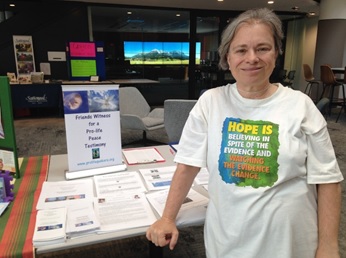
Rachel MacNair at FGC Gathering (national conference)
Since our national lobbying group, the Friends Committee on National Legislation (FCNL) is formally conducting this re-examination, a process asking Friends whether FCNL should change their neutral position, I’ve therefore been more actively trying to educate Friends. FCNL’s decision is to be made this November.
Fortunately, FCNL’s policy committee did give me a half-hour Zoom meeting to make my case, and I thought that meeting went quite well. But the questions there, along with the questions and arguments throughout the years, suggested three problems to me.
Problem 1: Extreme Cases
Many inquire about the strange and extreme cases, for both pacifism and abortion. These are usually isolated and often fictitious cases that don’t happen often. Sometimes there are responses directly to this; I give several on the madman chasing your mother with the knife. An excerpt:
In order to work as an example, the situation needs to be stripped down to its simplest components. Such is the nature of violence; it thrives on over-simplified thinking and withers with complicated reality.
Does this madman have a mother who will grieve his passing? Does he have a following that will avenge this death? Is he a police officer so that the weight of the dictatorial government will be coming down on you?
Why is it that a person whose mental illness is so dangerous is out on the streets – has society done its job in restraining such a person? How was it you were able to ascertain quickly that he’s insane – is he maybe drunk or high instead? Or simply off his medications and will be fine once he gets back on them? Has he recently suffered a trauma so that one quick distraction and a listening ear would solve the problem? Is he following a habit so that going contrary to his victimizing script would throw him off balance?
In any event, we haven’t identified the actual need. There is no need to kill or severely injure the man; there is a need for emergency restraint.
An example with abortion is the baby that’s going to die soon after birth, having some medical condition incompatible with life once the umbilical cord is cut. Yet isn’t it obvious that having the baby born and dying in mama’s arms, surrounded by love, is better than having someone reach up inside mama and cut the child into pieces? There are studies that show better psychological outcomes for families who go the holding route, but really, do we need studies? Isn’t it obvious as soon as it’s said that way? The problem is that people think of abortion as simply terminating the pregnancy. But as with violence in general, being familiar with what actually happens is often enough to make the violence seem less appealing.
But then there’s the observation that extreme cases are, by their nature, not common. So the second answer I gave dealt with the opposite – the cases that are more frequent. What about sex-selection abortions, common around the world? What about women who choose to give birth being abandoned and left impoverished by fathers who think the baby was her choice and not his? There are plenty of things that could be listed here, just as recounting which wars are clearly not justified is an easy exercise.
It just struck me as odd to observe that pacifists who are used to dealing with arguments about extreme cases and therefore using either or both of these two responses about other kinds of violence would then turn around and use the extreme-individual-cases technique on abortion.
Problem 2: Religious Differences
 My branch of Quakers, unlike the evangelical branch, tends toward an interfaith understanding. I’ve written on the importance of interfaith understanding for peace. There is “that of God” in everyone, and therefore reaching that of God in each person is helped by being respectful of their religious understanding. Also, we have no creed, because a creed tries to put reality in a box and truth doesn’t fit in a box. There’s always “yes, but . . .” and other nuances plus alternative perspectives.
So some Friends argue that different religions have different ideas of when life begins. Therefore, they think it follows that we allow those who think it’s later than conception to be able to kill those already conceived. That’s my wording rather than theirs, of course. It gives my first idea of what’s wrong with this approach.
But more to the point, if there’s anything that different religious groups disagree on, it’s the military. A lot of religions favor defensive “just” war, and many favor aggressive “holy” war. Plenty of soldiers actively engaged in war are very religious indeed, and will use religious justification for what they’re doing. Yet pacifists, by definition, take a stand against war. We don’t make arguments about religious pluralism to keep us from doing so.
And when the life of an individual human being begins isn’t a religious question. It’s a scientific one.
Problem 3: Conscience Rights
We normally apply the idea of conscience rights to objection to war. Many Friends may then be sympathetic also with those with conscientious objection to abortion, but I don’t know since I haven’t used that point much.
But there have been those who’ve applied the conscience principle this way: women should have the right to have abortions after consulting their own consciences.
But if a man’s conscience has him picking up a rifle to go to war, I say that there should be no war for him to use his conscience to fight in. And if the war is there all the same, I’ll try to talk him out of participating. I’ve never understood conscience rights to cover actively killing – only refusing to kill. After all, I’m a pacifist.
I also object to leaving a mother dangling as if she’s isolated and on her own. There’s always also a father, there are grandparents, there are employers and social workers and some incredibly callous social policies. People whose consciences allow them to pressure mothers into abortions are people whose consciences need more care.

===========================================
For more of Rachel’s posts on similar topics, see:
The Civil War Conundrum, 150 Years Later
Would Nonviolence Work on the Nazis?
Bigotry against Babies with Down Syndrome: International Experiences
by Sarah Terzo
Recently, the CLN Blog published an article about discrimination against people with Down syndrome and how it leads to abortion. The article looked at cases from the United States, but the same thing happens in other countries.
Writer Says She Would Have Aborted Her Children
If They Had Down Syndrome
An author in the Washington Post expressed the mindset of a parent who would abort a child with Down syndrome. Ruth Marcus wrote:
I can say without hesitation that, tragic as it would have felt and ghastly as a second-trimester abortion would have been, I would have terminated those pregnancies had the testing come back positive. I would have grieved the loss and moved on…
I’m going to be blunt here: That was not the child I wanted… You can call me selfish, or worse, but I am in good company.
Parents of children with Down syndrome condemned the article, but Marcus is correct that she’s in “good company.”
Abortion for Down Syndrome in Iceland
In Iceland, nearly all children with Down syndrome are aborted.
A CBS News article quoted Helga Sol Olafsdottir, who “counsels” Icelandic women whose preborn babies test positive for Down. When Olafsdottir encounters a woman who is wrestling with her decision, or feels guilty about aborting, she tells her, “This is your life — you have the right to choose how your life will look like.”
The baby’s life isn’t considered.
Olafsdottir showed the CBS reporter a prayer card memorializing an aborted baby who had Down syndrome. The card had tiny ink footprints from the baby. The parents kept the card as a keepsake of their child.
The reporter said, “In America . . . some people would be confused about people calling this ‘our child,’ saying a prayer or saying goodbye or having a priest come in — because to them abortion is murder.”
Olafsdottir responded, “We don’t look at abortion as a murder,” but as “preventing suffering for the child and for the family.”
Down syndrome is not a painful condition. In one survey, 99% of people with Down said they were happy with their lives. But Down syndrome requires parents to make sacrifices for their children. Some parents simply aren’t willing to make those sacrifices.
Abortion for Down Syndrome in Australia
In Australia, 93% of babies diagnosed with Down syndrome are aborted. Australian parents who chose life report being pressured to choose abortion.
On the program Lateline, Kathleen Simpkins says that when her doctor first suspected her preborn baby had Down syndrome, he “went into a spin.” She says, “I think he might even have been shaking when he said to me, ‘I’m so glad you came back. I’ve been trying to get hold of you, you’ve had an abnormal scan and your window for termination is closing.’”
She and her husband Andrew had decided in advance not to abort if their child had Down. Other parents, Andrew says, may have given in:
I can imagine that with the amount of negative advice we were given, that it would be hard to go through with the pregnancy, because it’s just so negative.
The outcome is shown to be so sad and awful that you wouldn’t want to go through with it. I’d say most of the obstetricians that we saw… [abortion] always came up in one way or another…
It’s one of those mind-blowing things that you can’t really believe it’s real, you can’t believe that these children really are being looked at as almost like a byproduct.
During the interview, Kathleen cried as she described how doctors treated her family. (The video at the site which shows this and the above quotes has been taken down)
Rebecca Kelly, the mother of a son with Down syndrome herself, did a survey of Australian mothers who chose life after their preborn babies were diagnosed.
Sixty percent said doctors delivered the diagnosis in a manner that was “poor or very poor and contained negative language, such as ‘I’m sorry, it’s bad news.'”
Two-thirds said doctors offered them abortion again after they declined it. One fifth said they were offered abortions repeatedly, despite telling their doctors they wanted their children. In these cases, doctors didn’t take no for an answer.

Live Action News covered the story of one Australian mother, Joelle Kelly.
At 13 weeks, doctors told Joelle and her husband that their preborn daughter Josee was in heart failure and wouldn’t survive. They suggested abortion. The couple refused. A week later, Josee was diagnosed with Down syndrome.
The doctors offered to arrange an abortion within 48 hours. Again, the couple refused.
Over the next few weeks, doctors repeatedly told the Kellys that Josee would die. At every appointment, they were told abortion was the right decision because there was no hope for their baby’s survival.
But at 19 weeks, the doctors discovered there was nothing wrong with the Josee’s heart after all—the potential problems had resolved.
Kelly says:
[W]hen she looked like her heart was ok . . . we imagined we wouldn’t receive any more coercion about abortion from medical professionals.
We were wrong.
At every weekly appointment from 19 weeks to 23 weeks, we were asked if we were sure we wanted to proceed with her pregnancy.
We were even told that “these things happen” in second marriages and asked if Lewis and I were a second marriage.
There was a local organization that supported and advocated for families of children with Down syndrome. This group offers resources and support to parents. However, doctors never told the couple about the group or the support available to them.
According to Joelle, “Not once were we given information about Down syndrome, not once . . . Despite me pleading for information, we were told to go home and Google her diagnosis.”
The doctor who asked the couple if they were on their second marriage turned out to be the one who delivered Josee.
Joelle says, “Once Josee was born she was smitten . . . Every time we saw her after she was intrigued by our Josee Hope . . . because the obstetricians that we encountered didn’t have a lived experience of the condition.”
It is easier to dehumanize disabled people and discriminate against them if one doesn’t know any disabled people personally.
Kelly now advocates for children with Down syndrome and their families. In her original Facebook post, she said:
I could have ended [Josee’s] life easily because abortion was at EVERY turn, and because I was made to feel like it was the right thing to do . . . by the same professionals that should have been objectively informing me and providing optimal prenatal clinical care.

Abortion for Down Syndrome in Great Britain
Abortion rates for babies with Down syndrome are also very high in Great Britain. An older study in the journal Prenatal Diagnosis found that 92% of British babies diagnosed with Down syndrome in the womb are aborted. A more recent BBC article gave the figure of 90%.
One British woman gave her reasons for aborting her child with Down syndrome:
I knew I didn’t want to bring a child into the world with those sorts of problems, and from a selfish point of view, my life would have been over. I would have ended up as a full-time carer . . .
The only thing I’ve been upset about since is that I haven’t got pregnant again. But neither of us have had a second of regret . . .
But some British mothers are speaking out against such ableist attitudes. British actress Sally Phillips, whose son Olly, now 12, has Down syndrome, was interviewed by the BBC.
Unlike many mothers, Phillips didn’t find out that Olly had Down syndrome until after he was born. According to her, “The doctor said to us: ‘I’m sorry, I’m so sorry.’ The nurse on duty cried. I don’t think anyone said anything at all positive. It wouldn’t have been any different if they’d told me my child wasn’t going to make it.”
Medical professionals, Phillips says, treated Olly’s birth like it was a tragedy.
But life with Olly, she says, is far more like a comedy. According to Phillips, “It’s like a sitcom, where something appears to go wrong but there’s nothing bad at the end of it . . . Having Olly in my life has changed me and my family for the better.”
Phillips describes Olly as kind and “gifted emotionally.” He notices when people are upset and always offers them comfort. Of her three children, Olly is the one who asks her “every single day” how her day was.
Aborting Because of a Down Syndrome Diagnosis Is Ableism
Prenatal testing can’t determine a child’s personality, their unique gifts and talents, or what they have to offer the world. All it can do is identify one thing about the child—their medical condition—and even that information is limited and sometimes wrong.
A test for Down syndrome may show whether a child has the condition, but it doesn’t reveal how severely the child will be affected, nor does it say anything about how much love that child has to give or what joy they can bring to their loved ones.
A disability is only one characteristic of a person—it is not their entire identity. Reducing a complex human being to a medical diagnosis is ableism. No preborn child, indeed, no human, should be sentenced to death for being disabled.
===========================================
For more of our posts on disability rights, see:
Bigotry against Babies with Down Syndrome
A Lawyer’s Turnaround on Baby Doe with Her Own Down Syndrome Baby
How Euthanasia and Poverty Threaten the Disabled
How Ableism Led (and Leads) to Abortion
The Deserving and Undeserving Poor vs. the Worthy and Unworthy of Life: How Both Major Political Parties Pick and Choose Who They Help and Whom They Kill
by Jacqueline H. Abernathy, Ph.D., M.S.S.W

Catholic social activist Dorothy Day once said, “The Gospel takes away our right, forever, to discriminate between the deserving and undeserving poor.” As I look at the current political landscape, I can see how this quote is far more dynamic than I once thought. The two parties that dominate our government are both guilty of discrimination in that they decide who “deserves” what. Not only do they debate who deserves food stamps or other welfare, the debate also includes who deserves to live.
Just as entire groups of human beings are labeled as “deserving poor” and “undeserving poor” in order to justify denying charity to those who “deserve” their poverty, both the American Left and Right have likewise labeled entire groups of human beings as “deserving of life” and “undeserving of life,” in order to justify killing those who “deserve” to die, either for their crimes or for their cost.
Those undeserving of life according to the Left are primarily unborn children disposed of via abortion, as well as those with terminal illnesses who wish to end their own lives rather than die from their diagnoses. The Left also champions unethical research on human beings in their earliest stages, insisting this is a noble thing because the death of these unworthy embryos could yield life-saving treatments for those they believe deserve to live.
Conversely, the Right condemns the Left’s positions on bioethics as evil, yet many of them enthusiastically support capital punishment for those they think should die for their crimes. Likewise, many on the Right insist that certain actions justify immediate deadly force, arguing that unarmed civilians killed by police had it coming if they resisted arrest or were simply judged to look suspicious or threatening. Or they may consider non-citizens who are deported to probable death in their home countries also “deserving” to die for being in our nation illegally.
These are just some examples of how the duopoly is pro-violence: neither Democrats nor Republicans in their party platforms care about all human lives, just those lives they think have value. Unsurprisingly, those deciding who is worthy to live and who isn’t almost always deem themselves worthy. Even when this isn’t so and people support violence for themselves (like physician-assisted suicide), this worldview that some lives are less sacred than others creates second-class citizens in our midst. There can be no equality as long as some people don’t have the right to even exist.
When trying to determine how the duopoly chooses what violence to protest and what violence to promote, it appears that Democrats and Republicans are operating from two distinct criteria.
Ableism and ageism (forms of discrimination that remain broadly accepted) often determine which humans are “undeserving of life” according to the Left. On the Right, it is often the concept of innocence, narrowly defined.
Ableism is a pervasive argument for both abortion and euthanasia, the suggestion being that life isn’t deserving of existence if it involves disabilities or chronic illnesses. Citing an unborn child’s inability to survive outside of the womb on their own before 5 months or so is simply ableism repackaged. It’s also ageism, as common arguments in favor of abortion and euthanasia include that the elderly have supposedly lived their lives, while an unborn child is so young and unaware that nothing is lost by killing them before they gain self-awareness.
The Left has cited the economic benefits of killing these populations. Letting those who want to die early do so saves valuable health resources for others, and abortion prevents children from being born into poverty. Once children are born, they become “deserving” of better lives. While they remain unborn, anyone who is unwelcoming of her child has every right to determine that she doesn’t wish to remain pregnant, even though this means taking her child’s life. Because to the Left, mothers not only deserve to live, but deserve to live the kind of life they want, even if their child must die for this to happen. Since unborn children don’t inherently deserve to live in their opinion, especially not at the expense of someone who does, abortion is an acceptable choice for any reason or no reason at all. The lives of the unborn don’t matter, just like those who are no longer healthy and prefer (or are pressured to choose) death rather than living with a terminal illness or disability.
There are those who oppose abortion and euthanasia and reject these qualifiers for whose life is deserving, but have their own criterion: innocence. Innocent human life is deserving of protection, while those guilty of a capital crime are no longer deserving of life. Donald Trump extended the guilt criterion to the families of terrorists, suggesting they should be “taken out.” This is a war crime, but sadly, mere geographic proximity to the guilty seems to be enough to be undeserving of life as well, since children killed by drones are dismissed as “collateral damage” without much uproar.
While the Left protested police killings, the Right counter-protested with guns, ready to shoot anyone they felt was out of line. In Wisconsin, Kyle Rittenhouse fatally shot two people but was heralded as a patriot for volunteering to patrol the streets. The second victim was just trying to apprehend Rittenhouse, who was fleeing on foot after his first lethal shot, but Rittenhouse is a folk hero on the Right who was merely defending himself and the public from “thugs.” To bolster this point, they were sure to bring up that the victims had criminal records—so killing them was justified because they weren’t “innocent” enough.
Actual guilt isn’t necessary, just the killer’s perception. Ahmaud Arbery was jogging on a public street when he was stalked and gunned down by a father and son who claimed they thought he was a burglar. He was innocent, but the defenders of his murder insist that assuming he was a thief justified chasing him down with a gun and that Arbery’s choice to try to escape his assailants meant they were just exercising self-defense. Unless someone is perfectly innocent by the Right’s inconsistent standards, their lives don’t matter.
The rationale used by each side is viewed as arbitrary and hypocritical by the other. This is abundantly clear regarding abortion and the death penalty. The Right mocks the Left for protesting the execution of a serial killer while protecting the execution of millions of innocent unborn children. The Left mocks the Right for zealously protecting unborn children on the grounds that “human life is precious,” while supporting the execution of a condemned criminal who is clearly just as human.
Both major political parties condemn the other as hypocrites for supporting one form of violence while opposing the other. Neither catches the irony that both accusations are true. Both ends of the political spectrum attempt to claim the moral high ground with what lives they decide are worthy of protection, yet both are morally defunct.
The Democrat and Republican parties alike support violence against human life. Their platforms explicitly champion the right to kill entire groups of human beings they deem undeserving of protection, while strongly condemning violence towards those whose lives they value. The justifications employed by each to kill human beings are all arbitrary and self-serving.
Killing is easier than caring, and typically less expensive. Violence is an easy way to rid ourselves of those who cost our time and money because they require care: healthcare, childcare, nursing home care, and incarceration. It’s an easy way to cleanse society of the worst of humanity by executing heinous criminals instead of paying to keep them in prison, and many say that the extra costs associated with death row are worth it if it means they won’t be seeing their tax-dollars used to feed, clothe and guard a murderer they insist needs to die for their offenses. The satisfaction of revenge comes only with executing the condemned.
Advocates of abortion claim that women benefit from violence rather than a non-violent alternative. Abortion relieves someone of parenting and the costs associated with it. Although adoption does the same by finding a home for the child and covering pregnancy-related expenses, it lacks the additional appeal of sparing a woman the physical burdens of childbearing and any social costs that come from being unable to do what she otherwise would. Abortion allows her to avoid the judgment she might receive from her family, friends, potential partners, and/or employers. Some assume that seeing a child grow up with an adoptive family would be emotionally harder on the birthmother than terminating the pregnancy.
We kill embryonic children for the not-yet-realized benefits of scientific research, or because they’re no longer wanted and it costs too much to keep them in storage. While releasing embryos for implantation by infertile couples could be free like traditional adoption is, this is commonly rejected for the same reasons: the biological parents would be uncomfortable knowing they may have a child out there in the world that they’ll never know, so it’s easier that their children die. They have no use for them anymore.
We kill the criminal for revenge and to eliminate someone we no longer want in society. We kill the unborn because we don’t want to incur the costs of letting them live. No matter who the victim is, it’s all about killing those who are more valuable to us dead than alive.
Both parties kill. They just don’t agree on who to kill.
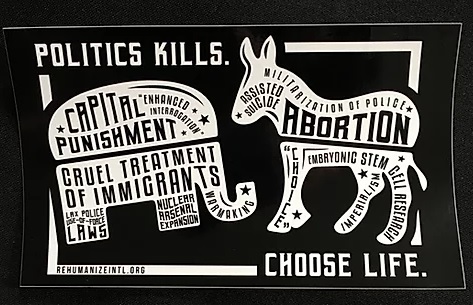
graphic from our member group Rehumanize International
A more subtle form of determining who deserves to live is determining who deserves to eat when they can’t afford to feed themselves (and the taxpayer is footing the bill). It’ss depraved that we should insist people be deemed deserving of help before we’re willing to assist with basic human needs. The concept of innocence plays into that in many ways as well. Children and the elderly, for some, deserve help because they have a limited ability to help themselves, but an able-bodied adult deserves to go hungry if they don’t work hard enough to earn a living wage. If they are in need because of alcoholism or addiction, this is also their fault. They’re guilty and undeserving of assistance.
Segregating human beings into the “deserving poor” and “undeserving poor” serves a selfish purpose: it allows people to rationalize their unwillingness to share their good fortune by insisting that many people in need are unworthy of their help. Segregating human beings into those “deserving of life” and “undeserving of life” is the other side of the same coin: it rationalizes for survivors the choice to kill and reap the benefits they only get if certain people die. Both major parties do it. Neither one stands consistently for equality and non-violence.
It’s time to stop pretending to value human life only when it suits us. For this reason, the only moral course of action for those who revere human life is to reject both the Left and the Right and stand consistently for non-violence.
===================================================
For posts on similar topics, see:
The Death Penalty and Abortion: The Conservative/Liberal Straitjacket
Elections 2020: Three Consistent-Life Approaches
Pro-life Voting Strategy: A Problem without an Answer
My Difficulty in Voting: Identifying the Problem (about the American Solidarity Party)
How Consistent-life Advocacy Would Benefit from Ranked-Choice Voting
See also our website which keeps track of Peace & Life Referendums
Common Sense Is Not So Common
by Josephine Garnem
As Matthew quotes Jesus, “Woe to you, scribes and Pharisees, you hypocrites. You…have neglected the weightier things of the law: judgment and mercy and fidelity. [But] these you should have done, without neglecting the others. Blind guides, who strain out the gnat and swallow the camel!” (Matthew 23: 23-24, New American Bible)
How do I explain something as fundamental as 1 + 1 = 2? How is it that, despite our evolved consciousness and knowledge, we still struggle to recognize and uphold the inherent dignity and value of every human being from conception to old age and beyond? Why do we continue to overlook the interconnectedness of life issues in shaping our society? We cannot speak of being pro-life if we neglect the effects of unmet social needs, poverty, forced migration due to conflict, both man-made and natural disasters, resource disparities favoring the privileged few, and the need for comprehensive systems, policies, and services that reduce the demand for abortions. We must prioritize dialogue, peace, quality end-of-life care, second chances, rehabilitation, and alternatives to the death penalty. We must confront systemic racism, violence, injustice, nuclear weapons building, environmental injustice, political corruption, and polarization, all of which are often fueled by religious institutions, self-righteous politicians, and religious leaders.
Far too often, we find ourselves trapped in a vicious cycle of ignoring the root causes of the issues we claim to be concerned about. Instead of addressing these causes, we resort to punitive responses that stigmatize, dehumanize, punish, and marginalize individuals. We must question what we truly understand as the meaning of human life.
When I first moved to the United States and found a community in a nearby Catholic church, I was filled with joy and admiration for the immense effort and resources put into planning the first March for Life event I attended. The sight of nearly the entire student body from the Catholic schools my children attended, the strong encouragement and support from school and church leadership, and the participation of people from diverse backgrounds—Catholics and Christians of all colors, genders, denominations, and ages—made me believe that I was surrounded by individuals willing to march for a cause that promotes the dignity of life.
However, a few incidents shook me to the core and continue to trouble me. When advocacy groups organized marches against various forms of violence—urging for sensible and ethical gun reform legislation, particularly after tragic events like the Virginia Tech shooting, Sandy Hook Elementary School shooting, Sutherland Springs church shooting, and many others—I never received a letter, email, or heard a sermon or any encouragement from our priests or schools to participate.
Gun violence in America claimed the lives of over 45,000 people in 2020. Approximately 117,000 people are shot annually and 19,000 children and teens are shot and killed or wounded each year. Gun violence is undeniably a pro-life issue. Yet, the familiar crowds from the March for Life events were conspicuously absent. Fewer Catholic and Christian leaders showed up, and even fewer politicians who claimed to support the pro-life cause were present.

Josephine Garnem
When the dignity of human life is at risk and we are called to account for our actions, such as in the face of systemic racism, disproportionate incarceration of young black and brown men, inequities in services, and police brutality, the pro-life crowd thins even further. The consistency of the pro-life stance appears to become biased and selective. It seems as though the message being conveyed is “not all lives matter” in the same way.
I pause to wonder why I don’t see the same pro-life crowds at events like the Poor People’s Campaign march to Washington. These marches address issues that speak to the inherent dignity of every human being. We must interweave the fabric of pro-life values with issues such as raising the minimum wage, ensuring fair wages for a better quality of life, breaking the cycle of poverty, providing access to healthcare, housing, and food, enabling individuals to bear and care for their children, and meeting other basic life necessities.
We often fail to recognize the importance of consistent life ethics when we proclaim the sacredness of life and the unquestionable perfection of God, but then fail to love and accept those who identify with different genders or no gender at all. We use religion and politics to deny others their rights to thrive, make choices, and experience love. We close our hearts and doors to those who bear the image and spark of the beloved.
I have developed a deep love for the United States, and I am proud and honored to call it my home. It has given me so much! However, I can’t help but question how we have forgotten the holy family’s journey as immigrants and Jesus’ teachings about feeding the hungry, clothing the naked, and sheltering the homeless. We have chosen to reconstruct the truth and manipulate religion, politics, and power to decide which lives are sacred and which are not, which migrants to welcome and which to shut out, which wars are just and which are unjust, which form of nuclear armament is justified, and what race is considered supreme. We determine who remains enslaved and who goes free.
Unfortunately, common sense is not so common. We are losing sight of the true meaning of life ethics and our moral obligation to recognize and uphold the dignity of every human being in all their forms. We fail to see the divine in others as we should.
Joan Chittister raises an important point when she states, “I do not believe that just because you are opposed to abortion, that makes you pro-life. In fact, I think in many cases, your morality is deeply lacking if all you want is a child born but not a child fed, a child educated, a child housed. And why would I think that you don’t? Because you don’t want any tax money to go there. That’s not pro-life. That’s pro-birth. We need a much broader conversation on what the morality of pro-life is.” She further expresses her perplexity at how the church fails to address women’s health issues or abortion with the same nuance as other life issues.
Pope Francis also warns against falsely prioritizing certain social concerns as if some lives were inherently more important than others. He cautions against allowing a particular focus, such as abortion or migrant issues, to distort our valuing of human life in other areas.
John Dear emphasizes Jesus’ instruction to passionately pursue social, economic, and racial justice. We are called to resist systemic injustice with every fiber of our being, to seek justice as if it were vital for our very sustenance.
As we strive for a consistent and dignified pro-life approach, Fr. Richard Rohr suggests that Christianity will regain its moral authority when it equally emphasizes social sin alongside individual sin, weaving both into a seamless garment of love and truth.
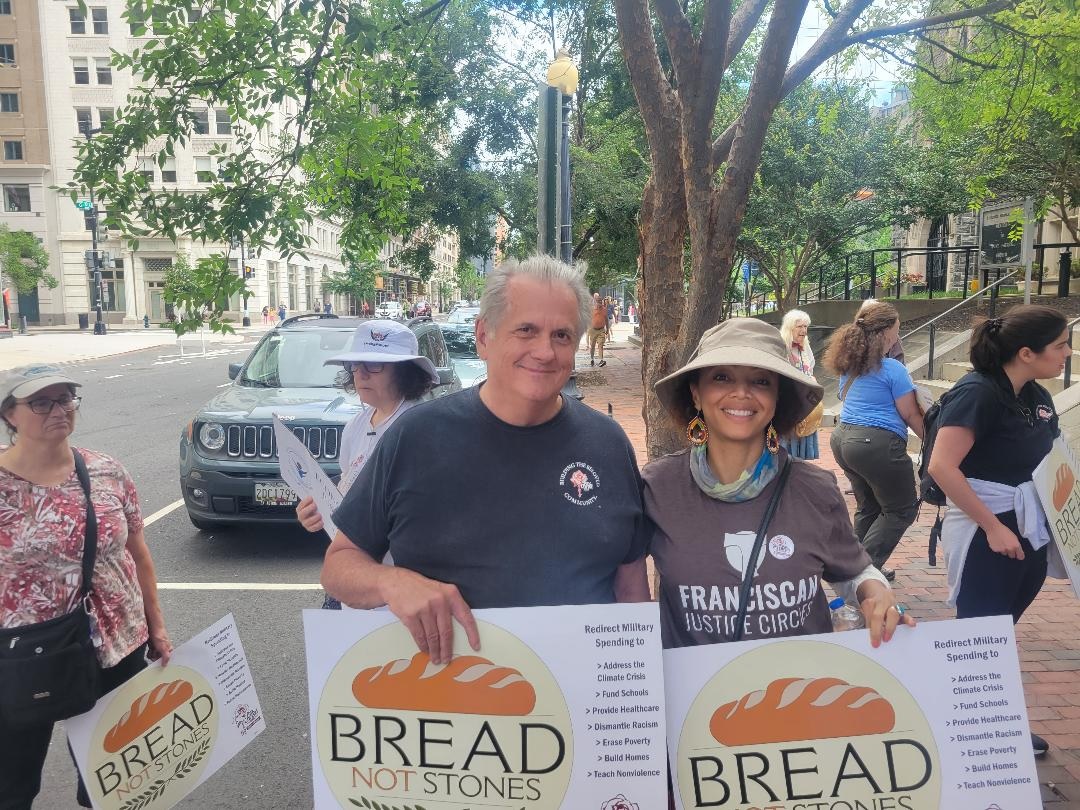
Bob Cooke & Josephine Garnem
In his sermon to mark the 50th anniversary of Pax Christi USA, Bishop John Stowe of the Roman Catholic Diocese of Lexington, Kentucky, reminded us of Jesus’ call to be vigilant, to never become complacent. He mentions how Pax Christi has vigilantly monitored the nuclear arms race, advocated for justice worldwide, challenged their own nation’s contributions to injustice, confronted climate change’s impact on vulnerable populations, and stood in solidarity with migrants and refugees. He stresses the need for vigilance against violence that can exist within our own hearts and urges us to build a treasury of peace through prayer, study, action, and calling each other to greater integrity as people of peace.
Ultimately, all life possesses immeasurable value. The weakest, most vulnerable, sick, old, unborn, and poor are masterpieces of God’s creation, made in His own image, destined to live forever, and deserving the utmost reverence and respect.
To heal our world, we must be willing to change our lifestyles for the sake of others’ lives. We must strive to create a society that values and protects every human being, ensuring access to food, education, work, healthcare, and freedom from violence. This comprehensive approach embodies the true essence of being pro-life.
======================================================
For posts on a similar topic, see:
Open Letter to Governor Stitt: the Pro-life Case against the Death Penalty
Social Programs to Help the Poor are Pro-life
What History Shows: The Consistent Life Ethic Works for Pro-life Referendums
War Hysteria and Post-Dobbs Reactions
by Rachel MacNair
The backlash to the overturn of Roe was predictable. I wrote a piece on the psychology behind Explaining Belligerency awhile back, and that’s a major way of explaining it on this issue and many others. That helps account for not just what we’re going through now, but the bits of belligerency we’ve had all along.
But what we’re going through now is more intense. Besides, the human mind is such that there are likely to be several explanations for how it works.
Here I want to add another concept from peace psychology: the normal mode of thinking, and the mythic mode/cartoon mentality/fairy-tale view that goes with what’s commonly called war hysteria.
Good vs. Evil, No Dissent Allowed
Lawrence LeShan, in his book The Psychology of War: Comprehending Its Mystique and Its Madness, preposes we have different modes of perceiving reality at different times. We move between these modes easily and automatically.
In his example, a businessman at his business thinks about things in a way that goes by his senses. LeShan calls this the sensory mode. The rules go with a realistic understanding of how the world operates. But at home, the businessman hears his child crying out in fear. As he dashes upstairs, he says a prayer that the child be all right. It would never occur to him to pray that way at work. That’s not how work works. Seeing the child is fine, he holds her and assures her everything’s all right and safe. He wouldn’t say this at work either – it’s inaccurate. But he isn’t lying to his child. The rules of comforting a frightened child are different. How he sees reality is different. The businessman shifts naturally between these different perceptions of reality with their different rules.
For war, LeShan proposes there’s often a shift to a mythic mode. The rules for understanding what’s going on change dramatically. Reasons that make so much sense in the sensory mode become quickly forgotten.
A prime example is the escalation to World War I. International travel in Europe was way up, so dehumanized views of the enemy weren’t caused by lack of exposure to other peoples. Many pacifist groups existed, and the international socialist movement was fairly strong. Once war broke out, the socialist groups shifted to belonging to their own nations and enthusiastically supported it. All the work on explaining what was wrong with war went down the tubes, remarkably quickly. LeShan suggests this is because people were no longer in a sensory mode that takes reasoning into account. Large numbers of people shifted to the mythic mode. The war was on.
Below is a chart, paraphrased from LeShan’s book, which explains the difference between normal peace-time thinking and what has come to commonly be called war hysteria.
Different Perceptions

Literary Example: The Wizard of Oz
Kansas, in black and white, is the real world. Dorothy travels to the mythic land of Oz. In this full-color world, rules change.
She kills two women. When the first woman is accidentally killed by the falling house, the people immediately sing and dance and throw a party. When the second woman is killed, her guards give Dorothy a cheer. Dorothy stays a heroine because both women are witches. They represent Evil. They can’t be reasoned with. They aren’t real people.
Back in Kansas, the same actress who played the Wicked Witch of the West plays Miss Gulch. Miss Gulch threatens Dorothy’s dog Toto. Yet the worst that befalls her is that she gets told off by Auntie Em and her plot to destroy Toto is foiled when Toto runs away. Both fates fit her offenses. The audience can cheer.
How would the audience feel if Dorothy had killed Miss Gulch?
Even accidentally, this would be sinister. Though the audience is against Miss Gulch, that doesn’t mean a killing could possibly be justified. Kansas is the real world. People may be mean, but they aren’t Evil Incarnate. Dorothy would no longer be an innocent person.

Shift to the Fairy Tale View
The point at which the mobilization to war becomes strongest is when enough of the population has made this shift that those people who remain in sensory mode are in danger. Questioning the rightness of the cause becomes treason. Many such people therefore keep quiet or join the shift.
The beginning of “The War Prayer,” by Mark Twain describes this shift especially well. The excitement generated by the war, the withdrawal of those who questioned its rightness, and the minister praying for victory are all signs of the shift to a mythic perception of reality. A stranger comes and explains to people what it was they had actually prayed for. The stranger was still in sensory mode, grounded in factual reality. That people were in mythic mode instead is shown by the punch line: “It was believed this man was a lunatic, since there was no sense in what he said.”
This is not to say all wars are fought with most of the population in mythic mode. The World Wars were, but for example the American war in Vietnam wasn’t. The population never mobilized for it. There were no popular war songs. When factual data from Vietnam came through on television sets, people were still in sensory mode. And so they were appalled.
Post-Dobbs
I’ll leave it to the reader to notice how the above concept might apply to many areas of post-Dobbs backlash. It’s especially obvious with groups like Jane’s Revenge, but it can also be seen in much of mainstream media and pronouncements of certain politicians.
Of course, it’s not a mobilization of the entire society, and major portions of society are only influenced by it rather than having fully shifted out of normal-reality mode. But those of us who are active on abortion can feel it keenly. I personally find the sting of that backlash in my own friends with a level of hostility badly out of bounds.
I’ve said for a long time that one of my major motivations for being active on the consistent life ethic is that the peace movement can’t be successful in achieving peace if it doesn’t act like a peace movement.
We may be able better to figure out how to counter this if we know when a mythic mode of thinking is there. It’s frustrating that simply explaining things well doesn’t work, but people have to be in the frame of mind that goes with caring about explanations.
But the good news is that this is by its nature temporary. War hysteria doesn’t maintain itself well. While the bits of belligerency will last awhile, there will come a point when the negative energy will soften. Our job is to help make that sooner rather than later.
===========================================
For more of our posts on similar topics, see:
Post-Roe Stats: the Natural Experiment
The Mind’s Drive for Consistency
The Creativity of the Fore-closed Option
Almost No One? How Survey Polls Work
Bigotry against Babies with Down Syndrome
by Sarah Terzo
Worldwide, most babies diagnosed prenatally with Down syndrome are aborted. US statistics vary, but one study put the overall number at 67%.
People Who Want to Abort Babies with Down Syndrome Give Their Reasons
Rayna Rapp, who aborted a baby with Down syndrome herself, interviewed parents who were waiting for the results of Down syndrome screenings. These parents all intended to abort their babies if they tested positive. Here are some of their comments:
- I would have a very hard time dealing with a retarded child… I would feel grief, not having what I consider a normal family.1
- I have an image of how I want to interact with my child, and that’s not the kind of interaction I want, not the kind I could maintain.2
- I’m something of a perfectionist. I want the best for my child. I’ve worked hard, I went to Cornell University, I’d want that for my child… I’m sorry I can’t be more accepting, but I’m clear I wouldn’t want to continue the pregnancy.3
- The bottom line is when my neighbor said to me: “Having a ‘tard, that’s a bummer for life.”4
- I just couldn’t do it, couldn’t be that kind of mother who accepts everything, loves her kid no matter what. What about me? Maybe it’s selfish, I don’t know. But I just didn’t want all those problems in my life.
- If he can’t grow up to have a shot at becoming the president, we don’t want him.6
- It’s devastating, it’s a waste, all the love that goes into kids like that. 7
- I think it’s kind of like triage, or like euthanasia… We’d have to move, to focus our whole family on getting a handicapped kid a better deal… Why spend $50,000 to save one child?8
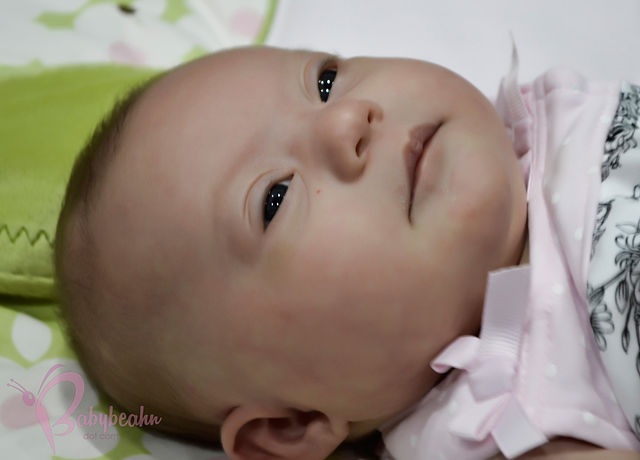
Aborting babies with Down syndrome is often seen as compassionate. Ob-gyn Katherine McHugh wrote in the Washington Post:
Research suggests that women terminate between 60 and 90 percent of pregnancies diagnosed with Down syndrome. These decisions are made out of love and compassion, a seemingly obvious concept but one that bears emphasizing.
Abortionist Says Aborting Down Syndrome Babies is Like Prescribing Antibiotics
There is an organization devoted to placing children with Down syndrome with adoptive parents, and they present stories of families that have welcomed a Down syndrome child into their lives.
Nevertheless, many still believe hurtful and ablest stereotypes.
Abortionist Malcolm Potts described abortion as a valid way to eliminate children with Down syndrome:
Abortion is a way in which nature — Darwinian evolution — deals with abnormalities… If a woman asks me to do what nature failed to do and she wishes it, I will, with great comfort, abort a Down syndrome when it’s been diagnosed in a pregnant woman if she wants it. I see abortion as a necessary healing process.
Potts refers to the child as “a Down syndrome,” reducing him or her to a medical diagnosis and dehumanizing them. He compares aborting these children to prescribing antibiotics:
As a doctor, if someone has pneumonia and their immune system is not keeping up with it, I will prescribe an antibiotic. If they have an abnormal baby and they wish to have an abortion, I will give them a medical abortion. To me, it is the same basic ethic that all, I think, physicians have.
Teaching “Counselors” to Recommend Abortion
A textbook meant to teach medical professionals how to “counsel” women considering abortion discourages “non-directive” counseling when a child is disabled. Instead, it encouraged “counselors” to directly advise abortion:
When counselling, the aim of the health professional involved would normally be to support a decision-making process but not to influence it. There has recently been lively debate whether a non-directive approach is possible or even ideal when fetal abnormality has been discovered…
By receiving non-directive counselling, the couple are urged to make their own impossible decision at a time when they are grief stricken and in emotional turmoil. Couples in this kind of situation are often desperate to be advised what to do, and being able to say “the doctor advised us to have a termination” can sometimes be a blessed relief.9
There is evidence that doctors are taking this advice to heart.
Painting a Negative Picture of Life with Down Syndrome
Jo-Ann described herself as “fearful and anxious” when she learned there was a one in 93 chance her preborn child would have Down syndrome. She says:
We were given a handout that itemized all the health issues related to Down syndrome. It painted a very negative picture of this condition. I do not recall receiving any information about support groups.
The “counselor” pressured her to have an amniocentesis, with its risk of miscarriage, to diagnose her baby. She was repeatedly told, again and again, that this would give her the opportunity to abort. Jo-Ann recalls, “The last thing I remember her saying to us was, ‘You do not need to have this child.’”
Her son James was born with Down syndrome. Jo-Ann says she has a “wonderful family” that was “made more complete” by her son.
Cynthia Yunke recalls telling the doctor she wouldn’t abort her baby with Down syndrome.
According to her, the doctor “mutter[ed] something about getting back to me in a few days because, ‘I don’t think it is registering with you what I have just told you.’”10
Another doctor, after detecting a possible problem via ultrasound, “shook her head with great displeasure”11 when the child’s mother told her she hadn’t had a screening to detect anomalies. The doctor arranged an amniocentesis for the next morning at 9 AM. According to the mother, Robin Roach, “she never even gave us a choice.”
The perinatologist doing the test assured Robin that she would still have time to abort if it came out positive. Robin recalls thinking, “Why did she keep saying that? No one asked me if I even wanted to.”12
Several days later, the doctor told her her child had Down syndrome and said, “I understand from the perinatologist that you would like to terminate.” Robin objected, saying she hadn’t decided what to do.
She describes herself as being “confused, sick, and hurt” and “angry that the perinatologist had been so aggressive and intrusive in my private affairs, especially at a time when I was so vulnerable to the power of suggestion.”13
She had her son over the objections of her doctors.

Secular Pro-Life highlighted another case where a woman was told her child was at risk for Down syndrome. Before the diagnosis was even confirmed, “The doctor gave me a long list of negative health conditions involved with Down syndrome… He emphasized it shouldn’t be hard for me to get immediately pregnant after an abortion if I wanted to ‘try again for a normal baby.’”
When the amniocentesis came back positive, the doctor again mentioned abortion. Fortunately, she and her husband found another doctor who was supportive. She named her daughter Kaylen and later adopted another little girl with Down syndrome.
In a study of 3,000 parents of children with Down syndrome, the majority reported that their doctors painted a dismal picture of life with Down, mentioning only the negative aspects.
Dehumanizing Babies with Disabilities
When an amniocentesis found that Jessica Capitani’s preborn son had Down syndrome, the doctor went ahead and scheduled an abortion for her. When she didn’t keep the appointment, she says, he was “very surprised.”
Capitani says that the doctor began calling her 21-week-old son “it” and “a fetus” instead of “baby” as soon as he discovered the disability, “[a]s if I had a horrible cyst growing inside of me they couldn’t wait to eradicate. There was that subtle pressure to have the abortion.”
Another woman was told her baby “would be more like a fish than a human and would only be as smart as a baboon.”
One doctor that if she had her baby with Down syndrome, her child would “just be hanging off of you, drooling.” The doctor “contort[ed] her face into a saggy, expressionless imitation” of what she thought a disabled child would look like.
Pressured, Scorned and Harassed
Pregnant at only 16, Danielle Urie was told her child had a heart defect and would require major surgery. While she was still “in deep shock,” her doctors advised abortion.
She says, “They gave me half an hour to decide… I told them there and then there was no possibility I was going to abort. They told me Steven wouldn’t be able to have a good quality of life.”
Although problems with the baby’s heart were found not to be as serious as originally believed, doctors later told her her son had Down syndrome. She calls Steven the “most amazing, beautiful, kindhearted little boy in the whole world.”
Kristina Artuković describes the reaction of doctors when she and her husband refused to abort their baby with Down syndrome:
[M]y husband and I were repeatedly harassed and generally scorned by the medical community. They tried to set us on the right track: screen, diagnose, abort. They made clear that as obstetricians, they were deeply aware of things, and, as mere parents, we were ignorant and irresponsible for wanting our child.

Footnotes
1. Rayna Rapp Testing Women, Testing the Fetus: The Social Impact of Amniocentesis in America (New York: Routledge, 1999) 133
2. Ibid., 133-134
3. Ibid., 91
4. Ibid., 138
5. Ibid., 92
6. Ibid., 134
7. Ibid., 146
8. Ibid.
9. Joanna Brien, Ida Fairbairn Pregnancy and Abortion Counseling (London: Routledge, 1996) 130-131
10. Cynthia Yunke “Surprise!” in Kathryn Lynard Soper Gifts: Mothers Reflect on How Children with Down Syndrome Enrich Their Lives (Bethesda, Maryland: Woodbine House, 2007) 115
11. Robin Roach “Oh, Yeah?” Kathryn Lynard Soper Gifts…, 26-27
12. Ibid.
13. Ibid., 28
================================
For more of our posts on this topic, see:
A Lawyer’s Turnaround on Baby Doe with Her Own Down Syndrome Baby
Abortion and People with Disabilities
How Euthanasia and Poverty Threaten the Disabled