Gaza War: Outrageous and Foolish
Statements of heartache and horror abound around the world. Every war is monstrous, and it hurts so badly when a new one is declared Here we offer comments focused on the one that flared up so badly this last weekend.
Stephen Zunes Facebook Posts
Professor of Politics, University of San Francisco
Zunes is co-editor of our book, Consistently Opposing Killing: From Abortion to Assisted Suicide, the Death Penalty, and War.
Hamas once again has failed to recognize that killing civilians is not just morally reprehensible but politically counter-productive. They aren’t like Israel and Saudi Arabia, which can kill thousands of civilians with impunity and still receive massive military and diplomatic support from the United States.
Hamas attacks on civilian targets in Israel, like any attacks against civilians by anyone, are completely unjustified. The Biden administration is totally wrong, however, to say they are “unprovoked.” Israel has been killing many scores of Palestinian civilians, including children, in recent months and Hamas has been warning it would retaliate if they continued.
Just a few months ago, I was talking with an Israeli friend who worried that if the Biden administration didn’t press Netanyahu to stop the repression, land confiscations, and other provocations things would explode. Yesterday, her kibbutz was overrun by Hamas. She is missing – apparently kidnapped or killed.
The Republican efforts to claim Iran is somehow behind the Hamas attacks misses the basic fact that Iran is not a big supporter of Hamas. They were on opposite sides in the Syrian Civil War. Unlike Hezbollah in Lebanon and allied militia in Syria and Iraq, Hamas has never received sophisticated weapons or Iranian advisors. This claim also denies agency to the long-suffering
Palestinians in the open air prison that is the Gaza Strip, who – however immoral and irrational their ongoing terror operations may be – have their own motivation to attack Israel.
Islamic Jihad, which also based in Gaza, has received some Iranian assistance, but Hamas is definitely taking the lead currently.
Also, historically, Hamas has gotten more support from sources in the Arab Gulf states – autocratic kingdoms backed by the United States – than they have from Iran or Syria.
If Iran was behind this, they would have pushed Hezbollah, which has far more sophisticated missiles and other ordinance, to attack as well.
This line being taken by the Republicans is a disingenuous effort to try to blame this ongoing tragedy on Biden for supposedly being “soft” on Iran. They are taking advantage of the suffering by both Israeli civilians and Palestinian civilians, who are taking the brunt of the war, to try to score political points.
I have friends in Kibbutz Kissufim and Kibbutz Kerem Shalom located just to the south of the Gaza Strip. They are progressives who have fought for decades against the occupation of the West Bank and the siege of Gaza. Both kibbutzim are currently under Hamas control and Israel is fighting to get them back. Haven’t heard from any of them. Don’t know if they have been kidnapped, killed, or are in hiding. It’s not looking good. They have been steadfast allies to the Palestinian struggle. They don’t deserve this.
World Beyond War
Palestine, Like Much of the World, Needs a Radical Change
While WBW is not a member group, they have made excellent presentations at the Rehumanize International conference.
[N]othing excuses the violence committed by Hamas. The Israeli government has not chosen to learn that its violence may produce more violence. Hamas has not chosen to learn that its violence may produce more violence . . .
In the first Palestinian intifada in the late 1980s to early 1990s, much of the subjugated population effectively became self-governing entities through nonviolent noncooperation. In Rashid Khalidi’s book The Hundred Years’ War on Palestine, he argues that this disorganized, spontaneous, grassroots, and largely nonviolent effort did more good than the PLO had done for decades, that it unified a resistance movement and shifted world opinion, despite co-option, opposition, and misdirection by a PLO oblivious to the need to influence world opinion and utterly naive about the need for applying pressure on Israel and the United States. This contrasts sharply with the violence and the counterproductive results of the Second Intifada in 2000, in the view of Khalidi and many others. We can expect counterproductive results from the latest attacks on Israel as well . . .
The challenge to everyone on Earth in these moments is to not think childishly, to not figure out which side to entirely condemn and which to entirely praise. The enemy, as always, is not a group of people, not the people of Gaza, not the people of Israel, and not any government. The enemy is warfare. It can only be ended by advancing superior alternatives.
Combatants for Peace
These are former Israeli and Palestinians fighters who have laid down their arms. This comes from an email.

We wept and watched in horror as Palestinian militants killed hundreds of Israeli civilians and kidnapped innocent women, children, and the elderly. We now hurt and grieve as the lives of so many innocent Palestinian civilians are taken in Gaza. As politicians stoke the flames of hatred, violence, and division, it is the innocent that suffer. For our movement of Israelis and Palestinians, the pain is unbearable. And yet, no matter what, our activists’ commitment to one another and to a nonviolent future of peace and freedom for all is unwavering . . .
Our movement knows that there is no future without an end to the occupation. We have witnessed nearly six decades of military control over an entire civilian population and a suffocating, unlivable blockade on Gaza for 16 years. CfP was formed almost 20 years ago by those who know, firsthand, that violence only begets violence, no one wins in war, and that we must protect all life by forging another way. We still believe in another way, even now, especially now.
In our bi-national WhatsApp groups, Israeli and Palestinian members are sending each other prayers and words of grief and love. In Hebrew and Arabic, they are forwarding safety protocols and practices for calming a trauma response. We are seeing a longing from both sides to see each other safe and for the violence to stop. They are checking on each other’s families, especially those who live on opposite sides of the Gaza border. We are all meeting later today to listen to one another and to discuss actions we can take as a community.
===========================================
We have many posts on war, of course, but here are couple of interest. See our full list of blog posts for more.
Looking Beyond Anti-Imperialism: A Response to Some Arguments about the Ukraine War
A Plea for Quiet – and for Peace: Consistent Life Ethic Themes in Fahrenheit 451
by John Whitehead
Fahrenheit 451, Ray Bradbury’s classic dystopian science fiction novel, turns 70 years old this October. The novel has been described as being about censorship, which is an accurate but limited characterization. The book contains other themes, some of which may interest consistent life ethic activists.
The novel imagines a future United States in which owning and reading books is a crime and any books discovered by the authorities are burned by a branch of the security forces known as “Firemen.”

The protagonist, Guy Montag, is a fireman who becomes disillusioned with his way of life and the anti-book policies he enforces. Montag eventually allies with dissidents who try to preserve books and knowledge. All this leads to an inevitable confrontation with his colleagues.
Along with its concern about the evils of censorship, Fahrenheit 451 contains two less obvious but significant themes, one about the importance of reflection and another about the devaluation of human life.
Stimulation Over Reflection
The censorship regime in Fahrenheit 451 has revealing characteristics. The dystopian government notably suppresses books as such: not books by any particular author or about any particular subject or expressing any particular ideology but all books.
Montag and the book-reading dissidents he encounters are similarly value-neutral about the books they preserve. One dissident, the retired schoolteacher Faber, enthuses over obtaining a copy of the Bible even though he acknowledges that he is not religious. Other books being preserved by the novel’s resistance movement are varied and contradictory in their content and significance, ranging from Plato to Buddhist thought to Bertrand Russell.
What the authorities are trying to stamp out—and the resistance is trying to preserve—is not any particular heterodox thought but thought in general, of which books are the prime representative.
Another distinct characteristic of the censorship regime is that it exists, in a sense, by popular demand, or at least through a kind of vicious circle between the people and their rulers.
The future United States imagined by Bradbury is a society of near-constant electronically produced stimulation. People listen to streams of news and music through the “Seashells,” miniature radios that fit in their ears. Television screens are floor-to-ceiling length, for maximum effect; three walls within Montag’s house are occupied by such screens and his vapid wife Mildred aspires to install a fourth wall-screen. Commercials play over the PA system on the subway, and so on.
During a scene when Mildred and her friends watch TV, we get a sense of the contemporary entertainment:
On one wall a woman smiled and drank orange juice simultaneously . . . In the other walls an x-ray of the same woman revealed the contracting journey of the refreshing beverage on its way to her delighted stomach! Abruptly the room took off on a rocket flight into the clouds, it plunged into a lime-green sea where blue fish ate red and yellow fish. A minute later, Three White Cartoon Clowns chopped off each other’s limbs to the accompaniment of immense incoming tides of laughter. Two minutes more and the room whipped out of town to the jet cars wildly circling an arena, bashing and backing up and bashing each other again. Montag saw a number of bodies fly in the air (pp. 93-94 [all page numbers are from the 1991 Ballantine Del Ray edition]).
In a society where ever-more-vivid and overwhelming entertainment is delivered at any ever-increasing pace, people are incapable of sustained interest in something that requires time, patience, and concentration, such as a book. As a result, reading becomes suspect, something eccentrics or contrarians do. The government then steps in to suppress the bizarre practice of reading, in accord with its own interests in keeping the people passive.
The insidious force here is not technology per se but rather the exaltation of stimulation at the expense of quiet and reflection. In 2023, when access to an online world of social media posts is only as far as our mobile phones, when earbuds do the work of the Seashells, and TVs can take up much of a wall, the relevance of this aspect of Fahrenheit 451 is hard to miss.
Life Is Cheap
The death of reflection and critical thought in Fahrenheit 451 ties into the theme of how life is devalued.
The novel’s dystopian United States is marked by pervasive violence. The most obvious violence is the repressive violence visited by the authorities on dissidents. This aspect of the story was provoked partly by Bradbury’s experience of being harassed by a Los Angeles police officer (an incident that also inspired his story “The Pedestrian.”)
However, violence also comes from private citizens. People, especially teenagers, drive too fast for the thrill of it—in one key scene, a group of joy-riding teenagers almost kill Montag. Some pursue even more dangerous activities. As a teenager comments, “Six of my friends have been shot in the last year alone. Ten of them died in car wrecks” (p. 30).
Another type of violence comes up when Montag confronts Mildred’s similarly vacuous friends. Reproaching Mrs. Bowles, who jokes about her lack of interest in her own children, Montag mentions “the dozen abortions you’ve had” (p. 101).
These different types of casual private violence are presumably meant to be symptoms of a society in which no one thinks about life or their responsibilities to others in anything but the most superficial of ways.
Fahrenheit 451 also addresses the violence of war, although this topic stays in the background until the end. A possible war between the United States and other nations looms over the characters for much the book, foreshadowed in the frequent presence of military planes overhead. Toward the novel’s climax, war moves inescapably from the background to the foreground of the story, leading to (for me, at least) the book’s most riveting and frightening passages.
Contemplating the situation, one member of the book-loving resistance expresses the hope that by preserving human knowledge and culture they can help humanity reach a point where we “dig the biggest grave of all time and shove war in and cover it up” (p. 164).

The connection between the anti-war theme and what has come before is easy to draw. The same ignorance, passivity, and irresponsibility that keeps people from reading also keeps them from paying attention to world events and from speaking out against the war before it came. An unreflective, unthinking public can give a war-mongering government the blank check it needs. As one official comments, “If you don’t want a man unhappy politically, don’t give him two sides to a question to worry him; give him one. Better yet, give him none. Let him forget there is such a thing as war” (p. 61).
The connections among Fahrenheit 451’s themes about censorship, public ignorance, and war are especially striking when one considers the historical context in which Bradbury wrote the book. In 1953, the Cold War was in one of its coldest periods, with the United States and Soviet Union embroiled in a bloody proxy war in Korea. Meanwhile, fears of Communist subversion were intense in the United States, and Senator Joseph R. McCarthy was then at the height of his influence. Bradbury’s novel echoed this real-world combination of events and trends.
As Bradbury later recalled, “The threat of atomic war was very fresh in my mind when I wrote the novel . . . We all were living in anticipation of being hurt or destroyed by this device. And the hydrogen bomb was in the process of being invented. It was a threat to all of us and I wrote the book under the cloud of this concept.”
He later thought the book’s war threat was an unnecessary addition, but I think it adds a very powerful extra significance to Fahrenheit 451.
Seventy years later, violent threats to life, whether from police repression, abortion, war, or other dangers, remain pressing problems in the United States and elsewhere. Such a dangerous world calls for people willing to engage in reflection, study, and criticism and to raise their voices against violence. Reading books is a good place to start.
===========================================
For more of our book reviews, see:
Book Review – Rehumanize: A Vision to Secure Human Rights for All
Defenders of the Unborn: The Pro-life Movement Before Roe v. Wade
The Tragedy of Carrie Buck: A Review of Imbeciles
How to Move from Theory to Practice: Reading “A Consistent Life”
Catastrophe by Mistake: The Button and the Danger of Accidental Nuclear War
Adoption and Foster Care
by Fr. Jim Hewes
There are several areas of concern when looking at foster care: the children, the biological parents, the potential foster care, guardianship, custodial relationship with a relative, the adoptive parents, the agencies involved, the court system, and states’ oversight.
Foster Care
According to a report on foster care by the American Enterprise Institute, each year, over half a million US children experience foster care, with over 100,000 children waiting for adoption. The majority of these children are designated for reunification with their biological parent or parents, because foster care is meant to be a temporary arrangement when children cannot remain safely in their parent or parents’ care, due to abuse, neglect, parental incapacity, abandonment, or other unsafe circumstances.
The most important aspect of foster care is the children involved in the foster care system. There is a real need for more caring foster or adoptive parents, especially for children with special needs, multiple siblings whose separation should be avoided, or older children. Improved care for these children would help shorten the average stay in foster homes, whether children seek permanent adoption or parental reunification.
Many if not most children in foster care have experienced some form of trauma, even PTSD, because of mental illness, drug addiction or some other problems of their parents. Babies placed in the foster care system may be suffering from Fetal Alcohol Spectrum Disorder (FASD) or a rarer form of Reactive Attachment Disorder (RAD).
In addition, there needs to be a full and completely transparent report (physical, mental, emotional, social, etc.) of the situation each child is coming from, in terms of their parents’ household. There are times where there is too little background or history of the child’s previous living situation, which means that future foster parents will not be equipped to deal with children who come out of traumatic situations. These children are placed in an unknown and strange place after coming out of an already dysfunctional environment.

Many children coming out of such toxic environments have found ways to cope and survive, which can often mean that they at times can be manipulative in getting what they want. After a while they can learn how to “play” the system in order to gain sympathy, or to be moved to another family, sometimes by threatening the foster family.
Thus, there is often a need to place such special needs children in what are called “therapeutic homes.” These foster parents are given extensive and comprehensive training to be able to parent children with challenging backgrounds, especially older children who have been in dysfunctional families or in the foster system for a longer period of time. Otherwise, the lack of necessary training will leave foster parents ill-equipped to adequately parent the children. Foster parents may then feel overwhelmed at dealing with very difficult situations, or they may be left almost on their own.
When the term “foster care” is mentioned, people often assume that foster parents are individuals looking for money. There is no doubt this happens, which shows the need to have more thorough screening, yet there are numerous examples of very generous couples and individuals who are loving foster parents.
Child Protective Services (CPS) caseworkers can have a real overload in the number of cases they manage, which doesn’t allow the time for more frequent or longer visits to the foster homes and hurts the needed quality of care. Also, their backs are against the wall when there are no beds available to place the foster children.
State legislators also play a role in passing legislation that will either enhance the entire foster care system or fail to do so.
Adoption
About 18,000 babies in the US are voluntarily placed for domestic infant adoption yearly, and each one of them is adopted. An estimated 2 million couples in the US await an infant child to adopt, but only 4% of women in the US with unplanned pregnancies place their children for adoption. In addition, every year approximately one million single women become unexpectedly pregnant. Sadly, less than two percent choose the loving option of adoption, while two million couples eagerly wait to adopt children.
There are up to 36 couples waiting for every one baby placed for adoption. In the USA, there are approximately two million infertile couples waiting to adopt, often regardless of the child’s medical problems such as Down Syndrome, Spina Bifida, HIV infection or terminal illness. When it comes to the option of adoption, there are a variety of choices; birthmothers and fathers can choose from a confidential adoption to one that is open or any level in between. Often the benefits of open adoption can even outweigh the challenges of pregnancy, birth, and emotional transitions.

Credit: perpetualfostering.co.uk
Overall, infants are probably the smallest age group in the foster care system, because babies are often either reunified rather quickly with their biological family, or adopted.
The problem in adoption is not newborn infants, but sometimes older children or special needs children who come into the adoption system long after their birth; in fact, a significant percentage of children adopted privately were placed when they are newborns or less than a year old. The vast majority of children of any age in the foster care system were wanted at birth, but their parents became unwilling or unable to properly care for them at some point due to problems such as addiction, mental health issues, incarceration, etc.
Why This Matters
Why write all this? Foster care at its best strives for a solid reunification with the child’s biological parent or parents. If this is not possible for whatever reason, then foster care at its best will place these children in a truly caring, safe, structured and consistent environment, which will allow the child to feel wanted, valued, precious, irreplaceable and deeply loved. Abortion by its very nature conveys that this child is unwanted, devalued, unloved, a disposable commodity, thrown away in the trash.
People who support abortion claim that the child would be better off aborted than placed in foster care. But abortion doesn’t solve any one of the defects named above, nor does it offer any solutions to help improve the flaws and problems of the foster care system. In fact, it is appalling to drag foster care children into the abortion issue by implying that these innocent, precious children would have been better off dead.
The interesting thing is that the “unwanted” children the abortion industry wants to kill (soon-to-be newborns) are actually the easiest to place for adoption. How does it make sense, or help, to kill pre-born children (that are not wanted by their own mothers) because of the state of a separate group of older children (that still long to be adopted)? Ultimately, foster care and adoption are about giving life, not death, to children, their mothers, and their foster and adoptive families, to not only thrive in the present, but in future generations as well.
Every system, institution and organization is in need of constant reform, and the foster care system is no exception. The solution in the foster care system means finding more qualified foster parents, better training for foster parents, an improved screening process, a more effective caseload for child protective services workers, a better treatment of those turning 18, seeing all forms of adoption in a much more positive light, and many more possible improvements. This approach should be an area of common ground, where people on both sides of the abortion issue can agree and work together, including having more adults become foster parents whatever their position on abortion.
Abortion, on the other hand, never has been nor ever will be a path to exploring and finding these life-giving solutions to enhance the needed reform in the foster care system.
==================================
For more of our posts on child welfare, see:
Excerpt – Peace Psychology Perspectives on Abortion: Child Abuse
Children in Cages (compilation of statements on separation of US immigrant parents and children)
For more posts from Jim Hewes, see:
Abortion and Other Issues of Life: Connecting the Dots
Death Penalty and other Killing: The Destructive Effect on Us
Consistent Life History: Being Across the Board
MAID in Despair
An earlier version of this post was published by Patheos on Sept. 7, 2023
by Lois Kerschen
In current discussions about programs like Canada’s Medical Assistance In Dying (MAID), I am reminded of an episode of Star Trek: The Next Generation: “Half a Life,” which aired on May 6, 1991. (Clips of this episode are available on YouTube.)

David Ogden Stiers plays a scientist who must abandon important research because he is turning 60, the age at which all people on his planet must perform the “Resolution,” a ritual act of voluntary euthanasia.
The ritual is intended to relieve society from the responsibility of caring for the elderly, and they aren’t going to bother with choosing a time based on case-by-case analysis—for convenience and “fairness,” everyone dies at the same age.
The Resolution is so ingrained in their culture that, when the scientist considers seeking asylum on the Enterprise, his daughter says she is ashamed of him for refusing to comply with his heritage and bringing dishonor to their family. He capitulates and goes home to die in a ceremony designed to bring dignity and honor to the ending of his life.
The Madness of Crowds
 Louise Penney’s most recent bestseller, The Madness of Crowds, deals with the question of “When does euthanasia become eugenics; when is it dying by one’s own choice and dying because you are considered a burden that needs to be eliminated?”
In other words, as in the Star Trek example, when does the right to die become the obligation to die? As Penney wrote: “Will the angel of mercy dispatch, not a tormented loved one, but an inconvenience?”
Penney, a Canadian, describes the case of a nursing home during the pandemic where the residents were abandoned by the staff. The elderly and infirm were discovered in deplorable conditions and many died. Here in the US, we had similar tragedies.
While there was outrage at the time, the incident generated discussion that included, “Well, they would have died soon anyway. Perhaps it’s not such a bad thing but a blessing. The deaths of the pandemic were a cull of the weak;” therefore, ultimately a healthy remedy.
Penney’s main character knows that the underlying condition “did not lie with those who died, but with those who allowed it to happen.” That is, don’t blame the dead and the dying; it’s those living who have the problem, and it’s a problem of ethics.
Slippery Slope
Since MAID began, the slippery slope has been in a steep decline. Already, MAID is being recommended to people with depression and other conditions that can be treated, but the attitude seems to be “Why bother? There’s no shortage of people, so those with problems should just exit and save us the effort.”
As one character in Penney’s book said, the plan “isn’t just spreading death, [it’s] spreading despair. Such policies tell people, if you are not perfect, quit taking up space. We don’t need you.” Culling the weak (the unlucky, the disabled, or anyone who needs services at the taxpayer’s expense) is just practical.
The Star Trek scientist would have dishonored his family and been banished by his government if he hadn’t submitted to mandatory suicide. It was the law, so breaking that law made him a criminal.
That is the direction the euthanasia bandwagon is taking: Some people are thought to have committed the “crime” of “taking too long to die” as Penney puts it, and therefore should be executed.
One on Every Corner or In God We Trust
 In the book Make Me by Lee Child (author of the Jack Reacher series), Reacher happens upon a town that is the final destination for those seeking physician-assisted suicide (PAS). “Is this the future?” one character asks. “It could be 100 years from now. Chaos, over-population, no water. There could be one of these [PAS centers] on every corner, like Starbucks.”
Are we headed to such a culture? If not mandated by law, will certain people be pressured by social censure into suicide? Will all the progress of accommodation go down the drain as the healthy, privileged, young, beautiful, and able-bodied ask, “Why should we have to spend money on their problems when they can just kill themselves?”
Already, many people, of all ages, say that they would commit suicide rather than be a burden in infirmity or old age, or have to endure pain. Examples of this choice are everywhere in the media: movies, TV, books (as my examples indicate). They permeate modern opinion.
===========================================
For a few of our other posts on euthanasia, see:
A Process of Tender Understanding and Loving Closure when Life Ends (also by Lois Kerschen)
Figuring out Euthanasia: What Does it Really Mean?
#SayHisName: The Medical Murder of Michael Hickson
How Euthanasia and Poverty Threaten the Disabled
What’s Cruel for the Incarcerated is Cruel for the Terminally Ill
Looking Beyond Anti-Imperialism: A Response to Some Arguments about the Ukraine War
by John Whitehead
A New York Times article caught my eye recently because it seemed to confirm a tendency I had noticed among certain peace activists, particularly those on the political Left.
The article comments, “As the war in Ukraine drags on, it is not uncommon to hear peace activists and progressive politicians, including many who have opposed American interventions elsewhere, make an exception for Ukraine’s self-defense against Russia.” The article notes the relatively muted response from certain anti-war groups to US military support for Ukraine and the swiftly abandoned proposal for diplomacy with Russia made by the Congressional Progressive Caucus last October.
The Times’ observations were broadly consistent with my own observations. In reading and personal encounters, I have encountered a reluctance among otherwise peace-minded people to call for a less hawkish US response to Russia’s invasion of Ukraine and even a willingness to support current US policy.
While I sympathize with the reasons given for this unusual stance, I think the stance rests on a mistaken emphasis on opposition to imperialism or aggression. Such opposition, while justified, neglects the importance of a general opposition to war.
Anti-Imperialist Arguments
Since the Russian invasion began, various self-identified critics of hawkish US policies who take a less critical stance toward the Ukraine war have explained their reasoning. These explanations contain recurring themes.
The most prominent theme is that supporting Ukraine’s armed self-defense is the logical conclusion of opposition to imperialism.
Joseph Cirincione, a foreign policy analyst whose political engagement began with protesting the US war in Vietnam, comments that support for Ukraine’s war effort is consistent with principles of “staunch opposition to imperialist intervention” and “steadfast support for a nation’s right of self-determination.”
Matthew Duss, a former foreign policy advisor to Senator Bernie Sanders (I-Vt) wrote in the New Republic that “preventing powerful countries from invading and obliterating weaker ones should be a core principle” of a “more stable, humane, and progressive” international order. He called for solidarity with Ukrainians and argued that by supporting Ukraine without directly intervening in the war the Biden administration “is getting it mostly right.”
Historian Matthew Specter, writing in Dissent, similarly commented that progressives “should unapologetically support the defensive war for Ukrainian sovereignty; the Left cannot afford to renounce its historical commitment to national self-determination… Ukraine’s struggle to survive is an anticolonial struggle.”
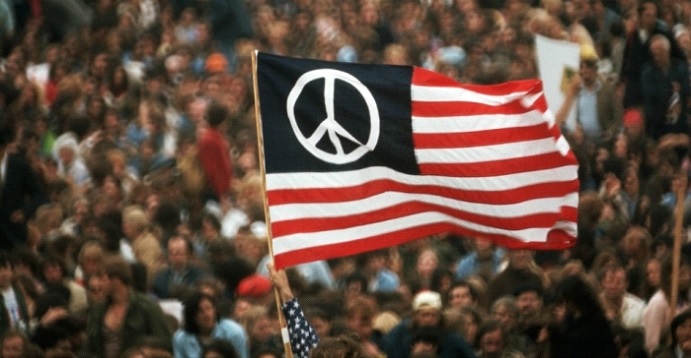
Another theme is the contrast between Ukraine’s war against Russia and past US wars, especially the Iraq War. Cirincione warned that fears of another war “such as the catastrophic U.S. invasion of Iraq” should not lead the Left to oppose action “to stop an imperialist aggressor.” Duss emphasized that “the Biden administration is not the Bush administration.”
Jon Rainwater of Peace Action distinguished between Ukraine’s “actual self-defense” and American “wars of choice in places like Iraq, Libya and Afghanistan.” Stephen Miles of Win without War drew a parallel between “Putin’s aggression in Ukraine and George W. Bush’s invasion of Iraq,” commenting that “the onus for ending the war is with the aggressor” and that in the case of Ukraine, “more often than not, President Biden has gotten it right.”
Beyond Anti-Imperialism
These writers and activists identify some important truths. Russia is engaged in an aggressive, imperialist war. Ukraine is seeking to defend itself, in a war effort that is quite different from the United States’ 2003 invasion of Iraq. Outrage over Russia’s actions and sympathy for Ukraine is the appropriate reaction to the current situation.
However, these commentators fail to address crucial questions: is war the best solution to Russian aggression? Could the war end up causing far more harm than good?
The various arguments for US military support to Ukraine cited above seem to implicitly assume that if a war is defensive or anti-imperialist then that fact should resolve all doubts or skepticism about the war. Such an assumption is unwarranted. The nature of war is to be massively destructive and often futile, and history gives examples of wars fought for defensive or otherwise worthy causes leading to bitterly disappointing outcomes.
Ukraine’s war of self-defense against Russia is unlikely to be an exception to the rule that war yields counter-productive results. I have argued before that most of the likely outcomes of the war continuing are extremely bad ones. I may be mistaken in that judgment but the question of how the Ukraine war will end needs to be addressed, even if it is a war for self-defense or against imperialism.
These writers and activists’ emphasis on anti-imperialism and the negative example of the Iraq War also reveals an oddly selective criticism of US foreign policy. As they must be aware, the United States has fought wars that were not as unambiguously aggressive as the Iraq War but that nevertheless had dire consequences—and that were opposed at the time by peace activists.

The US war in Afghanistan, for example, and the larger Global War on Terrorism were launched in response to the September 11, 2001, terrorist attacks. Both US policies could plausibly be described as forms of self-defense against an adversary that, if not precisely imperialistic, was certainly engaged in aggression. Yet these policies still ended in disaster because they relied on destructive means ill-suited to responding to the aggression that prompted them.
Going slightly further back in history provides another relevant example, the Persian Gulf War of 1990-1991. This US-led war was prompted by Iraq’s invasion of Kuwait, an act of aggression comparable to Russia’s invasion of Ukraine. Yet at the time many people, including most Democratic members of Congress, opposed using military force to stop Iraqi imperialism or defend Kuwait’s self-determination.
Opposition to the Gulf War could be based on a recognition of Iraqi aggression combined with reasonable concerns about the war’s destructive results. Such a stance was expressed at the war’s outset by Bernie Sanders, then a congressman.
Sanders called Iraqi President Saddam Hussein a “vicious dictator who illegally and brutally invaded Kuwait” but also expressed his concern that “the death and destruction caused will not, in my opinion, soon be forgotten by the Third World in general — and by the poor people of the Middle East in particular.” He presciently added, “I fear that someday we will regret that decision and that we are in fact laying the groundwork for more and more wars in that region in years to come.”
He continued with a call “to support our troops in the most basic way — by bringing them home alive and well. I urge my fellow members to ask the President to stop the bombing immediately and request that the Secretary General of the United Nations go to Iraq to begin immediate negotiations for the withdrawal of Iraq from Kuwait and the cessation of the war.”
Opposition to the current US policy of sending weapons, including cluster bombs, to Ukraine and support for diplomacy aimed at a cease-fire could be defended in similar terms. The anti-war group Peace Action, to its credit, has provided an excellent list of recommendations for constructive, nonviolent responses to the Ukraine war. (While produced relatively early in the war, many of the recommendations remain relevant today.)
More broadly, critics of hawkish US policies might do well to base their criticism more on war’s destructive, often uncontrollable consequences rather than on whether a given war is imperialistic or aggressive. Being anti-imperialistic or defensive is no guarantee against a war leading to disaster. Searching for nonviolent means of opposing imperialism and aggression is a wiser strategy.
============================================
For more of our posts on Ukraine, see:
A Hidden Cost of the Ukraine War: How Russia’s Invasion Encourages the Spread of Nuclear Weapons
A Catastrophe Decades in the Making: The Russian Invasion of Ukraine
Not Your Pawns: A CLE Examination of the Russia-Ukraine Conflict
For more of our posts on the cost of war, see:
Seeing War’s Victims: The New York Times Investigation of Civilian Casualties in Iraq and Syria
Finding Common Ground on and Learning from World War II
The Civil War Conundrum, 150 Years Later
Two Women Pregnant from Rape, Two Outcomes
by Sarah Terzo
In 2021, Janet Morana wrote a book for teens on abortion. She tells the story of two women who became pregnant from rape.
A Woman Who Aborted a Pregnancy from Rape
One rape victim was Nicole from Virginia. She had an abortion at four weeks. Nicole says she came to “deeply regret” her abortion:
There is no good reason to have an abortion. All the logical reasons fail to keep your heart from breaking when it’s over.
If, like me, you were raped, and you think you can’t bear nine months of pregnancy, I can tell you from experience the 17 years of regret have been worse.1
Nicole now believes “my baby was a gift from a loving God who wanted to give me a purpose for my pain.”2 Although the rape was extremely traumatic, Nicole says that the abortion was the “beginning of the real nightmare for me.”3 She adds, “The abortion made healing from rape infinitely more difficult by compounding the trauma . . . Abortion is not the answer for rape.”4

A Woman Who Chose Life
Liz was a 17-year-old high school student in Kentucky who was drugged and date raped after a party during her senior year.
Like many women, she didn’t want to talk about the rape with anyone. She just wanted to forget. Liz says, “I would never have told anyone about it, except I got pregnant.”5
Even though Liz had always been pro-life, she was emotionally overwhelmed by her situation and planned to abort. Everything changed when a friend told her, “You know you can’t kill a baby.”6Faced with the stark and terrible truth of what abortion really is, she gave her baby life.
Through Catholic Social Services, Liz arranged an open adoption. In an open adoption, the birth mother may keep in touch with the family that adopts her baby, and, many times, has ongoing contact with them.
She had a boy. Morana says:
People often ask [Liz] if she sees the face of her attacker when she looks at her son, this boy who is being raised in a loving home.
Her answer: ‘I have never seen anything other than that beautiful boy.’7
Pro-abortion activists, as well as many well-meaning people who consider themselves pro-life, often say that the baby will be a constant reminder of the rape. In reality, the rape victim doesn’t need need to be reminded in order to remember. Rape is emotionally devastating. She will never forget it.
In many cases, the baby is not a reminder, but is seen as something good that resulted from a horrible, tragic experience. (See the stories at the end of this article.)
Studies on People Who Became Pregnant from Rape
How Many Rape Pregnancies Are There?
According to a study in the prestigious American Journal of Obstetrics and Gynecology, an estimated 32,101 pregnancies result from rape every year. These are only a small fraction of pregnancies. There were 6,369,000 pregnancies in 2013, the most recent statistics I could find. This would mean that pregnancies through rape comprise half of one percent of pregnancies.
Nevertheless, 32,100 is not an insignificant number. It represents tens of thousands of people. These pregnancies also affect their families, friends, and loved ones.
Since the percentage of people who conceive through rape is extremely small, pro-lifers aren’t lying when they say pregnancy from rape is rare. However, 30,000+ pregnant people are far from insignificant. Each pregnant person has an individual story and is extremely important as a human being. Therefore, I would caution against using the “pregnancies through rape are so rare” argument, as this argument implies that over 32,000 people aren’t important.
According to the study:
A total 32.4% of these victims did not discover they were pregnant until they had already entered the second trimester; 32.2% opted to keep the infant, whereas 50% underwent abortion and 5.9% placed the infant for adoption; an additional 11.8% had spontaneous abortion [miscarriage].
So, over a third of pregnant people carry to term and most raise their children.
Only about 6% chose adoption, a number that may be surprising to some people. But it shows that during the pregnancy or at the time of birth, the remaining 94% of women bonded with their babies.
This shows that the common belief that people who become pregnant through rape can’t possibly love their children is wrong.
Do Those Who Abort After Rape Regret Their Abortions?
In an article for Live Action News, I discussed two studies analyzing the emotional impact of abortion after rape.
 David Reardon, Amy Sobie, and Julie Makimaa wrote a book called Victims and Victors: Speaking out about Their Pregnancies, Abortions, and Children Resulting from Sexual Assault. In it, they presented the statistics of their study, as well as first-hand testimonies from women who became pregnant from rape and either aborted or chose life for their babies.
The book is available for $3.99 on Kindle and one can read it with the Kindle app on any smart phone, tablet, laptop, or desktop computer. In some places, itcan be borrowed for free from libraries. It should be widely read among those who consider themselves pro-life.
This study found that 73% of pregnant rape victims chose life. Of these women, 64% raised their children, and 36% placed their babies for adoption.
The researchers found that 88% of women who aborted felt they made the wrong choice.
Of all the women interviewed, only one expressed positive feelings about her abortion. The others that said they didn’t regret their abortions had mixed feelings. They felt ambivalent, thinking abortion was the right choice for them but acknowledging that it was very painful.
Ninety-three percent of the woman who aborted said they wouldn’t recommend abortion to other pregnant rape survivors. Only 7% felt that abortion was a good solution for pregnancies conceived through rape.
Notably, 43% said they were coerced into their abortions. They mentioned pressure from family members and/or abortion providers.
This is a startling contrast to the women who carried to term. Of the women who chose life, 80% explicitly expressed happiness about their child and/or their situation. Only four out of eighty-two women who chose life say that abortion “might” be a good solution for women pregnant from rape. Ninety-four percent said abortion was not a good solution for rape pregnancies.
The Emotional Aftermath of Abortion after Rape
Another study was conducted by Dr. Sandra Mahkorn, MD. and William V Dolan, MD. Seemingly counterintuitively, Mahkorn and Dolan found that 75%, or three quarters, of the women in their study carried to term.
They explained why many women chose life:
Beliefs that abortion involves violence, killing, or was immoral were the reasons most frequently reported for clients’ decisions against abortion.
Client viewpoints such as abortion is a “violent way of ending a human life” or abortion is “killing” w ere noted.
Others expressed the belief in an intrinsic meaning to human life, reflected in opinions such as “all life has meaning” or “this child can bring love and happiness into someone’s life.”
One pregnant victim related that she felt she would suffer more mental anguish by taking the life of the child.8
Instead of interviewing the women, Mahkorn and Dolan sought feedback from their therapists. The researchers asked these mental health professionals to measure how the women were coping on a scale. They were asked to rate things like self-esteem, anxiety, fear, satisfaction with their life circumstances, loneliness, depression, and contentedness. The therapists rated the intensity of these feelings in the women they counseled.
One questionnaire was completed when the woman first contacted the mental health providers, and they completed more questionnaires as therapy continued.
The women who conceived through rape and chose life showed more positive improvement over time than the women who chose abortion. The study showed that, according to the mental health professionals, women who carried to term had an easier time coping and healed faster emotionally than those who aborted. They consistently scored better on the scale as time went on. According to Mahkorn and Dolan, their study showed that:
pregnancy need not impede the victim’s resolution of the trauma . . . rather, with loving support, nonjudgmental attitudes, and emphatic communication, healthy emotional and psychological responses are possible despite the added burden of pregnancy.9
While no one can make a generalization about how abortion after rape will affect every woman, research found that in many cases, abortion only added to survivor’s trauma and slowed their healing.
Not only does abortion kill a baby, it often scars and traumatizes the one who aborts—even in cases of rape.
Many Stories
Many other women have given testimonies that are like those quoted in this article. See some of their stories below:
https://www.liveaction.org/news/multiple-abortions-abuse-regret-wendy/
https://www.liveaction.org/news/brenda-abortion-rape-trauma-hid-decades/
https://www.liveaction.org/news/childhood-rape-survivors-pregnant-through-rape/
https://www.liveaction.org/news/rape-survivor-traumatized-coerced-abortion/
https://www.liveaction.org/news/rape-survivor-pregnant-regret-abortion-pill/
https://www.liveaction.org/news/abortion-rape-regret-suicide/
https://www.liveaction.org/news/forced-abort-baby-rape-pain-every-day/
https://www.liveaction.org/news/rape-victim-abortion-five-miscarriages/
Footnotes
- Janet Morana Everything You Need to Know about Abortion – For Teens (Gastonia, North Carolina: TAN Books, 2021) 78.
- Ibid., 78.
- Ibid.
- Ibid.
- Ibid., 79.
- Ibid.
- Ibid.
- Sandra Kathleen Mahkorn, MD and William V Dolan, MD “Sexual Assault in Pregnancy” in Thomas Hilgers, Dennis Horan, and David Mall eds.New Perspectives on Human Abortion (Frederick, Maryland: University Publications of America, 1981); Sandra Kathleen Mahkorn “Pregnancy and Sexual Assault“ David Mall and Walter Watts, Eds. The Psychological Aspects of Abortion (Washington DC: University Publications of America, 1979.
- Ibid.
=============================================
For more of our posts on rape and abortion, see:
Abortion Facilitates Sex Abuse: Documentation
The Message of “Never Rarely Sometimes Always”: Abortion Gets Sexual Predators Off the Hook
How Abortion is Useful for Rape Culture
A Pro-Life Feminist Critique of the “Rape and Incest Exception”
The Left/Right Divide: A New Approach
by Rachel MacNair
I’ve long had a problem in figuring out what the underlying principle is between distinguishing left-wing and right-wing.
I was told during the Reagan years that right-wingers want less government. But so many who identified as right-wing, and were understood that way in the media, wanted more and stronger military, police, FBI, etc. So that didn’t fit.
I was told that left-wingers want more protections for those who need it. But so many who identified as left-wing and were understood that way in the media made an exception for humans not yet born.
I inquired of several people what they thought the principle behind the difference was. Mainly, people didn’t know.
As a consistent-lifer, I was accounted as both right-wing and left-wing. Our saying was “The dove needs both wings to fly.”

Lines Matter. Or Don’t.
There’s quite a bit of study on the right/left distinction in political psychology, where they’re defined by self-identification. Scientific American recently published a new idea on this point, called Many Differences between Liberals and Conservatives May Boil Down to One Belief. To quote:
Psychologists have long suspected that a few fundamental differences in worldviews might underlie the conservative-liberal rift. Forty years of research has shown that, on average, conservatives see the world as a more dangerous place than liberals do. This one belief seemed to help explain many American conservative stances in policy disagreements, such as support of gun ownership, border enforcement, and increased spending on police and the military – all of which, one can argue, are meant to protect people from a threatening world.
But new research . . . contradicts that long-standing theory. We find instead that the main difference between the left and the right is whether people believe the world is inherently hierarchical. Conservatives, our work shows, tend to believe more strongly than liberals in . . . the view that the universe is a place where the lines between categories or concepts matter. A clearer understanding of that difference could help society better bridge political divides.
These researchers gave surveys to thousands of people. They asked the survey-takers to rate how conservative or liberal they are. They asked all kinds of questions about policy positions. Then they used the kind of statistics that pull out themes (factor analysis).
But belief that the world was dangerous wasn’t as linked to those as some other research had suggested. That makes sense to me. I know plenty who emphasize such things as nuclear risks, environmental degradation and police brutality as showing how dangerous the world is, and understand themselves to be left-wing while doing so. As with the amount of government and the protection of the vulnerable, these things actually vary by issue rather than being an underlying principle.
They found that the primary belief they called “hierarchical” was 20 times more strongly related to people’s self-identified right/left position:
People who score high in hierarchical world belief see the world as full of differences that matter because they usually reflect something real, inherent and significant. Such individuals often separate things of greater value from things of lesser value. You might imagine that to them the world looks full of big, bold black lines. In the opposite view—held by people with lower scores for this belief—differences tend to be seen as superficial and even silly. For those with this perspective, the world is mostly dotted lines or shades of gray.
Fitting in the Consistent Life Ethic
Under this idea (which I’m not endorsing, but playing with) –
Abortion: There’s a strong line at conception – that’s when the life of an individual human begins. Also, there’s a line against killing. Therefore, under this scheme, consistent-lifers have a right-wing position. Saying it’s iffy when the life of a human being begins, or that there are times when killing is ok, would then be left-wing.
Euthanasia: There’s a line at intention, saying that intending death is a form of killing – and again, a line against killing. So opposing euthanasia is right-wing under this definition. However, the people who favor “aid in dying” and oppose involuntary euthanasia will draw a line at the individual’s choice. That would also then be right-wing. Just different lines.
Death Penalty: There’s a line that executions are just plain wrong, period. No exceptions. Total death penalty abolition is therefore right-wing in this scheme. People who think there might be exceptions or that killing might be ok under some circumstances are therefore left-wing in this scheme. This is of course backwards from the positions as understood nowadays. But it could also be seen that there’s a strict line about horrific crimes deserving horrific punishment, requiring deterrence, etc., which would be more right-wing, and that may be how these researchers understand it.
War: Pacifists, by definition, draw the line and say no war, period. Hence, right-wing. Advocates of just war theory have clear lines, too – clear definitions, and in European-derived cultures, the criteria set out by Augustine. Those who fudge on those criteria, which includes just about all wars that actually happen, would then be more left-wing under this lines-matter method of ascertaining right/left differences.
Racism: When I was a girl in the 1960s, racists were understood to be right-wingers by definition. Dividing races into clear categories is also right-wing according to this scheme; left-wingers tend to see more blurred lines and see them as irrelevant. Unless, of course, they’re currently into identity politics and affirmative action, where the fine distinctions become very important. That would then be right-wing, only opposite: seeing various races positively rather than negatively. Of course, nowadays, being told a person is a right-winger isn’t enough to tell you the person isn’t Black, and Black right-wingers generally resent the suggestion of being racist.
Poverty: Right wing could include lines about the deserving poor and the undeserving poor, or lines about taxpayers not being charged for assistance, or charities being the organizations that should be the ones helping. But really, quite a few right-wingers live in poverty themselves. Poverty itself has a clear governmental definition based on income, and I fit that definition for several years while still doing international travel – it wasn’t really a good definition for ascertaining real deprivation. Lines are a lot harder to draw on this issue. But then, as the researchers said, not everything is lines.

Conclusion
One way to see the reason the CLE is both left- and right-wing is that we differ on making divisions – including the divisions on left and right. We support more policies understood to be left wing when that’s healthier, prevents harm, or provides economic justice. We tend to blur the line between right and left, which in this approach’s understanding is a very left-wing thing to do.
But we do have the clear line of not killing human beings. People who want to kill blur the boundaries, and rationalize.
I think, all in all, I don’t have any more of a handle on what the difference in principle between right-wing and left-wing is than I did before.
==========================================
For more of our posts on right-wing/left-wing differences, see:
The Death Penalty and Abortion: The Conservative/Liberal Straitjacket
“Never Again”: Taking Action against the Nuclear Threat
by John Whitehead
The following is adapted from remarks given at the Vigil to End the Nuclear Danger, a peace witness outside the White House co-sponsored by the Consistent Life Network.

John Whitehead, delivering these remarks
We are here today to call for an end to the nuclear threat that hangs over humanity. We are here to remember the past and to call for action in the present, because the nuclear threat has been a part of our past and is part of our present today. And if we do not prevent it, the nuclear threat may well prevent all of us from having a future.
The nuclear threat began 78 years ago this July with the testing of the first atomic bomb in New Mexico. The bomb’s terrible consequences became apparent immediately, when that initial test, through its radioactive fallout, harmed those living close by.
Nuclear weapons soon showed their horrific power to harm even more vividly when they were used 78 years ago this August to annihilate two cities, Hiroshima and Nagasaki, killing tens of thousands of their inhabitants. The mass killing at Hiroshima and Nagasaki was the first and—to date—only use of nuclear weapons in wartime. Sadly, though, Hiroshima and Nagasaki did not mark the end of the threat from nuclear weapons.
The United States and soon other nations (ultimately eight other nations in total) built more nuclear weapons in the years after 1945. And those nuclear weapons continued to wreak their terrible consequences.
More people were harmed and had their lives cut short because of continued nuclear testing, both here in the United States and across the globe. More people were harmed or had their lives cut short or had their land polluted by the toxic consequences of mining uranium to make nuclear weapons. Many more people, especially the world’s poorest people, were robbed of resources they needed that instead went into building and maintaining nuclear weapons.
Above all, the continued presence of nuclear weapons over the last 78 years has meant that all humanity, every single person on this planet, has been living under the threat of nuclear war. The threat of nuclear war means the threat of a war that could kill on a scale beyond imagining and bring an end to civilization.
The threat of nuclear war has not gone away. In fact, it is more present than ever today in 2023. The Ukraine war seriously threatens to escalate into a nuclear war between Russia and the United States. Other conflicts, such as those between the United States and China or North Korea, also hold the possibility of turning into nuclear conflicts. Meanwhile, still more hundreds of billions of dollars are slated to be wasted on nuclear weapons; the facilities at Los Alamos, which once built the first nuclear bomb, are now preparing to build nuclear weapons again.
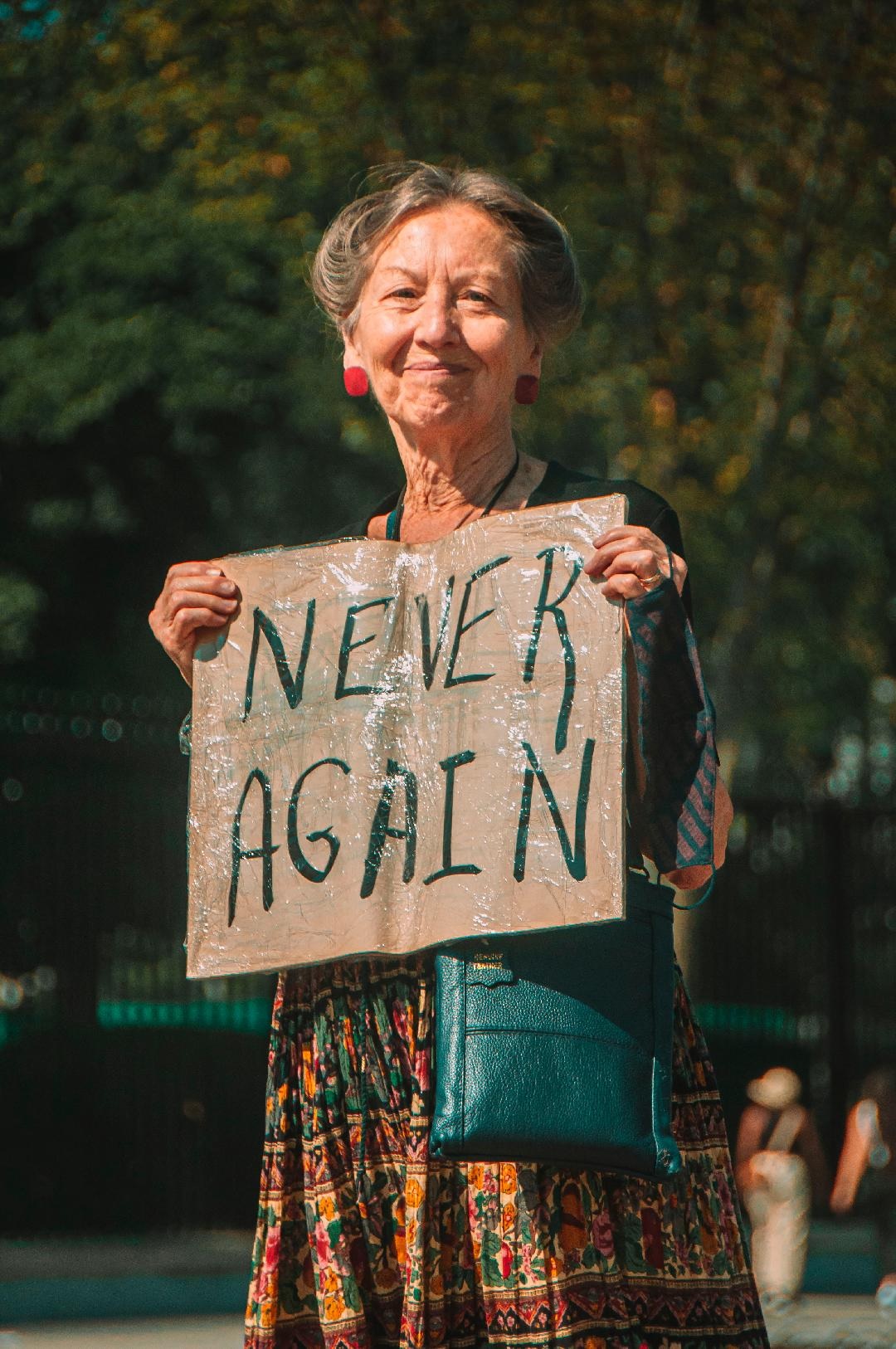
Mary Liepold at the vigil
The situation today is very dangerous and requires action. People are taking action, though, and that is reason for hope.
An international movement against nuclear weapons culminated a few years ago in an international Treaty on the Prohibition of Nuclear Weapons. That treaty, which came into effect in 2021, commits the nations who signed and ratified it to renounce the possession of nuclear weapons. To date, 68 nations have committed themselves to this treaty, which demonstrates the opposition to nuclear weapons that exists across the world.
Another hopeful sign is the efforts of the Back from the Brink Campaign. Back from the Brink is working to reduce the danger of nuclear war through a series of crucial policy steps that the United States could take. These steps include taking nuclear weapons off the high level of alert that allows the weapons to be used at a moment’s notice; making it impossible for nuclear weapons to be used only by the decision of a single human being, the president of the United States; and cancelling plans to spend untold amounts of money on new nuclear weapons.
Both these efforts to end the nuclear danger, the Treaty on the Prohibition of Nuclear Weapons and the Back from the Brink Campaign, have recently gained support within the United States Congress. This year, members of Congress introduced House Resolution 77, which calls on the United States both to adopt similar measures to those advocated by the Back from the Brink Campaign and to embrace the goals of the UN Treaty on the Prohibition of Nuclear Weapons. This resolution provides a crucial first step in building significant political momentum within the United States toward ending the nuclear threat.
All these efforts are reasons for hope because, to repeat, we need to take action to end this threat. We need to finally end the catastrophic danger that has hung over humanity since the first atomic bomb was tested 78 years ago. Remembering the horrific loss of life from the Hiroshima and Nagasaki bombings and the many, many people harmed by nuclear testing, nuclear weapons production, and the theft of resources from the poor for making these weapons, we are here today to say “Never again.”
=========================================
For more of our posts in which John Whitehead discusses nuclear weapons, see:
The Persisting Threat of Nuclear Weapons: A Brief Primer
Nuclear Disarmament as a Social Justice Issue
A Global Effort to Protect Life: The UN Treaty Banning Nuclear Weapons
“Everybody Else in the World Was Dead”: Hiroshima’s Legacy
Documentary Review: The Movement and the Madman
by Rachel MacNair
In the title, “The Movement and the Madman,” the “movement” is the peace movement trying to stop the American war in Vietnam. To be more precise, it was the Moratorium demonstrations in October and November of 1969. The “madman” is Richard Nixon, and it’s not intended as a mere insult. It’s actually the word he was using for the strategy he had in mind: convincing the North Vietnamese that he was crazy enough to escalate precipitously – maybe even to the point of using nuclear weapons.
This is a PBS documentary in their American Experience series and is currently available with PBS Passport. It’s going to get wider distribution, so hopefully there will be plenty of outlets soon; keep track here.

I saw it at a national Quaker conference, where the room of about 30 people had roughly a third of them lifting their hands when asked if they had attended those 1969 events.
The film documents how the Moratorium demonstrations were organized and how people in the Nixon administration reacted. Those who participated in the demonstrations were really depressed about what happened next: the war continued on for several years. Americans died, many more Vietnamese died, the military draft and environmental degradation continued. Had all that work achieved nothing?
The answer is no: it actually achieved something stupendous. Behind the scenes, with information that came out later but was unknown at the time, Nixon, Henry Kissinger, and other cabinet members had been planning a major escalation. Nuclear threats were a real possibility, which makes the actual use of nuclear weapons something that could have happened. This was only about two decades into the age of nuclear weapons, and there was less of a sense of taboo about their use.
And that’s what those demonstrations stopped.
Anti-war demonstrators stopped something they didn’t know existed, and the documentary shows how the demonstrations led directly to a change in policy – or rather, prevented a change to a much worse policy.
How many other wars have been contemplated by people in the upper echelons, in the U.S. or other countries, that never happened because upon reflection they decided it wasn’t worth the reaction? There may have been none, and there may have been several. But we can’t count what didn’t happen. We can’t even ever know that it would have happened otherwise.
The case in this documentary is far more clear-cut than we normally would expect in the real world. While the death penalty and euthanasia have had mainly fairly small demonstrations against them, there have been huge ones opposing racism, poverty, and abortion. In all those cases, plus other war protests, some impact can be traced as having happened due to them at least in part. There are undoubtedly many cases, though, where we can’t peg it down so neatly.
But knowing about what was going on behind the scenes, and what was planned before being stopped, is a real boost to activists who otherwise feel very discouraged. We simply have to know that we can’t always be aware of all the positive impacts our actions have.
===============================
For more of our posts on the dynamics of social movements, see:
Instead of Division, Schools of Thought
Almost No One? How Survey Polls Work
The Death Penalty and Abortion: The Conservative/Liberal Straitjacket
Hiroshima’s Children
by Sarah Terzo
On August 6, 1945, the United States dropped a nuclear bomb on Hiroshima. Two hundred forty-seven thousand people, over half the city’s population, were killed. Three days later, a second bomb was dropped on Nagasaki.
Contrary to what Americans are often told, the bombings may never have been necessary to end the war.
In 1951, Japanese professor Arata Osada compiled the testimonies of children who survived. In 1980, they were translated and published in the United States.
Witnessing Burned and Injured People
Hiroaki Ichikawa was five years old when Hiroshima was bombed. He described walking through the city:
[W]e saw naked people with their burned skin hanging from them like rags. We saw others covered with blood, being carried to safer places in trucks.In the tobacco factory about a mile and a half from the bomb center were many people crying from the pain of their burns. (p. 9)
Helping Others, If Only They Could
Kimiko Takai was also five. When she and her father fled from rapidly spreading fires in the wake of the blast, they saw bloated bodies floating in the river. They encountered a woman trapped under her house and her father stopped to help. When he couldn’t free the woman, Kimiko watched him cut off her leg with a rusty saw. (p. 50-51) Her sister, aunt, and uncle died in the bombing.
Toshihiko Kondo was in first grade. He was playing with friends when the bomb fell, and ran back home, only to find his house completely destroyed. He and his father set out to find his mother and brother. They too, were fleeing the fire. He says:
I heard a baby crying a few houses away. The cry was trembling with fear. We wanted to save the baby but there was nothing we could do because the house next door was already on fire. (p. 84)
Presumably, the baby burned to death.
They found Kondo’s brother, but he later died from his injuries. His mother also was killed.

Losses from the Atomic Bomb
Masao Baba was five at the time of the bombing. His home was destroyed, his father was killed, his brother lost his ear, and his little sister lost an eye. He says:
Other kids tease my little sister because she’s got only one eye, but she tries not to cry. Sometimes though, she cries anyway when they all start laughing at her . . .
If our father were alive, he would take her to the hospital and her eye would get better but we don’t have enough money to do that…I always worry about her and it’s hard to study because I worry whether she is being teased or whether she is crying by herself. (p. 36)
The family was prosperous before the bombing but afterwards were very poor and living in a house that was “falling to pieces.” (p. 36) Many other families lost everything they had and struggled to survive and find food after the bombing.
Toshio Nakamori was six. He lost both his parents. He says:
When I go downtown, I often see little children walking along the street holding their father’s or mother’s hand. They look so happy, and this always reminds me of my own parents. My father and mother were very kind and loved me very much. I feel they will come back at any time.
Sometimes I whisper ‘Mummy’ or ‘Daddy.’ But they don’t answer. I feel sad and envy my friends who have parents. (p. 37)

An Orphanage in Japan
Yoshimi Mukuda was already living in an orphanage when the bomb was dropped. She was in first grade and had been evacuated to the country during the war. On August 10, she returned to Hiroshima. She recalls:
There was a streetcar that was burned until you could see right through it, and you could see the passengers burned black inside. When I saw this, I started to shake and couldn’t stop.
And then we came to where the orphanage used to be. Not one of our beautiful buildings was left. The hall, the girls’ wing, and the boys’ wing – there was nothing left of any of them but ashes. We had so many wonderful times in that big hall. (p. 42)
Mother Kitamura, who ran the orphanage along with her husband, lost her daughter in the bombing. After the bombing, the orphanage struggled:
[W]e had a lot of trouble getting food. Father said he didn’t care whether he ate anything himself, but he wanted food for the children and he went here and there and into the countryside looking for food. And he had much trouble getting donations. (p. 42-43)
The people of Hiroshima had little or no money to donate. Mukuda says, “A lot of little children joined us at the orphanage after the atom bomb. We try to take good care of them.” (p. 43)
Children Dying of Injuries and Radiation Poisoning
Ruriko Araoka was four years old when the bomb was dropped. Her house collapsed. She and her mother stood looking at the wreckage:
Just then a neighbor came by carrying my little brother on her back. He had burns on his face and hands, and his face was very swollen… He was three years old, and such a sweet little boy. He died a week later. When he died, he was crying ‘Mummy, Mummy.’ (p. 27)
Ruriko describes what she saw while they were running from the fires:
The hill was almost covered with people whose clothes had been burned off. Some had burned skin hanging from them and some were all black and had already died. (p. 28)
Mineo Yamamoto was in sixth grade. He and his mother were living outside of Hiroshima. They went to the city, looking for his 13-year-old brother. He recalls:
Soon after we had started walking, we saw groups of people in ragged clothing coming from the direction of Hiroshima. Their faces were so scorched that we couldn’t tell if they were men or women. They were fleeing the city. One of them had a five- or six-inch piece of wood stuck in one eye…
We started seeing children and adults lying on the ground… [W]e saw that they were people who had been terribly burned and had fled that far, but then could go no farther.
Some had already drawn their last breath. Others were crying out in agonized voices, ‘Help me! Please give me some water.’ There were children crying for their mothers. (221)
Someone told them that their brother had gone home. Mineo says:
All of our sorrow disappeared with that, and we hurried home. When we got home, there was my brother without a scratch on him, not even looking particularly tired. (221)They were overjoyed to see him alive.
Mineo’s brother told him his school had collapsed, and all his friends had died. He survived because he was under a desk. Unfortunately, Mineo’s brother soon got sick from radiation poisoning. His hair fell out, and his condition got worse and worse. Mineo says:
He was still clearly conscious when the doctor told us that there was no hope of saving him.
‘Mother, help me, please,’ he said, grasping her hand and crying. ‘I don’t want to die. Please help me.’
He kept calling out in pain and asking for water. About an hour before he died, he seemed to be in great pain, lifting up his body and shaking his head. It was so bad, I could hardly bear to be with him…
He vomited something strange… I could not tell if it was coagulated blood or part of an organ or what. (p. 222-223)
Mineo and his mother stood by helplessly as his brother died after weeks of suffering.
Spending Time in a Hospital
Akira Shinjoh was in sixth grade and was in school when the bombing happened. He ran home to find his house destroyed and his father and brother badly burned. His mother had lost an eye.
Akira’s head was covered with blood. When his anxious mother washed it off, they realized his head was uninjured – the blood was from other students who’d been near him in the classroom.
Nearly everyone in his class died, either in the initial bombing or later. He says, “I spent the empty days going to the funerals of my teachers and friends.” (p. 219)
Akira began vomiting and started losing his hair. He went to the hospital and describes his stay:
In the beds around mine at the hospital, there were people whose open wounds had rotted and were breeding maggots. There was a child of about six years old, who screamed every time the doctors peeled the gauze off his burns to treat them.
Each day, one or two of the people with me died, and new patients came in., They died too. The bodies were cremated at night in the hospital yard. The wind carried the smell of the burning bodies into the rooms of the hospital. (p. 219)
Akira eventually recovered.
These children experienced horrors no one should endure. Their stories were only a few out of thousands.
Source: Arata Osada, PhD, translated by Yoichi Fukushima Children of Hiroshima (London: Taylor & French Ltd., 1980)
===================================
For more of our posts on the bombing of Hiroshima (August 6, 1945) and Nagasaki (August 9, 1945), see:
“Everybody Else in the World Was Dead”: Hiroshima’s Legacy
The Danger That Faces Us All: Hiroshima and Nagasaki after 75 Years
Rejecting Mass Murder: Looking Back on Hiroshima and Nagasaki
For positive action against nuclear weapons, see:
A Global Effort to Protect Life: The UN Treaty Banning Nuclear Weapons
The Reynolds Family, the Nuclear Age and a Brave Wooden Boat
Nukes and the Pro-Life Christian: A Conservative Takes a Second Look at the Morality of Nuclear Weapons