Book Review – Rehumanize: A Vision to Secure Human Rights for All
by Lois Kerschen
If you want to understand the theory behind the Consistent Life Ethic (CLE) as well as how to practice it, Aimee Murphy’s book, Rehumanize: A Vision to Secure Human Rights for All, is a vital resource.
Remarkably, she manages to explain CLE with clarity and simplicity. Its multiple references to philosophers, religious leaders, and social researchers don’t make it a slog to read. It is easy to understand, and even the footnotes can be interesting. There may be 507 of them, but they either add brief, interesting adjunct information or they serve as evidence of her research, thus adding validity to her claims.
The founder of Rehumanize International, Aimee Murphy uses this book to educate and to share her passionate belief in the innate dignity of every human being. Paramount to this belief is that the ultimate insults to this dignity are violence and killing. Peace comes when we respect each other’s value as a person.

The book proposes ways to end violence in:
- Reproduction (in-vitro fertilization and abortion)
- War (war and military torture)
- Response to Crime (police brutality, torture in the justice system, and the death penalty)
- Response to Disability (euthanasia and filicide, assisted suicide).
Each section defines the topic, identifies the violence, gives an analysis and brief history of the culture and policies pertaining to the topic, and then recommends solutions.
A very useful feature of each chapter is the nonviolent counterpoints that Murphy provides in answer to the most common arguments against the CLE point of view.
Each chapter ends with a short list of possible discussion questions and suggestions for further reading on the topic. Thus, the book can be used for a class or discussion group.
Murphy then presents a review on ways to end dehumanization and rehumanize the world. Here, she covers the changes needed to combat ableism, ageism, classism, homophobia/transphobia, racism, and sexism.
The book concludes with suggestions for putting the Consistent Life Ethic into action. Basically, she recommends living your CLE convictions, even to the point of interrupting conversations to suggest replacing biased words with unbiased alternatives. She also recommends building and transforming your community and building a culture of encounter.
Unless you have written a truly worthwhile book, you don’t get rave reviews from Martin Sheen (who participated in the book launch video), Jeannie Gaffigan, Gloria Purvis, Helen Alvare, and leaders of various CLE organizations. Murphy is worthy of the praise and the faith of the Magenta Series Editor, Charles Camosy (a prolific and much-admired author and professor of Ethics). Readers can be sure of a captivating read and useful material in Rehumanize: A Vision to Secure Human Rights for All.

Currently, Aimee Murphy is on a nationwide tour with her book (until Dec. 14). You can find out more and check her schedule. She is giving talks for low- or no-cost and welcomes your help to set up and advertise for these impactful events. If you live in any of the cities on her tour list, please reach out to aimee@rehumanizeintl.org or Herb Geraghty at herb@rehumanizeintl.org to help lay the groundwork for an awesome event in your community.
==========================
The book is available for purchase from Rehumanize International.
For more book reviews on our blog, see:
Defenders of the Unborn: The Pro-life Movement Before Roe v. Wade
Making a Nonviolent Revolution: Review of Civil Resistance: What Everyone Needs to Know
The Tragedy of Carrie Buck: A Review of Imbeciles
How to Move from Theory to Practice: Reading “A Consistent Life”
A Way Beyond the Abortion Wars?
Catastrophe by Mistake: The Button and the Danger of Accidental Nuclear War
Fallout at Home Base: Nuclear Testing within the United States
This month is the 30th anniversary of the last nuclear test, September 1992.
by John Whitehead
The United States conducted the world’s first test of a nuclear weapon in New Mexico on July 16, 1945. The test was followed in August by the use of nuclear weapons against Hiroshima and Nagasaki.
Although the wartime use of nuclear weapons has mercifully never been repeated since 1945, nuclear testing was repeated. From the 1940s to the 1990s, the United States would ultimately conduct 1,030 test detonations of nuclear weapons. These tests took place above ground, underground, and underwater in a variety of locations around the world, including Pacific islands. The vast majority of tests took place within the United States, though, and left a predictably harmful legacy.

The Nevada Test Site
Most nuclear testing within the United States was in Nevada. In 1950, the Truman administration designated a test site about 65 miles northwest of Las Vegas. The test site originally encompassed 680 square miles of land; it would expand over the decades. The inaugural test at the Nevada Test Site, of a 1-kiloton nuclear bomb, took place in January 1951.
Over the next few years, about 100 above-ground nuclear tests were conducted at the Nevada site. The average bomb yield of these tests was 8.6 kilotons, somewhat less than that of the bombs dropped on Japan. Nuclear testing was also conducted underground, with all testing eventually moving underground following the 1963 Limited Test-Ban Treaty that prohibited above-ground testing. Nuclear testing in Nevada served variously to determine the power and effects of weapons, to study fallout’s effects, and even to investigate possible peaceful uses of nuclear weapons, such as for mining.
The nuclear tests inevitably resulted in serious health threats from radioactive fallout. Winds carried the fallout of above-ground tests for thousands of miles. Even underground tests sometimes vented significant amounts of radiation. The underground “Storax Sedan” test of July 1962 produced the largest radioactive fallout contamination of any nuclear test within the United States: radiation was subsequently detected in Illinois, Iowa, Nebraska, and South Dakota.
A particularly dangerous element of the testing fallout was the radioactive form of iodine, I-131. A series of tests in 1957 released especially large amounts of this element into the atmosphere. I-131 can contaminate the grazing grounds of livestock and be transferred to human beings through milk. If nursing mothers are exposed to I-131, they can pass the radioactive element to their children through breast milk.
To say that many people did not initially appreciate the threat from testing would be an understatement. Detonations from above-ground nuclear tests were visible from up to 100 miles away and subsequently became tourist attractions in nearby Las Vegas. Hotels and casinos would promote the opportunity for patrons to view the nuclear explosions.

The spectators extended beyond Las Vegas. Danielle Stephens of Kingman, Arizona, about 150 miles from the test site, watched nuclear tests when she was young. She recalls once traveling, along with her father, brother, and uncle, to watch a test from a mountain. “Back then, no one thought the tests were dangerous,” she commented.
One infamous incident was the above-ground “Harry” nuclear bomb test of May 1953. The bomb produced a far greater explosive yield than US authorities were expecting. Winds carried the fallout to St. George, Utah, and surrounding areas. Authorities were sluggish in issuing warnings to people in the affected communities, though, and did not advise people to refrain temporarily from consuming local crops or milk that might have been contaminated.
Health Effects of Testing
Health problems emerged over time among western American communities close to the Nevada Test Site. A 1984 study of Utah residents near the site found higher cancer rates than expected, including leukemia rates five times above expectations. Cancer rates in St. George specifically rose between 1950 and 1980.
In Arizona, Danielle Stephens witnessed over 30 members of her family develop various cancers. Most of them died as a result. Stephens was diagnosed with stage 4 colon cancer in 2020.
Along with civilian residents of nearby areas, military personnel were exposed to the tests’ fallout. Military personnel were involved in observing tests and cleaning up their aftermath. Sometimes they took part in war games, meant to simulate conditions in a possible nuclear war, that involved entering a fallout zone after a test. A 1999 study by National Academy of Sciences’ Institute of Medicine subsequently found higher death rates from leukemia and other cancers among service personnel exposed to the Nevada tests than personnel serving at the time who were not involved in the tests.
The harmful effects of nuclear testing received legal recognition in 1984, when a US District Court judge ruled that testing in the 1950s had led to the deaths of 10 people and that government authorities had been negligent in their conduct of the tests. This negligence included failure to warn people in Nevada and nearby states about the tests’ danger.
Compensation Efforts
In 1990, the US Congress passed the Radiation Exposure Compensation Act (RECA), which required government compensation to people who had developed diseases such as leukemia and thyroid cancer because of testing fallout. By 2018, over $2 billion in compensation had been approved for tens of thousands of people harmed by nuclear testing, as well as to people involved in other aspects of nuclear weapons’ production, such as uranium mining.
As welcome as such compensation is, RECA has limitations. The compensation does not extend to people harmed by the original Trinity nuclear test in New Mexico. RECA compensation is also limited to residents of only certain parts of Nevada, Utah, and Arizona. Stephens and other Kingman residents, for example, are not covered by RECA.
Further, the compensation is currently intended for the original generation of people affected by the Nevada tests. It does not cover the testing victims’ children or grandchildren, many of whom feel they have experienced disabilities or other health challenges because of the testing.
A bill (H.R.5338/S.2798) introduced in 2021 would address at least some of these limitations. The proposed legislation would expand RECA coverage to more areas in Nevada, Utah, and Arizona as well as other test-affected regions. The legislation would also increase compensation amounts and provide medical benefits while also expanding compensation coverage for those involved in uranium mining. Please consider contacting your representatives in the House and Senate to urge them to support this bill.
Beyond finally providing adequate compensation to those affected by nuclear weapons testing, the United States should definitively end such tests. The last US nuclear weapons test took place 30 years ago this month, in September 1992. The United States has signed the Comprehensive Test Ban Treaty but never ratified it. The Senate should finally ratify the treaty and thus legally prohibit further nuclear testing.
History shows that nuclear weapons don’t need to be used in wartime to be harmful. Testing such weapons also has a terrible cost. Let’s work to ensure no one else suffers from nuclear tests.

=====================================
For similar posts on nuclear weapons, see:
The Persisting Threat of Nuclear Weapons: A Brief Primer
Nukes and the Pro-Life Christian: A Conservative Takes a Second Look at the Morality of Nuclear Weapons
Nuclear Disarmament as a Social Justice Issue
Is an Embryo More Important than a Woman?
by Rachel MacNair
As I wade through the avalanche of post-Dobbs media coverage, I note the familiar pattern of being totally oblivious to what the objection to induced abortion is: that it kills a human being. While there exist arguments that what’s killed isn’t a human being, and other arguments that such killing is justifiable, most of the coverage ignores the point entirely.
This is customary when committing violence. Victims of war are commonly invisible as well. Killed by bombs, drone strikes, bullets – it all goes under “defense.” And therefore, they say, freedom.
But another common tack is that a woman is more important than a mere embryo. A related argument is that pro-lifers favor “forced birth.”
Importance
When considering the relationship between a mother and a prenatal baby, the mother’s decisions are the ones that determine what happens. The mother gets to decide where the prenatal baby goes. Studying in class, frolicking on the beach, working hard in an office or a factory – mom’s decision. The baby is just along for the ride. The mother decides what part of the country they live in, what they’ll eat, who they’ll interact with – everything. She’ll decide whether she’s raising the baby after birth, or making an adoption plan or other arrangements. The baby has to go with whatever she decides.
Yes, the woman or teen mom is more important when it comes to decision-making. The baby isn’t developed enough to figure out such things.

No one is proposing that an embryo or fetus is more important than other human beings. The argument is that the right to not be killed is more important than any rights that are lesser than the right to not be killed. No one even has any other rights if they don’t have the right to not be killed.
When Americans were fighting wars in Vietnam, Iraq, and Afghanistan, the number of Americans soldiers’ deaths would be reported in American media. The deaths of local people weren’t reported, as if they weren’t as important. But they were every bit as important. Wars kill people deliberately, and every single killing in these wars was wrong. Every person was important and had the right to not be killed, be they soldiers on either side or civilians, adults or teens or children or babies. Every single one.
Yet when it comes to decision-making, there’s nothing wrong with Vietnamese deciding that only Vietnamese can vote in Vietnamese elections and Americans can’t. The same goes for every other country. Citizens of age are more important as decision-makers for public policy than non-citizens or the under-age.
That doesn’t make it ok to kill or injure immigrants or kids.
“Importance” in decision-making is a separate issue from everyone having a right to not be killed.
Forced Birth?
Just about every single birth that has occurred throughout human history has been a forced birth.
The fetus was comfortable where she was, and now there’s a sudden cold and a startling slap of light. And when she lets it be known right away and in no uncertain terms that she objects, we don’t say, “oh, dear, she doesn’t like this, we’d better put her back in.” To the contrary, we’re pleased. A robust cry means good health. So thorough is our understanding that the fetus-suddenly-turned-infant will object to birth that if she doesn’t, we worry. That’s a danger sign of poor health.
Of course, this isn’t what people who use the term “forced birth” mean. They’re referring to the mother. But here again, the term is odd. What pregnant woman wants to remain pregnant indefinitely? I kept reminding myself at the last stage of my pregnancy that the kid was a heck of a lot easier to care for inside than outside my womb. It didn’t matter. I really did want to get to birth. I daresay it would be hard to find a pregnant woman that wouldn’t find birth a better idea than keeping the baby inside endlessly.
Again, that’s not what they mean. What they mean is that they believe it’s not actually a birth if the baby comes out earlier and dead instead of later and alive. But they won’t say it that bluntly.

What if the Choice is – Which One Gets to Live?
Historically, childbirth could be dangerous enough that a midwife had to choose between mother and child. Fortunately, medicine has come a long way.
There are millions of pro-life women, so there are large numbers who have faced life-threatening pregnancies. We have every bit as much of an interest in medical care for these situations as everyone else.
Here are some situations where pregnancy might endanger the mother’s life:
Ectopic Pregnancy
The embryo never gets to the fetal stage, but is stuck outside the womb, usually in the Fallopian tubes. That baby has to be removed immediately, and won’t survive the process. She wouldn’t survive if left where she is either. There is no viable pregnancy.
Meanwhile, women who are heartbroken for the baby are a lot better off having pro-life doctors who can sympathize with them.
Miscarriage
It’s a bit confusing that the medical term for miscarriage is “spontaneous” abortion. So we need to say induced abortion is the practice we object to.
But it’s not the medical procedures involved in induced abortion that are the problem. It’s using those procedures to kill the baby. If the baby is already dead, then of course those procedures may be needed to clear out the corpse that isn’t coming out on its own.
Again, many women truly need doctors to be sympathetic that a baby died; treating the child as mere medical waste can be cruel.
Medical Care for the Mother that Endangers the Baby
Conditions such as cancer or diabetes require careful management. But the baby isn’t going to do well without a healthy mother, and getting needed medical care isn’t an induced abortion nor an attempt to injure the child.
When the Pregnancy Endangers the Mother and the Baby is Old Enough to Survive
An emergency C-section takes about an hour. Inducing labor could take a few hours. The normal late-term abortion is a two-day procedure due to the need to dilate the cervix. Getting the baby out dead rather than alive isn’t better for the mother’s biological health.
In the case of a partial-birth abortion, they start the birth process and then pause it to punch a hole in the kid’s skull. How can pausing in the middle possibly be better for the mother’s biological health than just pulling the baby out without delay?
If a C-section or induced labor isn’t ideal for the baby because she’s coming out too soon, then that’s a circumstance to take into account when assessing the medical situation. But of course it’s important to save the mother’s life, and to try to save the baby’s too. If it can’t be done, then if medical care is competent at least there was no deliberate attempt to kill the baby.
The Baby’s Going to Die Soon, But Hasn’t Yet
This is the one that’s tricky, and the one that has the most horror stories in the press. But again, separating the child from the mother so she doesn’t threaten her mother’s life is intending to save someone’s life, not intending to kill a child. As with euthanasia, which can also be quite tricky, intention matters.
And to those doctors who’ve been talked about in the mainstream press’s horror stories because they’re afraid of the local prosecutor if they do competent medical care in these situations, I say: fear more the malpractice suit.
Remember, pregnant pro-life women will find themselves in such dire circumstances at roughly the same rate as other pregnant women. And activist women are all the more likely to file malpractice suits.

Finally: When the Claim is Actually a Trick
Why do legislators often take a strict and skeptical view about the “life-of-the-mother” exception? In pre-Roe days, it was often a loophole, a bold-faced lie, for doing any abortions at all.
I’d say that actually, medical personnel who try to use a life-of-the-mother exception as a dishonest cover for any abortions don’t need so much to fear the local prosecutor, who’d have a hard time making a case. Those personnel need to fear the women to whom they’re giving abortions.
Women who’ve had abortions have been joining the pro-life movement in droves all along. Pro-life conferences commonly have women telling their abortion stories – negatively, of course. Therapy groups for women who were traumatized by their abortions are a major part of what the pro-life movement does.
This is one of the major reasons pro-lifers keep saying we don’t want women prosecuted for obtaining abortions: we’re practically the lobby group for those women with negative experience.
And we know very well that these women are the ones who are most crucial to enforcing the laws. They have the needed knowledge, and once they join the pro-life movement, they have the motivation.
====================================
See also the Dublin Declaration on Maternal Health Care, signed by over 1,000 ob-gyns.
For similar posts, see:
What Do Men Have to Say on Abortion?
No Combat Experience, No Opinion: Parallels in Pro-bombing and Pro-choice Rhetoric
How Abortion is Useful for Rape Culture
A Pro-Life Feminist Critique of the “Rape and Incest Exception”
Abortion Facilitates Sex Abuse: Documentation
Abortion and People with Disabilities
The Americans with Disabilities Act (ADA) passed in 1990. This anti-discrimination legislation should have had a positive effect on perceptions of the disabled. For those well beyond infancy, it did.
But there was a dramatic decrease in the birth rate for Down Syndrome babies. A study on media framing, 1998-2006, showed disability was presented in negative terms. There were positive portrayals of prenatal testing, so that when there was a disability diagnosis, the pregnancy was terminated.
Therefore, the ready availability of abortion and its positive portrayal sabotages the cause of disability rights.

The Replaceable Fetus: A Reflection on Abortion and Disability
 Bertha Alvarez Manninen, Disability Studies Quarterly:
Although I self-identify as pro-choice, I do believe certain instances of abortion can be classified as, in Judith Jarvis Thomson’s words, indecent. . . . In particular, I am concerned with cases where fetuses that had been thus far welcomed and loved by their respective community are suddenly regarded as candidates for abortion simply because they may have been diagnosed with a disability. That is, I am worried about cases where disability is deemed sufficient grounds for dehumanizing a being who had been, up until that point, embraced.
Disability Rights and Selective Abortion
Martha Saxton, Gender and Justice in the Gene Age (conference)
 While today’s feminists are not responsible for the eugenic biases of their fore-mothers, some of these prejudices have persisted or have gone unchallenged in the reproductive rights movement today. Consequently many women with disabilities feel alienated from this movement. On the other hand some pro-choice feminists felt so deeply alienated from the disability community that they have been willing to claim, “The right wing wants to force us to have defective babies.” Clearly there is work to be done. . . .
The fact is, it is discriminatory attitudes and thoughtless behaviors, and the ostracization and lack of accommodation which follow, that make life difficult. The oppression, one way or another, is what’s most disabling about disability. . .
But many parents of disabled children have spoken up to validate the joys and satisfactions of raising a disabled child. A vast literature of books and articles by these parents confirm the view that discriminatory attitudes make raising a disabled child much more difficult than the actual logistics of their unique care. . . How is it possible to defend selective abortion on the basis of “a woman’s right to choose” when this “choice” is so constrained by oppressive values and attitudes? . . . For those with “disability-positive” attitudes, the analogy with sex-selection is obvious. Oppressive assumptions, not inherent characteristics, have devalued who this fetus will grow into.
Pregnancy with a Physical Disability: One Psychologist’s Journey.
Erin E. Andrews, Spotlight on Disability Newsletter
 When I found out I was pregnant, I was overjoyed, but also apprehensive. I am a congenital triple amputee who uses a power wheelchair for mobility. I was less concerned about the effects of my disability, and more concerned about the attitudes of others toward my pregnancy. As a rehabilitation psychologist, I am well aware that women with disabilities face barriers to reproductive health and that social biases exist which portray women with disabilities as asexual, infertile, and incapable as mothers.
 Those advocating the ready availability of abortion have also often used the same principle to approve the idea that people with disabilities might benefit from physician-assisted suicide.
For a disability-rights group with opinions about this, see
==============================
For more of our posts on disability rights, see:
How Ableism Led (and Leads) to Abortion
Roe v. Wade: Legal Scholars Comment
These quotations, in chronological order, come entirely from legal experts who approve of abortion legalization.
The Wages of Crying Wolf: A Comment on Roe v. Wade
John Hart Ely, Yale Law Journal, 82, 920, 935-937 (1973)

Roe “is not constitutional law and gives almost no sense of an obligation to try to be.”
What is frightening about Roe is that this super-protected right is not inferable from the language of the Constitution, the framers’ thinking respecting the specific problem in issue, any general value derivable from the provisions they included, or the nation’s governmental structure. Nor is it explainable in terms of the unusual political impotence of the group judicially protected vis-à-vis the interest that legislatively prevailed over it . . . At times the inferences the Court has drawn from the values the Constitution marks for special protection have been controversial, even shaky, but never before has its sense of an obligation to draw one been so obviously lacking.

The Supreme Court, 1972 Term—Foreword: Toward a Model of Roles in the Due Process of Life and Law
 Laurence Tribe, Harvard Law Review, 87, 1, 7, (1973)
One of the most curious things about Roe is that, behind its own verbal smokescreen, the substantive judgment on which it rests is nowhere to be found.
Some Thoughts on Autonomy and Equality in Relation to Roe v. Wade
 Ruth Bader Ginsburg, Associate Justice of the U.S. Supreme Court
North Carolina Law Review, 1985
Roe, I believe, would have been more acceptable as a judicial decision if it had not gone beyond a ruling on the extreme statute before the court . . . Heavy-handed judicial intervention was difficult to justify and appears to have provoked, not resolved, conflict.
The Lingering Problems with Roe v. Wade
Edward Lazarus, Former clerk to Harry Blackmun, Find Law Legal Commentary, Oct. 3, 2002
 As a matter of constitutional interpretation and judicial method, Roe borders on the indefensible. I say this as someone utterly committed to the right to choose, as someone who believes such a right has grounding elsewhere in the Constitution instead of where Roe placed it, and as someone who loved Roe’s author like a grandfather. . . .
[W]hen Democratic senators oppose a judicial appointment because of the nominee’s opposition to Roe, they not only endorse but make a litmus test out of one of the most intellectually suspect constitutional decisions of the modern era. They practically require that a judicial nominee sign on to logic that is, at best, questionable, and at worst, disingenuous and results-oriented. In doing so, they select not for faithful, but for unfaithful, constitutional interpreters to people the federal judiciary.
This is a strategy with baleful long-term consequences. The standard critique of liberal judges trumpets their willingness to substitute personal preference for legal analysis – and Roe is universally featured as Exhibit A. Conservative judges, in truth, perform the same kind of substitution just as often – but there is not yet as flagrant an Exhibit A for this contention as Roe provides.
As long as liberals embrace Roe, they will be forced to unilaterally shoulder an “activist” label that by rights, they should share with conservatives too. By not only embracing Roe, but pointing to it as the defining case of liberal constitutionalism, the Senate grandstanders only enhance the all too popular perception that liberal (but never conservative) judges routinely depart from the law, and give it far more credibility than it deserves.
The real debate in constitutional law today ought to be over the truly revolutionary nature of the conservatives’ agenda, and their willingness to do exactly what they accuse the liberals of having done in Roe: depart from constitutional sources to impose their own policy preferences. But until Democrats abandon Roe as the be all and end all of constitutional decision-making, they will continue to fight an uphill battle, having yielded the intellectual high ground to those who have no just claim to that terrain.
Shaky Basis for a Constitutional “Right”
Kermit Roosevelt, University of Pennsylvania Law School, Washington Post, January 22, 2003
 [I]t is time to admit in public that, as an example of the practice of constitutional opinion writing, Roe is a serious disappointment. You will be hard-pressed to find a constitutional law professor, even among those who support the idea of constitutional protection for the right to choose, who will embrace the opinion itself rather than the result.
This is not surprising. As constitutional argument, Roe is barely coherent. The court pulled its fundamental right to choose more or less from the constitutional ether. . . .
No opinion with such deficiencies could be expected to provide a sound basis for resolution of a hotly contested social issue, and indeed, Roe has aged poorly. . . .
By declaring an inviolable fundamental right to abortion, Roe short-circuited the democratic deliberation that is the most reliable method of deciding questions of competing values.
Akhil Reed Amar, Wall Street Journal, May 14, 2022. (Reading requires subscription)
WSJ Intro: For a constitutional scholar and pro-choice Democrat, there are reasons to endorse the leaked draft opinion overturning the 1973 abortion decision—and to see it as vindication for a range of liberal priorities.
 In 1954, in Brown v. Board of Education, the justices rightly buried their predecessors’ 1896 ruling in Plessy v. Ferguson, which had proclaimed the dubious doctrine of “separate but equal.” . . . Likewise, the New Deal Court properly repudiated dozens of earlier Gilded Age cases that read property and contract rights far too broadly and in the process invalidated minimum-wage, maximum-hour, worker-safety and consumer-protection laws of various sorts—laws that are now seen, quite rightly, as perfectly proper.
The liberal Warren Court also overruled a staggering number of precedents, introducing now familiar terms to our constitutional lexicon. . . .
Today, the Supreme Court’s 1973 opinion in Roe v. Wade, written by Justice Harry Blackmun, is similarly ripe for reversal. In the eyes of many constitutional experts across the ideological spectrum, it too lacks solid grounding in the Constitution itself . . .
Does Justice Alito’s draft, as many are now claiming, inflict collateral damage on other areas of constitutional case law, such as the Warren Court’s precedents on contraception and interracial marriage?
It does not. In fact, the Dobbs draft reinforces these iconic opinions by explaining why they were right—namely, because the freedoms recognized in these cases were “deeply rooted in the Nation’s history and tradition.” . . .
Whereas the Court in Griswold [the case allowing married couples to have contraception] sided with 49 states against the outlier Connecticut, the Court in Roe invalidated the laws of at least 49—perhaps all 50—states. The Dobbs draft takes pains to cite this stunning fact . . .
In short, I am a Democrat who supports abortion rights but opposes Roe. The Court’s ruling in the case was simply not grounded either in what the Constitution says or in the long-standing, widely embraced mores and practices of the country.
=================================
For more of our posts on Roe v. Wade:
Reflections on the Alito Draft Leak of May 2, 2022
My Ideas for Post-Roe Legislation
Beneath Layers of Lies: The Surge in Efforts to Legalize Euthanasia
by Sonja Morin

Sonja Morin
Euthanasia has returned to legislative consideration in Massachusetts, my home state. For as long as I can remember, an attempt to introduce euthanasia into our state laws would rise up every couple of years like clockwork. And every time, the bill would be struck down soon enough, even if it was by a slim majority.
This year’s euthanasia bill campaign feels different: that there is a potential for the euthanasia bill to succeed. The reason? The deceptive language, attitudes, and actions that continue to entrench our society in dehumanization.
“Not My Problem”
Even for a seasoned consistent life ethic advocate, there was much to learn from my two-year stint working in a 276-bed nursing home facility. One of those realizations that haunts me to this day is the loneliness many of the residents experienced. It was so tangible that you could see it in their eyes.
Some of these residents were living in the facility because their relatives had already died. Others were there simply because their families made their ailing or elderly members out to be a burden: not worthy of their time or effort. Too many times, I encountered the same careless attitude in coworkers and visiting staff. It was no wonder that a few residents confided in me that they wondered whether life was worth living in the first place.
Utilitarianism is built into every part of our society. That is, if a person isn’t contributing something deemed “worthy” at every waking moment, they’re just not worth it. This callous attitude has festered in the world of care for the elderly and the sick. The focus isn’t care for the human person as they exist, but expediency. Those who hold this attitude likely wouldn’t say it out loud, but they wouldn’t mind another legal way to erase these “burdens.”
Euphemisms Aplenty
A recent article from the Los Angeles Times highlights the story of Gabriella Walsh, a California woman who died by physician-assisted suicide. When asked about her decision, she declared, “My life, my body, my death.” The similarity between this statement and the “my body, my choice” cry of the pro-choice movement was immediately obvious.
But that’s not the only way pro-euthanasia groups have taken notes from abortion efforts. The overall language used – from words like “autonomy” to phrases like “bodily freedom” and “private decision” – is plastered all over. Such language is repeated so often that it lulls the public into a passive acceptance of euthanasia, without really understanding its implications.
From a media and communications standpoint, this strategy tends to work: something short, repeatable, and gripping that broadly reaffirms socially-accepted attitudes. But how many more will be woefully deceived by this messaging that convinces the masses that it is better for the elderly, sick, and disabled to die rather than exist at all?

Band-Aids for Gaping Wounds
Countless people suffer today because of lack of access to healthcare – from financial barriers, geographic distance, discrimination, or lack of availability. No matter one’s stance on how the healthcare systems in countries are reformed, nearly everyone understands that reform is absolutely necessary.
Live Action recently covered the story of Gwen*, a Canadian woman who struggles with chronic illness. She was seeking out euthanasia because she couldn’t obtain the healthcare she desperately needed. Gwen suffers, not through any fault of her own, but from the failures of a system that is supposed to be based upon care.
A small but emerging portion of the pro-euthanasia movement dares to argue that legalization would help with environmental efforts. They’ve resurrected a centuries-old argument that someone who is consuming resources but isn’t “meaningfully contributing to society” does not necessarily deserve to exist. They falsely place blame on the elderly, sick, and disabled as the main forces of environmental destruction, rather than the corporations and governments that are largely contributing to it.
People widely recognize the importance of caring for the environment and improving access to healthcare. In fact, these issues often go hand in hand: when we are invested in creating a healthier planet, we improve health conditions for ourselves, and vice versa. But just as abortion doesn’t solve misogyny, war doesn’t solve disputes, and destroying homeless encampments doesn’t solve poverty – eliminating humans cannot be a substitute for true social change. When we use other forms of injustice to avoid fully solving issues, we only perpetuate harm.
The pro-euthanasia movement – whether consciously or not – is burying humans out of misguided ideology. The one thing that can stop it in its tracks is the truth: that humans have dignity, and deserve to live free from violence, no matter their circumstances. We might not have all the answers when it comes to solving injustices towards the elderly, sick, and disabled, but we do know that violence isn’t one of them.
Want to help stop the expansion of euthanasia in the US? Please contact Massachusetts state representatives and senators and tell them to oppose H.2381/S.1384!
Keep alert for such legislation in your states or countries, and take action if there are such proposals.
*Her name was changed for privacy reasons.
=======================
For more of our coverage on euthanasia, see:
Figuring out Euthanasia: What Does it Really Mean?
How Euthanasia and Poverty Threaten the Disabled
What’s Cruel for the Incarcerated is Cruel for the Terminally Ill
Will I be Treated the Same Way Now?
A Process of Tender Understanding and Loving Closure when Life Ends
The Persisting Threat of Nuclear Weapons: A Brief Primer
by John Whitehead
The anniversaries of the Hiroshima and Nagasaki bombings mark 77 years since the only wartime uses of nuclear weapons. We should be profoundly grateful that such weapons have never been used again in this way to date. Yet our increasing distance from the bombings carries a risk with it.
As the nuclear bombings move further into the past, awareness of the colossal threat posed by nuclear weapons may also become more distant. Complacency or ignorance about the threat hanging over the world since 1945 may become common. The result might be people ignoring the nuclear danger until it’s too late.
The nuclear bombing anniversaries are an appropriate time to address this problem. Reviewing basic facts about the nature and effects of nuclear weapons may help revive the awareness and concern necessary to counter their threat.

Mechanisms of Nuclear Weapons
Nuclear weapons generally work through either nuclear fission or some combination of fission with nuclear fusion. Nuclear fission occurs when the nucleus of an atom splits into smaller nuclei; under the right conditions, splitting an atom nucleus causes other nuclei to split in the same way, leading to a chain reaction. Nuclear fusion occurs when atom nuclei fuse with other nuclei, forming heavier nuclei. Both processes can release enormous amounts energy that can be weaponized.
Nuclear weapons’ destructive power, or yield, is measured in equivalents to tons of dynamite: the “Little Boy” bomb dropped on Hiroshima had a yield of 15 kilotons, or the equivalent of 15,000 tons of dynamite. The “Fat Man” bomb dropped on Nagasaki had a yield of 21 kilotons, or 21,000 tons of dynamite.
Fission is generally achieved using the elements uranium or plutonium. The Little Boy bomb used conventional explosives to forcibly combine two pieces of uranium to cause a fission chain reaction. The Fat Man bomb used explosives to implode a sphere (or “pit”) of plutonium in such a way as to cause a fission chain reaction. More contemporary nuclear fission weapons also typically implode uranium or plutonium.
Fusion is generally achieved using deuterium and tritium, both isotopes (variants) of hydrogen. In a fusion nuclear bomb, also known as a hydrogen bomb or a thermonuclear bomb, a fission chain reaction is used to produce sufficient energy to cause the deuterium and tritium atoms to fuse. The energy from the fusion also accelerates the accompanying fission, in a kind of vicious circle. The result is a massively more destructive release of energy than in a fission nuclear bomb.
Effects of Nuclear Weapons
When a nuclear weapon is detonated, it produces several immediate destructive effects, which all occur within about a minute:
Direct radiation. A nuclear detonation first emits a brief (less than a second) but intense burst of radiation. Such radiation is lethal to those close to the explosion. For a nuclear bomb with a 10-kiloton yield, direct radiation would be lethal within a 1-mile radius. Other, more wide-ranging, effects quickly become more important, though.
Thermal flash. A detonating nuclear weapon radiates energy that heats the surrounding air, creating a vast fireball. This thermal flash lasts several seconds. A 1 megaton nuclear weapon (yield equivalent to 1 million tons of dynamite) creates a fireball that is ultimately 1 mile in diameter and that is brighter than the sun for up to 50 miles away. Depending on the weapon’s power, a thermal flash can severely burn people 20 miles away.
Blast wave. The expanding fireball causes a rapid jump in the surrounding air pressure, creating a blast wave that radiates out from the explosion. Initially moving at thousands of miles per hour, the blast wave causes most of the destruction to buildings that results from a nuclear detonation.

The scope of death caused by these immediate effects of a nuclear weapon depends on the weapon’s destructive power, or yield. To give rough estimates, a 100 kiloton nuclear weapon would kill everyone within a 2-mile radius; a 1 megaton weapon would kill everyone within about 4 miles; and a 10 megaton weapon would kill everyone within almost 10 miles.
Beyond these immediate effects, nuclear weapons cause further damage in the short- and long-term. Fires caused by the thermal flash or blast wave will continue to burn and may even combine into a firestorm; this occurred at Hiroshima. Nuclear detonations also spread harmful radioactive materials, known as a “fallout,” which are mainly created by fission.
In addition to a weapon’s yield, the location of a nuclear detonation influences the harm caused. If a weapon detonates in the air (an “air burst”), the resulting blast wave reflects off the ground and causes more extensive destruction. If a weapon detonates on the ground (a “ground burst”), the blast wave destruction is more limited. Much of the fallout from an air burst rises into the stratosphere and may not reach the earth for months or even years. Fallout from a ground burst becomes attached to the immense amount of soil, rock, and other materials consumed in the explosion and returns to earth relatively quickly. Depending on weather conditions, fallout with high or even lethal radioactivity may descend to earth quite far from the detonation.
Consequences of Nuclear Weapons
To put all these destructive effects into specific terms that American readers might find meaningful, consider the calculations made by historian Alex Wellerstein. Wellerstein simulated the effects of using nuclear weapons with yields equivalent to the Little Boy bomb against several American cities.
Used against New York City, such a nuclear weapon would kill an estimated 264,000 people, while injuring 512,000 people. Against Los Angeles, such a weapon would kill 100,000 people and injure about 151,000. Against Chicago, the toll would be 151,000 killed, 209,000 injured. Against Washington, DC, 120,000 killed, 169,000 injured.
Even these estimates don’t provide a full sense of the nuclear threat, however. The bomb used against Hiroshima has limited value as a model for future nuclear destructiveness. In a nuclear war between the United States and Russia or some other nuclear-armed nation, the bombs used would be much more powerful than the Little Boy bomb and far more of them would be used. We happily have no past model for such a situation, but we have a general idea of what would happen.
A 1979 US government study of nuclear war’s effects explained matters clearly:
The destruction resulting from an all-out nuclear attack would probably be far greater [than US policymakers anticipate]. In addition to the tens of millions of deaths during the days and weeks after the attack, there would probably be further millions (perhaps further tens of millions) of deaths in the ensuing months or years. In addition to the enormous economic destruction caused by the actual nuclear explosions, there would be some years during which the residual economy would decline further, as stocks were consumed and machines wore out faster than recovered production could replace them. Nobody knows how to estimate the likelihood that industrial civilization might collapse in the areas attacked; additionally, the possibility of significant long-term ecological damage cannot be excluded. (Office of Technology Assessment study, p. 4)
More recent assessments of ecological damage from nuclear war paint a similarly bleak portrait.
Conclusion
The bombings of Hiroshima and Nagasaki are growing more distant in time but sadly the threat to humanity from nuclear weapons is not becoming more distant. We need to persistently educate ourselves about the devastation nuclear weapons can wreak, remember that danger, and resolve never to allow nuclear weapons to be used again.
===========================
More of our posts from John Whitehead on these anniversaries:
Rejecting Mass Murder: Looking Back on Hiroshima and Nagasaki
“Everybody Else in the World Was Dead”: Hiroshima’s Legacy
The Danger That Faces Us All: Hiroshima and Nagasaki after 75 Years
And for a positive development:
A Global Effort to Protect Life: The UN Treaty Banning Nuclear Weapons
Abortion: A Restorative Justice Response
by Jim Hewes
This is a response to the question of what states will now do after the Dobbs decision when women procure illegal abortions.
There was a joint letter from more than 70 leading pro-life organizations stating that “criminalizing women who have abortions is not pro-life.” Many pro-life leaders and politicians have publicly stated a similar view, and this is reflected in the state bans that have passed.
Since pro-life people have always held that life within the womb is no different and needs to be treated as life outside the womb, does this mean that if a mother kills a child right after a child is born or a year after birth, she too shouldn’t be held accountable, and her actions should also not be criminalized?
Doesn’t this approach minimalize what abortion does, killing innocent pre-born lives? If a woman doesn’t go to an abortionist, then the killing never takes place. Yet almost no one wants to punish women who hired abortionists, because of the complex and difficult circumstances surrounding women who procure abortions. This includes the belief society has created that abortion is a mere elimination of a clump of cells, a simple outpatient surgery procedure, or taking a few medical pills.
A Healing Approach
I believe there is a way to face this challenging dilemma which comes from my 20 years of ministering to many broken and wounded post-abortive women through Project Rachel (also my ministry with Rachel Vineyard Retreats), as well as my years as a jail chaplain and mediator, where a restorative justice approach was used.

How is the concern of repairing the harm done to the victim (an innocent pre-born child) addressed? This is where “restorative justice” becomes so valuable. The goal is to offer the offender/perpetrator a time of reflection, accepting responsibility, transformation, rehabilitation, reconciliation, restoration, reintegration and reparation; and also to give the community an opportunity to see if their practices or lack of support in any way contributed to the offenders’ actions.
Something could be established with similar principles used in the current practice of “drug/opioid courts” Sentencing takes into account mitigating factors (being a first-time offender, not a threat to the safety of the society, etc.) Specially trained judge-mediators are appointed who determine what extenuating circumstances (pressures, poverty, failed contraceptives, lacking in knowledge of what an abortion actually is because of 50 years of propaganda, etc.) led to the abortion and then what creative “sentence” would be given to the women who procured the abortion. As in “Drug/Opioid Courts,” the “sentence’s” goal would not be to punish the person, but to help these women rebuild their lives. Women wouldn’t lose their dignity after their crime or have to face any type of incarceration.
In this restorative justice approach, a woman might be helped to develop certain life skills and work together at the same place with other women in similar situations, as she attempts to find healing, repair injuries, rebuild and restore her life. Restorative justice is primarily not about retribution or punishment but conveys that we as a society haven’t given up on someone.
These women would serve what is called “transformative incarceration,” which is a “character based” place, having rehabilitative, restorative and ministry based programs available; in their “sentence” they would be offered both individual counseling (such as Cognitive Behavior Techniques) and group counseling (modeled after the Rachel Vineyard Retreats), especially if is she was suffering from PTSD, as many post-abortive women do.
Since 75% of those who have abortions are either poor or low-income women (the poorest 13% have over 50% of the abortions), these key systemic factors must be addressed by society as a whole. Whatever led her to an abortion, resources would be made available to her, such as working on a degree, work as a tutor to help other women. She could be taught good decision-making processes; job assistance, training and placement; assistance finding affordable housing; availability of mental health personnel; educational programs; help with transportation; training in certain life skills; help with healing and restoring broken relationships; ongoing mentoring; medical care; spiritual support; help with reintegrating into the community. All of this could help keep this tragic action from being repeated in the future.
Restorative justice doesn’t diminish the seriousness of the wrong or cancel the affect this act has perpetuated. It offers an alternative way to make the best out of a tragedy. One can detest the deed or crime but not the person who has committed it.
Working Models
Crime or wrongdoing depersonalizes both the victim and (surprisingly) also the perpetrator. Restorative justice humanizes both the offender and the victim (the pre-born), which is desperately needed in our culture of violence and death.
The number one concern of victims in the restorative justice approach is that what happened to them won’t happen to anyone else. Thus, a primary goal would be to lower the recidivism rate of 45% of repeat abortions.
An important element of this approach would be to offer actual working models such as the peacemaking circles, healing circles, and conferencing circles along the lines of the Longmont Community Justice Partnership, the Precious Blood Ministry of Reconciliation, the Welcome Home Reentry Program of Maryland, or the Hawaii Friends of Restorative Justice process.
Other models would use the principles and experiences of the South African Truth and Reconciliation Commission (TRC). There’s a recognition that a human life has been taken; otherwise, it would convey that the pre-born’s life is not worth as much as a born child’s life.
There’s also the example Rwanda . The government reinstated a traditional system of justice called “Gacaca” (which means “on the grass”), a community court located near a village/ Those who had participated in the terrible violence were brought to communities to face their victims and their victims’ families. If those overseeing the “gacaca” didn’t believe what the killer stated or didn’t think the person’s apology was sincere, they sent them back to prison. If those who had been in prison, who were also considered neighbors, convinced the people they were sincere, they let them go back home. Those who organized the genocide (abortionists in this analogy) still went to court.

No one wants to be known or defined by the worst action of their lives. Any of us could be one bad action away from incarceration. All of us have at some point in our life “aborted” God’s will for us.
All of these model programs would be tailored to help each person and provide resources so they may truly live in society, to be given a second chance to become the best version of themselves.
Not Wanting Abortions at All
If this new ideal were to be implemented, the challenge would be for society to have all possible resources made available to pregnant women, so they may not even consider an abortion in the first place. We need to treat women (including those who have had an abortion) the way we want them to treat any possible future pre-born children: with reverence, compassion and support. We as a society have to be as generous and committed to these women, as we are asking women in unintended or crisis pregnancies to be.
Also, there would be a need to address the fathers of aborted children. A large portion of abortions wouldn’t happen if the father had wanted the child. So, the mother often first feels unwanted by the significant people around her, and sadly, passes this along to her pre-born child (“Pain that is not transformed is transmitted”). Society would need to hold men accountable as well for pressuring women, paying for illegal abortions, transporting women for abortions or abandoning them in one of the most vulnerable moments of their lives.
Dr Bernard Nathanson, Dr. Anthony Levantino, Dr. Steven Hammond, Dr. John Bruchalski, Dr. Haywood Robinson, Dr. McArthur Hill, Dr. David Brewer, Dr Beverly McMillan, Dr Kathi Aultman, Dr. Noreen Johnson, Dr. Patti Geibink, Dr. Joseph Randal, and Dr Kathi Aultman have all done many abortions but later changed. Not only do they no longer do abortions but they now speak out strongly against abortion from their first-hand experience. So other abortionists too may be eligible for a restorative justice approach, with models like the organization “And Then There Were None.”
It may take a transitional period, when abortion is made illegal in certain states. This approach may not be the final outcome, but it could be an important direction to find a creative and restorative way to face this very challenging situation created by the Supreme Court’s Dobbs decision.
==========================
Our member group, Rehumanize International, has delved into this topic at length in a white paper, Justice After Roe: Healing the Communal Trauma of Abortion through a Restorative Justice System
Post-Roe Stats: the Natural Experiment
by Rachel MacNair
Rachel notes: On April 7, 2026, I went through the predictions below published on July 19, 2022; Dobbs was decided June 12, 2022. I update the information on how Questions 1 and 2 turned out, since the documentation is clear. For the remaining three questions, it’s still too early to tell.
All additions from 2026 are in green bold.
In a post-Roe world, predictions (hypotheses) can be made to test claims of differing perspectives. What’s coming is a huge “natural experiment.”
A natural experiment, unlike a lab experiment, wasn’t arranged in advance. An 1854 London cholera outbreak had differing patterns of water sources – cholera could be caused by contaminated water. Another example is the random lottery for the military draft for American men sent to Vietnam; those selected were an intervention group. The rest were a comparison group.
Of course, for an experimenter to randomly assign some men to kill others and other men not to would be grotesquely unethical, as would deliberately giving randomly picked people contaminated water and others not. For post-Roe, having some states ban abortion and others not would be astonishingly unethical as an experimental design. But as something that’s foreseeably going to happen, it’s entirely ethical to collect the data.
Researchers have already used this method to ascertain that the Hyde Amendment led to a substantially lower abortion rate in those states that observe it compared with those states that use state funds to fund abortions.
Question 1: Will Women Die?
This is the back-alley butcher claim. When Roe was announced in 1973 when I was 14, my first thought was this was a good thing. It would put back-alley butchers out of business.
I soon found otherwise.
In 1968, a woman died from an abortion performed by Richard Mucie; I’ll spare you gruesome details. The jury gave him the maximum sentence for manslaughter. He got out on parole, but lost his medical license and set up an antique shop.
Then, because of Roe, Mucie went back to court and got his license back. He set up shop on Main Street – a Main Street address I picketed – and got an ad in the Yellow Pages. But his medical skills were such that family planning clinics didn’t refer patients to him. He stopped when he died of an old-age-related illness.
This is just one I know in my own city (Kansas City, Missouri). Various mainstream news media reports of scandalous abortion facilities have been published throughout the decades. See here for a consolidated list of documented problems at Planned Parenthood alone, including deaths, malpractice suits, health code violations, and ambulance calls. Americans United for Life offers an extensive report.
So, will women die from abortion? Yes. Individuals have died during all this time. But be clear:
Women’s deaths from abortion will mostly if not entirely happen from legal abortions.
This is because:
- The states that keep abortion legal are more populous than the states likely to ban it.
- The states that keep it legal have far higher abortion rates than those that ban it. The rate is the number of abortions per 1,000 women of child-bearing age. So a larger portion of the larger population of women in abortion-promoting states have abortions.
- A large portion of the women in states that ban abortions who nevertheless get abortions will do so by traveling to states where it’s legal.
Meanwhile, the very fact of a legal ban is likely to lower abortion numbers as people become more careful about getting pregnant (numbers of vasectomies have already shot up) and those who get pregnant are less likely to be pressured, or will resolve any ambivalence in favor of not doing it.
The pool of women getting legal abortions will dwarf the pool of women who figure out a way to do illegal abortions. Therefore, it’s a statistical matter that more of them will be available to be subjected to the kinds of problems that come with hard-hearted assembly lines.
We can be sure if there ever is a death from an illegal abortion, it will get major media coverage. Here, absence of evidence is evidence of absence. The major abortion restrictions started in Texas in September 2021 probably haven’t led to any women’s deaths as of this writing, or it would have been trumpeted all over.
In the far more likely event that a woman dies from a legal abortion, it will probably remain as unmentioned by the media as has become customary throughout these decades.
April 7, 2026 update: See my post that explains in detail how this prediction was pretty well accurate:
Is There a Post-Dobbs Back Alley? The Record on Women’s Abortion-Related Deaths
Question 2: Maternal Mortality

Two countries instituted legal bans after having abortion freely available: Poland and Nicaragua. For both, maternal mortality went down.
Other dramatic things going on at the time may help account for this. But at least the argument that banning abortions would mean more women die doesn’t find support here.
Mexico had a natural experiment as abortion was legalized in some of its 32 states but not others. Over ten years, one study found states with less permissive laws had lower maternal mortality than states with more permissive laws.
However, there were independent associations with female literacy, skilled attendance at birth, low birth weight, clean water, sanitation, and intimate partner violence. These statistically accounted for a lot.
The question of why less permissive abortion laws were associated with these other measures of benefit was beyond the scope of the study.
Will states that ban abortion have an uptick in maternal mortality over the long term, as predicted by abortion-legalization advocates? Will they instead have a lower rate, as predicted by those who think greater sensitivity to the lives of children will also translate into greater sensitivity for mothers? Will there be no impact?
We’re about to find out.
April 7, 2026 update: We did find out at least for the early period we’ve had so far. Overall maternal mortality is down, but that’s because the spike in mortality from Covid is subsiding. To be more specific about abortion-allowed vs. abortion-banned states, the Journal of the American Medical Association (JAMA) just published a study that concludes: “This cohort study found that abortion bans were not associated with statistically significant overall or state-specific increases in pregnancy-associated mortality.”
Question 3: Poverty

In the Dobbs case, there was an amicus brief from economistsclaiming their statistical methods showed women’s economic benefits from abortion were substantial. One major problem is their measures were from the early 1970s. Many married women couldn’t get credit cards in their own names until 1974. Economic conditions and attitudes about women’s roles have changed substantially.
Also, rather than killing children to elevate women’s positions, it would make sense to make conditions change all the more substantially – better childcare availability, paid parental leave, programs that alleviate poverty, etc.
These economists also disregard a glaring statistic: the feminization of poverty shot up after Roe. There’s a logic to that: men were more self-righteous about abandoning their own children and their children’s mothers. Unwed births and single motherhood went up. Any impacts of post-abortion trauma would also lead to more poverty.
So the question is: Will poverty go up in states that ban abortion, as women are impoverished by unaborted children? Or will poverty go down, reversing the trend that abortion availability set? Or might it go down because legislators who ban abortion realize they do need to provide more substantial anti-poverty supports?
Question 4: Child Abuse

I cover this in more detail in Chapter 13 of Peace Psychology Perspectives on Abortion, summarized in this post.
One theory is that unwanted and therefore resented children are more likely to be abused. Another theory is that abortion removes a taboo on hurting children, and because it allows violence to children prenatally, violence will then be greater to postnatal children as well.
The current situation favors the second theory, in that child abuse rates shot up after Roe.
That doesn’t settle the question; there are plenty of alternative explanations. But whether child abuse rates go up or down in those states that ban abortion compared to those states that don’t will be quite helpful for getting an empirical answer.
More specifically: will the rate of sexual abuse of children go down, as the abortion facility is no longer handy to cover up the crime?
We already have a case to illustrate: while there’s been a uproar over the case of the ten-year-old child impregnated through rape who traveled from Ohio to Indiana to get an abortion, the fact is that the rapist was caught. If the judicial system works, he won’t be able to victimize more girls. In contrast to cases where the rapist took the victim to the nearby abortion facility, the cover-up wasn’t so easy. Perhaps the publicity may help communicate to other potential abusers that cover-ups aren’t quite as easy any more.
Question 5: Violent Crime

What will happen to the crime rate in those states that change their abortion status by restricting it?
One theory popularized by Freakonomics is that the drop in crime a couple of decades after Roe was due to all the kids who would have been committing crimes as teenagers and young adults being aborted instead.
I would note, however, that the crime drop was accompanied in the same time period by a substantial drop in abortions. Maybe whatever was causing a lowering of violence in one area was causing a lowering of violence in the other; which direction, or a feedback loop going both ways, would take way more study.
But the abortion-as-violence understanding would expect the crime rate, especially violent crimes, to go down in those states that ban abortion, while not going down it states that retain widespread abortion practice. Abortion would no longer be serving as a role model on how to solve problems.
Conclusion
I think we can count on it that researchers will take advantage of new circumstances to gather data on what the impact of abortion really is. Consistent-lifers have argued that violence is deceptive as a problem-solver across all the issues – war, death penalty, and euthanasia, as well as abortion.
We have a clear-cut natural experiment coming, with clear predictions depending on whether abortion is seen as a needed option or instead as horrific violence. We should be able to get a firmer grasp on which of the two perspectives better fit abortion by looking at future data.
>===========================
For more from Rachel MacNair on consistent-life stats, see:
Almost No One? How Survey Polls Work
Does Socially-Approved Killing Increase Criminal Homicide?
Suicide Prevention and Other Kinds of Killing
Why the Hyde Amendment Helps Low-Income Women
Excerpt – Peace Psychology Perspectives on Abortion: Wars Cause Abortion
Excerpt – Peace Psychology Perspectives on Abortion: Child Abuse
Unholy Trinity: The Terrible Consequences of the First Nuclear Test
We publish this in observance of the upcoming anniversary of the test.
by John Whitehead
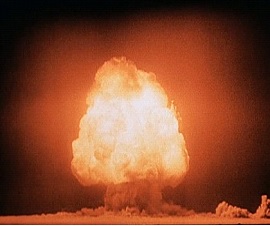
The nuclear age began when the United States conducted the first atomic bomb test in New Mexico on July 16, 1945. That day, years of work by civilian and military personnel involved in the Manhattan Project culminated in a use of the most destructive weapon in history. While overshadowed by the wartime use of nuclear weapons against Hiroshima and Nagasaki the following month, that original test, known as “Trinity,” had its own terrible legacy. The bomb test took its toll on people in surrounding communities whose suffering has not been fully recognized.
“The Brightest Light I Have Ever Seen”
The Trinity test took place in a barren region between the Rio Grande and the Sierra Oscura, a place aptly known as Jornada del Muerto — Journey of Death. The weapon, a plutonium bomb known as “the Gadget,” was placed on a platform atop a steel tower constructed at the site.
Detonation occurred just before dawn, at 5:30 am. The Gadget had an explosive yield of roughly 20 kilotons, somewhat more than the bomb that would be dropped on Hiroshima a few weeks later. Watching the test from an observation point miles away, physicist I. I. Rabi described the sight:
Suddenly, there was an enormous flash of light, the brightest light I have ever seen or that I think anyone has ever seen. It blasted; it pounced; it bored its way right through you . . . It was seen to last forever. You would wish it would stop; altogether it lasted about two seconds. Finally it was over, diminishing, and we looked toward the place where the bomb had been; there was an enormous ball of fire which grew and grew and it rolled as it grew; it went up into the air, in yellow flashes and into scarlet and green…It seemed to come toward one. (Quoted in Richard Rhodes, The Making of the Atomic Bomb, p. 672)
The Manhattan Project staff were hardly the only ones to witness the sight; the light from the Trinity test could be seen from about 280 miles, as far away as Amarillo, Texas.”
Snow in July
Following detonation, the bomb’s effects fell on various communities, who had received no warning about the test.
A family living on a ranch 70 miles away from the test site took shelter that morning as the sky suddenly turned dark, a thunder-like rumble filled the air, and their home shook. Outside their home, they found white powder covering their crops, cows, and water supplies. Other people in the region also found such powder on orchards, livestock, and other vital resources.
This same white powder was seen by 13-year-old Barbara Kent and other girls at a summer dance camp in Ruidoso, New Mexico. They were awakened in their cabin that morning by a tremendous explosion. The girls and their instructor ran outside.
As Kent later remembered, “We were all just shocked . . . and then, all of a sudden, there was this big cloud overhead, and lights in the sky . . . It even hurt our eyes when we looked up. The whole sky turned strange. It was as if the sun came out tremendous.”
The strange white powder began falling from the sky later that morning. “We all thought ‘Oh my gosh,’ it’s July and it’s snowing.” The campers decided to go swimming in a nearby river. “We were grabbing all of this white, which we thought was snow, and we were putting it all over our faces,” Kent recalled. “But the strange thing, instead of being cold like snow, it was hot. And we all thought, ‘Well, the reason it’s hot is because it’s summer.’”
The “snow” was the bomb’s radioactive fallout. The radioactive materials in fallout can be extremely harmful to humans exposed to them, whether the exposure is through the materials having direct external contact with the skin or through people breathing in the materials or eating and drinking contaminated food and water.
The fallout ultimately spread across thousands of square miles, reaching as far as Rochester, New York. Nineteen counties in New Mexico, including 78 cities and towns, were affected. The Centers for Disease Control and Prevention later estimated that in some areas radiation reached “almost 10,000 times what is currently allowed in public areas.”
Private and Public Statements
Stafford Warren, the Manhattan Project’s chief medical officer, noted the danger created by the Trinity test. Five days after the test, Warren wrote to Manhattan Project head General Leslie R. Groves commenting “There is still a tremendous quantity of radioactive dust floating in the air.” He warned that “a very serious [radiation] hazard” was present within a 2,700-square-mile area downwind of the test. Warren recommended that no future nuclear tests be held within a 150-mile radius of inhabited areas—a recommendation that came too late for the half-million people in New Mexico, Texas, and Mexico within such a radius of the Trinity test.
Whatever concerns officials might have had in private, the public story given to the media was that the July 16 explosion was a detonation of ammunition and other military materials that caused no deaths or injuries. Barbara Kent remembers hearing a public announcement about the July 16 explosion: “They said, ‘No one worry about anything, everything’s fine, just go along with your own business.’”
Even after the atomic bombings of Japan, when strict secrecy was no longer essential, information about the test’s dangers was not forthcoming. Dr. Kathryn Behnke of Roswell, New Mexico, wrote to Stafford Warren in October 1947 to express concern about a rise in infant deaths in the region. “As I recall, in August 1945, the month after the first bomb was tested in New Mexico, there were about 35 infant deaths here,” Behnke wrote, “I understand the rate at Alamogordo, nearer the site of the test, was even higher than Roswell.” Although Warren had privately raised concerns about the test’s effects, his assistant wrote back to Behnke assuring her that “the safety and health of the people at large is not in any way endangered.”

The Test’s Legacy
The full toll of the Trinity atomic test is unknown. Because New Mexicans have been exposed to a variety of hazards, from plutonium operations at the Los Alamos National Laboratory to other nuclear tests within the United States, identifying the specific health consequences of the original nuclear test is difficult.
A 2020 National Cancer Institute (NCI) study concluded that up to 1,000 people may have developed cancer because of the Trinity test, but the study’s lead investigator acknowledged that determining exposure is challenging “because all of the needed data is not available.”
The NCI study also doesn’t take into account the increase in infant deaths noted by Dr. Behnke in 1947: data from that period indicates New Mexico’s infant death rate was 56% higher in 1945 relative to previous years.
In the absence of more definite data, anecdotal evidence suggests people exposed to the Trinity test suffered for it. Over the years following her encounter with the summertime “snow,” Barbara Kent had to have her thyroid removed and developed various cancers, including endometrial cancer and different skin cancers. Kent was luckier than her fellow dance campmates, though: she reports that by the time she was 30 she was the only one of those girls still alive.
Tina Cordova’s extended family lived in and around the town of Tularosa, about 40 miles from the test site. Ten of her relatives, including both her parents, developed various types of cancer, some of which proved fatal. Her father developed two types of oral cancer despite never smoking or chewing tobacco.
Cordova, who was not even born at the time of the test, was diagnosed with thyroid cancer when she was 39.
In 2005, Cordova co-founded the Tularosa Basin Downwinders Consortium (TBDC). TBDC members gathered information, including through health surveys, of people alive during the Trinity test and their descendants. Of 1,000 surveys conducted, all include reports of cancers and other health problems that could result from radiation exposure. Similar cancers have often recurred across multiple generations.
Cordova and other activists have been seeking to obtain financial compensation for those harmed by the Trinity test. The federal Radiation Exposure Compensation Act (RECA) was passed in 1990 to provide compensation to people who lived in parts of Nevada, Utah, and Arizona and who may have been harmed by nuclear testing in Nevada in the 1950s and 1960s. RECA was subsequently expanded to compensate people involved in uranium production and civilian and military personnel directly involved in nuclear tests.
However, the ordinary civilians in New Mexico and elsewhere affected by the Trinity test are not yet eligible for compensation. RECA was extended for another two years this June, and Cordova hopes to build support for expanding the act to cover Trinity test victims.
Financial compensation, and a formal government apology, is long overdue for those people who can fairly be called nuclear weapons’ first victims. As Cordova comments, “In their [the government’s] rush to bomb Japan, we were sacrificed in the process. We were enlisted in the service of our country, unknowing, unwilling, and remain uncompensated.”
=========================
For other posts on nuclear testing and development, see:
Lethal from the Start: Uranium Mining’s Danger to the Most Vulnerable