Beyond the Human – Plus Everyday Peace Actions
by Rachel MacNair
Among the insights of the consistent life ethic are:
- When we perceive human beings as potential targets and therefore dehumanize them, this is an outrage. It’s also inaccurate. All human beings should be respected and free from violence.
- When people perpetrate violence, it’s mentally unhealthy for them.
- Committing violence in one area leads to committing violence in other areas. The dynamics of violence have been set in motion.
But what if we subtract that first point? In some situations, it’s not inaccurate to say beings aren’t human, because they aren’t. If we consider non-human animals, do the other two points still apply?
The Consistent Life Network as a group opposes the killing human beings specifically, so we’re now discussing my own opinion. I offer some examples to illustrate why those remaining two insights still apply.

Violence and Mental Health
Experiments that Harm Animals
Researcher Harold Herzog reports his own experience: “My stomach turned queasy, I began to sweat, and my hands shook when I dropped it into the near-boiling water . . . More shaky hands, a sweaty brow, a queasy stomach . . . my response was purely visceral, a physical nausea akin to the body’s involuntary shudder in response to the odor of putrification.”
Euthanizing
The euthanizing of animals in shelters has been reported as a trauma for staff in Psychology Today: “Shelter workers who have to euthanize animals as a regular part of their jobs suffer a wide range of distressing reactions, including grief, anger, nightmares and depression, according to a study I conducted with a fellow social worker . . . .[comments include] ‘ I have a lot of sleepless nights, a lot of crying’ . . . ‘I’ve had breakdowns in the euthanasia room because I feel so helpless’”
Blood Sports
In a report of the American television newsmagazine, 60 Minutes (air date January 11, 1998) a Spanish bullfighter is reported as saying that he dreams of bullfighting every night – a possible post-trauma symptom. Another symptom is intrusive imagery: “You know every – each bull that I – that I fight and kill him, he’s a — he’s a part of you for the rest of your life. You understand that?”
Slaughterhouses
Jennifer Dillard wrote A Slaughterhouse Nightmare: Psychological Harm Suffered by Slaughterhouse Employees. From the abstract: “to the slaughterhouse workers, the cost of a hamburger includes the financial and physical hardships of the slaughterhouse work itself . . . Not only do the employees face serious physical health hazards, but they also view, on a daily basis, large-scale violence and death that most of the American population will never have to encounter.”
Violence Leading to More Violence
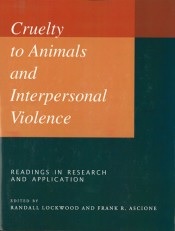 Studies show a strong connection between children being cruel to pets as a pattern that builds up to a pattern of violence against other human beings. See for example the book Cruelty to Animals and Interpersonal Violence. The U.S. Federal Bureau of Investigation is quoted in that book: “investigation and prosecution of crimes against animals is an important tool for identifying people who are, or may become, perpetrators of violent crimes against people” (p. 211).
Reasons for this may include:
- the priming effect of violence – that is, when it happens, you think of it more
- the lack of empathy necessary to be cruel
- habit and conditioning (in academic talk, systematic desensitization)
Systematic desensitization is used well by behavioral therapists in clients with phobias. Clients gradually get used to small things and then things closer to what they are afraid of. They relax themselves as a practice, and eventually the phobia is gone. In this case, however, if children are cruel to pets and this is not regarded as a serious problem, then they can become quite used to what would be repulsive to most people. The step to cruelty against people is not so large a step.
That’s likely to apply beyond children and pets. Desensitization spreads.
Solutions: Everyday Peace Actions
Long Transitions
The good news is that, unlike so many other issues, we can all take actions that help promote nonviolence in our daily lives. We don’t depend entirely on persuading others to act.
The bad news is, changing life-long habits is not an easy thing to do.
But again, the good news is that it doesn’t have to be done all at once. In fact, I propose it shouldn’t be. In the case of a vegetarian or vegan diet, for example, I did a survey several years ago at vegetarian events to discover the experience of successful vegetarians. I found their transition period was mainly from 6 months to 3 years. I took about a year on the transition to vegetarianism myself, finishing back in 1975.
Try a vegan dish or a vegan restaurant. If you like it, add it into your diet more frequently. If you don’t, drop it and go to the next one. There are all kinds of veggie burgers, and vegan pizzas, yogurt, ice cream, sausages, hot dogs, and possibilities within all kinds of different ethnic foods. Nowadays, the abundance of options in many places is quite large. That’s sometimes even the case in regular grocery stores, not necessarily specialty shops. Your nearest vegetarian and vegan restaurants can be found world-wide at happycow.net.
That’s the psychology, but biology also says a transition over time is best. While a high-fiber diet is usually ideal, going from low-fiber to high-fiber suddenly can make the body rebel with flatulence and digestive problems. A sudden upsurge in fruit or cruciferous vegetables can bring on diarrhea in some people.
Overall, however, the American Dietetic Association’s position is that appropriately planned vegetarian and vegan diets “are healthful, nutritionally adequate, and may provide health benefits in the prevention and treatment of certain diseases.”
Currently, it’s impossible to be 100% vegan. But in many places it’s easy to be 99% vegan; I’ve done it for decades. Yet people who have no intention of ever becoming vegetarian are still making a contribution to nonviolence by experimenting with dishes and restaurants and using the ones they like.
Expanding Personal Nonviolence
Of course the nonviolent diet goes beyond what happens to the animals. Are the workers who produced the food well treated? Was the production environmentally sound? Are the corporations who produce it doing nasty things, or did it come straight from the farmer?
Buying fair trade in bananas, coffee, and chocolate – tropical products – is especially important. Those that aren’t fair trade generally have some horrific treatment of workers involved. For chocolate, that includes child slavery.
Then again, nonviolence in purchases goes well beyond food. See for example the Better World Shopper, which grades companies on these criteria:

Expanding What “Voting” Means
The way I see it is that spending a dollar is like casting a vote. Every dollar you spend is casting a vote for something.
I remember one election day, when after casting my ballot I went to eat lunch in a vegan restaurant. Candidate voting for us consistent lifers is pretty bleak. So later, I cast votes that vegan restaurants should be readily available. Those dollars spent there were a way of voting for that. I had a strong sense that visit had more impact than what marks I put on that piece of paper.
None of us can be pure on how we buy, of course – large corporations run by those of callous heart are too widespread. Boycott everything with a taint, and you have very little left to live on.
But I take the approach of a “tight wallet” and a “loose wallet.” My expenditures will be limited with large corporations. I’m much looser in spending when it’s such things as a mom-and-pop shop, local, employee-owned, small business, and especially if it’s oriented to charity or nonviolent advocacy.
I go to all kinds of demonstrations to protest war, the death penalty, abortion, police brutality, etc. I’ll keep at it, but when I do, I’m trying to influence the behavior of other people. I do find it gratifying to also have things I can do myself that will have a positive impact for nonviolence.
===========================
For more of our posts on nonviolence in personal practice, see:
Suffering and Injustice Concern Us All / Vasu Murti
Parallels of Veganism and Prolife-ism / Kristin Monahan
My Personal Journey on Veganism, War, and Abortion / Frank Lane
Consistently Nonviolent Mutual Funds
Untying the Knot of War: Seek Negotiation, Not Escalation in Ukraine
by John Whitehead
The Russian war against Ukraine is nearing its two-month mark with no clear end in sight. The human suffering caused by the war, including reported human rights violations by Russian forces, is terrible to contemplate. Further, the ongoing US confrontation with Russia over Ukraine carries its own set of dangers: a more uncompromising stance toward the opposing side and the risk of escalation to a wider war.
No Room for Compromise?
US President Joe Biden has made several statements that a negotiated solution to the war less likely. He has repeatedly called Russian President Vladimir Putin a “war criminal” and also referred to the Russian president as a “butcher.”
Other US policymakers have made similar statements. The State Department announced that it formally judged Russian forces guilty of war crimes in Ukraine. Both the Democratic and Republican ranking members of the Senate Foreign Relations Committee have indicated Putin must face consequences for such crimes. Senator Bob Menendez (D-NJ) said, “Putin must be held accountable for this tragic and barbaric assault on innocent civilians.” Senator Jim Risch (R-ID) said, “The international community must also take concrete steps to hold Putin and his cronies accountable for their war crimes.”

In a more just world order than the present one, world leaders who violate international law—whether Putin or anyone else—would indeed be held accountable for their crimes. That is regrettably not the current situation, however.
The United States doesn’t currently have jurisdiction to try Russian policymakers for war crimes and Russia isn’t a party to the International Criminal Court (and neither is the United States). Also, Russia’s status as a permanent member of the United Nations Security Council would likely allow it to block effective prosecution of Russian war crimes. Most important, as long as Putin and his associates remain in power, they remain effectively immune from prosecution by a foreign or international court.
Calling Putin a war criminal is unlikely to lead to the Russian president being brought to justice. However, such statements are likely to make Putin more committed to waging war against Ukraine and less willing to negotiate.
The war has created a dire political situation for Putin. For all the death and devastation they have caused to date, Russian forces have not succeeded in seizing the Ukrainian capital of Kiev or otherwise decisively defeating the Ukrainians. The war might well end in a Russian defeat. Wartime defeat could threaten Russian President Vladimir Putin’s legitimacy and hold on power, which means he has strong incentive to do whatever is required to win. If a fall from power also means probable prosecution for war crimes, then that incentive to win becomes even stronger.
If US policymakers are effectively saying that Putin must be removed from power—a step that Biden has explicitly advocated, although he later walked back that statement—then that leaves little room for Putin to make any concession or negotiate an end to the Ukraine war. Russian officials have responded to condemnatory American statements by calling them “absolutely unacceptable and inexcusable” and warning of a “collapse” in US-Russian relations.
Escalating Conflict
In the absence of a negotiated solution, the Ukraine war continues and threatens to expand. The United States has provided an estimated $2.6 billion in military assistance to Ukraine since the February 2022 Russian invasion (and was providing military assistance to the Ukrainians for years before that point). Most recently, the Biden administration decided to send $800 million in military assistance to Ukraine, including military equipment previously not provided to that country.
Whatever else one might think of such assistance, US support to Ukraine’s war fighting carries with it the danger that the United States will be drawn into a direct conflict with Russia. If US military personnel train Ukrainian military personnel—as is apparently planned under the most recent military aid package—that opens the possibility of US troops being caught up in combat. Great caution is necessary.

The Biden administration has at least so far refrained from committing US troops directly to the war. In particular, the administration has not embraced the policy of a “no-fly-zone” over Ukraine, despite repeated requests for such a policy from Ukrainian President Volodymyr Zelensky.
A no-fly-zone would effectively require US or other NATO forces to shoot down Russian aircraft, if necessary. This would turn the Ukraine war into a full-fledged world war between Russia and the west.
The administration has also to date rejected the notion of giving Ukraine fighter jets. While not as extreme as imposing a no-fly-zone, flying jets from NATO nations into Ukraine so Ukrainians can use them against Russians could still be interpreted by Russia as an escalation.
Nevertheless, various voices within the United States have called for giving Ukraine fighter jets or even imposing the no-fly-zone. Senator Ben Sasse (R-NE) has questioned the fighter jet decision, saying “President Biden should explain exactly why he vetoed fighter jets for Ukraine.” Congressman Kevin McCarthy (R-CA), the Republican House minority leader, has said the United States should “provide [the Ukrainians] the planes where they can create a no-fly-zone,” a stance seconded by House Republican Whip Steve Scalise (R-LA). Senator Rick Scott (R-FL) has released a statement expressing support either for supplying jets or imposing a no-fly-zone (and also calling for measures to “further devastate the Russian economy”). We must hope the Biden administration continues to avoid such escalations.
Escalation on the Russian side is also a real danger, especially if the war continues to go badly and Putin gets desperate. What this might entail was recently spelled out by CIA Director William Burns: “a potential resort to tactical nuclear weapons or low-yield nuclear weapon” While such a drastic step does not seem likely at present, what the future holds is unknown.
The Diplomatic Path
As long as the war continues without a diplomatic resolution, more people will die and the risk of some terrible escalation continues. All parties need to seek a cease-fire and some kind of negotiated settlement. The settlement’s precise form will no doubt depend on how the situation on the ground changes, but it will probably require an agreement of Ukrainian neutrality between Russia and NATO as well as concessions by all sides.
The idea of negotiations with and concessions to Putin and the current Russian leadership undoubtedly seems a bitter pill to swallow after the events of the past two months. However, a diplomatic resolution will ultimately not be bitter to the untold numbers of people whose lives will be saved by the war ending—not to speak of the still greater number of people who will spared if further escalation can be prevented.
During the Cuban Missile Crisis, Soviet leader Nikita Khrushchev urged President John F. Kennedy that they “ought not now to pull on the ends of the rope in which you have tied the knot of war . . . a moment may come when that knot will be tied so tight that even he who tied it will not have the strength to untie it.” After that, the only option would be to “cut the knot”—that is, wage world war. Now as then, leaders on both sides should not “pull the knot tighter” through further verbal and military escalation. They should seek to untie the knot and end the war.
===================================
For more of our posts on Ukraine, see:
Not Your Pawns: A CLE Examination of the Russia-Ukraine Conflict
A Catastrophe Decades in the Making: The Russian Invasion of Ukraine
A Hidden Cost of the Ukraine War: How Russia’s Invasion Encourages the Spread of Nuclear Weapons
Walk On: Responding To Recent Situations in the Pro-Life Movement
by Sonja Morin
Content warning: physical assault, medical malpractice, and brutality against pre-born children are discussed in this article. Reader discretion is advised, especially for those who have experienced pregnancy loss.
“What?”… “what?”… “what?”

Sonja Morin
I did not realize how bad my hearing loss was until the four of us arrived in Boston’s North End. We had just counter-protested Rise Up 4 Abortion Rights (RU4AR) and their violent messaging in the “free speech zone” at the Boston Common this past Saturday, April 9. One of the organizers had come up behind me, and – after both taking my sign and practically hurdling over me to place one of RU4AR’s stickers on my megaphone – she whistled into my ears at a high pitch so as to disrupt my hearing for a sustained ten minutes.
As I write this, I am still dealing with the effects of that assault, ears still ringing and all. In reliving that moment again and again in my own mind, it brought my attention back to the intended topic of this week’s blog post: the situation of the 115 pre-born bodies recovered in Washington, DC by members of Progressive Anti-Abortion Uprising (PAAU) and Survivors of the Abortion Holocaust.
As the sole abortionist at Washington Surgi-Clinic, Dr. Cesare Santangelo knew what he was doing. His track record reveals countless incidences of malpractice, dehumanization, and absolute disregard for his parental and pre-born patients. He has admitted on camera that he would refuse care for pre-born children delivered alive after botched abortions. His errors have sent several women to the hospital after complications, one of whom died (see more details and the wrongful death lawsuit complaint). If the 115 babies’ bodies had not been intercepted, they would have faced a far more morbid fate even after death: immolation in the furnaces of Curtis Medical Waste to generate energy for the D.C/Maryland/Virginia metro area. Who knows how many bodies have been immolated prior to this discovery.
Conflicts about the manner in which these bodies were retrieved, as well as the release of information to the public, have ensued in the weeks following the recovery of the babies. This is the first time we are dealing with a situation to this degree and with this many bodies. Confusion, questions, and concerns are absolutely understandable as we embark into uncharted territory. Personally, I welcome this discussion as we seek to learn how best to grieve and call for justice.
But in the midst of all the dialogue about this situation, what we are missing is the fact that we would not have this situation to deal with had it not been for the initial brutality at the hands of Dr. Cesare Santangelo. We’ve let our own fears and confusion take rein. We forget that – at the time of writing this post – five bodies are still waiting in the DC medical examiner’s office, awaiting the moment of truth when their cause of death will be revealed. We forget that Dr. Cesare Santangelo and his complicit staff are still practicing in Washington, DC, regardless of the harm they’ve caused.
And if we ignore this situation, if we let our own preferences interrupt our work, how much more violence will occur? The people who assaulted the four of us counter-protestors in Boston this past Saturday give such an example. While our experience is in no way comparable to the gruesome death of these five babies, we saw a glimpse of the consequences of violent rhetoric. We cannot let violence and dehumanization conquer the frightened minds of all of us observers.

While we cannot undo the violence that has already happened, we can use our voices collectively to demand justice for all who have been harmed. We must expose the horrors happening in our own communities, starting with Dr. Santangelo’s office. We couldn’t give these 115 babies a chance at life; the least we could do is honor them in death, and ensure no more lives experience the same fate they did.
=======================
For more of our posts from Sonja Morin, see:
Not Your Pawns: A CLE Examination of the Russia-Ukraine Conflict
Behind and Beyond the Shout for Abortion
We need works of art that convey
the radical horror of abortion

Rosemarie Tischer Stith, “Triumph” (1973)
The US Supreme Court in Planned Parenthood v. Casey (1992) stated in support of abortion that the “ability of women to participate equally in the economic and social life of the Nation has been facilitated by their ability to control their reproductive lives.”
But laws are not the only impediment to a woman’s choice to abort.
The negation of social as well as legal constraints on abortion is necessary for abortion freedom. Moral qualms (and consequent mental health worries) could stop the choice of abortion. These, too, must be negated in order for women to feel free to abort. Abortion must become a normal part of a decent life.
Women must be made ready and willing to choose abortion if they are to “participate equally in . . . economic and social life” with their male colleagues. Abortion must become ordinary.
To this end, women are being encouraged to speak loudly about their abortions.
Shout Your Abortion is a movement working “to normalize abortion through art, media, and community events all over the country,” according to its mission statement. It’s a kind of shame-shaming in which women are exhorted to normalize “terminations,” to see them as an everyday part of life.
Its Twitter feed is full of messages like:
- “Abortion is normal. Our stories are ours to tell. This is not a debate.”
- “I aid and abet abortion and will do so proudly and constantly for the rest of my life.”
- “Happy #CelebrateAbortionProviders Appreciation Day!”
- “It seems incredibly damaging to label folks who choose abortion as naïve or uneducated or selfish. Or victims.”
From the beginning, as in the basic training of soldiers, shouting was going to be needed to make humans feel good about killing other humans.
Words can go only so far in combating this purposeful hardening of hearts. Closely reasoned arguments and statistics may fail to pierce the defiance of its “iron dome.” There is a thick layer of pain, abuse, fear, loneliness, and anger shielding abortion supporters from the truth.
Perhaps the best way to dissolve this coating is with art. Recall Picasso’s great painting of the carpet bombing of a town in northern Spain, Guérnica (now Gernika). It is a more radical revelation of the horror of war than any textbook.
Where is the art radically uncovering the horror of abortion?
I’d like to nominate the sculpture below: “Triumph,” by Rosemarie Tischer Stith (1973)
Artist Stith, herself a child refugee from the WWII firebombing obliterating Dessau, Germany, foresaw the great shout for abortion way back in 1973, the year a right to abortion was first proclaimed by the US Supreme Court.
Her 36-inch ceramic sculpture, “Triumph,” depicts a woman — standing tall in victory — her left hand on her hip and her right fist thrust into the air. Her head and hair are back. Her eyes are closed. Her mouth is open in a cry of triumph. Her chest swells in exultation, while her peculiarly elongated legs raise her pridefully high.
Under her feet lies her vanquished baby.

Here we see a mother’s contemporary assertion of dominion over her unborn child, but with her triumphal shout she dehumanizes herself rather than her child.
Indeed, the child is still intact, not yet aborted but only made available for abortion. The point of the sculpture is to depict not abortion itself but the new idea of motherhood that came with the US Supreme Court’s abortion proclamation.
This brief video reflects further upon old and new ideas of motherhood:

artist Rosemarie Stith and author Richard Stith, wife and husband
======================================
Richard Stith is a professor emeritus of law at Valparaiso University in Indiana. He is on the board of the Consistent Life Network. See selected works.
This is a slightly revised version of an article appearing in MercatorNet, 3/28/22
======================================
For more on art and the consistent life ethic, see:
Art Exhibit
Gendercide: Millions of “Missing” (Dead) Women
Poetry
“Seamless Garment” – Poem by Daniel Berrigan
Let us all agree on this one simple thing: It is not OK to kill people.
For more of our posts from Richard Stith, see:
Oppressors of Women Scapegoat Fetuses to Preserve Patriarchy
Equal Concern for Each Human Being, Not for Each Human Issue
When “Choice” Itself Hurts the Quality of Life
“Trust Landlords”: Pro-Choice Candidate Supports Eviction Rights (satire)
Open Letter to Fellow Human Rights Activists
A Hidden Cost of the Ukraine War: How Russia’s Invasion Encourages the Spread of Nuclear Weapons
by John Whitehead
The terrible toll of Russia’s invasion of Ukraine is plain to see: thousands killed and millions driven from their homes. The invasion also threatens to bring about a nuclear disaster. Fighting around Ukraine’s nuclear power plants might cause an accident like that at Chernobyl almost 36 years ago. The war might draw NATO into direct conflict with Russia, leading to nuclear war. All these costs and threats from the war require an immediate humanitarian and diplomatic response.
In addition, we should not forget a subtler, longer-term impact of the Russia-Ukraine war. The Russian invasion of Ukraine could seriously damage the cause of nuclear nonproliferation. The current war provides fresh encouragement for nations to build or otherwise acquire nuclear weapons. Even if this war ends without nuclear disaster, the world may well be living with dangerous nuclear consequences for a long time to come.
Ukraine Gives Up Nuclear Weapons
Ukraine today possesses no nuclear weapons and is a party to the Nuclear Non-Proliferation Treaty, which commits the country to not seek such weapons. However, this situation is a change from 30 years ago.
When Ukraine was part of the Soviet Union, the country was a base for Soviet nuclear weapons. At the time of the Soviet Union’s collapse in 1991, 1,900 nuclear weapons remained stationed on Ukrainian soil. Measured in sheer numbers, Ukraine had the third-largest nuclear arsenal in the world, after the United States and Russia, within its borders. This arsenal included weapons with a destructive power of 400-550 kilotons, or more than 20 times the power of the bomb dropped on Hiroshima.
Newly independent Ukraine’s government took an ambivalent stance toward the nuclear weapons on its territory. President Leonid Kravchuk established “administrative control” over the nuclear weapons in 1992 but assured US President George H. W. Bush that Ukraine would get rid of the weapons while “taking into consideration her national security.” The Ukrainian parliament, the Rada, similarly declared that the country would disarm but first required security guarantees. Ukrainian policymakers were presumably concerned about post-Soviet Russia, with which relations were tense. Meanwhile, the Bush administration wanted to reduce the number of former Soviet states with nuclear weapons to just one, Russia, perhaps out of a fear of a nuclear exchange among feuding post-Soviet states.
This situation led to a long diplomatic wrangle between the United States and Ukraine. American policymakers offered assurances to the Ukrainians about their country’s independence and territorial integrity being respected. However, the American policymakers would not offer their Ukrainian counterparts what the latter wanted: a legally binding guarantee that included assistance to Ukraine and automatic sanctions on an aggressor in the event of a threat to Ukraine.
Ukraine, the United States, and Russia were eventually able to negotiate a settlement, which included the Budapest Memorandum of December 9, 1994. In the Memorandum, the United States and Russia (and the United Kingdom, which was also a party to the agreement) committed “to respect the independence and sovereignty and the existing borders of Ukraine” and “to refrain from the threat or use of force against the territorial integrity or political independence of Ukraine.”
The Memorandum contained essentially no means of enforcing this commitment, though: Russia and the United States pledged “to seek immediate United Nations Security Council action to provide assistance to Ukraine… if Ukraine should become a victim of an act of aggression.” Since both nations are veto-wielding permanent members of the UN Security Council, each could block any Security Council “action” on Ukraine’s behalf.
Whatever the Budapest Memorandum’s shortcomings, Ukraine agreed to give up its nuclear weapons and to join the Nuclear Non-Proliferation Treaty—although the Rada warned that Ukraine might withdraw from the treaty if its territorial integrity were threatened. The Ukrainians began transferring their nuclear weapons to Russia and dismantling their own means for using such weapons. The last nuclear warhead left Ukraine in 1996; the last missile silo was demolished in 2001.

The limitations of the Budapest Memorandum became apparent in 2014, when Russia annexed Ukraine’s Crimea region and vetoed a UN Security Council resolution condemning the territory’s transfer. Russia used its veto again this February to stop a resolution condemning its current invasion of Ukraine.
The terrible significance of these events for anti-nuclear activists is clear. As Daryl Kimball of the Arms Control Association recently commented, “[Russian President Vladimir Putin]’s behavior undermines the [Nuclear Non-Proliferation Treaty] and reinforces the impression that nuclear-armed states can bully non-nuclear states, thus reducing the incentives for disarmament and making it more difficult to prevent nuclear proliferation.”
Even before the current invasion, some Ukrainians seemed to have second thoughts about giving up nuclear weapons. In 2014, at the time of Crimea’s annexation, several Rada members proposed that Ukraine withdraw from the Non-Proliferation Treaty. Others introduced a bill, which was ultimately defeated, calling for a renewal of Ukraine’s nuclear status. Volodymyr Ohryzko, a former Ukrainian foreign minister, proposed that the country start producing nuclear weapons. Ohryzko commented, “[W]e have the moral and legal right to restore our nuclear status and take measures to protect ourselves independently.”
Ukrainian popular opinion became more supportive of obtaining nuclear weapons again, with almost 50 percent of survey respondents favoring this policy in 2014. More recently, Ukraine’s ambassador to Germany, Andriy Melnyk, seemed to suggest in spring 2021 that Ukraine could pursue nuclear weapons in the future—although the Foreign Ministry later walked back that comment. What course Ukraine will ultimately take, like the conclusion of the present war, remains to be seen.
Best Option Available?
The dangers of nuclear weapons spreading to more countries is yet another tragic result of Russia’s aggression against Ukraine. Faced with such a maddening situation, the temptation is to say that the Budapest Memorandum should have provided more robust, definite guarantees to Ukraine. What such guarantees might have been is not obvious, though.
Had the United States signed a legally binding treaty in 1994 promising to defend Ukraine from attack, such a treaty would have been the practical equivalent of making Ukraine part of NATO. Yet Ukrainian NATO membership has been one of the central sticking points in US-Russian relations and has arguably contributed to the current conflict. Such a promise by the United States might have led to a conflict with Russia sooner rather than later.
An American guarantee of aid to Ukraine and sanctions on Russia in the event of a Russian attack on Ukraine might have been more politically feasible in the early 1990s. However, a combination of aid and sanctions has essentially been the actual American response to Russia’s 2014 and 2022 aggression against Ukraine—and, as we have seen, such a response has hardly resolved the problem.
The disheartening reality may be that the United States and other western nations did not have a practical way in the early 1990s of protecting a nuclear-free Ukraine from Russia. The largely symbolic Budapest Memorandum may have been the best available option. Beyond the Memorandum, the most effective way of protecting Ukraine would have been preventing the relationships among Ukraine, Russia, and the west from deteriorating to the level they reached in the 2010s. That did not happen, though, and now Ukraine and the world must deal with the consequences.
Several significant events over the last 20 years have made nuclear nonproliferation and controlling nuclear weapons more difficult. One was the 2011 military intervention by a coalition of nations, including the United States, in Libya. By leading to the overthrow of Libyan ruler Muammar Qaddafi, who had renounced his nation’s nuclear weapons program in 2003, the intervention provided another strong incentive for rulers to acquire nuclear weapons and never give them up.
Other significant events have been the United States’ withdrawal from agreements such as the Anti-Ballistic Missile Treaty and the Intermediate-Range Nuclear Forces Treaty, as well Russia’s apparent violations of the latter treaty. Russia’s attacks on Ukraine, in violation of the Budapest Memorandum, are yet more episodes in this lamentable pattern.
The two nations with the world’s largest nuclear arsenals have predictably proven to be among the most significant obstacles to reducing the nuclear threat.

===============================
For more of our posts on Ukraine, see:
Not Your Pawns: A CLE Examination of the Russia-Ukraine Conflict
A Catastrophe Decades in the Making: The Russian Invasion of Ukraine
For more of our posts on nuclear weapons, see:
Nukes and the Pro-Life Christian: A Conservative Takes a Second Look at the Morality of Nuclear Weapons
The Reynolds Family, the Nuclear Age and a Brave Wooden Boat “An Inferno That
Even the Mind of Dante Could Not Envision”: Martin Luther King on Nuclear Weapons
Nuclear Disarmament as a Social Justice Issue
A Global Effort to Protect Life: The UN Treaty Banning Nuclear Weapons
What Studies Show: Impact of Abortion Regulations
 The upcoming Dobbs v. Jackson case in the U.S. Supreme Court, which may overturn or curtail Roe v. Wade, calls for educating about this question: What do we know about what restrictions do?
The edited excerpts below are from Peace Psychology Perspectives on Abortion, Chapter 15, The Psychological and Social Impact of Legal Regulations.
by Rachel MacNair
Different states (U.S. and Mexican) had regulations in effect one year but not the previous year. Some impact one group more than another; for example, parental consent laws only matter to minors. Therefore, this could be analyzed as a natural experiment.
Women Who Ask and Are Turned Down
When abortions were primarily illegal and societal pressures for legalization were mounting, one method of easing restrictions allowed women to apply to a committee for permission to abort a pregnancy. A 1988 book reporting research from this condition is Born Unwanted: Development Effects of Denied Abortion.
How would the children compare with the children from accepted pregnancies? The answer is complicated, but the author’s summary includes:
Inspection of the data reveals that the difference is not so much in UP [unwanted pregnancy] children failing more often, but rather in being substantially underrepresented among the students graded above average, very good, or outstanding . . . the UP children consistently appeared worse, primarily due to underrepresentation in the above-average categories. (p. 88)
To re-iterate: “the UP subjects are not so much overrepresented on the extremely negative indicators as they are underrepresented on the positive ones” (p. 124).
Those of the “abortion-as-violence” position, however, argue that if abortion is killing a human being, doing so to avoid being underrepresented among the above average seems rather draconian. (The headline in Sisterlife, then newsletter of Feminists for Life: Prof Repulsed by Working Class; Recommends Elimination. Not Clear Who Will Repair His Mercedes.)
Funding
In the United States, after the 1973 Supreme Court decision Roe v. Wade suddenly legalized abortion in all 50 states, the Medicaid program for funding medical services to low- income people included abortion. Then in 1976 a legislative provision, the Hyde Amendment, restricted Medicaid funding to only cases of rape, incest, and preventing the death of the pregnant woman. These being rare, in many states funding was immediately severed, while other states continued. This provided a natural experiment.
The Guttmacher Institute reported that in states without funding, the abortion rate was 1.6 times higher for Medicaid-eligible women than for women of higher income. The fact that it is greater than one to one suggests poverty plays a role in abortion decisions. However, the rate in states with funding is 3.9 times higher for women on Medicaid.
Yet childbirths in the states without funding either stayed the same or were also reduced. The missing abortions were not entirely replaced by women continuing pregnancies, but by couples taking more care about becoming pregnant.
Distance of Facilities
An early study showed counties further away from the abortion clinics of Atlanta had lower abortion-to-live birth ratios than those nearer. A more recent study in Texas using 1993 data found the probability of a pregnant woman choosing abortion appeared quite sensitive to availability variables; women in counties further away from clinics had a lower rate than those near.
Parental Involvement
See the topic page on this at Peace and Life Referendums: What Studies Show for Parental Involvement for Abortions Performed on Minors.
Outright Legal Ban
The restrictions covered here will only prevent abortions in women whose desire to have an abortion is sufficiently ambivalent, or if the added inconvenience of procuring abortion puts the inconvenience of using a condom in a better light. Pregnant women who are determined to have an abortion will find funding, drive extra distances, tolerate information and waiting periods, and forge ahead. Only an outright legal ban makes abortion essentially unavailable. Even then, determined women will travel to where they are not banned or have them surreptitiously.
Two countries that have instituted legal bans after a period of fairly free availability are Poland in 1993 and Nicaragua in 2006. In both, the abortion rate went down (inasmuch as it was reported since it was banned), the maternal mortality rate went down, and indicators of maternal health went up.
However, there were simultaneous dramatic occurrences in both – a transition out of communism in Poland, and an assertive women’s health-care campaign by the Nicaraguan government.
In the opposite direction, abortion legalization in South Africa, Ethiopia, and Nepal was also accompanied by better maternal health outcomes, and likely for similar reasons.
Mexico had a “natural experiment” as abortion was legalized in some of its 32 states but not others. One 2015 study tested whether there was an association with maternal mortality (from both aborted and continued pregnancies) after controlling for other variables such as clean water. Over ten years, they found states with less permissive laws had lower maternal mortality than states with more permissive laws. However, there were independent associations with female literacy, skilled attendance at birth, low birth weight, clean water, sanitation, and intimate partner violence, which in a regression accounted for most of the variance in maternal mortality. Authors conclude: “Although less permissive states exhibited consistently lower maternal mortality rates, this finding was not explained by abortion legislation itself. Rather, these differences were explained by other independent factors, which appeared to have a more favorable distribution in these states.” The question of why less permissive abortion laws were associated with these other measures of benefit was beyond the scope of the study.
=========================
For our posts on similar topics, see:
Why the Hyde Amendment Helps Low-Income Women
Abortion Facilitates Sex Abuse: Documentation
“The Daily Show” Doesn’t Do Its Homework
A Process of Tender Understanding and Loving Closure when Life Ends

Lois Kerschen
by Lois Kerschen
Palliative Care
Legislatures around the world are increasingly passing bills that allow for euthanasia and assisted suicide. This is a trend we must resist, and we can do so by educating ourselves and others about palliative care.
Allow me to recommend an excellent book on this subject: That Good Night: Life and Medicine in the Eleventh Hour (2019), written by Dr. Sunita Puri.

This book is not technical or academic. It is biographical, easy to read, and a fascinating meditation on Dr. Puri’s experiences during her residency in palliative medicine. She takes you through the options and emotions involved in end-of-life care for the patient and the family.
While the concept can be applied to any serious illness, terminal or not, the goal to relieve symptoms and stress for the patient becomes even more important if we want to facilitate a peaceful death.
This effort entails creating a team of health care providers who are all on the same page with the patient’s wishes and each other. This collaboration gives patients more control over their care and improves their quality of life.
Quality of life in this discussion means that patients get to die with dignity on their own terms. Sometimes patients feel as if they can’t deal with the pain, or that they are a burden to their families, so they try to hasten death with assisted suicide.
As Dr. Puri notes, studies show that, with palliative care, most patients get sufficient pain relief to be able to function at an acceptable level to make their remaining time worthwhile. Patients can also be treated for the depression that causes them to want to die by suicide.
Sometimes worries about financial or family matters can be alleviated through counseling with the palliative specialist. Serving as a buffer, and sometimes as the voice of reason, the palliative specialist often deals with one of two extremes.
One is that the family is making the patient feel like a burden and seems to be looking for ways to dump the patient or hasten death. The palliative specialist can recommend compassionate and practical options to the family and provide support to the patient.
The other is a family that won’t accept the impending death and is demanding extreme efforts to save the patient’s life. This situation often results in great suffering and distress for the patient who submits to unwanted treatment to appease the family.
Palliative care helps the family hear what the patient wants, accept the inevitable, and make the best use of the remaining time with their loved one.
Perinatal Hospice
Perinatal Hospice is a wonderful, compassionate practice that is not well-known. It is intended for pre-born children who have serious medical problems that result in death, either shortly before or just after birth.
In those rare cases, it is important that we respect their humanity and provide a dignified end of life while helping the parents and family to navigate a very difficult ending to what started as joyful expectation.
Perinatal Hospice provides a support system for parents who receive a terminal diagnosis for their unborn child such as a lethal heart defect, Trisomy 18, limited brain development, or other conditions. Knowing that carrying to term will not mean carrying home a baby is, of course, heartbreaking, but it can be an awe-inspiring and uplifting experience, nonetheless.
Sometimes the child will die before being born. Other times it will live just a few minutes, hours, or days, but that precious time can be filled with profound love.
Perinatal hospice is not a place but a process. Planning starts at the diagnosis with the parents fully involved. Basically, though, whether the child is born alive or stillborn, it is bathed, wrapped in blankets, and given to the parents to hold (and perhaps other family members). The baby is made comfortable with pain medication, if needed.
The grieving process is eased if the parents have something to remember, so they can take a lock of hair and photos, make a footprint mold, pray or sing to the child — whatever is meaningful to the family, including the presence of clergy and a baptism. Then, the baby will pass away in the arms of its parents having known only love.
There will be a birth certificate, a death certificate and a funeral to validate the child’s existence. The parents could also provide the life-giving gift of donated organs.
Abortion Fixes Nothing
Most of the time, when parents are given an “incompatible with life” diagnosis, they are advised to abort the child. The abortion mentality justifies this action by claiming that that the child will be spared suffering, and that it is emotionally too distressing for the parents to continue the pregnancy.
In truth, the emotional toll of abortion is much worse. Parents who abort are left with the guilt and grief of having killed their own child. They do not usually get to see the child who has been dismembered (causing excruciating pain) and discarded with the medical waste.
Sometimes, in a third trimester abortion (in which the child is stabbed through the heart with a needle, injected with a poison, and delivered intact), the parents will be allowed to hold their dead baby, but that’s it. There is no birth certificate, no organ donations, no death certificate, no funeral for closure, no photos or footprints, no lock of hair, no happy memories of love and comfort, just the possibility that the mother has been harmed by the procedure.
The reality of the situation is that abortion is promoted because the more people have abortions, the more normal and acceptable it becomes, and therefore more abortions will be sold by the abortion industry. Who cares if parents are left bereft if abortion can get one more stat in its favor?
Compare the two outcomes between abortion and perinatal hospice and it seems obvious which is the better choice.
Learn More
Unfortunately, there are only about 250 programs in U.S. hospitals, although many more allow the parents to create their own experience. Still, all who understand the value of the palliative concept need to request or initiate Perinatal Hospice in their communities.
Perinatal Hospice & Palliative Care
Amy Kuebelbeck is the editor of this clearinghouse of information, including a list of American and international programs. She is also the author of A Gift of Time: Continuing Your Pregnancy When Your Baby’s Life Is Expected to Be Brief and Waiting with Gabriel: A Story of Cherishing a Baby’s Brief Life.
Other sites:
Perinatal Care Helps Families Deal with Heartbreaking Situations
The Welcome Outreach of Perinatal Hospice
Perinatal Hospice Supports Parents When a Baby’s Life is Short
The Pain – and Surprising Beauty – of Hospice Care for Babies
Secular Prolife: A Pro-Life Introduction to Perinatal Hospice
=========================================
For posts on similar topics, see:
Figuring out Euthanasia: What Does it Really Mean?
#SayHisName: The Medical Murder of Michael Hickson
How Euthanasia and Poverty Threaten the Disabled
What’s Cruel for the Incarcerated is Cruel for the Terminally Ill
The Traumatized Lash Out
 by Rachel MacNair
Addressing the question: From where do abortion-performing doctors get their social support?
An excerpt from Achieving Peace in the Abortion War.
Chapter 11: Colleagues and Clients
(sources adapted for a website)
Gratitude?
If other doctors and the pro-choice movement are inadequate as sources of support, then surely at least the clients can be expected to be grateful. And of course many of them are. Yet many seriously do not want to be there. This isn’t unusual in medicine, but most medicine has on-going care so that the doctor is able to monitor the patient and see that she’s improving, allowing for both a sense of accomplishment and gratitude.
The assembly-line set-up of the average abortion clinic is not asking for respect from the clients. In fact, this technique may be employed partly because of knowledge that the gratitude is never really going to come. It’s deliberately not asked for . . .
An abortion doctor who had a problem with inner strength commented on this in the Boston Globe (November 11, 1994) “I could have put up with some more, but I felt no community support at all. I could have taken a lot more abuse, but there was not even a patient saying, ‘I know you’re not a murderer.’ That demoralized me.”
The Feeling is Mutual
Feeling highly stressed can be expected to lead to a lashing out. The lambaste can be aimed at several targets, and for the abortion doctor, there are plenty available. Pro-life picketers are among the best to aim for, but they’re outside the building. Throwing barbs at them on the way in and on the way out only does so much. Politicians, media, other doctors, and the pro-choice movement can be complained about, but they’re off somewhere else and so can be targeted only verbally. Staff people are close by and can make excellent targets, but they’re hired and not likely to stay if they are the butt of too much resentment. Besides, they’re in the same fix.
There is one target left that falls into place nicely – the person that the doctor has never seen before and likely will never see again. The person who is going to allow the doctor to come close to her with sharp instruments. The person who makes this whole job necessary, then isn’t even grateful.
The doctor can blame the person who, if she had only kept her pants on, wouldn’t be doing this. Never mind that there is, in each and every case, another person who could also have prevented it by keeping his pants on. He’s not there to lash out at, and she is. Besides, blaming the woman for getting pregnant is traditional.
Current abortion opponents are not the only ones to have noticed this phenomenon. Marjorie Brerer’s position is unambiguously in favor of ready access to abortion. Yet on a panel discussion at a conference on RU-486 she listed one of the reasons for someone being an abortion provider as, “a relatively sadistic way of punishing women.” She later says that, with RU-486, she, “would like to ask whether providers will still be able to have a punitive role, if that’s the role they want to have.”1
Those that have looked at this in scholarly fashion have found indications of this. “Many faculty and resident physicians doing abortion work reported clinical symptomology. Among these symptoms, the researchers discovered obsession over abortion per se and over the morality of abortion, depression, a need to find ‘reasons’ for performing the abortions, and anger directed primarily at the aborting women.”2

Dr. Hern notes: “One respondent expressed increasing resentment of the casual attitudes of some patients considering the emotional cost to those providing the service.”
The American Medical News article, “Abortion Providers Share Inner Conflicts,” indicates that anger at the woman is regarded as a commonplace, especially for women who wait for late terms. “A New Mexico physician said he was sometimes surprised by the anger a late-term abortion can arouse in him. On the one hand, the physician said, he is angry at the woman. ‘But paradoxically,’ he added, ‘I have angry feelings at myself.'”3 Why is this paradoxical, when he is just as much a participant as she is? Because it’s unusual to admit that responsibility lies on everyone involved, and blaming the woman alone is more common.
Another example is recounted in Don Sloan’s book, Abortion: A Doctor’s Perspective, a Woman’s Dilemma. Dr. Sloan was an abortionist (his own self-description) who was still in the field and still advocated for it strongly. He tells this story (pp. 234-235) as told to him by one of his patients:
“I was working upstate, and I got involved with this guy – it was dumb, but I got pregnant. I mean, we both knew it was just a summer thing, that we weren’t going to see each other again. Well, I asked around and got the name of a doctor there who did abortions in his office. It wasn’t that expensive, a few hundred bucks, and we could get that together between us. I mean, the guy was all right, he just wasn’t the love of my life. So I made an appointment.
“The people in the office seemed real nice, so I was kind of surprised by this guy. He kind of leered at me, you know? But at the same time he really had an attitude – like I was dirt or something. I thought, was it ’cause I’m black? But I think it was just him.
“He said, ‘Get your things off and lie down.’ And I’m thinking isn’t there a gown or something? I was standing right there. So I asked for some place to change and he said, ‘Do it here. We have to get this over with.’ But he gave a sheet to wrap up in, which was clean, at least.
“When I went to put my feet in the stirrups, my legs were too long. And while he’s adjusting them, he’s making these cute little remarks about my legs and my nail polish. I’d already paid, and I wanted to get it over with too, or I’d have been out of there, I swear. I was that angry.
“It hurt – a lot. And I could hear the suction thing – it was real loud, and it was like it was sucking out my whole insides. I kept asking questions, and the whole time, he didn’t say one thing. Just ignored me.”
It seemed like an eternity, Keisha said, but it was probably only a few minutes until the doctor told her he was done.
“When I got up, I felt sort of faint, and there was blood running down my leg. I showed him, and he said it was nothing. But when I went to get my clothes, the blood was getting on the floor. And he said to me, ‘You’re dirtying things up. Get back up here.’ He did some more stuff, and I heard the machine again. It didn’t hurt as much, though, or maybe I was just so out of it I didn’t care.”
He gestured to her to get up again, and this time he gave her a sanitary napkin. ‘You know how to use these things, I suppose?’ he sneered.
Dr. Sloan blames this unknown doctor’s attitude on sexism, a reasonable assessment. He then goes on to relate it to other kinds of sexism in the health care system, as with obstetrics, and he’s right that those are areas in need of improvement. Of course, in any individual case, the doctor may have had a major argument with somebody that day and been in a sour mood. Nor would it be fair to draw any conclusions from one incident.
Still, it does fit the pattern. It could be that the doctor was frustrated for the reasons we’re talking about now, or it could be that the patient was seeing the symptom of estrangement from others that is a symptom of post-traumatic stress.
Sexism is something that can be gotten rid of, to a large extent, if it’s worked on. It certainly can be removed from areas like obstetrics, diagnostic D & C’s, hysterectomies, and C-sections. Much progress has been made already, and hopefully more will be made. If that’s the problem with abortion, progress will be made there as well. But if the problem is the lashing out or the alienation that goes with PTSD, then progress toward sensitivity to the clients could be harder to come by.
Footnotes
- Antiprogestin Drugs: Ethical, Legal and Medical Issues, Arlington, Virginia, December 6-7, 1991.
- Marianne Such-Baer, “Professional staff reaction to abortion work,” Social Casework, July 1974.
- Diane M. Gianelli, “Abortion Providers Share Inner Conflicts,” American Medical News, July 12, 1993.
===================================
For similar posts, see:
“I Became Like a Soldier Going to Battle”: Post-Abortion Trauma
Abortion Doctor Says: We are the Executioners
“But I was Empty”: The Story of a Doctor Who Left Planned Parenthood
For more on how various kinds of socially-approved killing are traumatizing to those doing the violence, see Perpetration Trauma.
A Catastrophe Decades in the Making: The Russian Invasion of Ukraine
by John Whitehead
The Russian invasion of Ukraine is a monstrous injustice. Russia’s blatant aggression of 2022 recalls such similar infamous episodes as the Soviet Union’s invasion of Afghanistan in 1979, repression of a rebellion in Hungary in 1956, and annexation of the Baltic states in 1940.
How many people have been killed since the invasion began on February 24th is unknown; as of this writing, there are hundreds of Ukrainian civilian deaths, including children. Hundreds of thousands of people have fled Ukraine. Filippo Grandi, the UN High Commissioner for Refugees, has warned that “The humanitarian consequences on civilian populations will be devastating . . . countless lives will be torn apart.” Perhaps most worrying, Russian President Vladimir Putin has apparently placed Russian nuclear forces on heightened alert. How this conflict will end is anyone’s guess, but more people will die before it does.

The primary responsibility and guilt for this invasion lies with the Russian government, especially Putin. Putin’s decision to order this invasion of another country is wholly without justification.
While the Russian invasion may be unjustified, it was not unpredictable. That events would come to this could have been foreseen, even before the build-up of Russian troops close to Ukraine began in fall 2021. This invasion is the end result of a long sequence of events stretching back over 20 years.
Putin and other Russian policymakers bear the primary responsibility for this war, but they do not bear it alone. Other people, including policymakers in the United States, helped bring events to this point. This outbreak of war in Europe is an occasion to remember how events got to this point and to consider what to do next.
NATO Expansion and the Seeds of Conflict
While Putin no doubt has multiple motives for invading Ukraine, a significant motive is the desire to prevent Ukraine from joining NATO. Putin has repeatedly expressed his view that Ukrainian NATO membership would pose a threat to Russia. If Ukraine becomes part of NATO, the country could become a gateway for a future western invasion of Russia or a base for US nuclear missiles capable of reaching Moscow quickly.
Fear of a NATO threat to Russia was a major theme, along with other grievances, in Putin’s speech of February 21, in which he said that “Ukraine’s accession to NATO and the subsequent deployment of NATO facilities” would mean “the level of military threats to Russia will increase dramatically, several times over. And I would like to emphasise [sic] at this point that the risk of a sudden strike at our country will multiply… Ukraine will serve as an advanced bridgehead for such a strike.”
Such fears of future threats are not a moral justification for invading another country. Nevertheless, such fears are the kind of realpolitik security concerns one might expect a nation’s leaders to have. In the western hemisphere, the United States’ policies toward Cuba, for example, provide a parallel to Russian policy.
A prudent US and NATO policy would have anticipated Russian security concerns and avoided provoking a military intervention such as the one currently unfolding in Ukraine. However, prudence has been sadly lacking in this area since the 1990s.
Following the collapse of the Soviet Union and its satellite regimes in Eastern Europe, NATO expanded to include nations that had previously been in the Soviet sphere of influence and even former Soviet republics. The Czech Republic, Hungary, and Poland joined NATO in 1999; followed by Bulgaria, Romania, Slovakia, Estonia, Latvia, and Lithuania in 2004.
Many prominent US policymakers warned about how Russia would react to NATO expansion. William Perry, who was secretary of defense when the expansion was being pursued, commented in 1997 that the Russian reaction “ranges between being unhappy to being very unhappy…This is not just one or two or a few officials expressing a view, this is a very widely and very deeply held view in Russia.” Years later, Perry reflected that in the post-Cold War period, the Russians “were beginning to get used to the idea that [NATO] could be a friend rather than an enemy…but they were very uncomfortable about having [NATO] right up on their border and they made a strong appeal for us not to go ahead with that.”
William Burns, who was serving in the US embassy in Moscow in the 1990s (and is currently CIA director), cautioned at the time that “Hostility to early NATO expansion…is almost universally felt across the domestic political spectrum [in Russia].”
George F. Kennan, a US diplomat who had played an important role in making US Cold War policy, said of NATO expansion: “I think it is the beginning of a new cold war. I think the Russians will gradually react quite adversely and it will affect their policies. I think it is a tragic mistake . . . Of course there is going to be a bad reaction from Russia.”
In 2008, when George W. Bush’s administration was pursuing NATO membership for Ukraine, Burns, who by now had served as US ambassador to Russia, offered a new warning:
Ukrainian entry into NATO is the brightest of all redlines for the Russian elite (not just Putin) . . . In more than two and a half years of conversations with key Russian players, from knuckle-draggers in the dark recesses of the Kremlin to Putin’s sharpest liberal critics, I have yet to find anyone who views Ukraine in NATO as anything other than a direct challenge to Russian interests.
Burns also prophetically wrote that the pursuit of Ukrainian NATO membership would “create fertile soil for Russian meddling in Crimea and eastern Ukraine.”
In 2014, when Russia was fulfilling Burns’ prophecy by annexing Ukraine’s Crimea region, former Secretary of State Henry Kissinger wrote that “if Ukraine is to survive and thrive, it must not be either [Russia or the West’s] outpost against the other — it should function as a bridge between them.” He also flatly stated “Ukraine should not join NATO.” Former National Security Adviser Zbigniew Brzezinski similarly commented that Ukraine could have “no participation in any military alliance viewed by Moscow as directed at itself.” During the Cold War, both Kissinger and Brzezinski were associated with hawkish US policies, yet they did not advocate Ukrainian NATO membership.
Fear of NATO is not necessarily the only reason Russia has now invaded Ukraine. (Nor, for that matter, is NATO expansion the only reason the Russians might understandably be suspicious of the United States and its allies.) The prospect of NATO including Ukraine has played a role in creating the current crisis, though, as demonstrated by the Russians’ repeated emphasis on this point during the lead-up to the invasion.
Granted, Russian actions over the past few months made preventing Ukrainian membership in NATO far more politically complicated. The United States and other NATO countries would understandably refuse to make such a major concession in the face of apparent military threats. A concession would be rewarding aggression. (For my part, I argued against such a concession earlier in this crisis.) In retrospect, however, maybe an unyielding stance was not the correct one to take. Compromise in the face of a threatened invasion would have been bad, yet failure to compromise may have led to the far worse outcome we are seeing today.

What Next?
Avoiding any escalation in the war is imperative. If another nation gets directly involved in the war, the violence might only worsen; if the United States or NATO gets directly involved, then World War III becomes a possibility. US President Joseph Biden’s repeated statements that American troops will not intervene in the Ukraine-Russia war are encouraging. The United States and other nations should remain committed to non-intervention.
While not as perilous as direct involvement, the United States or other nations continuing to send weapons or military equipment to Ukraine could be very dangerous. More weapons could mean longer and bloodier fighting and greater loss of life. Rather than send more weapons to Ukraine, the community of nations should make every effort to keep additional weapons out of Russia’s hands.
Economic sanctions on Putin and other Russian elites are a reasonable response. Also, the Ukrainians should seriously consider using nonviolent methods of resistance to defend their independence. Compared to violent resistance, such methods are more likely to succeed in at least limiting Russian rule over the country and are far less likely to provoke extreme violent repression.
Giving refugees from the fighting a safe haven and getting humanitarian aid to those affected by the war is essential. Please consider giving to Catholic Relief Services, Mennonite Central Committee, and other groups working to help people in Ukraine.
Above all, diplomatic efforts are needed to bring about a cease-fire. The actions of peace-minded Russians who have protested the war in spite of state repression are encouraging. Let’s hope their voices and those of others opposed to war prevail.

Russian anti-war protester in 2014
=====================================
For our posts on similar topics, see:
Not Your Pawns: A CLE Examination of the Russia-Ukraine Conflict
Seeing War’s Victims: The New York Times Investigation of Civilian Casualties in Iraq and Syria
Using Empathy during a New Cold War
Would Nonviolence Work on the Nazis?
Suicide Prevention and Other Kinds of Killing
by Rachel MacNair

War
It’s well-documented that combat veterans have a shockingly high suicide rate. Much of this comes from being traumatized by war. There are many kinds of trauma. The one I study most is Perpetration-Induced Traumatic Stress, which comes from the act of killing itself.
For my dissertation back in 1999, I got the US government’s data set of 1,638 combat veterans from its war in Vietnam, called The National Vietnam Veterans Readjustment Study. One question was: “Did you kill or think you killed anyone in Vietnam?” I made two groups – those who answered “yes” and those who answered “no.”
For trauma as a whole and for every symptom but one, those who said yes had much higher trauma scores than those who said no. This is even when taking intensity of battle into account. Results can be seen in Chapter 1 plus the appendix of my book, Perpetration-Induced Traumatic Stress: The Psychological Consequences of Killing.
The symptom that was the one exception was suicidal thoughts. I puzzled over this until I had a chilling thought: being “more severe” in suicidal thoughts could mean having actually committed suicide. Those whose symptoms were most severe may not have lived to be included in the data set.
Abortion
Post-Abortive Women:
Studies based on thousands of records comparing medical records and death certificates show considerably higher suicide rates among post-abortive women in Finland, , and California. A study showed increased suicidal behaviors.
Abortion defenders point out that when we’ve selected women who’ve had abortions, we’ve also selected a group more likely to have problems, such as being victims of intimate partner violence.
Still, there are reports of attempted or completed suicides on the anniversary date of the abortion or expected due date, which suggests that abortion may in fact be a major contributor. There are also individual women’s own stories that suggest an abortion-suicide connection.
Un-aborted Children:
What about children whose mothers intended to abort them but were unable to? One justification offered for abortion is that it’s so very hard to be an “unwanted child.”
A 1988 book called Born Unwanted: Development Effects of Denied Abortion tries to make this case. They report on studies in Sweden, Finland, and Czechoslovakia, coming from the days when women had to apply to committees for abortions. If they were turned down, they appealed. If turned down again, they had the baby. Follow-up studies were done matching these children with children of similar demographics.
The authors report, with a straight face: “the UP [unplanned pregnancy] subjects are not so much overrepresented on the extremely negative indicators as they are underrepresented on the positive ones” (page 124). That is, they’re underrepresented among the above average. They were excessively average.
The authors argued this grave disadvantage means abortions shouldn’t be denied. This led Frederica Mathewes-Green, editor of Sisterlife, then the newsletter of Feminists for Life, to report on the book using this headline: Prof Repulsed by Working Class; Recommends Elimination. Not Clear Who Will Repair His Mercedes.
Many mothers changed their minds, as over a third – 36% – denied they had made the abortion request, and 73% were satisfied with how the situation was resolved (page 48).
As for suicide? The children don’t seem to agree with the proposal they’re better off dead. Only one suicide was found, a very small proportion given the size of the group (page 43). There’s no reason to think that failure to kill the children earlier means they’ll just kill themselves later on.
Abortion Legislation:
found states with parental involvement laws (notification or consent) were associated with an 11% to 21% reduction in suicides among females 15-17 years old. Yet they found no difference for males in that age group or older females.
looked at what impact waiting periods had on mental health. Did such periods serve as a protective cooling-off period? Or were they instead a source of additional stress? It used suicide rates of women in different states as a way to measure mental health. The analyses found the states with waiting periods associated with about a 10% reduction in suicide rates.
While it may be that notifying parents or being informed and waiting may lead post-abortive women to be less likely to commit suicide, another explanation is that these methods lowered the abortion rate, and that in turn lowered the suicide rate.
Assisted Suicide/Euthanasia
Are unauthorized suicides connected to “authorized” suicides? Once you tell the 16-year-old girl that her grandmother is justified in committing suicide because life with a severe disease or disability is so difficult to bear, how do you tell her that the fact that her boyfriend left her doesn’t make her life too difficult to bear? With talk of bringing on death as a form of autonomy, and individuals deciding for themselves what is and isn’t a worthy life, where does the reasoning end?
We’re also disproportionately putting certain people – especially those with disabilities – into a category of people who don’t get the suicide-prevention services normally offered to everyone else.
The alternative idea by euthanasia proponents is that offering assistance is supposed to reduce suicides, because people don’t feel the need to do it quickly while they still can, before they get too sick.
A major study done on this, comparing US states, found that when assisted suicides were legalized, all suicides went up. The “non-assisted” suicides stayed about the same once researchers statistically controlled for several things. So the pro-euthanasia idea that allowing euthanasia lowers suicide rates isn’t backed up by the evidence so far (as always, more studies are needed).
In this field, we have another variable that studies tend not to consider: the actions of the pro-life and disability-rights movements may have served as a brake on suicide reasoning being applied too broadly.
Conclusion
The Consistent Life Ethic, which opposes all forms of killing human beings with a focus on when such killing is socially approved, also holds that these forms of killing are connected. Violence forms a web, causing more violence – and stopping violence is also in that web, stopping more violence. Studies on suicide back this idea up: violence unsurprisingly leads to more suicides, and preventing that violence (as seen in the abortion-regulating legislation mentioned above) may help to prevent suicides.
Suicide prevention efforts targeted at individuals are a crucial service. But when wider societal violence is at the root of so many suicides, preventing that violence is also crucial to preventing subsequent despair and suicide.
=================================
For posts on similar topics, see:
Figuring out Euthanasia: What Does it Really Mean?
“I Became Like a Soldier Going to Battle”: Post-Abortion Trauma
“But I was Empty”: The Story of a Doctor Who Left Planned Parenthood
Abortion Doctor Says: We are the Executioners
Death Penalty and other Killing: The Destructive Effect on Us